

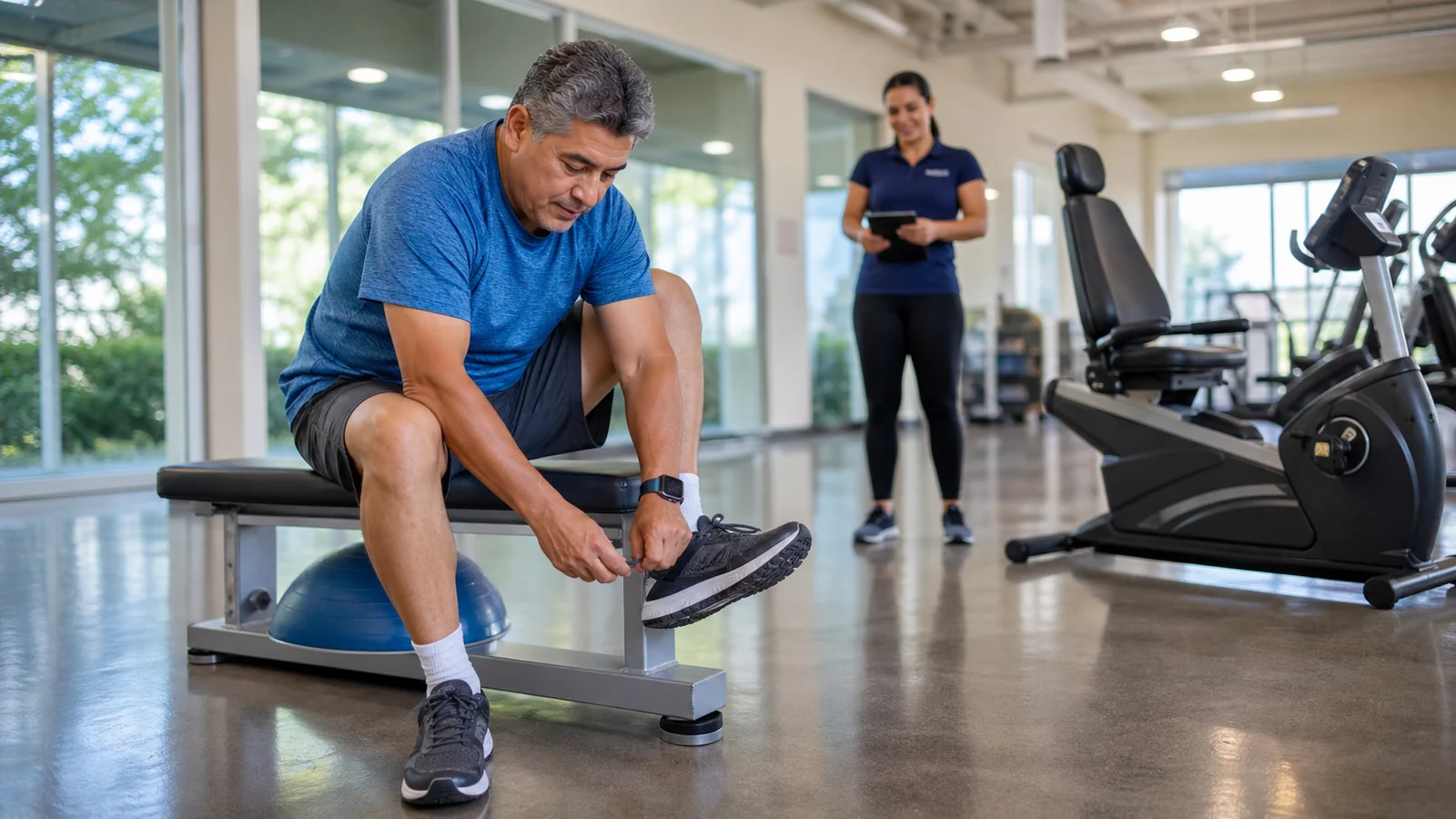
Illustration note: The walking and footwear scenes are editorial illustrations, not identified patients, clinicians or proof that an activity is suitable for a particular person.
Prepare for diabetes exercise by reviewing medicines, monitoring, supplies, complications and a response plan with your team.
This guide concerns adults already living with diabetes. Children, pregnancy, recent procedures and individual treatment changes need their own care guidance rather than a copied exercise schedule.
Which precautions should come before the workout?
Regular activity is an important part of diabetes care, and the CDC encourages starting gradually with activities that fit a person’s situation. A weekly activity goal and permission to perform a particular session are different questions.
| Check | Clarify in your care plan | Avoid assuming |
|---|---|---|
| Medicines | Whether your treatment can cause lows around activity. | All diabetes medicines create the same exercise risk. |
| Monitoring | When to check, your activity targets and what to do with an unexpected result. | One published cutoff gives everyone permission to start. |
| Supplies | Monitoring equipment, fast-acting carbohydrate and any prescribed emergency treatment. | A sensor eliminates the need for a response plan. |
| Complications | Foot, eye, heart, balance or autonomic problems that change the activity. | Walking, cycling or swimming is suitable in every circumstance. |
| Afterward | Follow-up monitoring, including later or overnight precautions when needed. | The risk ends when the workout stops. |
The table is a preparation aid, not a clearance score. If the relevant instructions are missing or unclear, ask the diabetes team to explain them before trying to improvise medication changes around exercise.
Why medicines change the risk of low glucose
The 2026 ADA Standards identify greater exercise-related low-glucose risk with insulin or insulin secretagogues. Routine preventive measures are usually unnecessary for people not using these treatments.
The ACSM type 2 diabetes consensus includes sulfonylureas and meglitinides among insulin secretagogues. Check the actual medication list and combinations; tablet or injection form does not determine risk.
Ask the prescriber which of your medicines can contribute to lows and whether your exercise plan needs carbohydrate or medication adjustments. This article does not supply an insulin reduction, pump setting or snack formula.
For example, two adults can plan the same walk while having very different medication-related precautions. That is a reason to individualize the plan, not a reason to conclude that one person’s routine is unsafe for everyone.
Can exercise raise glucose as well as lower it?
The 2026 ADA guidance notes that intense activity can temporarily raise glucose. Responses vary with activity type, duration and circumstances; individualize monitoring and education about later effects.
A reading taken immediately after exercise answers what happened at that moment. It does not describe the entire evening or establish how a different session will affect you.
The 2026 ADA/EASD adult type 1 consensus notes lows up to 24 hours after exercise. Review later or overnight monitoring for new, longer or harder sessions.
Take patterns to that conversation rather than reacting to one number with an improvised medication correction. Useful context includes the activity, start and finish times, meals, medicines, symptoms and readings already requested in your care plan.
Why a starting target is different from a low-glucose treatment threshold
Public exercise pages may discuss a starting glucose range, preventive carbohydrate or treatment of an established low. Those are different decisions, so a number copied from one paragraph should not become a universal rule for another.
The CDC defines blood glucose below 70 mg/dL as low and explains prompt treatment. Your diabetes team should separately explain your pre-exercise targets and when to delay, stop, treat or seek help.
When at risk, carry your plan’s fast-acting carbohydrate. Stop for a suspected low, check and follow the treatment, rechecking and return instructions.
For adults with type 1 diabetes, the ADA/EASD report recommends meter access even with continuous monitoring. Confirm when symptoms conflict with sensor readings or interstitial glucose lags during recovery from a low.
Ask when to use your meter and follow the device instructions and care plan. A trend arrow is useful information, but it is not permission to dismiss symptoms or repeatedly take treatment without checking the situation.
How foot precautions differ with neuropathy and an open wound
Reduced foot sensation can make an injury harder to notice. The CDC recommends checking feet every day, even when they feel fine.
Look for cuts, blisters, redness, swelling, sores or other skin and nail changes. Use a mirror or ask for help if you cannot see the soles, and wear properly fitting footwear rather than relying on pain to warn you.
Foot neuropathy does not automatically rule out all walking. The ADA’s 2026 guidance distinguishes appropriately assessed moderate walking with proper footwear from weight-bearing activity when there is a foot injury or open sore.
With an open wound, obtain a foot-care plan for activities that avoid loading the affected foot. Do not automatically substitute swimming: the ACSM consensus specifically advises against aquatic exercise with unhealed plantar ulcers.
A new blister, sore, ulcer or concerning change needs prompt assessment by the regular doctor or foot doctor. The CDC advises against waiting until the next scheduled appointment for these problems.
Which eye and other complications need specific guidance?
The ADA’s complications guide shows why different conditions change exercise choices. Its activity lists are discussion aids, not confirmation that a named activity is appropriate for every reader.
The 2026 Standards identify proliferative or severe nonproliferative diabetic retinopathy as situations where vigorous aerobic or resistance exercise may be contraindicated. Ask the ophthalmologist about your diagnosed stage and any restrictions before an intense program.
This is more precise than treating every eye diagnosis as the same restriction. Recent eye treatment or unstable disease also calls for specific instructions rather than selecting a supposedly safer exercise from a general list.
Autonomic neuropathy can affect heart-rate responses, blood pressure with position changes and temperature regulation. The ACSM consensus discusses perceived effort and environmental precautions in this context, so a generic heart-rate target may not be suitable.
For heart symptoms, reduced exercise tolerance, faintness or a planned increase beyond familiar activity, discuss the need for evaluation with the clinical team. Do not use a short online checklist to diagnose the cause or clear yourself for more intense training.
When does illness or a possible emergency change the plan?
Do not try to exercise away a possible diabetic ketoacidosis episode. Follow your ketone and sick-day instructions, and obtain urgent medical help for concerning symptoms.
The CDC advises emergency care for signs such as trouble breathing, fruity breath, vomiting with inability to keep fluids down or multiple symptoms of ketoacidosis. Call 911 or go to the emergency department rather than beginning a workout.
Severe hypoglycemia can also prevent someone from treating themselves. If a person loses consciousness or cannot swallow safely, do not give food or drink by mouth; call emergency services and have a trained helper follow the prescribed glucagon instructions if available.
Agree in advance where emergency treatment is kept and who knows how to help. This preparation is different from changing a medication dose on the basis of a public exercise article.
A practical record for reviewing an exercise response
A short record can help the care team interpret an unexpected low, high or symptom. Record what happened during ordinary activity under your existing plan; do not deliberately provoke a glucose change to fill the table.
| Include | Example of useful detail | Team question |
|---|---|---|
| Session | Activity, start/finish time and whether it differed from usual. | Does this type or duration need different preparation? |
| Treatment and food | Actual medicine names/times and relevant meals or snacks. | Does the current plan cover this situation? |
| Monitoring | Requested readings, sensor trend and any meter confirmation. | When should I check next time? |
| Symptoms and response | What you felt, what your plan directed and what happened later. | Do the response or overnight instructions need clarification? |
Discuss recurring lows with your doctor alongside medicines, activity and food patterns. Update the plan together; the lowest post-workout number is not the goal.
References
- American Diabetes Association Professional Practice Committee for Diabetes. (2026). Physical activity guidance in the 2026 standards. Diabetes Care, 49(Supplement 1), S89 to S131. doi:10.2337/dc26-S005.
- Holt, R. I. G., et al. (2026). Updated adult type 1 diabetes consensus. Diabetologia. doi:10.1007/s00125-026-06833-z.
- Kanaley, J. A., et al. (2022). Physical activity consensus for type 2 diabetes. Medicine & Science in Sports & Exercise, 54(2), 353 to 368. doi:10.1249/MSS.0000000000002800.
- American Diabetes Association. Exercising with diabetes complications. Accessed October 27, 2026.
- Centers for Disease Control and Prevention. Get active; Your feet and diabetes; Treatment of low blood sugar; Diabetic ketoacidosis. Accessed October 27, 2026.
Watch the source overview
RSSDI Digital’s overview discusses aerobic, strength, flexibility and balance activity, meal and medication timing, and medical input with complications. Its automatic English captions are an overview, not a personal glucose-management or exercise-clearance plan.
Watch the original overview on YouTube if the embedded player does not load.
Medical information: This article provides general information about diabetes and physical activity, not a diagnosis, personal exercise clearance or a medication plan. Work with your diabetes team and appropriately qualified healthcare professionals on individual monitoring, treatment, activity restrictions and emergency instructions.