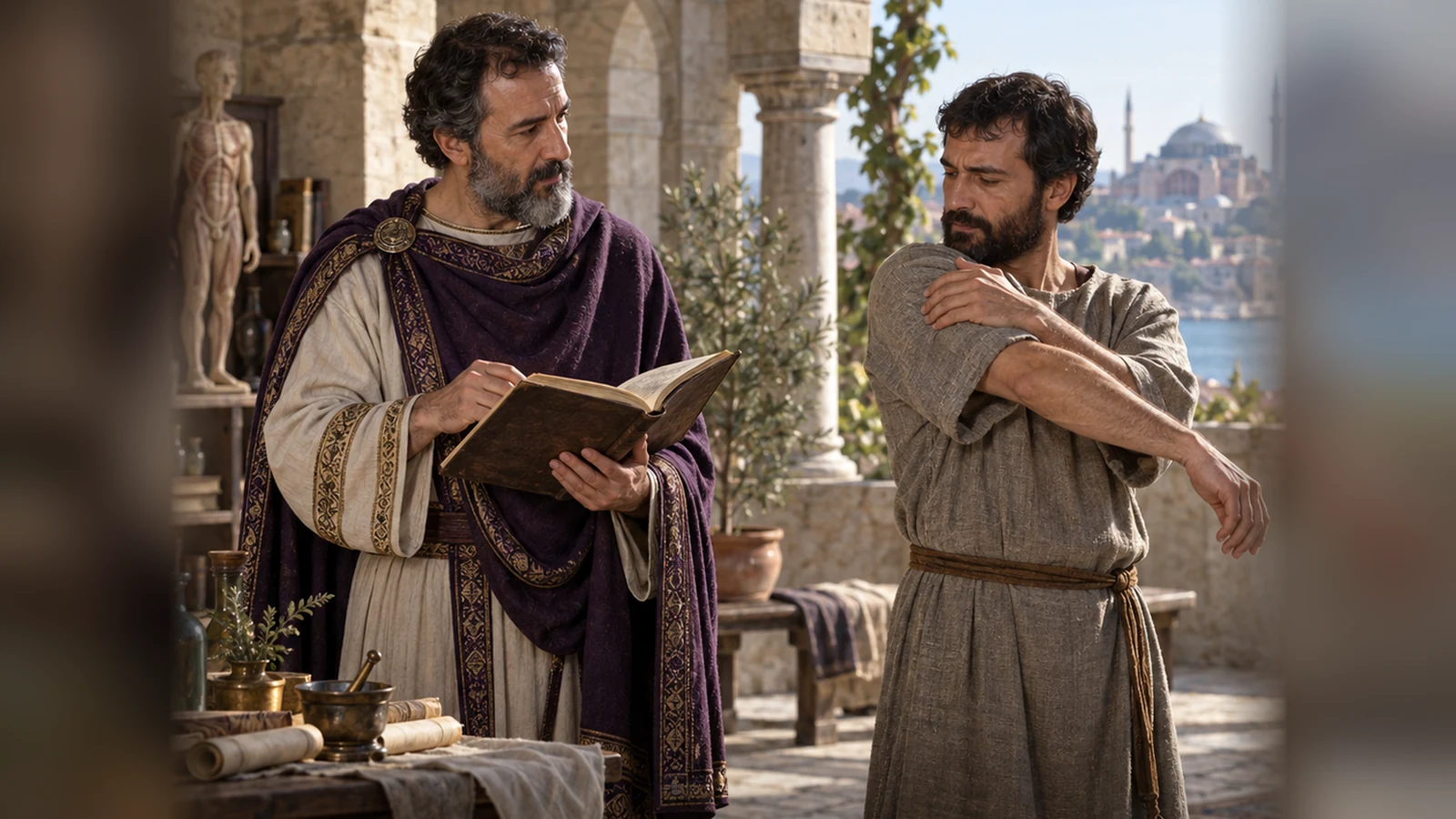

Historical illustration: The pictured figures are not authenticated as Aetius or a documented encounter.
Checking a historical exercise claim requires separating the book record, the alleged passage and modern activity advice.
Who Aetius of Amida Was
UVA’s exhibit describes Aetius as a Byzantine-period compiler drawing on earlier writers, especially Galen.
The Sixteen Books on Medicine
UVA records a 1542 Latin printing translated by Janus Cornarius.
A title page identifies an edition; it does not locate the claimed exercise advice.
Did He Really Write Exercise Plans by Age?
The checked sources did not establish a readable age-specific exercise passage.
Ask a retelling for the book, chapter or page and the translator. Leave the claim unresolved until its wording can be checked.
- Record the witness: author, edition, language and publication date.
- Find the claim: a page or chapter and the words being interpreted.
- Keep the voices separate: ancient author, translator, later commentator and modern retelling.
Why Old Advice Needs a Warning Label
A historical passage can document an author’s advice without demonstrating a health benefit for a particular reader.
Ask two separate questions: what does the passage say, and what present-day evidence supports using it? Confirming the first does not settle the second.
What Modern Guidelines Say About Age
WHO’s 2020 guideline overview covers children, adolescents, adults and older adults, with additional recommendations for pregnancy, chronic conditions and disability.
The WHO physical-activity fact sheet includes walking, cycling, wheeling, sport and play among ways to be active. It emphasizes that activity counts beyond a formal workout and that some activity is better than none.
Strength Training Keeps Mattering With Age
The 2019 NSCA position statement reviews resistance training for older adults. Its abstract addresses muscle strength and mass, physical function, programme design, and considerations for frailty and chronic conditions.
A position statement summarizes evidence and recommendations; it is not one randomized test of an age-by-age routine. It does not establish a fixed recovery clock or weight increase for each birthday.
For practical movement choices, our exercise-in-your-40s guide provides an editorial strength and cardio example. Our deadlifts-for-seniors guide discusses choosing and learning a hip hinge.
How to Match Exercise to Your Age Today
Use a short preparation note when looking for an activity or discussing a plan. These fields organize the conversation; they do not assign a programme or assess medical readiness.
- Your purpose: name the activity or everyday task you want to work on.
- Your setting: note available time, space, equipment and help.
- Your starting experience: describe what you already do rather than selecting a plan from age alone.
- Your question: write the particular adaptation you want help with.
Common Mistakes
- Treating a library catalog as if it quoted the exercise passage.
- Leaving the translator or edition out of a historical citation.
- Presenting an editorial maxim as an attributed ancient quotation.
- Treating a general guideline as an individual assessment.
Who Should Be Careful
If an injury, persistent pain or a health condition affects your activity, discuss changes with a clinician or physical therapist. Historical reading and a general activity guide cannot provide personal clearance.
The Bottom Line
Keep the historical citation and the modern exercise question on separate lines of your notes. That makes it easier to see what has actually been established and what still needs an answer.
References
University of Virginia Library. Aëtius, of Amida, Vaulted Treasures; catalog record for the 1542 printing.
World Health Organization. (2020). WHO guidelines on physical activity and sedentary behaviour. Publication overview.
World Health Organization. (2024). Physical activity. Fact sheet.
Fragala, M. S., et al. (2019). Resistance training for older adults: Position statement from the National Strength and Conditioning Association. Journal of Strength and Conditioning Research, 33, 2019 to 2052.
Reviewed source types: library exhibit and edition record, official guidance summaries, and a position-statement abstract.
Fitness disclaimer: This is general fitness information, not personal medical advice. A clinician or physical therapist can help adapt activity when an injury, ongoing pain or medical condition affects exercise.