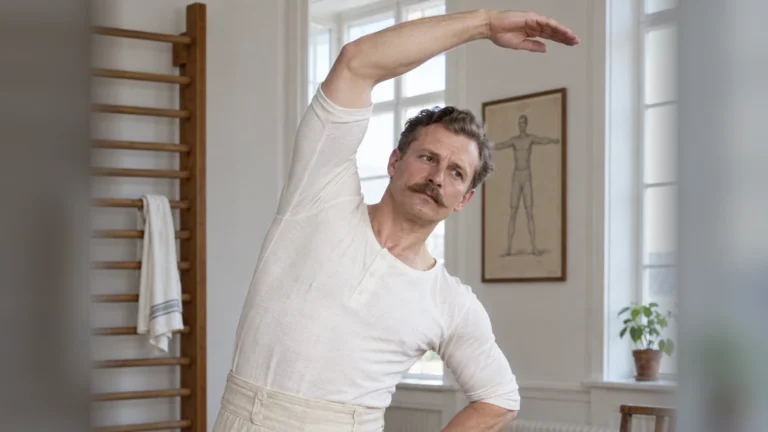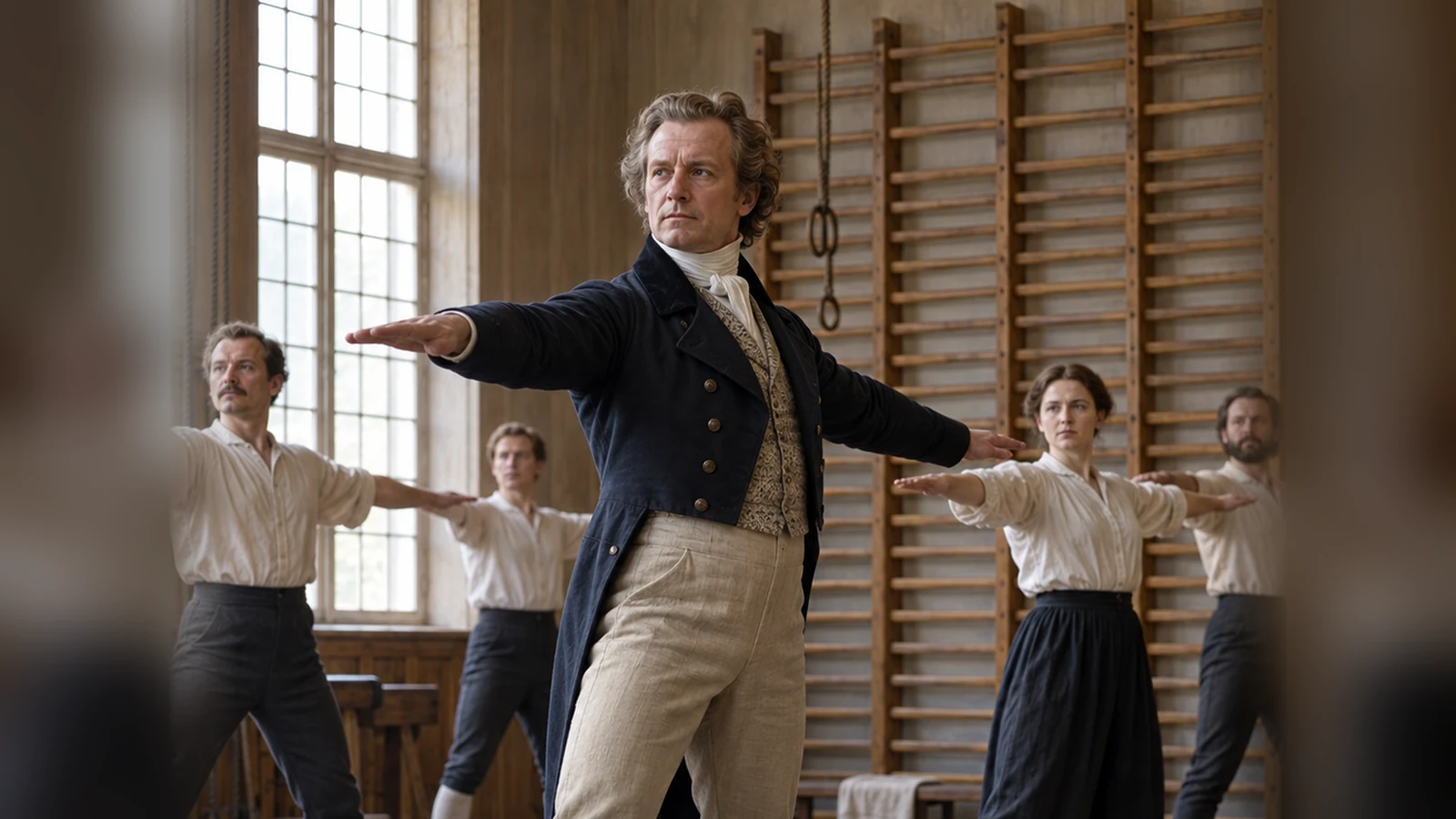

Image context: This historical-style illustration is not an authenticated portrait of Ling or a documented class.
Swedish gymnastics is a historical system of physical education. In Johnson’s 1897 English account, its four overlapping branches are educational, medical, military and aesthetic.
Institute
GIH’s history dates Ling’s Stockholm institute to 1813 and credits later development to his son Hjalmar. It also describes a book published after Ling’s death.
That distinction keeps a founder, an institution and subsequent teaching from becoming one undated claim. This article examines the classification, rather than retelling an entire life.
English Account
Johnson’s English account describes overlap.
These are historical descriptions, not modern clinical findings.
Four Purposes
| Branch | Historical purpose |
|---|---|
| Educational | School/class exercise with optional apparatus. |
| Medical | Curative/preventive purposes and massage. |
| Military | Training soldiers. |
| Aesthetic | Emotion through pose/gesture, especially for dramatic artists. |
Aesthetic means expression, not bodybuilding.
Medical Meaning
Historical purpose is not clinical efficacy.
Describing an old practice and recommending it are different tasks. This guide supplies no passive-movement, massage or rehabilitation instructions.
Date Check
| Record | What it says | Reading limit |
|---|---|---|
| Johnson, 1897: 1815. | Institute date. | Later English account. |
| GIH institutional history | GCI founded in 1813. | The successor institution’s chronology. |
| Swedish edition title record | Displays 1834 and 1840. | Edition metadata, not a verified translation of every page. |
A useful citation records the source and location as well as the number. Do not silently combine conflicting dates into a confident timeline.
Edition Limits
The Swedish title record and associated machine-readable text were located. Page images were not verified for a new literal translation.
These English meanings are Johnson’s, not new translations.
For a claim about exact original wording, identify the edition, page and translator. A searchable transcription is a locator, not a substitute for checking a difficult word against its page.
Modern Questions
These are original present-day prompts, not historical quotations or a tested training programme. Answer only the questions that fit your goal.
- What skill would I like to learn, and how would I recognize learning it?
- If a health condition is involved, what question should I take to my care team?
- If a job or activity has requirements, where are the actual requirements documented?
- If expression or appearance matters to me, which do I mean, and what would I observe?
A fictional reader might write: “I want to learn a dance sequence and describe what I can perform.” That states an observable aim without turning a historical category into an exercise prescription.
Separate the Claims
Keep three notes: what the source says, what you infer and what you want to do. If those notes differ, name the extra evidence or advice needed before moving from one to another.
For example, a description of teaching does not supply a comparison of two modern programmes. The question “better for what?” still needs an outcome and an appropriate comparison.
A Reading Tool
Use the questions to clarify a conversation, not to choose treatment or prove that an exercise is suitable. For pain, illness or rehabilitation decisions, discuss your circumstances with an appropriately qualified healthcare professional.
A job standard, a clinical plan and an expressive goal may call for different information. This historical guide does not set the standard, choose the plan or supply a personal workload.
Keep the Source Attached
Write the author, date, passage and remaining question beside a historical fitness claim. That small record helps you explain what you learned without adding a benefit or instruction the source did not establish.
References
Theodora Johnson. (1897). The Swedish System of Physical Education: Its Medical and General Aspects. Chapter 1. John Wright & Co.
Swedish School of Sport and Health Sciences (GIH). History.
Ling, P. H. Gymnastikens Allmänna Grunder. Title record, Project Runeberg.
Source scope: English account and edition records reviewed; no complete Swedish translation or clinical validation.
Medical disclaimer: This article provides general historical and fitness information, not individualized medical advice. A qualified healthcare professional can assess questions about pain, rehabilitation or exercise in your circumstances.