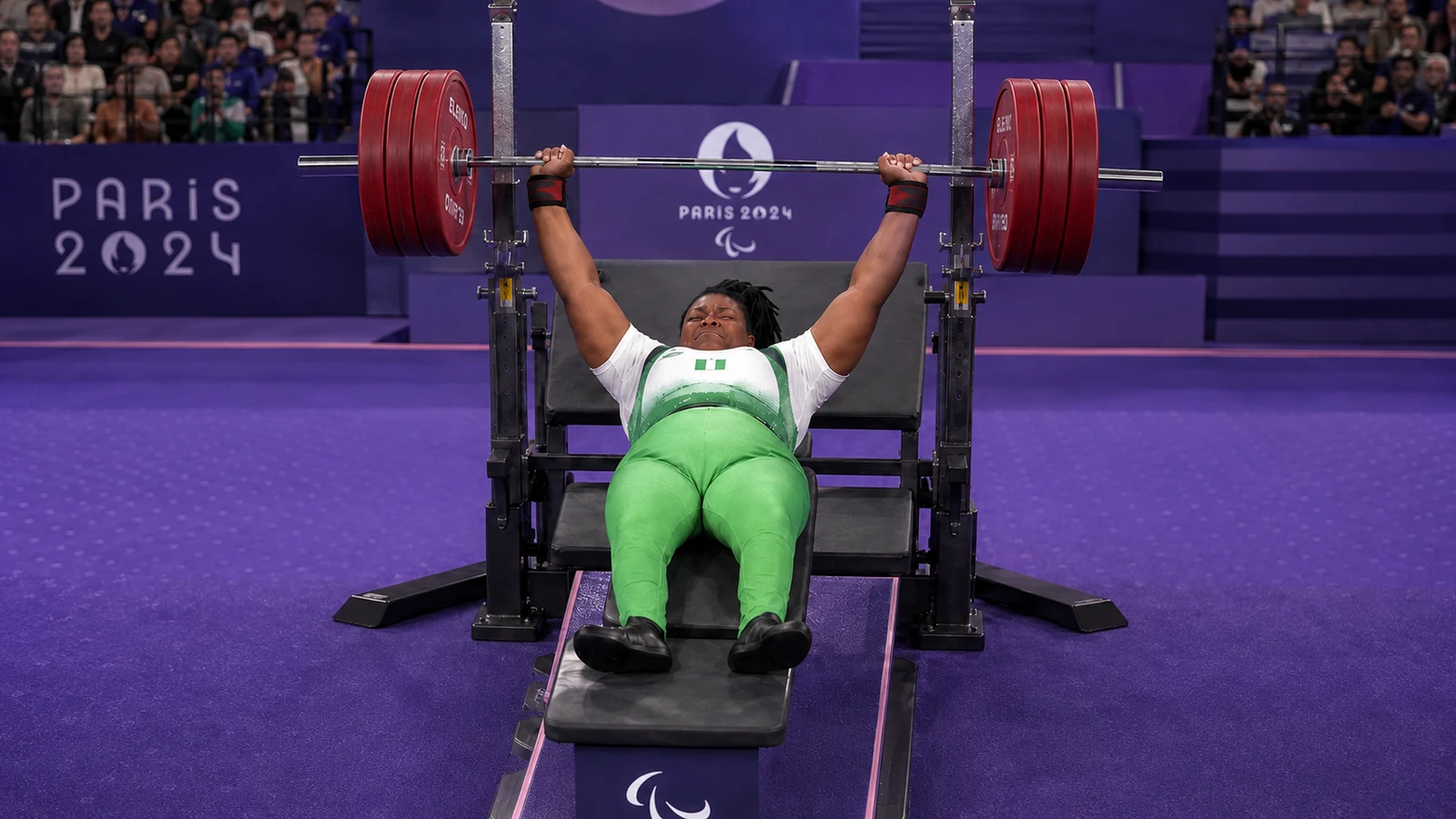

Folashade Oluwafemiayo walked into the 2024 Paris Paralympics as the athlete every other lifter in her weight class had to beat.
She left with gold, and with a number attached to her name that made headlines well beyond Para sport circles: 167 kilograms, about 368 pounds, pressed off her chest in the women’s over 86 kg category.
NBC Sports covered the lift under a headline that says everything: “World record.”
The number alone is impressive by any measure.
What makes it worth a closer look is the sport itself.
Para powerlifting is not a modified version of the barbell bench press most gym goers know.
It is a distinct competitive discipline, with its own rules, its own governing body, and its own physics.
Understanding those differences is the only way to understand what Oluwafemiayo actually did in Paris.
What Happened in the Women’s Over 86 kg Final
The women’s over 86 kg category, sometimes written as +86 kg, is the heaviest of the ten weight classes on the women’s side of para powerlifting.
Oluwafemiayo’s own scorecard from Paris tells the story of a lifter building toward something specific.
She opened with 157 kg, then moved to 162 kg, then to 166 kg, a lift that already secured the gold medal on its own.
Para powerlifting competitions give each athlete three attempts to build a total, the same basic structure used in Olympic style weightlifting.
Once an athlete has already clinched the win, the rules allow one additional attempt aimed specifically at a record rather than at placing.
Oluwafemiayo used hers.
Her fourth and final lift, 167 kg, is the number that turned a winning total into a world record.
She was not the only Nigerian to strike gold in powerlifting at that Games.
Onyinyechi Mark won the women’s 61 kg category, and both Esther Nworgu and Bose Omolayo also medaled for Nigeria in the sport, a showing that reflects how deep the country’s para powerlifting program has become.
Bench Press Only: How Para Powerlifting Actually Works
The biggest misconception about para powerlifting is that it mirrors able bodied powerlifting, just adapted for athletes with disabilities.
It does not.
Able bodied powerlifting is built around three separate lifts, the squat, the bench press, and the deadlift, combined into one total.
Para powerlifting has exactly one lift.
According to the International Paralympic Committee’s own description of the sport, competitors “lower the bar to their chest, hold it motionless on the chest, and then press it upwards to arms length with locked elbows.”
There is no squat.
There is no deadlift.
The entire competition, gold medals and all, comes down to a single controlled press.
Athletes compete lying on a specially designed bench, built to a fixed international standard: 2.1 meters long, 61 centimeters wide, and 48 to 50 centimeters high.
Three international referees judge every lift, and a successful attempt needs at least two of their three white lights to count.
Why the Legs Stay Out of It
Para powerlifting exists specifically for athletes with impairments affecting the legs or hips.
The International Paralympic Committee lists eight eligible impairment types for the sport, among them impaired muscle power, limb deficiency, leg length difference, and hypertonia, and every one of them affects the lower body rather than the arms, shoulders, or chest.
Because of that, athletes are secured on the bench in a fixed, extended position for the entire lift.
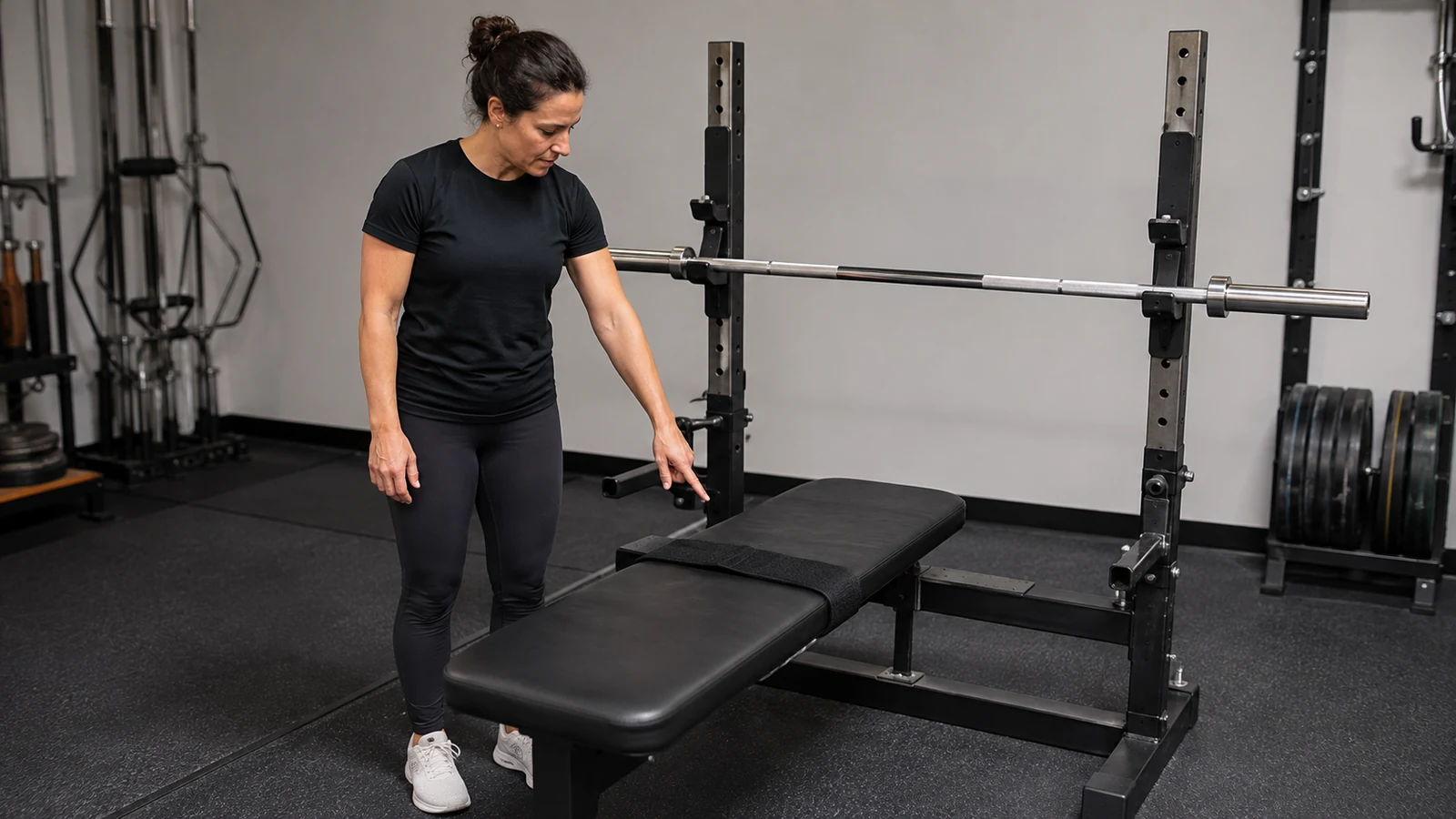
There is no leg drive to borrow from, no arch built up through the heels, and no way to use the lower body to help move the bar.
Every kilogram Oluwafemiayo pressed in Paris came from her chest, shoulders, and arms alone.
That single fact is why direct comparisons between a para powerlifting bench total and an able bodied raw bench total, tempting as they are, tend to miss the point.
The two lifts share a name and not much else.
Take away the legs, and a bench press stops being a full body lift. It becomes a pure test of what the chest, shoulders, and arms can do on their own, with nothing else in the chain to help.
The Classification System Behind the Weight Classes
Para powerlifting uses a single sport class for competition, meaning every eligible athlete competes against every other eligible athlete regardless of the specific nature of their impairment.
What separates competitors instead is bodyweight, the same way it does in able bodied powerlifting and Olympic weightlifting.
There are ten weight categories on each side of the competition.
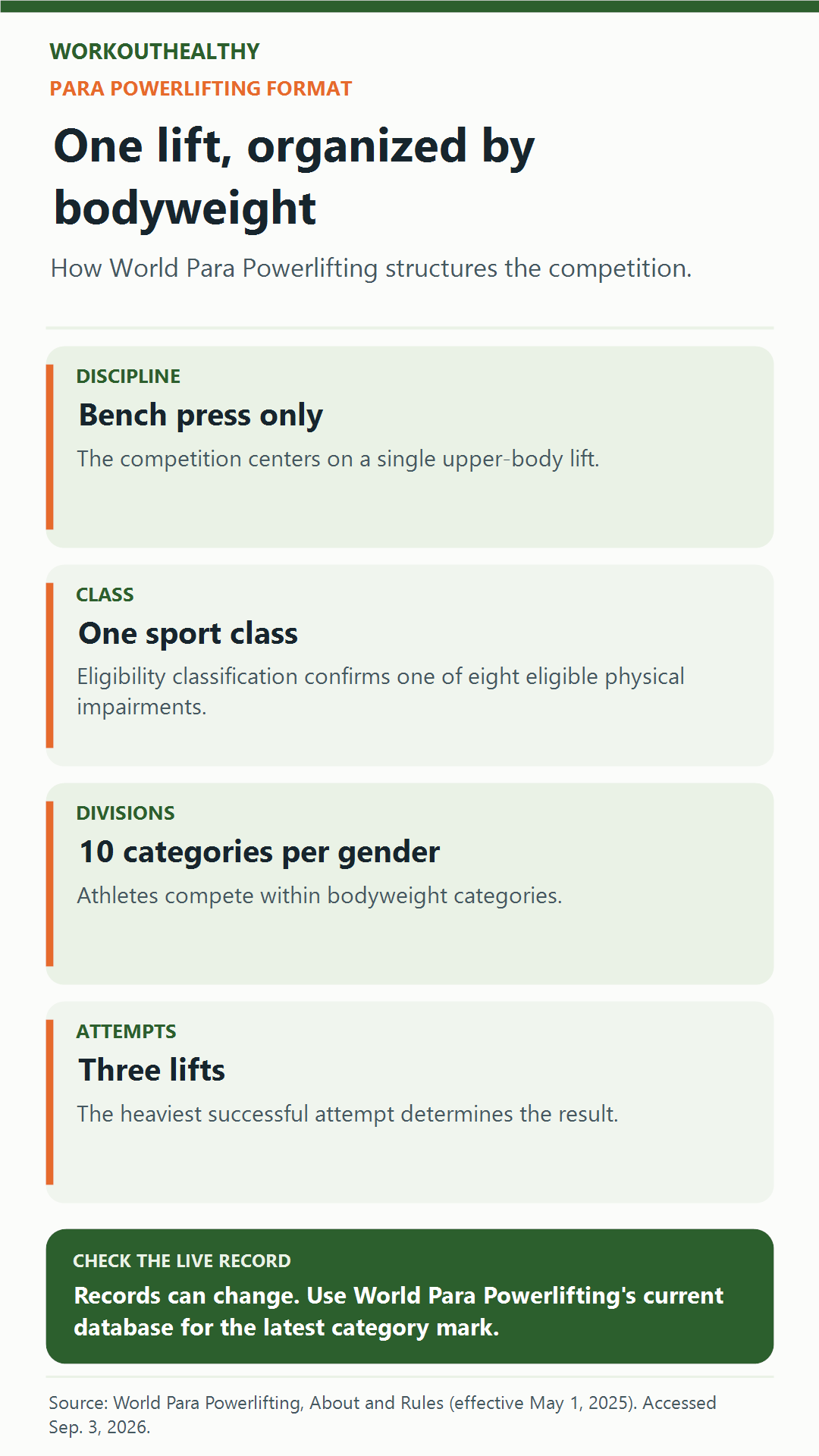
The women’s categories run from 41 kg up through the open ended over 86 kg class Oluwafemiayo competes in, where there is no upper bodyweight limit at all.
That last detail matters.
An over 86 kg class rewards raw strength differently than a capped class does, since there is no reason to cut weight before competing.
The sport is governed by World Para Powerlifting, commonly shortened to WPPO, which operates under the International Paralympic Committee and is based in Bonn, Germany.
WPPO took that name in November 2016, when the IPC rebranded several of the sports it directly governs under a shared “World Para” naming convention.
It is a separate organization from the International Powerlifting Federation, the body that governs elite able bodied raw powerlifting.
The two sports share a family resemblance in the barbell and the bench, and very little else administratively.
A Career Built Long Before Paris
Oluwafemiayo’s gold in Paris was less a breakthrough than a continuation.
She won silver at the 2012 London Paralympics, competing in a lighter weight category earlier in her career.
She added a World Championships gold medal in Mexico City in 2017, then another at the 2021 World Championships in Tbilisi, Georgia, where she also set a world record in her category at the time.
By 2022, competing at the Commonwealth Games, she was already lifting in the heaviest bracket available to her.
Paris 2024 was the culmination of that climb, not a first appearance out of nowhere.
It is the kind of résumé that shows up in athletes who dominate a division for years rather than athletes who simply catch one great day.
Still Winning After Paris
A gold medal and a headline number are one thing.
Staying on top afterward is another.
Oluwafemiayo did both.
At the 2025 World Para Powerlifting Championships, held in Cairo, Egypt, in October 2025, she won gold again in the women’s over 86 kg category, finishing well clear of the field according to the competition’s own published results.
That result matters for a simple reason.
World records in a sport this competitive sometimes hold for only a few months before someone else in the division closes the gap.
Oluwafemiayo’s win in Cairo, more than a year after Paris, shows a lifter who was not just peaking for one meet, but who stayed the class’s benchmark afterward.
What This Record Does Not Prove
It is worth being precise about what a 167 kg Paralympic bench press does and does not tell you.
It does not mean Oluwafemiayo could out bench elite able bodied male lifters, whose all time raw and equipped bench marks run into several hundred kilograms more, set under a completely different set of rules with the legs fully involved.
It also does not settle, on its own, whether 167 kg remains the exact official world record in her category at this precise moment.
World Para Powerlifting keeps a live, interactive results and records database on its own website, and that kind of database cannot always be queried the way a static page can.
What can be said with confidence is this.
167 kg was reported at the time as a new world record by NBC Sports’ own coverage of the Games.
Oluwafemiayo has also continued to win gold in the same category since, most recently in Cairo in October 2025.
Readers who want the officially current number should check WorldParaPowerlifting.org’s own records database directly, since it updates continuously and a snapshot taken today can be outdated within months in a sport this competitive.
Common Mistakes People Make Watching This Sport
The most common mistake is assuming para powerlifting is a lesser or simplified version of able bodied powerlifting.
It is neither lesser nor simplified.
It is a different sport, built around a single lift performed to a demanding, internationally judged standard, by athletes who cannot rely on the leg drive that able bodied lifters use without ever thinking about it.
A second mistake is treating a “world record” in this sport as a rare, once a decade event.
Because the pool of eligible athletes in some categories is smaller than in mainstream powerlifting, records can move more often, which is part of why competitions specifically build in a fourth, record only attempt.
A third mistake is assuming classification is about the severity of a disability rather than its type.
Classification in para powerlifting exists to confirm eligibility, based on impairments affecting the legs or hips specifically, not to rank how disabled an athlete is.
Once an athlete is confirmed eligible, the competition itself is decided the same way any strength sport is decided.
Whoever presses the most weight wins.
For readers who want to see how a bench press changes when even a small variable shifts, from a full leg drive setup to one with the legs removed from the equation, our comparison of the floor press and the standard bench press covers a related, much smaller scale version of the same principle: take away part of the base, and the lift has to be won entirely with the upper body.
Para powerlifting simply takes that idea to its logical extreme, with the legs fully secured and the entire lift decided at the chest, shoulders, and arms.
Oluwafemiayo’s record joins a small but growing shelf of independently verified strength feats we have covered, including DonnaJean Wilde’s push up world record and Edith Connor’s Guinness record for oldest female bodybuilder, two more cases where the headline number only tells part of the story.
Watch the Original Video
Want more verified strength stories like this one? Subscribe to WorkoutHealthy Insider for practical explanations behind popular fitness claims.
References
International Paralympic Committee. (n.d.). Para powerlifting. https://www.paralympic.org/powerlifting
International Paralympic Committee. (n.d.). Para powerlifting: About the sport. https://www.paralympic.org/powerlifting/about
International Paralympic Committee. (n.d.). Para powerlifting classification. https://www.paralympic.org/powerlifting/classification
NBC Sports. (2024, September 6). World record! Oluwafemiayo benches 368lbs to set women’s powerlifting mark in Paris [Video]. YouTube. https://www.youtube.com/watch?v=tNyLWXJ5U8Y
Wikipedia contributors. (n.d.). Nigeria at the 2024 Summer Paralympics. Wikipedia. https://en.wikipedia.org/wiki/Nigeria_at_the_2024_Summer_Paralympics
World Para Powerlifting. (2025, October). 2025 World Championships results: Women’s over 86 kg, total [Results document]. Cairo, Egypt. https://www.easywl.com/cairo2025/senior/pdf/res_727_total.pdf
This article is for general information only and is not medical advice. If you have an injury, ongoing pain, or a medical condition, talk to a doctor or physical therapist before you change how you train or eat.