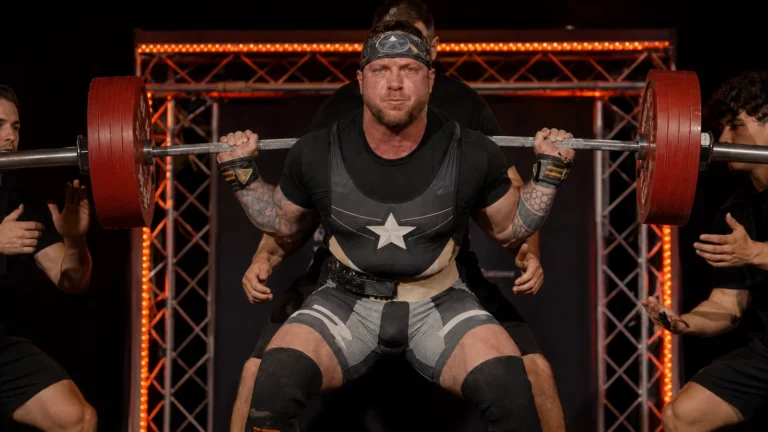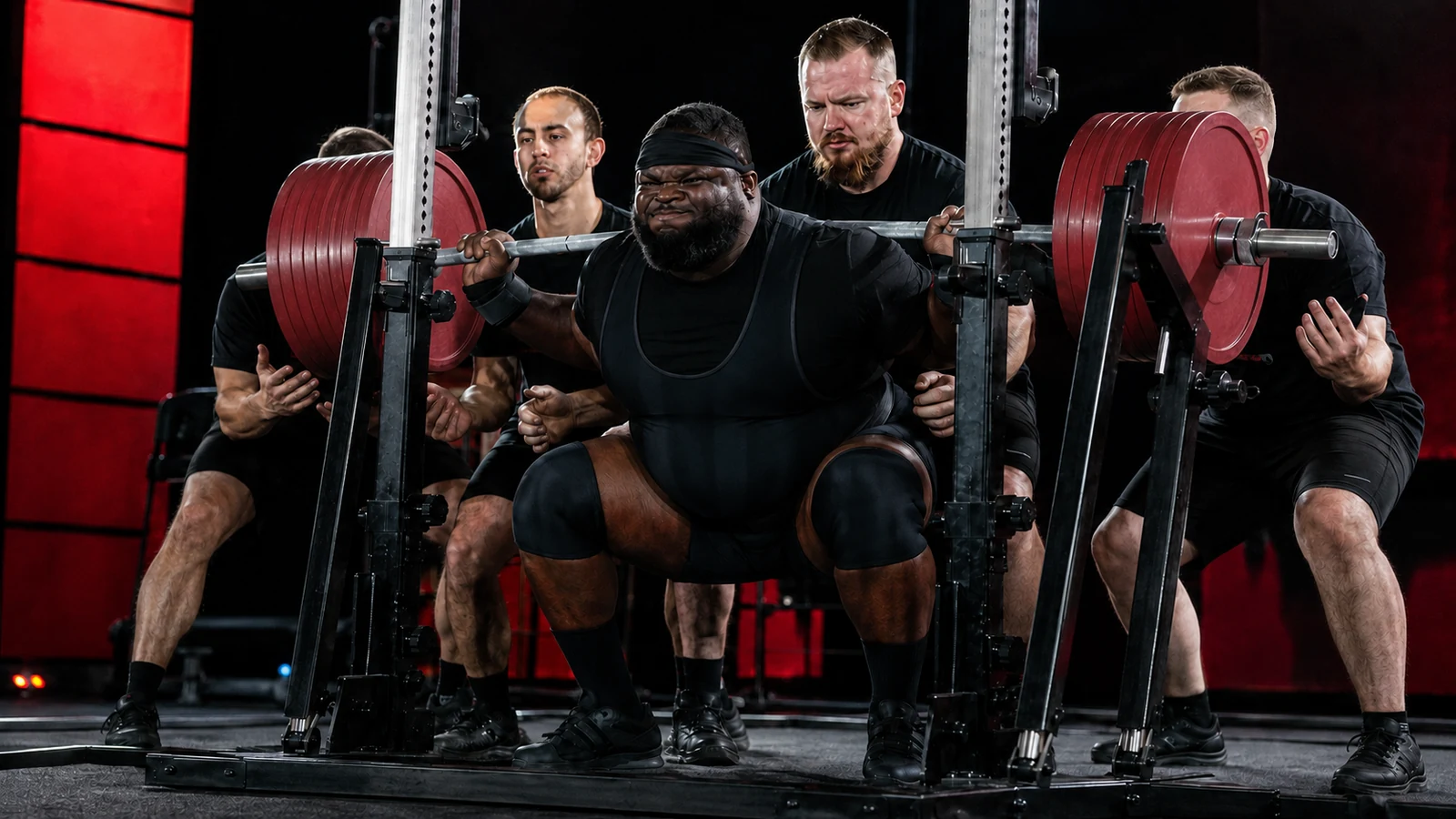

Ray Williams unracked a bar loaded to 490 kilograms and squatted it below parallel, alone, with nothing on his hips but a belt and a pair of knee sleeves.
That is 1,080.27 pounds, more weight than three grown men standing on a bathroom scale together, carried down into a full squat and driven back up under his own power.
No suit stiffened his hips.
No wraps locked his knees.
He set that number at a powerlifting meet in Columbus, Ohio, on March 2, 2019.
On paper, it is still the heaviest raw squat any competitive powerlifter has ever put on the books.
It has also never been recognized as an official world record by the sport’s own international federation.
This article checks both halves of that claim.
What actually happened in Columbus, why the same meet gets described under two different names, what “raw” means at this weight, and why the heaviest number ever recorded is not always the official one.
What Actually Happened in Columbus
On March 2, 2019, Ray Williams competed at a USA Powerlifting meet held during Arnold Sports Festival weekend in Columbus, Ohio.
The meet’s own sanctioned name was the Arnold SBD Pro American, one of several competitions that run under the wider Arnold Sports Festival banner that same weekend, alongside strongman, arm wrestling, and bodybuilding.
Williams competed in the super heavyweight class, which has no bodyweight ceiling.
He loaded a bar to 490 kilograms for his third and final squat attempt.
He hit depth, held the bottom position, and stood the weight back up without assistance.
Three white lights followed, confirming a legal lift under the judges watching that day.
The same meet also saw him bench 247.5 kilograms and deadlift 375 kilograms, for a combined total of 1,112.5 kilograms, reported at the time as an all-time world record total regardless of federation.
Converted to pounds, the squat alone comes out to 1,080.27, the number that has circulated in fitness posts and video titles ever since.
Two Names for the Same Meet
This lift gets described two different ways depending on the source.
Some accounts name the specific competition, the SBD Pro American, sanctioned by USA Powerlifting.
Others simply call it the Arnold Sports Festival, without naming a meet inside it.
Both descriptions point to the same event, not two different ones.
The Arnold Sports Festival is a multi-sport weekend held every year in Columbus, and one of the competitions it hosts is a USA Powerlifting-sanctioned meet that carried the name Arnold SBD Pro American in 2019.
A year earlier the same annual meet ran as the Arnold Slingshot Pro American, since the title sponsor has changed more than once.
OpenPowerlifting’s own competition database lists the meet exactly that way: 2019 Arnold SBD Pro American, federation USAPL, dated March 2, 2019, location Ohio, with a 490 kilogram squat entry that matches Williams’s result down to the bench and deadlift numbers from the same day.
So a source that names the meet “the Arnold Sports Festival” and one that names it “the SBD Pro American” are describing the identical competition at two different levels of precision.
Neither name is wrong. Neither name is the full picture on its own.
Why “Unofficial” Is the Right Word
USA Powerlifting, known as USAPL, is the United States’ national affiliate of the International Powerlifting Federation, the sport’s largest global governing body.
A lift at a USAPL national meet counts toward USAPL’s own American record book the moment the judges approve it.
It does not automatically become an IPF world record.
IPF’s own world records track lifts made at IPF-sanctioned international competitions, events like the IPF World Classic Championships and continental championships, run directly under IPF’s own officials and testing protocols.
A domestic national meet, even one sanctioned by an IPF member federation, sits outside that specific pathway unless the result is separately submitted through IPF’s own ratification process.
Coverage of Williams’s 490 kilogram squat at the time described it as a new USAPL national record and, separately, an unofficial IPF world record.
That second label signals exactly this gap.
The number was real, and the lift was judged clean, but it never went through IPF’s own ratification process as a world record.
That is a meaningful distinction, not a technicality invented to undersell the lift.
IPF’s own recognized raw squat world record in the super heavyweight class traces through a separate chain of ratified lifts, one Williams himself was part of at an earlier, smaller number before Jesus Olivares broke it in February 2024 at 478 kilograms.
No lifter, including Williams himself, has topped 490 kilograms raw at an IPF-sanctioned meet since that March 2019 weekend in Columbus.
The heaviest number on paper and the official record book point to two different weights, and both statements can be true at the same time.
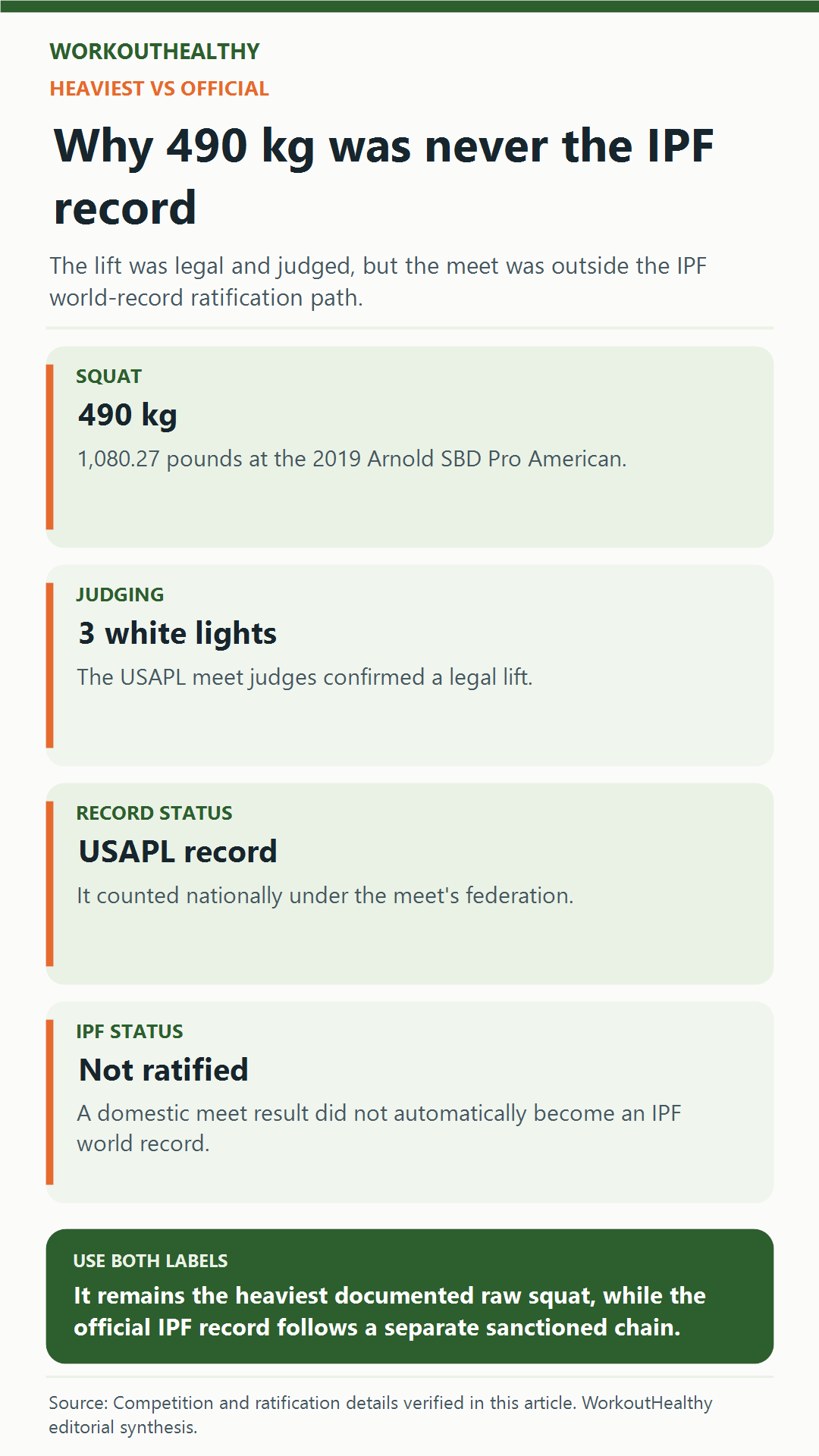
A world record in powerlifting is not simply the heaviest number ever put on a bar. It is that number, cleared under one federation’s own rulebook, at one of that federation’s own sanctioned meets, with that federation’s own officials confirming it. Move the meet, and the number can still be real without being official.
What “Raw” Means at 490 Kilograms
Raw does not mean no equipment at all.
Under USAPL and IPF Classic rules, a raw lifter can wear a lifting belt, a pair of knee sleeves, and wrist wraps.
Everything else, squat suits and knee wraps built to store and release elastic energy at the bottom of the lift, is reserved for the equipped divisions.
Williams’s 490 kilogram squat stayed inside that raw allowance exactly: a belt and knee sleeves, nothing more.
The belt’s job is not to add lifting power on its own.
Research on weightlifting belts has found that bracing against one increases intra-abdominal pressure and trunk muscle activity during a heavy lift, which helps stiffen the spine under load rather than generating extra force at the hips or knees (McGill, Norman, & Sharratt, 1990).
That stiffness matters enormously at 490 kilograms, where even a small breakdown in spinal position could turn a legal lift into an injury.
Knee sleeves work differently, offering compression and warmth around the joint rather than the elastic rebound that knee wraps are built to provide.
That difference is exactly why sleeves and wraps sit in separate equipment categories under competition rulebooks, with only sleeves allowed in the raw division.
The Biomechanics of a Squat This Heavy
A competition squat is judged on more than the number loaded onto the bar.
USAPL and IPF rules require the hip crease to drop below the top of the knee before a lifter can stand back up, a depth standard that removes any temptation to cut the movement short.
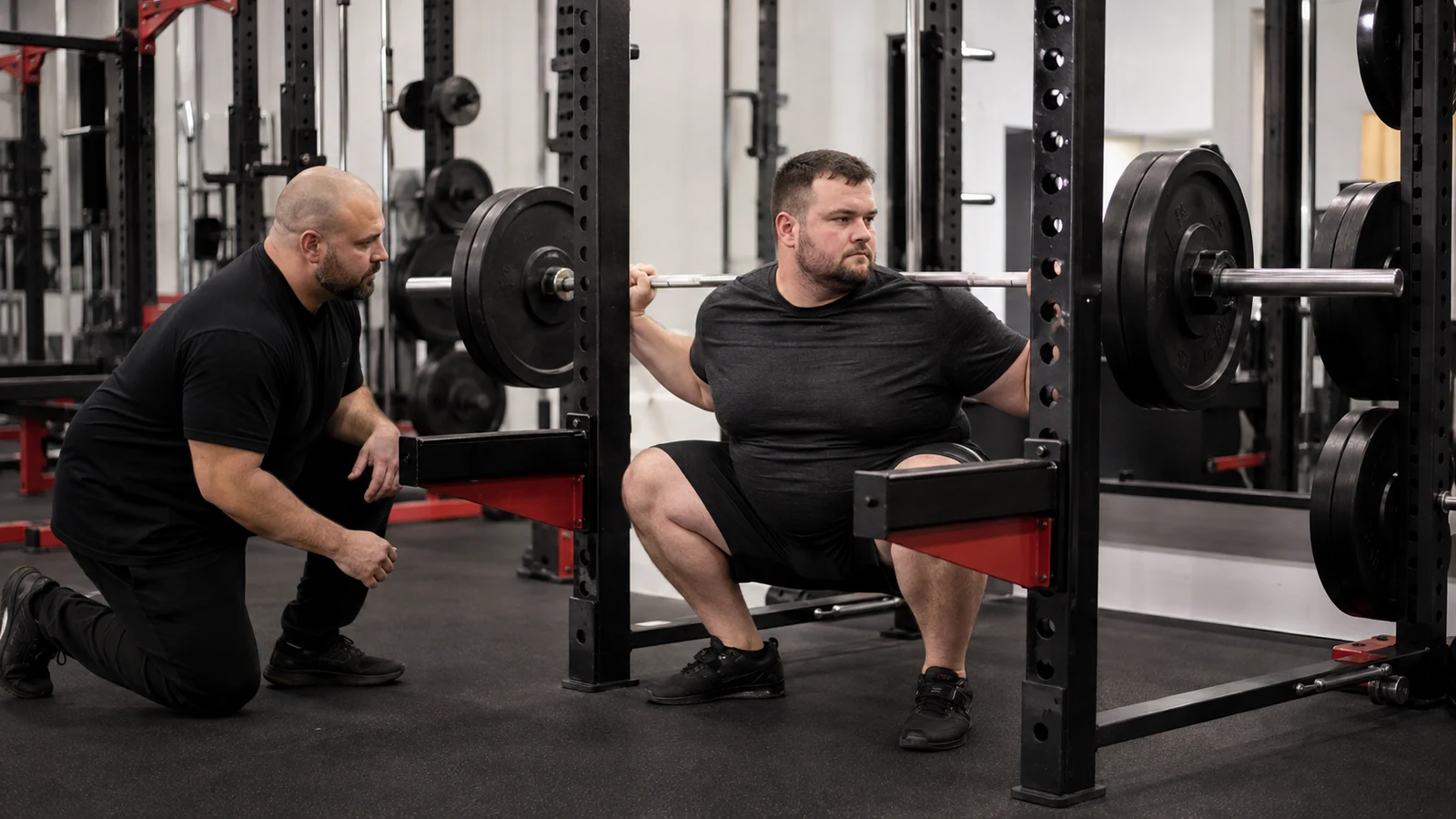
Research comparing different squat depths has found that going deeper generally increases the muscular demand placed on the hips and thighs, part of why a full, judged squat is a harder test than a partial one performed with the same weight (Bryanton, Kennedy, Carey, & Chiu, 2012).
At 490 kilograms, that depth requirement is not a minor technicality.
It is the difference between a lift that earns three white lights and one that gets red-lighted no matter how much weight sat on the bar.
Small technical breakdowns, a heel that lifts, a knee that caves inward, a chest that collapses forward, become far more consequential the heavier the bar gets.
Built Over Years, Not Overnight
Nobody arrives at a 490 kilogram squat quickly.
Building the kind of strength adaptation needed to move a load like this takes years of progressive loading, during which the nervous system learns to recruit more muscle fibers at once and connective tissue gradually thickens and stiffens in response to repeated heavy training (Folland & Williams, 2007).
Williams’s own competition record shows that pattern in the numbers.
His competition squat climbed from 467.5 kilograms in 2017 to 490 kilograms less than two years later, a rise built through repeated national and international meets rather than one breakthrough session.
Super heavyweight, the class Williams competed in, has no upper bodyweight limit, unlike every other class in the sport.
A lifter walking in at 140 kilograms and one walking in at 190 kilograms both compete in the same category, which is part of why raw poundage moved is only part of the story at this weight class.
Powerlifting has its own tool for comparing strength across different bodyweights, called the Wilks formula, which adjusts a total for bodyweight so lifters of different sizes can be ranked by relative strength rather than raw numbers alone (Vanderburgh & Batterham, 1999).
By that measure, a smaller lifter’s total can sometimes outscore a heavier lifter’s bigger total, a reminder that heaviest ever and strongest ever are not automatically the same claim.
What This Lift Does Not Prove
A 490 kilogram raw squat proves Williams could move enormous weight through a legal, judged range of motion in real competition.
It does not prove several things people often assume it does.
It does not mean nobody has ever squatted more weight in any setting.
Equipped lifters wearing supportive squat suits have moved considerably heavier loads than this, because that gear is specifically built to store and return energy at the bottom of the lift.
It does not mean every powerlifting federation would recognize the number the same way.
A national meet result and an internationally ratified world record are not automatically the same thing, even when the same governing body’s name is attached to both.
Guinness World Records runs its own separate certification process for the feats it recognizes, a process worth understanding on its own terms, the way a 75-year-old bodybuilder’s Guinness title held up when this site checked it directly against Guinness’s own record listing.
A sport federation’s internal record book is a different system with different rules, and neither one automatically defers to the other.
It also does not mean the claim is settled forever.
Jesus Olivares, the current IPF-ratified raw squat world record holder at 478 kilograms, has personally squatted 478.5 kilograms outside IPF competition as of late 2025, and if any lifter eventually tops 490 kilograms at a fully sanctioned, internationally ratified meet, the picture in this article will need to be revisited.
Common Mistakes People Make Reading a Claim Like This
Three mistakes come up often when a lift like this spreads online.
The first is treating every heavy number attached to a real competition as automatically official, without asking which record book it actually belongs to.
The second is assuming “raw” means identical rules everywhere, when federations differ on what belt, sleeve, or wrap allowance counts as raw.
The third is assuming a claim that went viral once has been checked against everything that has happened since, rather than simply repeated from an older post without a second look.
This site has run into that same pattern before while checking the pacing math behind a grandmother’s push-up world record claim, another case where a headline number needed real verification before it was safe to repeat as fact.
Who Should Be Cautious Chasing Heavy Squats
Nobody needs to squat anywhere near 490 kilograms to get strong, healthy, or athletic.
Loads like this sit at the extreme outer edge of human capability, built over years of progressive training under close coaching, not something to chase casually in a home gym.
Heavy compression through the spine and lower body carries real risk, and that risk rises sharply as the load increases relative to a lifter’s own strength and preparation (Folland & Williams, 2007).
Anyone with a history of back pain, disc issues, hip or knee problems, or uncontrolled blood pressure should talk to a doctor or physical therapist before attempting any near-maximal squat, let alone chasing a personal record.
Working with a qualified coach matters more at heavier loads, not less, since technical breakdowns that are minor at lighter weight can turn dangerous at much higher ones.
Anyone unsure whether they need that kind of guidance can start with the basics of deciding whether a personal trainer is worth hiring before loading a bar anywhere near a personal maximum.
Watch the Original Video
Want more record claims checked before you share them? Subscribe to WorkoutHealthy Insider for practical explanations behind popular fitness claims.
References
Bryanton, M. A., Kennedy, M. D., Carey, J. P., & Chiu, L. Z. F. (2012). Effect of squat depth and barbell load on relative muscular effort in squatting. Journal of Strength and Conditioning Research, 26(10), 2820-2828. https://doi.org/10.1519/JSC.0b013e31826791a7
Folland, J. P., & Williams, A. G. (2007). The adaptations to strength training: Morphological and neurological contributions to increased strength. Sports Medicine, 37(2), 145-168. https://doi.org/10.2165/00007256-200737020-00004
McGill, S. M., Norman, R. W., & Sharratt, M. T. (1990). The effect of an abdominal belt on trunk muscle activity and intra-abdominal pressure during squat lifts. Ergonomics, 33(2), 147-160. https://doi.org/10.1080/00140139008927106
Vanderburgh, P. M., & Batterham, A. M. (1999). Validation of the Wilks powerlifting formula. Medicine & Science in Sports & Exercise, 31(12), 1869-1875. https://doi.org/10.1097/00005768-199912000-00027
This article is for general information only and is not medical advice. If you have an injury, ongoing pain, or a medical condition, talk to a doctor or physical therapist before you change how you train or eat.