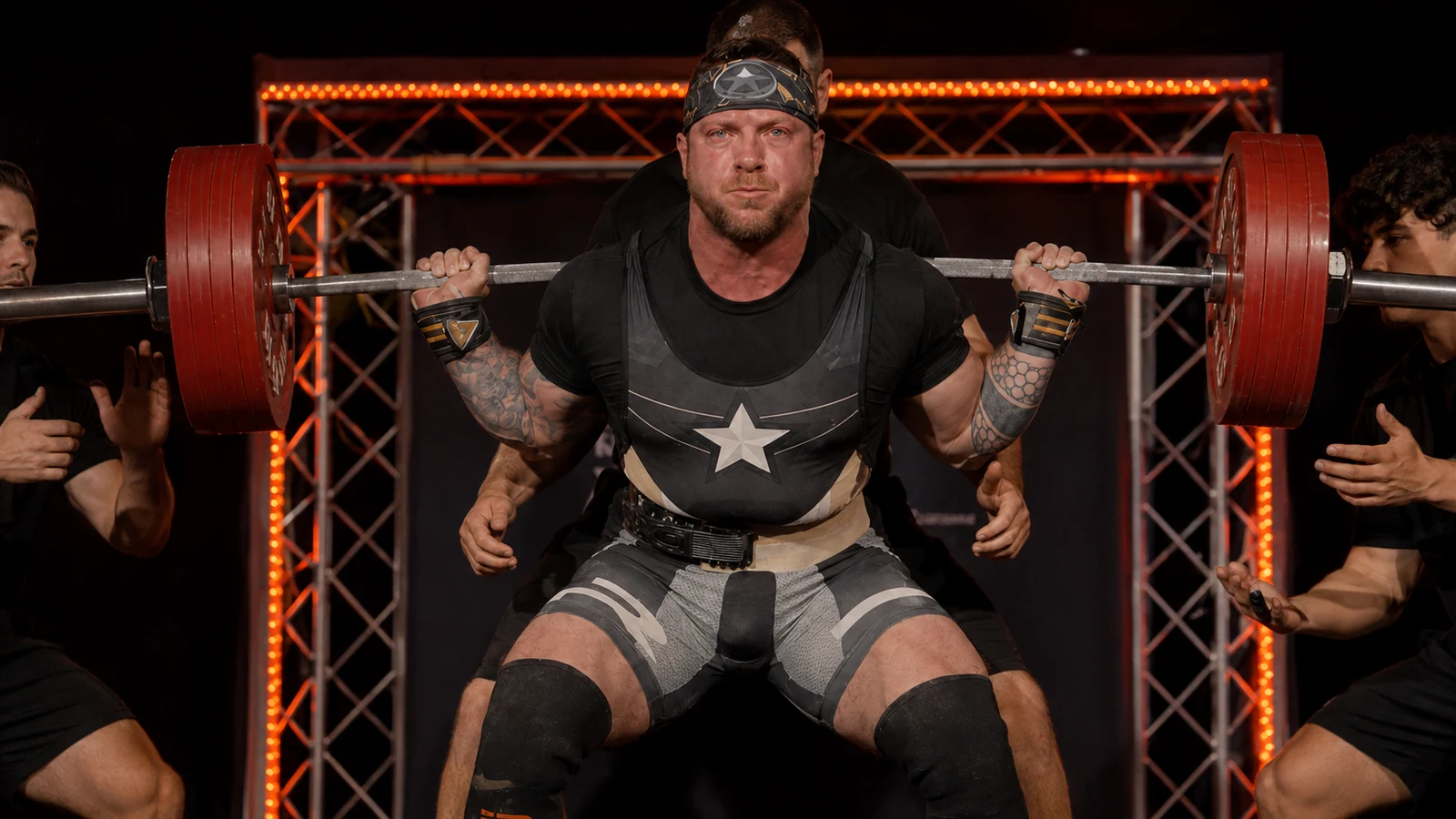

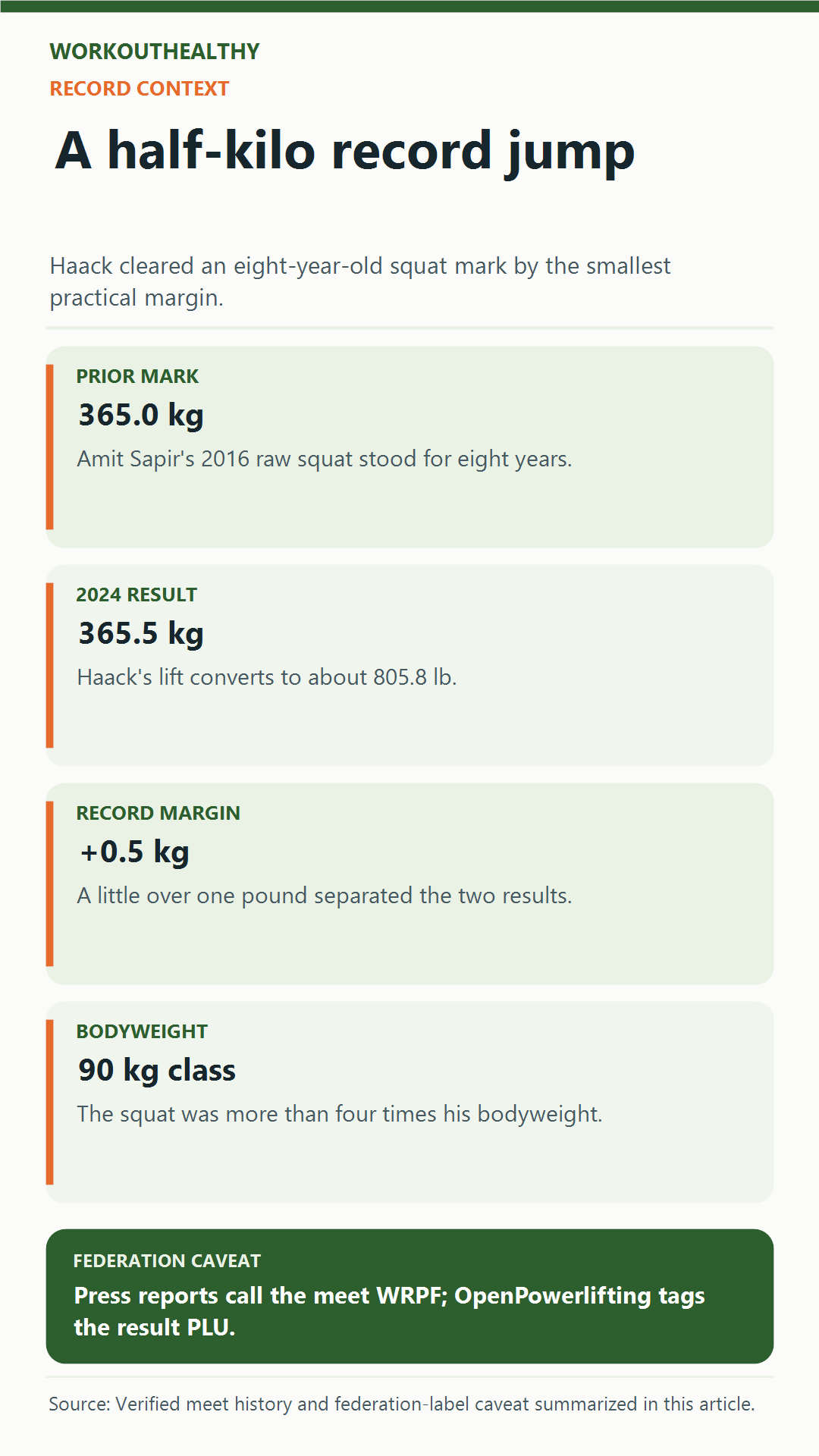
John Haack loaded 365.5 kilograms onto a barbell in Illinois and squatted it.
That converts to 805.8 pounds, close to the 805.79 figure that spread across social media afterward.
He weighed 90 kilograms that day, about 198.4 pounds himself.
The bar he stood up carried more than four times his own bodyweight.
It happened raw, meaning a belt and a pair of knee sleeves, nothing stiffer strapped to his body.
The lift broke a squat world record that had stood since 2016.
Haack built his reputation mostly on his deadlift and his combined total, not his squat, which is part of what made this particular record feel like a genuine surprise inside the sport rather than an expected next step for him.
This article checks what actually happened at that meet, what “raw” and “world record” mean under the specific federation that recognized it, and how this single lift fits into a career that already includes world records in two other lifts across two different weight classes.
A Decade in the Making
Haack did not appear out of nowhere in 2024.
Public competition records show him lifting in sanctioned meets going back to 2013, more than a decade before this squat.
Over that span he has competed across several federations, including USA Powerlifting, the International Powerlifting Federation, USPA, and WRPF.
Moving between federations is common in powerlifting, since lifters often chase whichever meet, weight class, or record book fits their goals in a given year.
By 2024, Haack had settled into the raw scene, competing mainly at 90 and 100 kilograms depending on the event.
His squat had never been the lift that made headlines before this meet.
His deadlift and his overall total had.
The Lift at Power Surge Pro/Am VIII
On September 28, 2024, Haack competed at the WRPF Power Surge Pro/Am VIII in Illinois.
The Roman numeral in the name signals this was the eighth edition of the series, a recurring meet rather than a one-off exhibition.
His squat progression that day did not go in a straight line.
He opened with 325 kilograms and made it clean.
His second attempt, 350 kilograms, came back down.
Rather than take a smaller jump on his third attempt, his team called for 365.5 kilograms, a 15.5 kilogram leap past a weight he had just missed.
He hit depth, held it, and stood the bar back up.
Three good lights followed.
Breaking an Eight-Year-Old Record
The previous mark belonged to Amit Sapir, who squatted 365 kilograms, 804.7 pounds, in 2016.
Haack cleared it by half a kilogram, a little over a pound.
An eight-year-old record is not usually broken by a margin that thin.
Most world records fall by a more comfortable cushion, not by the smallest jump a federation’s own rounding rules will allow.
That thin margin is part of what makes the lift worth checking carefully rather than taking at face value.
What “Raw” Means Under WRPF Rules
WRPF stands for World Raw Powerlifting Federation, and its raw category follows a similar definition to what most major raw federations use.
A lifter can wear a belt, a pair of knee sleeves, and wrist wraps.
A supportive squat suit is not allowed, and neither are the stiff knee wraps used in equipped divisions.
Knee wraps in particular can add real weight to a squat, since they store and release elastic energy at the bottom of the movement in a way soft neoprene sleeves do not.
Comparing raw numbers across federations only works when the gear rules actually match, and WRPF’s raw rules here line up closely with what the International Powerlifting Federation calls raw as well.
WRPF also runs both tested and untested divisions at many of its meets, a distinction that changes how a record should be read.
Public coverage of Power Surge Pro/Am VIII did not specify which division Haack’s squat was recorded in, and that detail could not be confirmed independently, so it is worth naming as an open question rather than assumed either way.
A Torn Callus and the Total That Got Away
The squat was not the only lift Haack attempted that day.
His bench press climbed from 235 kilograms to 255, then to a final make of 262.5 kilograms.
His deadlift did not go as smoothly.
He missed his opener at 385 kilograms, then came back and locked it out on his second attempt.
His third attempt, a planned 415.5 kilograms, ended when a callus tore open in his hand mid-pull.
“Just sucks to have pretty much everything go perfect for it to slip out of my hands at the last moment,” Haack said afterward, according to Fitness Volt’s coverage of the meet.
His total for the day landed at 1,013 kilograms, 2,233.3 pounds.
That is a massive number on its own, but a torn callus is what stood between him and a shot at both a heavier deadlift and a total record at 90 kilograms that afternoon.
A single torn callus can be the difference between a great day on the platform and a day remembered for one lift instead of three, no matter how much weight already sits in the record book.
The Case for Haack as the Sport’s Most Balanced Lifter
Going into that meet, Haack’s reputation rested mostly on his deadlift and his total, not his squat.
He had pulled 420 kilograms, 925.9 pounds, raw in training the year before, a number that circulated widely among lifters even though it happened outside sanctioned competition.
His competition record backs up the broader reputation.
At the 2022 WRPF American Pro, competing at 90 kilograms, he set three separate all-time world records in a single day.
At the 2022 USPA Pro Raw, moving up to 100 kilograms, he added a bench press world record and a total record on the same afternoon.
At the 2024 WRPF Ghost Clash 3, he set an all-time raw total world record of 1,043.5 kilograms, 2,300.5 pounds, at 100 kilograms.
He broke that total record again in August 2026, totaling 1,044 kilograms, 2,301.6 pounds, at the same weight class, only weeks before this article was written.
Put together, that is a lifter who has held all-time world records in the squat, the bench press, and the total, across two separate weight classes, inside a four-year window.
That kind of spread is genuinely rare in powerlifting.
Most elite lifters build a career around one dominant lift and treat the other two as supporting numbers, not as records of their own.
One Federation Among Many
Powerlifting does not have a single governing body the way a sport like swimming does.
WRPF, the IPF, USPA, and a long list of other federations each keep their own separate record books, with their own weigh-in rules, testing policies, and equipment standards.
A “world record” almost always means a record inside one specific federation’s own book, not literally the heaviest raw squat any human has ever completed anywhere, under any set of rules.
That is a different situation from a single global arbiter like Guinness World Records, which tracks one unified record per category rather than letting dozens of organizations run parallel record books for the same lift.
One honest complication turned up while checking this specific record.
Press coverage from Fitness Volt and BarBend both describe Power Surge Pro/Am VIII as a WRPF-sanctioned meet and this squat as a WRPF world record.
OpenPowerlifting’s own public results database lists the same meet, on the same date, with the same lifter and the same numbers, but files it under a different federation tag, one connected to Powerlifting United rather than WRPF.
WRPF itself remains an active federation with its own ongoing meet calendar, including further editions of Power Surge Pro/Am in later years, so this is not a case of one federation quietly disappearing from the sport.
It reads more like a promotion whose sanctioning body a results database and a press outlet recorded differently, and that specific mismatch could not be fully resolved from publicly available sources during this verification.
Rather than silently pick one version and move on, that discrepancy is disclosed here plainly.
The core lift itself, 365.5 kilograms by John Haack at 90 kilograms bodyweight on September 28, 2024, is confirmed by multiple independent sources and is not in question.
The Strength Behind the Number
A squat this heavy at a mid-sized weight class is a different kind of feat than the same weight would be at super heavyweight.
Powerlifting has its own tool for comparing strength across different bodyweights, called the Wilks formula, which adjusts a lift or total for bodyweight so smaller and larger lifters can be ranked by relative strength rather than raw pounds alone (Vanderburgh & Batterham, 1999).
By that kind of measure, a 198-pound lifter squatting more than four times his own bodyweight compares favorably with much heavier squats performed by lifters carrying far more mass to begin with.
For context, current raw squat marks in the unlimited super heavyweight class sit well past 470 kilograms, lifted by men who often weigh 50 or more kilograms more than Haack does.
Comparing the two lifts by bar weight alone misses the point, which is exactly where relative strength math earns its place.
Competition squat rules also matter here.
A judged raw squat requires the hip crease to drop below the top of the knee before a lifter can stand back up, and research comparing squat depths has found that going deeper generally increases the muscular demand placed on the hips and thighs, not less (Bryanton et al., 2012).
There is no shortcut version of this lift that still counts in a meet.
The full depth requirement is part of what makes a number like 365.5 kilograms meaningfully different from a partial-range lift of the same weight in a gym.
What This Record Does Not Prove
A record like this proves Haack moved 365.5 kilograms through a full, judged range of motion, under WRPF’s specific raw rules, in real competition.
It does not prove this is the heaviest raw squat any human has ever completed.
Fitness Volt’s own archive lists a 367.5 kilogram raw squat by Haack in training in March 2025, a heavier personal number than his own WRPF competition record.
That lift happened outside sanctioned competition, so it does not replace the official record, the same way a gym personal best never officially replaces a competition mark in any federation.
It also does not prove no other WRPF lifter has since matched or beaten 365.5 kilograms at 90 kilograms.
Haack’s own later results in the 90 kilogram class, including a 352.5 kilogram squat at the 2025 Power Surge Pro/Am IX, stayed below his 2024 mark, and he has since moved up into heavier weight classes rather than chasing his own squat record again.
No result turned up anywhere in public reporting of another lifter surpassing it in WRPF’s 90 kilogram raw division, but WRPF’s own official record ledger could not be directly reached during this verification, so that should be read as the best available public confirmation rather than a guarantee that nothing has changed since.
It also does not settle whether this specific lift came from a tested or untested division, a detail that matters to some readers more than others and one that simply was not available in the sources checked.
Who Should Be Cautious Chasing Squats Like This
Nobody needs to squat anywhere close to 365.5 kilograms to get strong or stay healthy.
Numbers at this level sit at the extreme outer edge of human capability, built over years of progressive, closely coached training.
Heavy compression through the spine and lower body carries real risk, and that risk rises as the load increases relative to a lifter’s own strength and preparation (Folland & Williams, 2007).
Anyone with a history of back pain, disc issues, hip or knee problems, or uncontrolled blood pressure should talk to a doctor or physical therapist before attempting any near-maximal squat.
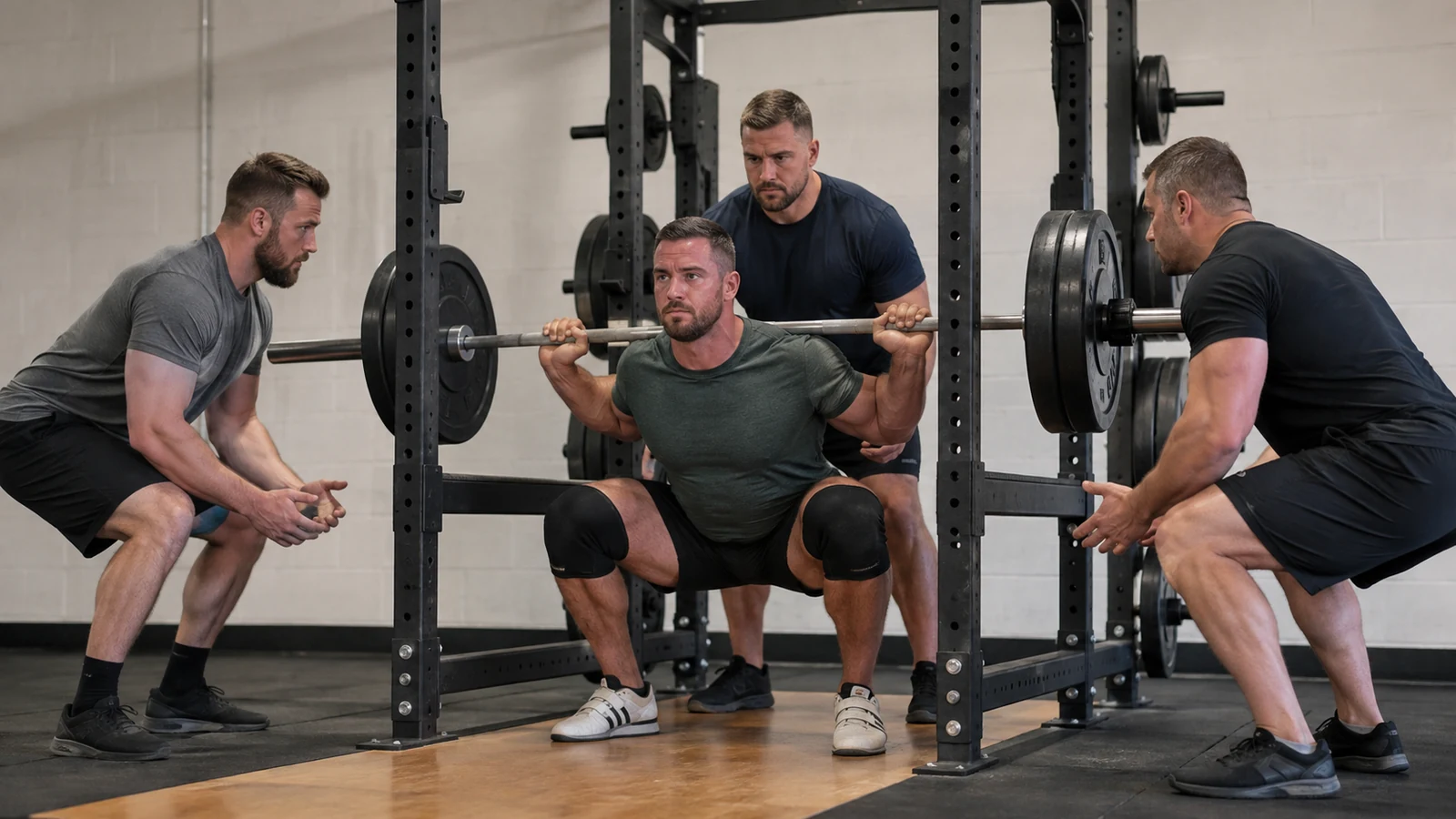
Coaching matters more at heavier loads, not less, since a technical breakdown that is minor at a light weight can turn dangerous once the bar gets close to a true one-rep max.
Anyone unsure whether they need that kind of guidance can start with the basics of deciding whether a personal trainer is worth hiring long before loading a bar anywhere near a personal record.
The same caution applies to the pressing side of a lifter’s training, since the bench press carries its own technical demands that change once heavy weight and full range of motion both come into play.
Elite lifters like Haack do not build numbers like these overnight, and that same patient pacing shows up in very different kinds of records too, including the pacing math behind a bodyweight world record that has nothing to do with a barbell at all.
Watch the Original Video
Want more record claims checked before you share them? Subscribe to WorkoutHealthy Insider for practical explanations behind popular fitness claims.
References
Bryanton, M. A., Kennedy, M. D., Carey, J. P., & Chiu, L. Z. F. (2012). Effect of squat depth and barbell load on relative muscular effort in squatting. Journal of Strength and Conditioning Research, 26(10), 2820-2828. https://doi.org/10.1519/JSC.0b013e31826791a7
Folland, J. P., & Williams, A. G. (2007). The adaptations to strength training: Morphological and neurological contributions to increased strength. Sports Medicine, 37(2), 145-168. https://doi.org/10.2165/00007256-200737020-00004
Vanderburgh, P. M., & Batterham, A. M. (1999). Validation of the Wilks powerlifting formula. Medicine & Science in Sports & Exercise, 31(12), 1869-1875. https://doi.org/10.1097/00005768-199912000-00027
This article is for general information only and is not medical advice. If you have an injury, ongoing pain, or a medical condition, talk to a doctor or physical therapist before you change how you train or eat.