
Cheerleading and dance both look graceful from the stands.
Underneath that grace is a lot of physical risk that most parents and athletes never see coming.
Tahoe Forest Health System, a regional hospital system based in the Lake Tahoe area, published a YouTube video called “Cheer and Dance Injury Prevention Tips for Athletes.”
The video offers general safety guidance aimed at cheer and dance athletes and their families.
We wanted to check that guidance against the actual research on how cheerleaders and dancers get hurt.
What the Video Claims
Tahoe Forest Health System is a real regional health system serving the Lake Tahoe area of California and Nevada.
It operates an Orthopedics and Sports Medicine program that is affiliated with UC Davis Health.
This is a different video from the same channel than the one behind an earlier WorkoutHealthy Insider article on weekend warrior injuries.
Tahoe Forest’s published transcript identifies the presenter as Jazlyn Richardson, an orthopedic technician at Tahoe Forest Sports Medicine. This identifies her role without implying she is a physician or physical therapist.
Based on the video’s framing, the core message is that cheer and dance are physically demanding sports that deserve the same injury prevention attention as football or soccer.
The video encourages athletes to warm up properly before practice and competition.
It stresses building strength and flexibility outside of regular practice time.
It recommends listening to pain signals instead of pushing through them.
It points to proper technique, coaching, and spotting as key ways to avoid injury during stunts and tumbling.
It frames rest and recovery as part of training, not a break from it.
These are reasonable, general recommendations from a credible regional sports medicine source.
The rest of this article looks at what peer reviewed research says about where cheer and dance injuries actually come from.
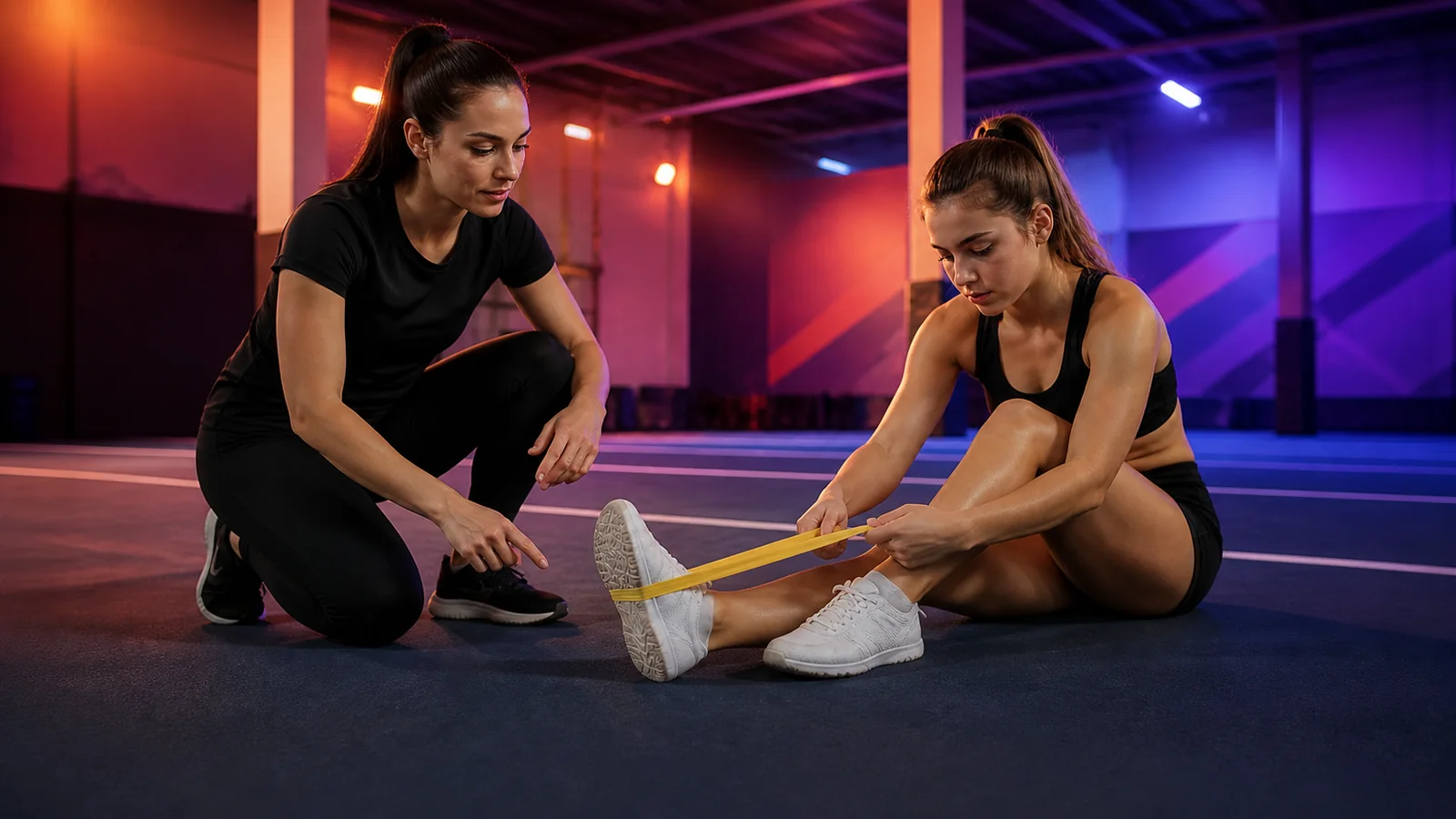
Richardson names ankle and foot injuries during jumps, turns, and landings, then discusses knee, hip, low-back, shoulder, and wrist problems. Her prevention advice includes ankle ABCs and slow ankle rolls, bending the knees and controlling the hips on landing, core and shoulder strength, and gradual progression of new skills. She suggests taking five minutes to warm up before participation; she does not present a tested five-minute protocol or claim that five minutes alone prevents injury.
Her specific warning signs are swelling, bruising, numbness, or pain that continues. An athlete with these symptoms should stop pushing through the movement and seek an evaluation from sports medicine or physical therapy before returning to the floor.
What Real Research Shows About Cheerleading Stunt Injuries
Cheerleading injury patterns have been studied for years using national surveillance systems.
A 2016 study in Pediatrics tracked cheerleading injuries across a nationally representative sample of United States high schools (Currie et al., 2016).
The researchers found that concussions and closed head injuries were among the most common diagnoses among injured cheerleaders.
Ankle and lower leg sprains from tumbling and stunting were also common.
Competitive cheer has grown more gymnastic over the past two decades, with more elevated stunts, tosses, and tumbling passes than older sideline routines used to include.
That shift is part of why researchers keep returning to this sport for close study.
A separate study in the Journal of Athletic Training looked specifically at stunt related injuries in cheerleading (Shields et al., 2009).
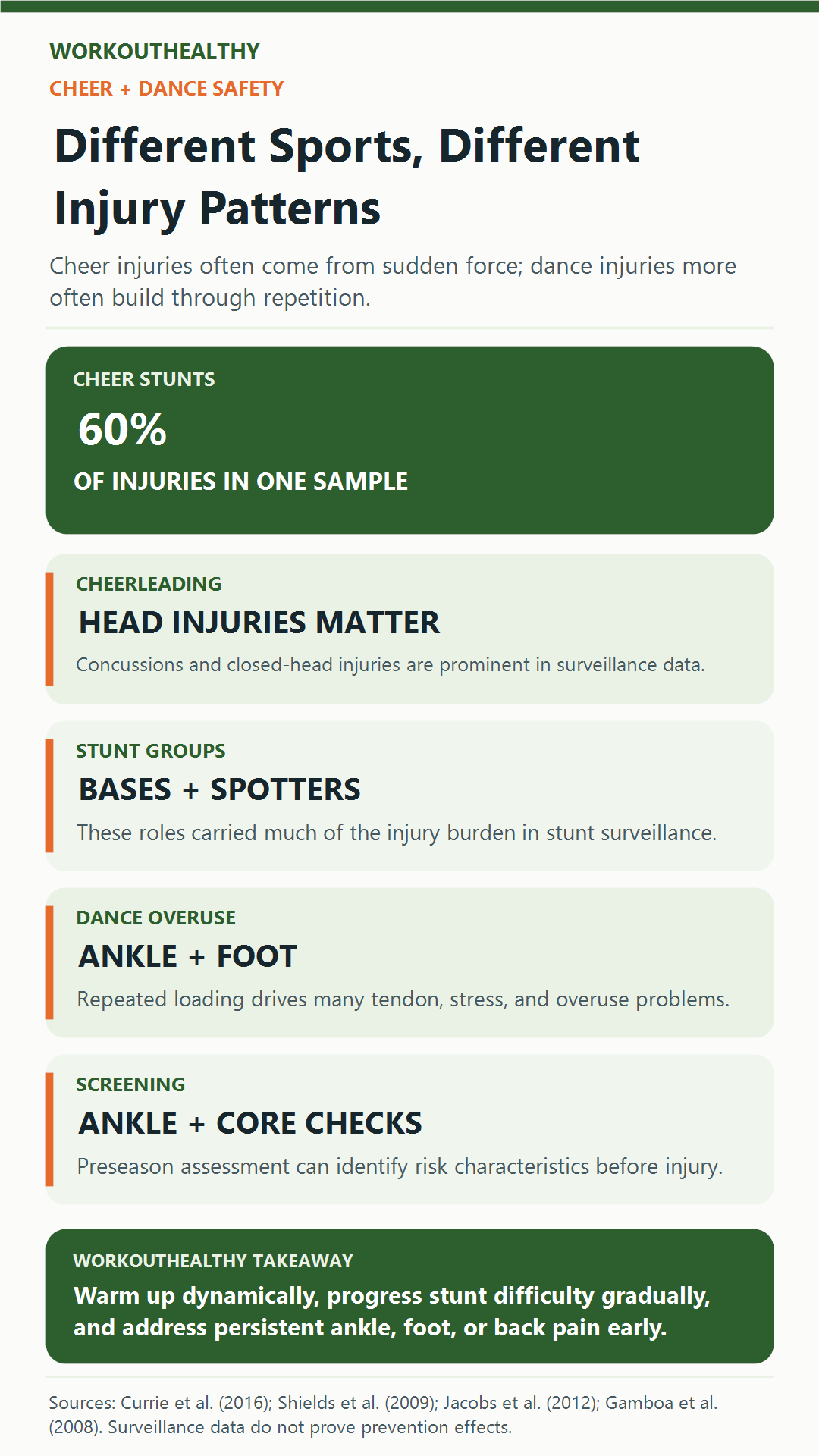
The researchers found that stunts accounted for 60 percent of all cheerleading injuries in their surveillance sample.
They also found that bases and spotters, the athletes supporting a flyer in the air, were injured more often than the flyers themselves.
Stunts caused 60 percent of all cheerleading injuries in one national surveillance study, and the athletes catching a falling teammate were hurt more often than the flyer in the air.
That finding matters because it challenges a common assumption.
Many people picture the athlete at the top of a stunt as the one taking the biggest risk.
The data instead points to the athletes on the ground catching and supporting that weight.
A third study, published in The American Journal of Sports Medicine, focused on the most serious injuries in the sport (Boden et al., 2003).
The researchers reviewed catastrophic cheerleading injuries, meaning injuries involving the brain or spinal cord.
They found that a large share of these severe injuries happened during pyramid and stunt sequences, particularly when a fall was not caught or broken.
That research has been cited for years to help explain why cheerleading accounts for a disproportionate share of catastrophic injuries among female high school and college athletes.
Together, these three studies point to one consistent pattern.
The stunt and pyramid portions of cheer, not the dance and cheer motions themselves, carry most of the serious injury risk.
What Real Research Shows About Dance Overuse Injuries
Dance injuries tend to follow a very different pattern than cheerleading injuries.
A systematic review update published in the Journal of Dance Medicine and Science pooled findings across many dance injury studies (Jacobs et al., 2012).
The review found that most dance injuries are overuse injuries rather than sudden traumatic injuries.
The lower extremities, especially the ankle and foot, were the most commonly injured body regions across the studies reviewed.
The dancers included in this body of research range from professional ballet companies to preprofessional training programs and student dancers.
That range matters because it shows the pattern holds across skill levels, not just among elite performers with unusually heavy training loads.
A separate study in the Journal of Orthopaedic and Sports Physical Therapy screened elite preprofessional ballet dancers before their season started (Gamboa et al., 2008).
The researchers then tracked which dancers went on to develop injuries that season.
Dancers with limited ankle flexibility, reduced core strength, and certain alignment differences were more likely to be injured later on.
That screening approach is now used by some dance medicine clinics to flag dancers who may need extra conditioning before an injury happens.
A review focused specifically on the foot and ankle described the mechanical demands unique to dance training (Kadel, 2006).
Repeated relevé and pointe work loads the small bones and tendons of the foot thousands of times across a single season.
Most dance injuries do not come from one bad landing. They build up slowly from thousands of repeated jumps, turns, and pointe repetitions.
That repetition, more than any single misstep, is what drives stress fractures and tendon injuries in serious dancers.
The Mechanism
Cheer and dance injuries come from two very different physical processes.
Cheer stunt injuries are mostly about force.
When a flyer falls or is caught incorrectly, the bases and spotters absorb a sudden, heavy, and often unpredictable load.
Ligaments and joints handle controlled, expected forces well.
They are far more vulnerable when a load arrives suddenly from an odd angle, which is exactly what happens during a missed catch.
A base catching a falling flyer has almost no time to adjust body position before the weight lands.
That lack of reaction time is a big part of why bases and spotters show up so often in the injury data.
Dance overuse injuries work through a slower process called cumulative microtrauma.
Tendons and bones can handle a lot of repeated stress if they get enough time to recover between sessions.
When training volume rises faster than the body’s ability to repair itself, small amounts of damage build up faster than they heal.
Over weeks or months, that unrepaired damage can turn into a stress fracture or a chronic tendon injury.
A dancer rarely feels a single moment where the injury happened, which is part of why these injuries are so easy to ignore in the early stages.
Both mechanisms explain why the video’s advice about technique, conditioning, and rest lines up with the research.
What This Evidence Does Not Prove
It is worth being clear about the limits of this research.
Injury surveillance studies like Currie et al. (2016) and Shields et al. (2009) describe patterns in injuries that already happened.
They do not prove that any single tip, on its own, will prevent a future injury.
Much of cheer and dance injury data relies on athletic trainers or coaches reporting what they observed.
That kind of reporting can miss minor injuries that athletes never mention to a trainer.
The ballet screening research from Gamboa et al. (2008) identifies risk factors associated with future injury.
Association is not the same as proof that fixing one risk factor, like ankle flexibility, will by itself prevent an injury.
Large randomized trials testing specific injury prevention programs, the kind that exist for ACL injuries in soccer and basketball, are less common in cheer and dance.
That does not mean prevention efforts do not work in these sports.
It means the evidence in cheer and dance specifically is still built more on injury pattern research than on head to head prevention trials.
Who Should Be Extra Careful
Some athletes carry more risk than others based on what the research shows.
Bases and spotters in stunt groups deserve particular attention, since they are injured more often than flyers according to Shields et al. (2009).
New or inexperienced stunt groups face higher risk while they are still building timing and trust with each other.
Growing adolescents are more vulnerable to stress injuries in bone, since growth plates are still developing during the teenage years.
Dancers who already show limited ankle flexibility or weak core strength on a screening assessment fit the risk profile identified by Gamboa et al. (2008).
Athletes who do both competitive cheer and a separate dance program can build up training volume from two directions at once.
Anyone returning from a prior ankle, knee, or back injury should treat a full return to stunting or pointe work as a gradual process.
Coaches and parents should treat persistent pain in any of these athletes as a signal to get an evaluation, not a sign to push harder.
A Five-Minute Starting Warm-Up
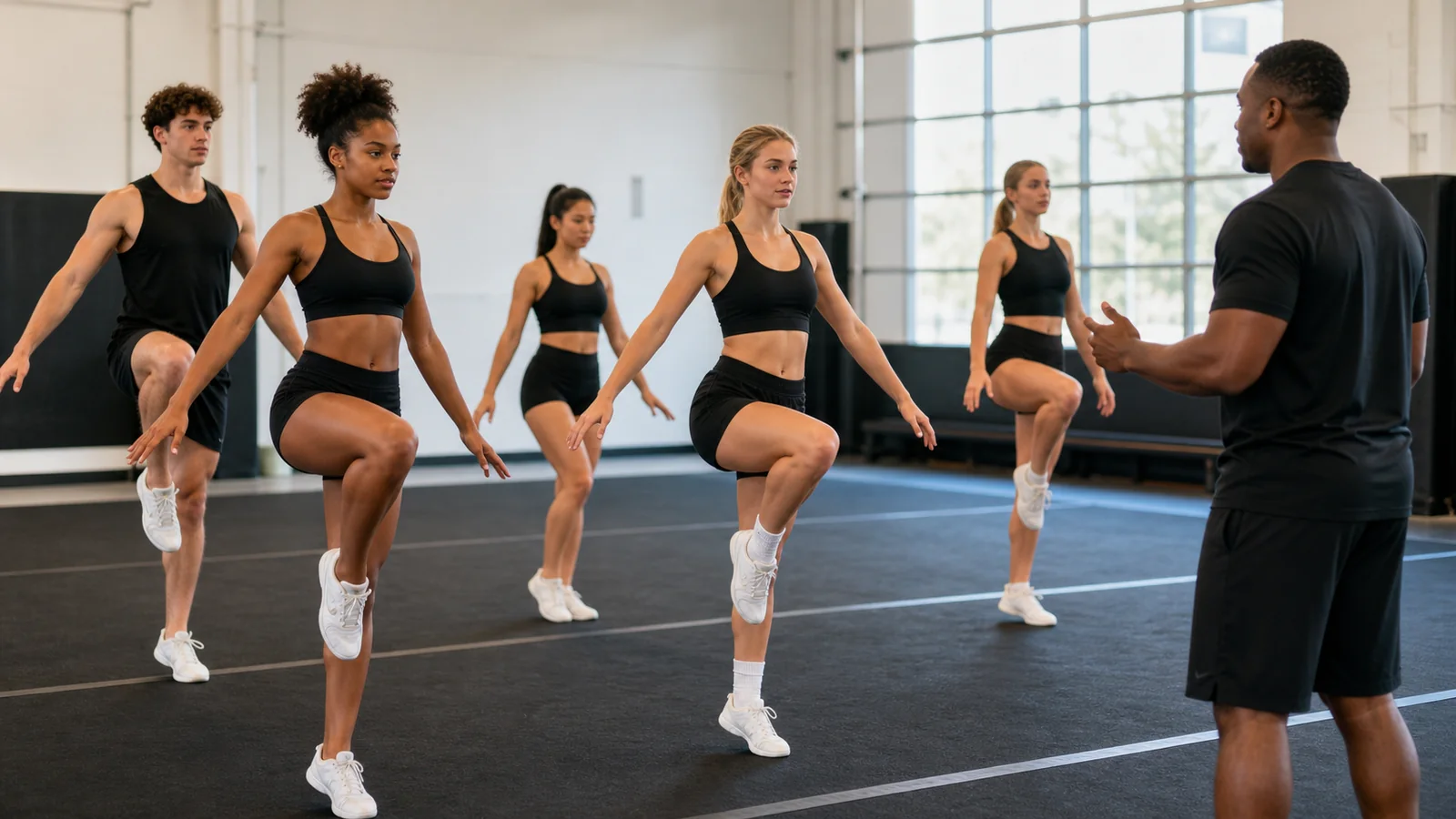
As a practical example, not a clinically validated five-minute injury-prevention protocol, a coach can use one minute of easy marching or light steps, one minute of ankle ABCs and controlled ankle rolls, one minute of gentle single-leg balance, one minute of slow squat or landing-position rehearsals with bent knees and controlled hips, and one minute of sport-specific low-intensity movement. The sequence should be pain-free, age-appropriate, and adjusted by a qualified coach or clinician for an athlete returning from injury.
A five-minute start is not a guarantee of safety and does not replace strength work, technique instruction, safe spotting, sensible skill progression, or sufficient recovery. If swelling, bruising, numbness, or persistent pain is present, skip the routine and get the athlete assessed rather than using a warm-up to test whether the injury can be ignored.
A Practical Takeaway
The research points toward a few concrete steps that go beyond generic advice.
Stunt groups should build skills in a clear progression, with a qualified coach confirming each step before adding height or difficulty.
Catching and spotting technique deserves as much practice time as the stunt itself, since bases and spotters carry much of the injury burden.
Dancers should treat foot and ankle strength as its own training goal, not something that technique class automatically builds.
A simple daily routine of ankle mobility work and single leg balance drills can target the exact risk factors identified in ballet screening research.
Coaches and studios should track an athlete’s total training volume across all teams and classes, not just their own program’s hours.
Mats and landing surfaces for stunts and tumbling should be checked and maintained, since a worn or thin mat changes how much force a fall transmits.
Preseason screening, similar to the ankle and core checks used in ballet research, can flag an at risk dancer or flyer before their first serious injury rather than after it.
Building general lower body strength, similar to the landing mechanics practiced in jump training research, supports the same soft tissue capacity that dance and tumbling demand.
Athletes who spend hours on pointe or in dance shoes may find foot recovery techniques useful for everyday soreness, though massage is not a substitute for treating a real injury.
Professional dancers are not immune to serious injury either, and what recovery from a major dance related injury actually takes is a useful reality check for younger dancers and their parents.
Cross training with low impact cardio, similar to the conditioning demands described in jump rope training research, can build cardiovascular fitness without piling more repetitive impact onto already loaded joints.
None of these steps guarantee an injury free season.
They do match what the research says actually drives risk in these two sports.
Watch the video
Want more like this? Subscribe to WorkoutHealthy Insider for practical explanations behind popular fitness claims.
References
Boden, B. P., Tacchetti, R., & Mueller, F. O. (2003). Catastrophic cheerleading injuries. The American Journal of Sports Medicine, 31(6), 881 to 888. https://doi.org/10.1177/03635465030310062501
Currie, D. W., Fields, S. K., Patterson, M. J., & Comstock, R. D. (2016). Cheerleading injuries in United States high schools. Pediatrics, 137(1), e20152447. https://doi.org/10.1542/peds.2015-2447
Gamboa, J. M., Roberts, L. A., Maring, J., & Fergus, A. (2008). Injury patterns in elite preprofessional ballet dancers and the utility of screening programs to identify risk characteristics. Journal of Orthopaedic & Sports Physical Therapy, 38(3), 126 to 136. https://doi.org/10.2519/jospt.2008.2390
Jacobs, C. L., Hincapié, C. A., & Cassidy, J. D. (2012). Musculoskeletal injuries and pain in dancers: A systematic review update. Journal of Dance Medicine & Science, 16(2), 74 to 84. https://doi.org/10.1177/1089313X1201600204
Kadel, N. J. (2006). Foot and ankle injuries in dance. Physical Medicine and Rehabilitation Clinics of North America, 17(4), 813 to 826. https://doi.org/10.1016/j.pmr.2006.06.006
Shields, B. J., Fernandez, S. A., & Smith, G. A. (2009). Epidemiology of cheerleading stunt-related injuries in the United States. Journal of Athletic Training, 44(6), 586 to 594. https://doi.org/10.4085/1062-6050-44.6.586
This article is for general information only and is not medical advice. If you have an injury, ongoing pain, or a medical condition, talk to a doctor or physical therapist before you change how you train or eat.