

Bad weather has been wrecking workout plans for a very long time.
More than 2,000 years ago, a Roman writer described a building answer to that problem.
His name was Vitruvius, and his book is called De Architectura.
A popular post says he called for covered running tracks for winter and open tracks for summer.
That is close, but the text says something a little different.
Who Vitruvius Was
Vitruvius was a Roman architect and engineer.
His exact birth and death dates are not known.
His ten book work, De Architectura, was probably written between 30 and 20 BC.
It covers building materials, temples, public buildings, houses, water supply, and machines.
The book was later “rediscovered” in 1416 by the Florentine scholar Poggio Bracciolini.
He found a copy in the abbey library of Saint Gall, in what is now Switzerland.
After that rediscovery, the book gained a wide new audience among Renaissance scholars and builders.
What Book V Says About Training Spaces
Book V deals with public buildings. Chapter 11 describes the Greek palaestra, a training complex for athletes.
In the Gwilt English translation, the plan is detailed.
- A large colonnaded court. Its walk runs two stadia around.
- Rooms for athletes. These include a large hall with seats called the ephebeum, rooms called the coriceum and conisterium, and a cold bath.
- A double portico. This is a long covered walkway beside the training area.
- A sunken track. The center is sunk a foot and a half below the side paths.
That sunken design had a practical reason.
People walking the paths in their clothes would not be bothered by the oiled wrestlers training below.
The Covered Track, Checked Against the Text
Here is the key passage, in Gwilt’s translation.
Vitruvius writes that this kind of portico is called a xystus by the Greeks, “for the wrestlers exercise in covered stadia in the winter time.”
He then describes open walks beside the xystus and double portico.
Athletes used those open walks “when the weather is fine, in the winter.”
So the covered part of the claim is right.
The open track, though, is described for fine winter days, not as a summer track.
The deeper point still holds. Vitruvius planned for training to continue whatever the weather did.
A good training plan has a backup for bad weather. The Romans built theirs out of stone.
What Research Says About Weather and Exercise
Modern research backs up the problem Vitruvius was trying to solve.
In 2007, Tucker and Gilliland published a systematic review on season, weather, and physical activity.
They looked at 37 studies from 1980 to 2006, with close to 292,000 participants across eight countries.
They found that activity levels change with the seasons.
They also found that poor or extreme weather is a barrier to being active.
Their suggestion sounds a lot like a covered xystus.
They wrote that providing indoor options during cold and wet months may help people stay active all year.
What This Does Not Prove
The review shows that weather affects activity on average. It does not show that every person needs a gym.
Many people keep training outside in rain or cold with the right clothing and planning.
For some, a brisk winter walk is the best part of the week.
The review also did not test ancient building designs.
And Vitruvius was describing a Greek style of building for athletes, not a public health program for everyone.
Still, the match between his plan and the modern finding is striking.
Why Facility Design Still Matters
Vitruvius was not writing about motivation. He was writing about buildings.
Yet his plan quietly removes a common excuse.
If the track is covered, a cold or wet day no longer decides whether training happens.
The same logic shows up in modern life.
Climate controlled gyms, indoor pools, and covered walking paths all do the job his xystus once did.
Even the layout mattered to him.
Walkers and wrestlers each had their own space, so neither group got in the other’s way.
Anyone who has tried to train in a crowded, awkward space knows why that helps.
The lesson is simple. Make the easy choice the active one, and fewer days slip away.
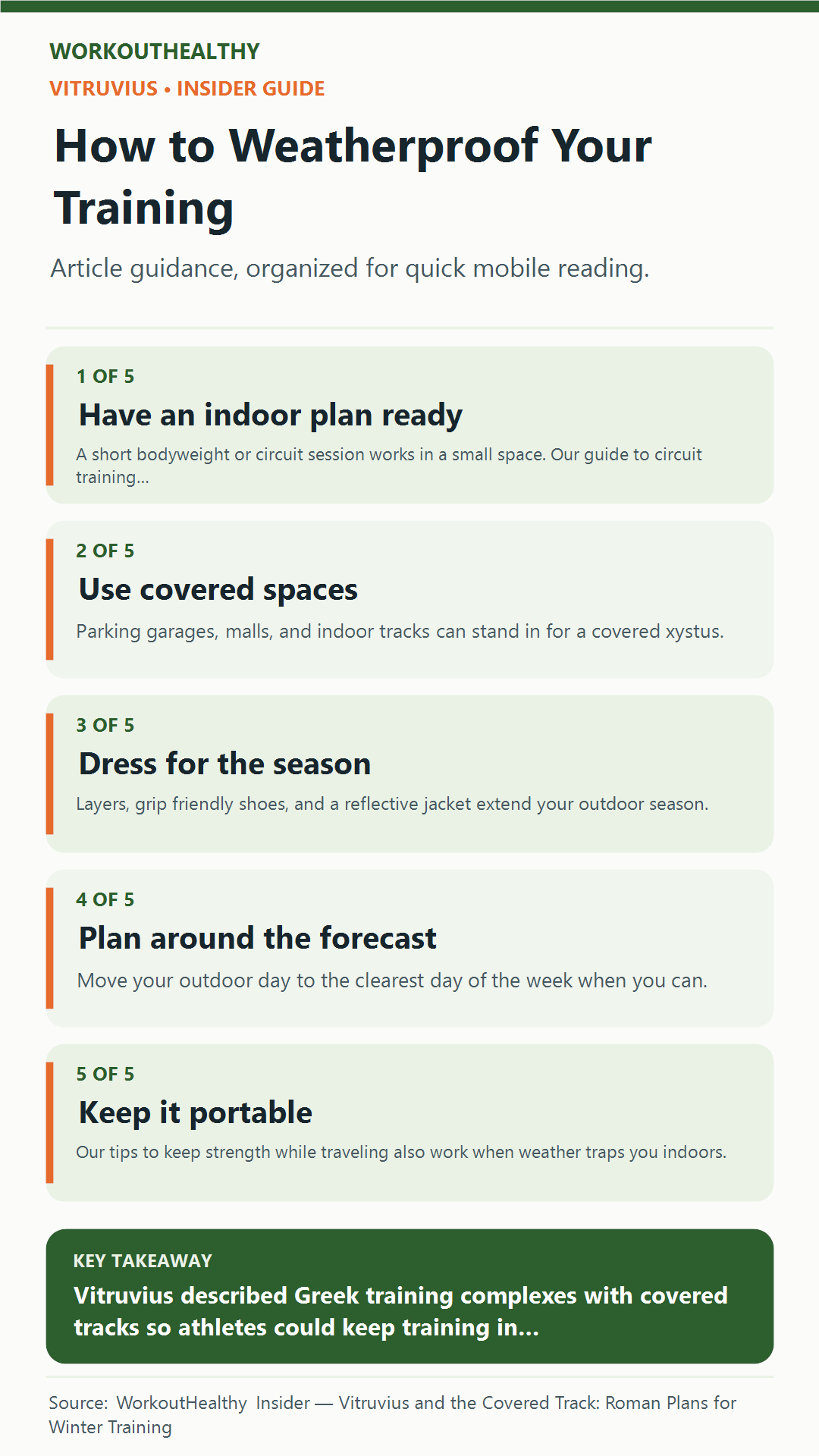
How to Weatherproof Your Training
- Have an indoor plan ready. A short bodyweight or circuit session works in a small space. Our guide to circuit training benefits explains why.
- Use covered spaces. Parking garages, malls, and indoor tracks can stand in for a covered xystus.
- Dress for the season. Layers, grip friendly shoes, and a reflective jacket extend your outdoor season.
- Plan around the forecast. Move your outdoor day to the clearest day of the week when you can.
- Keep it portable. Our tips to keep strength while traveling also work when weather traps you indoors.
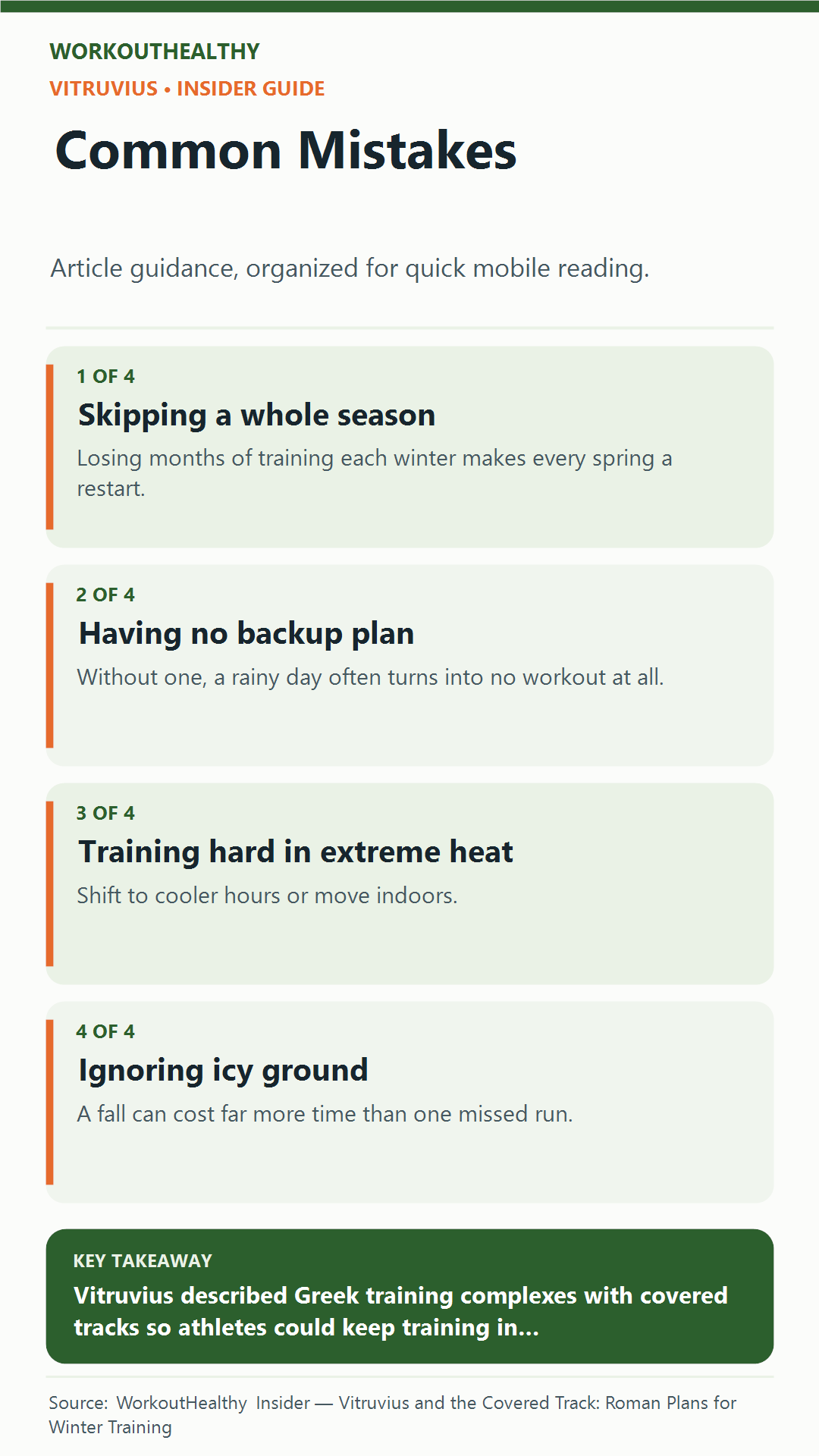
Common Mistakes
- Skipping a whole season. Losing months of training each winter makes every spring a restart.
- Having no backup plan. Without one, a rainy day often turns into no workout at all.
- Training hard in extreme heat. Shift to cooler hours or move indoors.
- Ignoring icy ground. A fall can cost far more time than one missed run.
Who Should Be Careful
People with heart or lung conditions, including asthma, should ask a doctor about exercising in very cold or very hot weather.
Older adults and anyone with balance problems should avoid icy or wet surfaces.
Stop and get help if you feel dizzy, confused, or unusually short of breath in extreme temperatures.
The Bottom Line
Vitruvius described Greek training complexes with covered tracks so athletes could keep training in winter.
The claim about open summer tracks is a little off, since he tied the open walks to fine winter weather.
Modern research agrees that weather is a real barrier to exercise.
Plan your own covered track, whether that is a gym, a hallway, or a living room.
Then the weather gets a vote on where you train, but not on whether you do.
Want more stories like this? Subscribe to WorkoutHealthy Insider for practical explanations behind popular fitness claims.
References
- Tucker, P., & Gilliland, J. (2007). The effect of season and weather on physical activity: A systematic review. Public Health, 121(12), 909 to 922. https://doi.org/10.1016/j.puhe.2007.04.009
- Vitruvius. (n.d.). De architectura, Book V, Chapter 11 (J. Gwilt, Trans.). LacusCurtius. https://penelope.uchicago.edu/Thayer/E/Roman/Texts/Vitruvius/5*.html
- Wikipedia contributors. (n.d.). De architectura. In Wikipedia. Retrieved September 16, 2026, from https://en.wikipedia.org/wiki/De_architectura
This article is for general information only and is not medical advice. If you have an injury, ongoing pain, or a medical condition, talk to a doctor or physical therapist before you change how you train or eat.