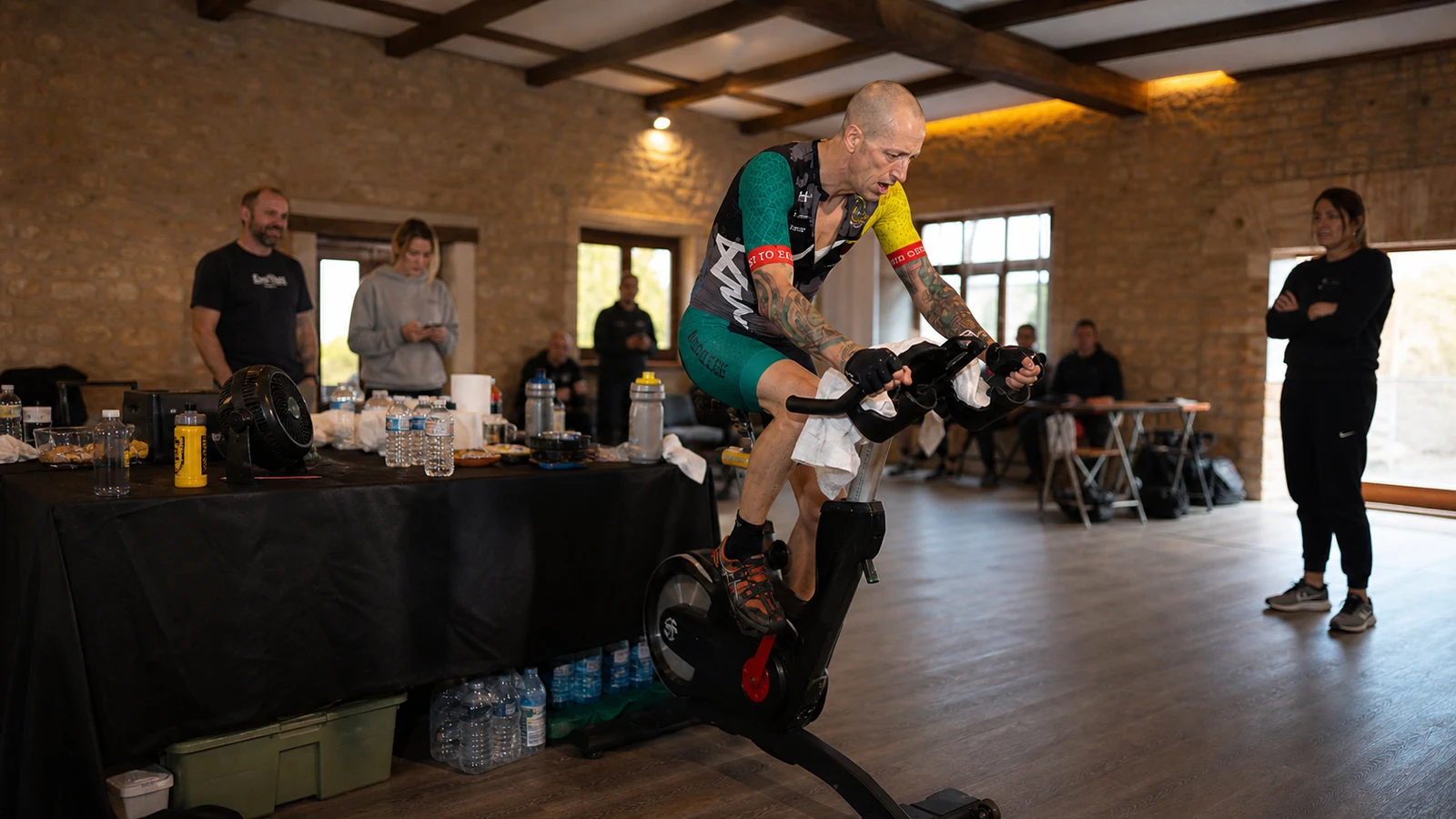

Most people get off a stationary bike after forty five minutes and call it a workout.
Ben Miles stayed on his for 277 hours, 20 minutes, and 30 seconds.
That is just over eleven and a half days of pedaling, broken only by the short rest periods Guinness World Records allows inside its official rules.
He set the record in June 2020 at his own training venue in Mallorca, Spain.
When Guinness confirmed the total, he did not just celebrate a title.
He got down and proposed to his girlfriend, who said yes.
What “Longest Marathon Static Cycling” Actually Means
Guinness tracks this feat under a specific category: longest marathon static cycling.
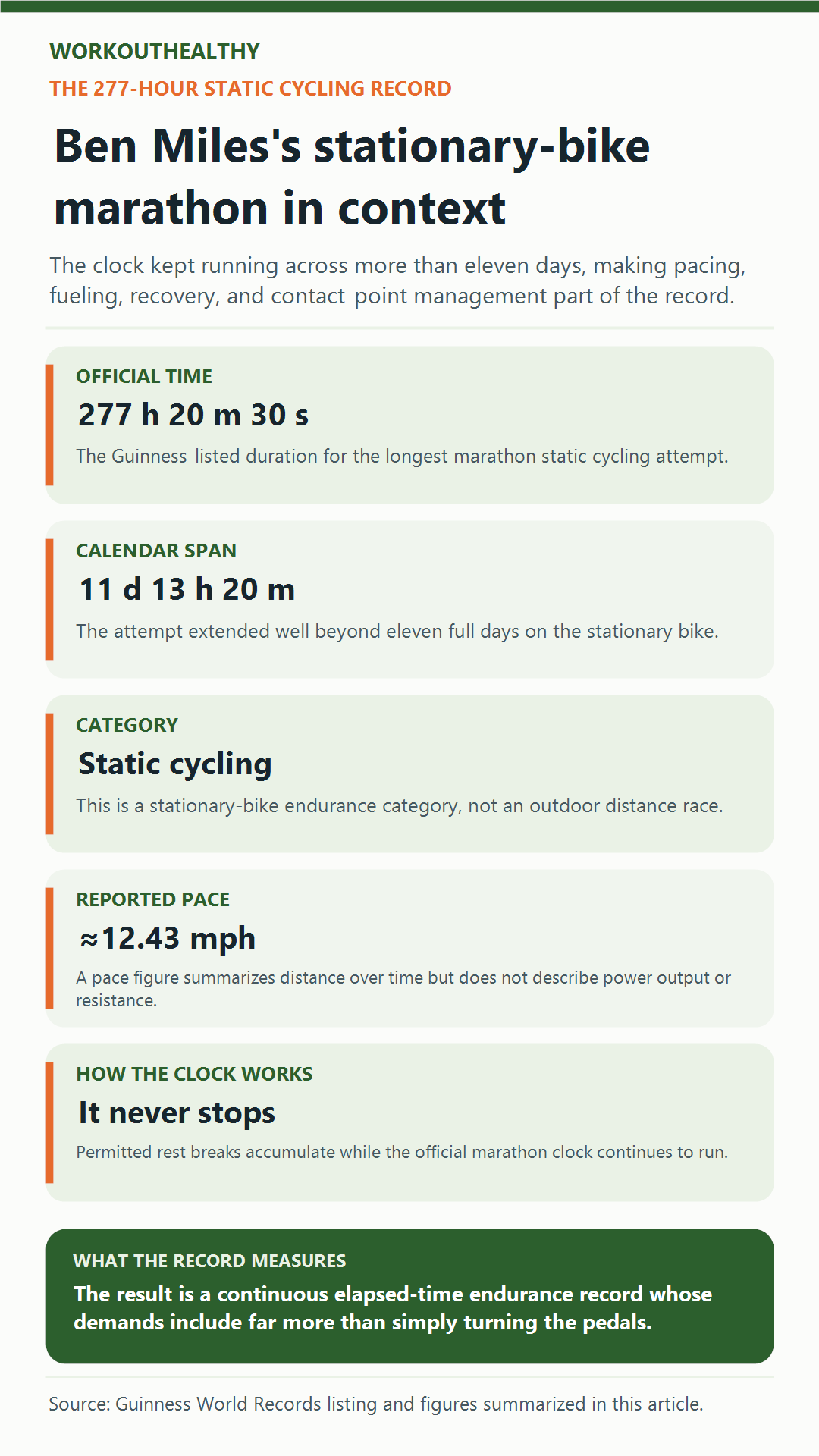
It is not the same record as the 24 hour indoor cycling distance record, and it is not a road ultracycling mark like the Race Across America.
The rules allow short breaks that accrue as the attempt goes on, typically a few minutes for every hour completed.
A rider can bank that time and use it later for sleep, food, or a bathroom break.
The clock never fully stops until the attempt ends.
That structure makes the category brutal in a different way than a single all out effort.
It rewards a rider who can keep moving for well over a week, not one who can produce the biggest single burst of power.
Eleven Days, Thirteen Hours, and One Proposal
Miles began his attempt on June 5, 2020, which is World Environment Day.
That timing was not an accident.
He has said the ride was meant to draw attention to plastic pollution and everyday recycling habits, rather than to raise money through a traditional fundraiser.
He held a pace close to 12.43 miles per hour for the full attempt.
By his own account, that covered a distance roughly equal to flying from London to Dubai.
Medical staff monitored him throughout the attempt.
He used his accrued break time carefully, banking enough on the first day to bring him closer to real sleep later on.
It did not spare him from the mental toll of the effort.
Reporting on the attempt described him developing noticeable speech difficulties by around day four.
That detail is consistent with what sleep researchers see in people pushed past three or four days without real rest.
Eleven and a half days on a bike that goes nowhere is not really a story about a bicycle. It is a story about what a body and a mind can still do once the easy hours are long gone.
When Guinness confirmed the total by video call at the end of the attempt, Miles used the moment to propose.
His girlfriend said yes.
He left that bike as both a record holder and an engaged man on the same afternoon.
Verifying the Record Today
The workbook entry behind this article flagged the claim as not independently refreshed.
It was checked directly against Guinness’s own current listing rather than taken on faith.
Guinness World Records’ own site still lists Benjamin Alexis Miles of the United Kingdom as the current holder of the longest marathon static cycling record.
The listed mark is 277 hours, 20 minutes, and 30 seconds, set at Son Amar in Mallorca, Spain, on June 16, 2020.
No newer attempt has replaced it as of this writing.
Records in this category do get challenged occasionally, since a stationary bike and a room are all a would be challenger technically needs.
Guinness itself notes that its published listings are not always updated the same day a new attempt is verified.
This is the most current confirmed status available, not a permanent guarantee.
What Happens to the Body During a Multi-Day Endurance Effort
An effort measured in days rather than hours puts a different kind of stress on the body than a hard single session does.
The heart and lungs are not working at a maximal, all out pace.
Instead they are asked to sustain a moderate, repeatable load for what amounts to almost two weeks without a true rest day.
That distinction matters physiologically.
A short, intense sauna session can push the heart rate into a range similar to light exercise, and research on sauna use and heart health shows that kind of acute cardiovascular stress is generally well tolerated by a healthy heart in short bursts.
A multi-day effort like Miles’s attempt asks something different of the cardiovascular system.
It is not about peak intensity.
It is about how long the body can keep repaying a moderate, unglamorous energy demand before something else in the system becomes the limiting factor instead of the heart itself.
The Cost of Staying Awake for Eleven Days
Sleep is the piece of this equation most people underestimate.
A classic review in the journal Sports Medicine examined what happens to exercise capacity when sleep is restricted for 30 to 72 hours (Van Helder & Radomski, 1989).
The researchers found that moderate sleep deprivation in that window does not dramatically reduce raw cardiovascular capacity or muscle strength on its own.
What it does reliably reduce is time to exhaustion.
A fatigued rider gives up sooner, even when the underlying engine is still working.
Perceived effort also rises sharply during sleep loss.
A pace that felt manageable on day one can feel much harder by day five, even if heart rate and oxygen use have barely changed.
The review also linked sleep deprivation to worse insulin sensitivity and glucose tolerance, which matters directly for an athlete trying to keep fueling a body that is burning calories nearly around the clock.
Miles’s own accrued break system, banking short rest periods into a longer sleep block, lines up with how ultra-endurance athletes generally manage this problem.
Total sleep elimination is rarely the strategy.
Fragmented, short blocks of real sleep are.
Anyone curious about how ordinary daily habits interact with sleep pressure can see a smaller scale version of the same idea in how caffeine timing affects sleep, where even a normal dose taken hours before bed measurably disrupted rest in a controlled study.
Pacing a Record That Lasts Longer Than a Work Week
Records this long are won or lost on pacing, not on a single strong hour.
A study published in SpringerPlus analyzed a different self-paced world record attempt, a 24-hour road cycling record, and found the rider’s speed and power output declined in a steady, linear pattern across the full 24 hours (Knechtle, Bragazzi, Rosemann, & Rüst, 2015).
That pattern is known as positive pacing.
A rider intentionally or unintentionally starts faster than the average they can sustain, then gradually settles into a lower, more survivable rhythm.
The researchers also found that ambient temperature and wind speed meaningfully affected how much a rider’s output dropped over the day.
Miles’s own reported average of 12.43 miles per hour for the entire 277 hour attempt suggests a rider who deliberately chose a conservative, highly repeatable pace rather than chasing a faster early split.
For an event stretching past eleven days, that kind of restraint is arguably more important than raw fitness.
A rider who starts too fast on day one has no way to bank back the fatigue it creates by day nine.
Fueling and Hydrating a Body That Never Stops Moving
Feeding an effort this long is its own discipline, separate from the pedaling itself.
A case study published in the Journal of the International Society of Sports Nutrition tracked one athlete through two full days of continuous stationary cycling and measured exactly how the numbers added up (Stewart & Stewart, 2007).
Over roughly 46.7 hours, that rider expended about 14,487 kilocalories while taking in only 11,098.
The shortfall of more than 3,000 kilocalories showed up directly as body weight lost during the attempt.
Carbohydrate intake also fell short of the recommended range for sustained endurance output.
Sodium intake was low enough that the researchers flagged it as a likely contributor to the dizziness and confusion the athlete experienced afterward.
The lesson from that case study generalizes well beyond one specific rider.
An effort measured in days, not hours, cannot be fueled by instinct or convenience food picked up along the way.
It requires the same kind of planning ahead of time that the schedule itself demands, since there is no good moment mid-attempt to solve a nutrition problem that should have been solved the week before.
The Overlooked Injury Risk: Saddle Sores and Perineal Pressure
Ask any long-distance cyclist what actually ends an attempt early, and pain in the saddle area comes up constantly.
A narrative review in the Journal of Functional Morphology and Kinesiology examined the research on saddle pressure and perineal load in road and off-road cyclists of both genders (Vicari et al., 2023).
The review found that sustained pressure on the perineal region, the soft tissue between the sit bones, is directly linked to numbness and skin breakdown.
In more severe or prolonged cases, that same pressure can cause nerve compression that affects sensation well after a ride ends.
Saddle width, shape, and setback all changed how much pressure reached that region in the studies reviewed.
Riding position and how often a rider shifted weight during a long session mattered too.
For an attempt stretching past eleven days, that pressure is not an occasional annoyance.
It is one of the most likely reasons an attempt like this fails before the clock does, which is presumably why extreme duration record holders spend real time before an attempt dialing in saddle fit rather than treating it as an afterthought.
Who Should Be Cautious, and What an Everyday Rider Can Actually Take From It
Nothing about this record is a training template for a typical rider, and it should not be read as one.
Anyone with a diagnosed heart condition, uncontrolled diabetes, a sleep disorder, or a history of overuse injury should not attempt to extend their own riding time based on a single extreme case study.
A conversation with a doctor belongs before any real jump in duration, not after symptoms show up.
What does transfer, in a much smaller form, is the underlying logic behind the record.
Building real endurance capacity happens gradually, through consistent, moderate sessions rather than occasional heroic ones.
A far more realistic version of that same principle shows up in guidance on how many miles an average adult should walk each day, where steady, repeatable effort beats one exhausting outlier every time.
The same logic applies to picking a cardio activity that fits a real schedule rather than an impressive one.
Something like a properly paced session of jump rope training can build the same aerobic base in a fraction of the time a marathon cycling attempt requires, without any of the sleep deprivation or saddle related risk that comes with stretching a single session into days.
The most useful lesson from Miles’s ride may simply be planning.
He banked breaks deliberately, chose a pace he could sustain rather than one that felt exciting on day one, and treated fueling as seriously as pedaling.
Those same three habits, pacing, planning ahead, and respecting recovery, scale down perfectly well to an ordinary person building a much shorter and much safer endurance habit.
Watch the Original Video
Enjoy stories like this one? Subscribe to WorkoutHealthy Insider for practical explanations behind popular fitness claims.
References
Knechtle, B., Bragazzi, N. L., Rosemann, T., & Rüst, C. A. (2015). Pacing in a self-paced world record attempt in 24-h road cycling. SpringerPlus, 4, 650. https://doi.org/10.1186/s40064-015-1445-1
Stewart, I. B., & Stewart, K. L. (2007). Energy balance during two days of continuous stationary cycling. Journal of the International Society of Sports Nutrition, 4, 15. https://doi.org/10.1186/1550-2783-4-15
Van Helder, T., & Radomski, M. W. (1989). Sleep deprivation and the effect on exercise performance. Sports Medicine, 7(4), 235 to 247. https://doi.org/10.2165/00007256-198907040-00002
Vicari, D. S. S., Patti, A., Giustino, V., Figlioli, F., Alamia, G., Palma, A., & Bianco, A. (2023). Saddle pressures factors in road and off-road cyclists of both genders: A narrative review. Journal of Functional Morphology and Kinesiology, 8(2), 71. https://doi.org/10.3390/jfmk8020071
This article is for general information only and is not medical advice. If you have an injury, ongoing pain, or a medical condition, talk to a doctor or physical therapist before you change how you train or eat.