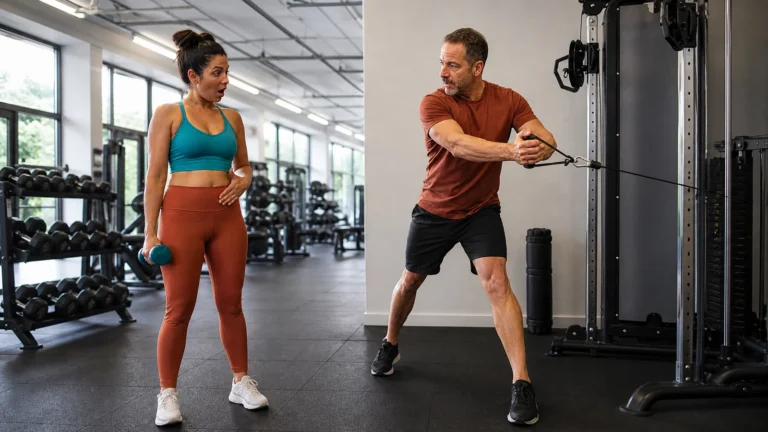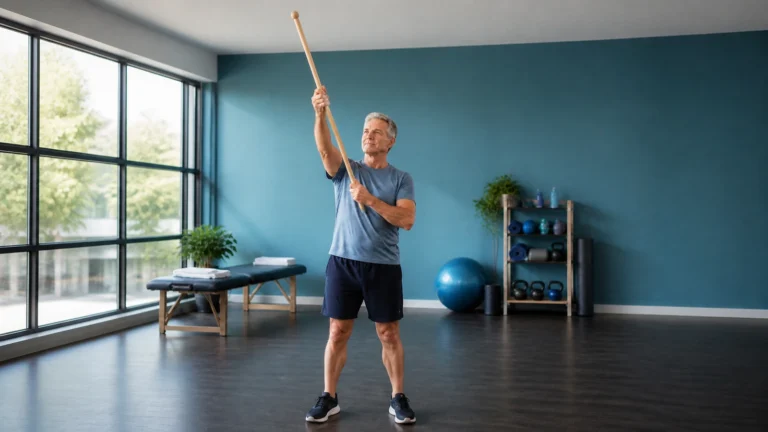

A YouTube video from the channel Medical Dialogues carries a blunt headline about hip arthritis and exercise.
It says hip arthritis patients may benefit less from exercise than doctors previously believed.
That claim traces back to a real Cochrane review, not a single small study picked out of context.
The review pooled data from eighteen clinical trials.
Those trials covered 1,368 people living with hip osteoarthritis.
The headline captures something true, but it leaves out most of the actual story.
Exercise still eased hip pain in the pooled data, and the review rated a lot of that evidence as solid.
The honest problem is not that exercise failed.
The honest problem is that the average improvement was smaller than the confident advice around exercise usually suggests.
This article goes through what the review actually measured, what an earlier trial found when it tested exercise against a placebo-like sham treatment, and what a modest effect size does and does not mean for someone living with a painful hip.
What the Study Actually Looked At
The review in question is called “Exercise for osteoarthritis of the hip.”
It was published in 2026 in the Cochrane Database of Systematic Reviews, led by researcher Michelle Hall along with nine coauthors.
Cochrane reviews use explicit eligibility criteria and structured methods to synthesize relevant trials. This review assessed the certainty of each result with GRADE, so its estimates and limitations should be read together (Hall et al., 2026).
This particular review is not new territory.
It updates a review first published in 2009 and last updated in 2014.
The team searched for new evidence through February 2025 and folded it into the existing body of research.
They looked at land-based exercise programs, meaning exercise done on solid ground rather than in a pool.
The eighteen trials they included compared exercise against a few different things.
Some compared exercise with an inactive placebo treatment.
Others compared exercise with no treatment at all, or with usual care.
A few looked at what happens when exercise is added on top of another treatment, compared with that other treatment alone.
The main outcomes they tracked were pain, physical function, and quality of life.
What the Review Actually Found
The topline conclusion, in the authors’ own words, is that exercise showed minimal clinically meaningful benefits for hip osteoarthritis across most of the outcomes measured, when compared with the various control conditions in the trials.
That is a careful, deliberately unflashy sentence, and it is worth sitting with.
It does not say exercise does nothing.
Across the pooled trials, people who exercised generally reported less pain than people in comparison groups.
The reviewers used GRADE to rate certainty. Against no treatment, usual care, or limited education, the average pain difference was 7.19 points and the physical-function difference was 8.79 points on 100-point scales; both were rated moderate-certainty. Against an attention control or placebo, the pain evidence was low-certainty and compatible with little or no effect (Hall et al., 2026).
What kept the overall verdict modest was the size of the gap between groups, not just the direction of it.
WorkoutHealthy’s numbers check: On the review’s 0–100 scale, the average pain advantage against no treatment, usual care, or limited education was 7.19 points (95% confidence interval 3.68 to 10.70 points). The function advantage was 8.79 points (95% confidence interval 5.41 to 12.00 points). These are differences between group averages immediately after treatment, not a promise that every person feels seven points better. Against an attention control or placebo, the pain estimate was 6.31 points, but its confidence interval included zero and certainty was low (Hall et al., 2026).
Exercise showed minimal clinically meaningful benefits for hip osteoarthritis across most outcomes compared to control conditions.
Small, real improvements are still real.
The pooled comparison with no treatment or usual care favors exercise on average, but it does not predict whether a particular person will feel a meaningful difference. The 7.19-point pain estimate is a group average, not a guarantee for each participant (Hall et al., 2026).
The gap between “somewhat better” and “meaningfully better,” though, is exactly what the video’s dramatic framing glosses over.
One Trial That Found an Even Smaller Gap
The Cochrane review is not the only place this question has been tested carefully.
A widely cited 2014 trial published in JAMA, led by researcher Kim Bennell, is one of the more sobering data points behind the review’s overall caution.
Researchers randomly assigned 102 adults with hip osteoarthritis to one of two groups.
One group received individualized physical therapy, including manual therapy, a home exercise program, and education.
The other group received a sham treatment designed to look and feel like real therapy without an active exercise component.
After 13 weeks, the two groups reported similar levels of hip pain and physical function.
The active physical therapy group did not come out significantly ahead of the sham group on the trial’s main measures.
This trial tested an individualized physical-therapy package, so its null comparison is important context; it does not test every exercise program or show that care should be abandoned (Bennell et al., 2014).
It does not prove exercise never helps.
It does show that even a well-designed, professionally delivered program can land closer to a placebo response than clinicians would like, at least over a 13 week window.
The trial is one important data point, but its results should not be treated as the entire pooled estimate or applied to every exercise approach (Bennell et al., 2014; Hall et al., 2026).
What a Decade of Research Adds
This is not the first time this exact question has been asked at this scale.
A 2014 version of the same Cochrane review, led by researcher Marlene Fransen, reached a broadly similar conclusion using fewer available trials.
That earlier review also found land-based exercise produced modest gains in pain and function, without a clear improvement in overall quality of life.
Benefits in that older review tended to fade somewhat in the months after a program ended.
Comparing the two reviews side by side tells its own story.
More trials, more participants, and more than a decade of additional research did not turn a modest effect into a dramatic one.
It refined the same modest finding and made researchers more confident that it is accurate, rather than a fluke of a smaller dataset.
The two reviews point toward modest average benefits, while trial design and comparator choice still leave uncertainty about who benefits most (Fransen et al., 2014; Hall et al., 2026).
Why Exercise Cannot Fix the Joint Itself
Hip osteoarthritis affects the whole joint, including cartilage, bone, and surrounding tissues. Exercise is used to manage symptoms and function; it is not proven to regrow cartilage or reverse osteoarthritis.
Strength and movement practice may help people perform daily tasks, but this review measured clinical outcomes rather than proving a single mechanism for the modest average benefit. That distinction matters: an exercise plan can still be worth trying without promising joint repair or substantial pain relief (Hall et al., 2026).
Carrying extra body weight adds even more direct load to the hip with every single step, which is part of why our guide on losing weight and muscle mass matters for anyone managing a joint condition alongside their training.
What This Evidence Does Not Mean
It would be easy to read a modest pain effect size and conclude exercise is not worth the effort for hip arthritis.
That conclusion goes further than the actual research supports.
The review measured one specific thing: hip pain and function scores compared with a control group.
It did not measure, and was never designed to measure, the cardiovascular benefit of staying active.
It did not measure the mood benefits that regular movement tends to produce.
It did not measure the broader functional gains that come from staying strong and mobile as people age, well beyond one joint.
Physical activity can have benefits beyond hip symptoms, but this hip-specific review cannot tell us how much a particular person will gain in cardiovascular health, mood, or balance. Those outcomes need their own evidence and an individualized plan.
The review excluded perioperative exercise programs, so it should not be used to judge exercise before or after hip replacement. People preparing for surgery should follow their surgical and rehabilitation team’s advice (Hall et al., 2026).
Our coverage of Misty Copeland’s hip replacement recovery shows how much work goes into rebuilding strength both before and after that kind of surgery.
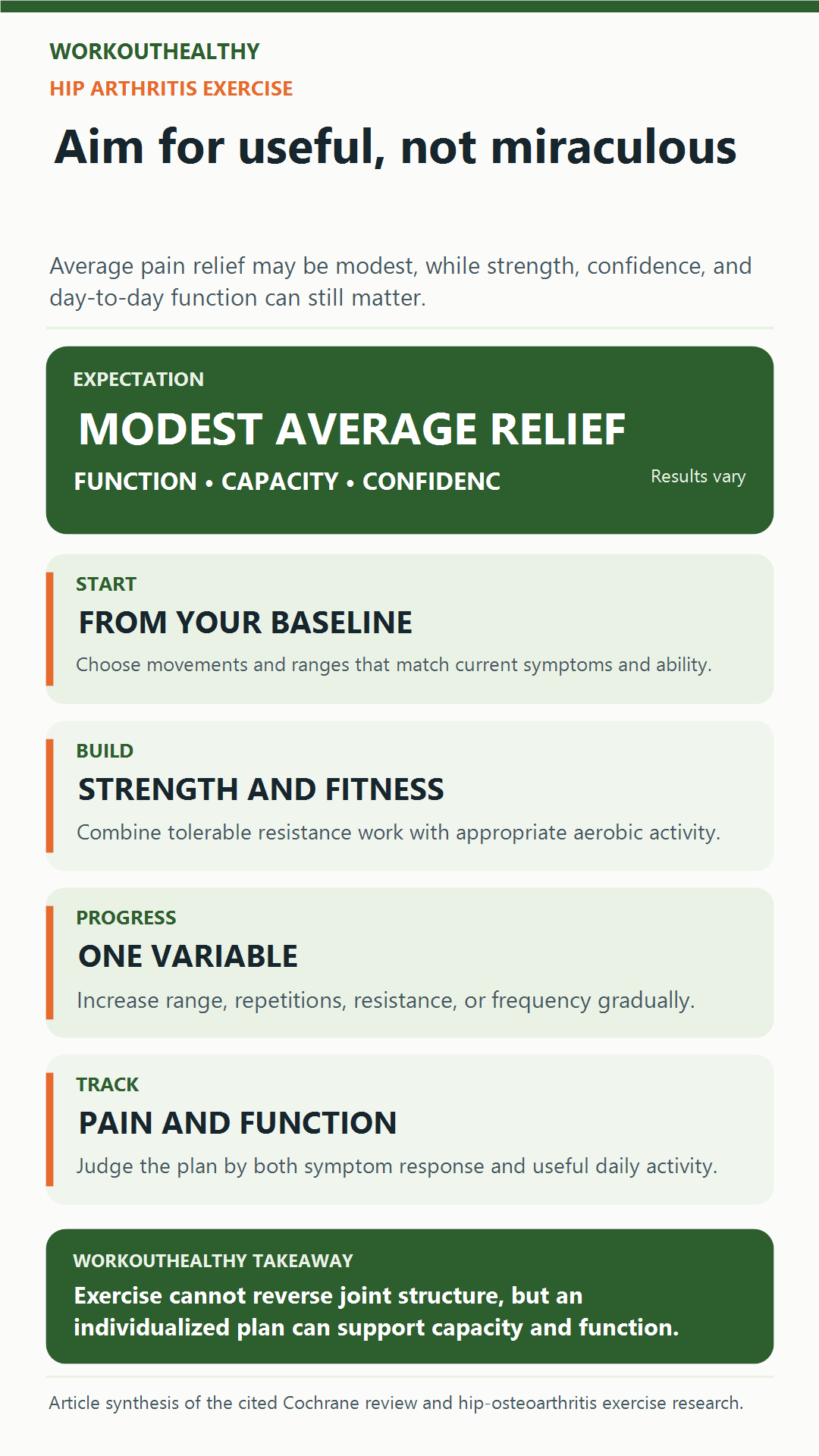
A modest pain benefit from exercise is a reason to set realistic expectations, not a reason to stop moving.
Common Mistakes People Make
Many people expect exercise to noticeably reduce hip pain within a week or two.
That expectation sets people up for disappointment and for quitting early, since most trials measured change over many weeks, not days.
Some people skip professional guidance even when pain, balance, or uncertainty about exercise selection makes tailored advice useful. The Bennell trial did not compare supervised with unsupervised exercise, so it cannot tell us which delivery method is superior (Bennell et al., 2014).
Other people push through sharp or worsening pain, assuming more effort always means more benefit.
Sharp, sudden, or worsening symptoms are a reason to pause and seek individualized clinical advice rather than simply increasing the exercise dose.
Some people treat exercise as a stand-alone cure and ignore other factors entirely, like body weight, footwear, or daily walking volume.
Our guide on how many miles you should walk a day is a reasonable place to start if walking volume feels like an unknown.
Skipping consistency is another common mistake, since gains in these trials built up gradually rather than appearing after a single session.
Who Should Check With a Doctor First
Anyone with new or worsening hip pain should get a proper diagnosis before starting an exercise program on their own.
Hip pain can come from arthritis, but it can also come from a labral tear, a stress fracture, or a problem outside the joint entirely.
People who have already had a joint injection, a prior surgery, or a hip replacement should follow their surgeon’s specific guidance rather than a generic plan.
Anyone with significant swelling, a locking or catching sensation, or sudden severe pain should be seen sooner rather than later.
Older adults with balance concerns should loop in a physical therapist before starting anything new.
Anyone managing a separate heart or lung condition, or taking blood thinners, should also confirm a new exercise plan with their doctor first.

How to Actually Use Exercise for Hip Arthritis
Start with low-impact activity that does not load the joint too hard right away.
Walking is one of the simplest starting points for most people with hip osteoarthritis, and it is easy to scale up gradually.
Add basic strengthening work for the muscles around the hip, particularly the glutes and outer hip muscles, since those are the muscles the review’s mechanism points back to.
A physical therapist or qualified trainer can check form so the joint gets supported rather than stressed during those movements.
If you are deciding between building strength and doing more cardio, our reader survey on weightlifting versus running is a useful look at how people weigh those two general approaches.
The review did not establish that supervised programs outperform unsupervised ones. A physical therapist can help individualize exercise when symptoms or function make a standard plan hard to follow; cost and access also matter (Hall et al., 2026).
Track how a program feels over several weeks, not after a single session, since that matches how the trials actually measured change.
Plan for periodic check-ins with a professional rather than expecting one program to work forever without adjustment.
If symptoms worsen, function declines, or a consistent plan is not helping after several weeks, review the diagnosis and program with a clinician rather than pushing through or assuming exercise has failed you personally. This is a practical follow-up rule, not a treatment threshold proven by the review.
Watch the Original Video
Want more like this? Subscribe to WorkoutHealthy Insider for practical explanations behind popular fitness claims.
References
Bennell, K. L., Egerton, T., Martin, J., Abbott, J. H., Metcalf, B., McManus, F., Sims, K., Pua, Y. H., Wrigley, T. V., Forbes, A., Smith, C., Harris, A., & Buchbinder, R. (2014). Effect of physical therapy on pain and function in patients with hip osteoarthritis: A randomized clinical trial. JAMA, 311(19), 1987 to 1997. https://doi.org/10.1001/jama.2014.4591
Fransen, M., McConnell, S., Hernandez-Molina, G., & Reichenbach, S. (2014). Exercise for osteoarthritis of the hip. Cochrane Database of Systematic Reviews, 2014(4), CD007912. https://doi.org/10.1002/14651858.CD007912.pub2
Hall, M., Lawford, B. J., Hinman, R. S., Dobson, F., Spiers, L., Kimp, A., French, H. P., Reichenbach, S., Hernandez-Molina, G., & Bennell, K. L. (2026). Exercise for osteoarthritis of the hip. Cochrane Database of Systematic Reviews, 2026(7), CD007912. https://doi.org/10.1002/14651858.CD007912.pub3
This article is for general information only and is not medical advice. If you have an injury, ongoing pain, or a medical condition, talk to a doctor or physical therapist before you change how you train or eat.