
A lot of people with breathing problems are turning to YouTube for help.
One popular video promises simple bodyweight exercises for pulmonary rehabilitation beginners.
Pulmonary rehabilitation is real medicine, and it genuinely works for many people.
But does a home video match what real pulmonary rehab research actually studied?
Pulmonary rehabilitation usually treats people with COPD, chronic lung disease, or lasting lung weakness after a serious illness.
That makes this a real medical topic, not just a general fitness trend.
This article checks the video’s basic idea against real, published research on pulmonary rehabilitation.
What the Video Claims
The video is called “Pulmonary Rehabilitation Exercises for Beginners: Bodyweight Calisthenics.”
It comes from a YouTube channel called Pulmonary & Cardiac Exercise.
The channel describes its content as “evidence-based” and “expert-guided” on its about page.
This session searched the channel’s public pages for the name behind it.
No name, license number, or professional title was listed anywhere on the channel.
No respiratory therapist, physical therapist, or other licensed credential could be independently confirmed.
That does not prove the advice in the video is wrong.
It just means viewers should not assume a licensed clinician is personally watching them exercise.
This article does not walk through, number, or rank the video’s specific exercises.
Instead, it looks at what real pulmonary rehabilitation research actually shows.
What Real Research Shows About Exercise Capacity and Breathlessness
A major Cochrane review pooled results from dozens of pulmonary rehabilitation trials in people with COPD.
Cochrane reviews are widely considered some of the strongest evidence available in medicine.
McCarthy and colleagues found that pulmonary rehabilitation clearly improved how far people could walk.
It also reduced how breathless people felt during everyday activity.
A major Cochrane review found that pulmonary rehabilitation improved both how far people with COPD could walk and how breathless they felt during daily activities.
A separate randomized controlled trial followed people with COPD for a full year after rehab.
Griffiths and colleagues found that people who completed a structured program spent fewer days in the hospital.
They also reported a better quality of life than people who did not do the program.
Both studies point to the same basic idea.
Structured, repeated exercise training helps people with lung disease do more with less breathlessness.
What Real Research Shows About Muscle Strength and Daily Function
The video specifically features bodyweight calisthenics, which count as a form of resistance exercise.
A systematic review by O’Shea and colleagues looked at progressive resistance exercise in people with COPD.
It found that resistance training reliably increased muscle strength in this group.
Stronger muscles matter because COPD often causes muscle wasting, not just lung damage.
The review also found some evidence that stronger muscles helped with daily tasks.
That daily task evidence was weaker and less consistent than the strength evidence.
Most of the resistance training in these trials used equipment like weights, machines, or resistance bands.
Bodyweight only training, with no added resistance at all, was not the specific focus of this research.
That is a real gap between what the studies tested and what the video shows.
What Real Research Shows About Recovery After a Flare-Up or Hospital Stay
People with COPD often have flare-ups that doctors call exacerbations.
A flare-up can mean a hospital stay and a long, difficult recovery afterward.
Another Cochrane review, by Puhan and colleagues, studied pulmonary rehab started soon after an exacerbation.
It found that rehab lowered the risk of being readmitted to the hospital.
It also improved exercise capacity and quality of life after a flare-up.
These programs were closely supervised by clinical teams, not self-guided from a video at home.
Timing and professional supervision were part of why the programs worked so well.
What Real Research Shows About Home-Based Programs
The video is essentially a home workout, so home-based research is directly relevant here.
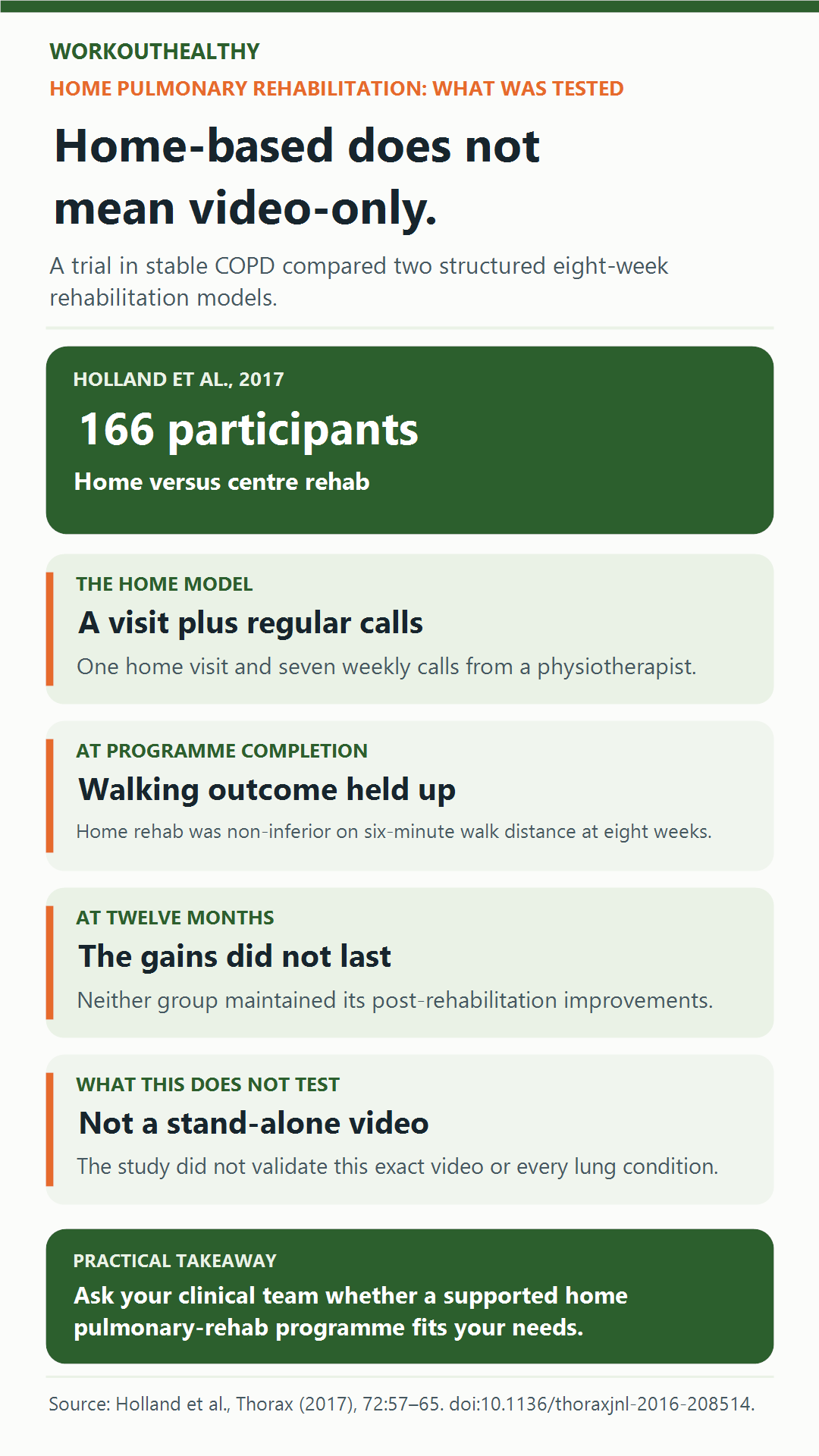
Holland and colleagues tested a home-based pulmonary rehab program against a traditional clinic-based one.
The home version used minimal equipment, mostly walking and simple strength exercises.
It produced exercise capacity results that were roughly equivalent to the clinic-based program.
A home-based pulmonary rehab program with minimal equipment matched a clinic-based program, but only because it still included a clinical assessment and regular check-ins.
That is a genuinely encouraging finding for people who cannot easily travel to a clinic.
But the home program in that trial was still built by a clinical team.
Participants were checked for oxygen levels and heart risk before the program even started.
They also received regular check-in calls from a clinician throughout the whole program.
A YouTube video watched alone, with no assessment and no check-ins, is not the same thing.
This finding supports home-based pulmonary rehab, not unsupervised pulmonary rehab.
Watch the video
The Mechanism
Lung disease does not just damage the lungs.
It also sets off a cycle of inactivity that weakens the whole body.
People feel breathless, so they move less.
Moving less causes muscles to lose strength and conditioning over time.
Weaker muscles need more oxygen to do the exact same task.
That makes breathlessness feel even worse, so people move even less.
The official ATS and ERS statement on pulmonary rehabilitation describes this exact cycle.
Exercise training interrupts that cycle at the muscle, not only at the lungs.
This kind of deconditioning cycle is not unique to lung disease either.
Broader research on daily steps and mortality risk shows how much regular movement matters for health at any age.
There is also a lung mechanics piece specific to conditions like COPD.
Air can get trapped in the lungs during exercise, a problem called dynamic hyperinflation.
O’Donnell and Laveneziana describe how trapped air makes every single breath more effortful.
Regular training does not repair damaged lung tissue.
But it can improve how efficiently the muscles use the oxygen the lungs do deliver.
What This Evidence Does Not Prove
None of the studies cited here tested this specific YouTube video.
They tested formal pulmonary rehabilitation programs, almost always run in a clinic or hospital.
Those programs included supervised exercise, education, and staff watching for warning signs.
A person following a video alone at home does not have that same safety net.
Most trial participants also had COPD specifically, not every possible lung condition.
Results in COPD do not automatically transfer to asthma, interstitial lung disease, or lingering weakness after a serious illness.
The research does not prove that bodyweight only exercise works exactly as well as the programs studied.
And it does not prove that any single video is a safe substitute for a real pulmonary rehab referral.
Who Should Work With a Clinical Team
Anyone with a diagnosed lung condition should talk to a doctor before starting a new exercise routine.
People with COPD or interstitial lung disease should ask about a referral to formal pulmonary rehab. The same goes for anyone recovering from a recent serious lung illness.
These programs are usually run by respiratory therapists, physical therapists, and other trained clinical staff.
A clinical team can check oxygen levels during exercise, which a video obviously cannot do.
They can also adjust the exercise plan to a person’s specific lung function and heart health.
People recovering from a hospital stay or a recent flare-up benefit the most from this kind of supervision.
The same basic principle showed up in how Misty Copeland’s structured, professionally guided recovery worked after her hip replacement.
A plan built around one person’s actual condition tends to beat a generic routine from a video.
Who Should Be Extra Careful
Some people face higher risk from unsupervised exercise and should be especially cautious.
This includes anyone with low blood oxygen levels at rest, even if they already use supplemental oxygen.
It includes people with unstable heart conditions or a recent heart attack.
It also includes anyone hospitalized for a lung or heart problem within the last few weeks.
People with severe COPD, sometimes labeled GOLD stage 3 or 4, need closer monitoring during any exercise.
People still recovering from a serious respiratory illness, including lingering symptoms after COVID 19, should also be cautious.
A video cannot check oxygen levels or heart rate the way a clinician can.
That means it cannot tell when someone has quietly pushed too hard.
Severe breathlessness, chest pain, dizziness, or blue tinted lips mean stop right away and get medical help.
A Practical Takeaway
Pulmonary rehabilitation is one of the most strongly evidence backed treatments in all of lung medicine.
The research behind it is genuinely strong, even though the research behind any one YouTube video is not.
The safest first step is a conversation with a doctor or pulmonologist about a formal referral.

Many people qualify for a covered pulmonary rehab program and simply do not realize it.
For people cleared for general light activity, a daily walking habit is a reasonable place to start.
Once cleared by a clinician, slow and gentle bodyweight movement can be a reasonable starting point.
Strength work matters too, since broader research on resistance training shows benefits that reach well beyond the lungs.
None of this replaces an actual clinical assessment of a person’s specific lung and heart function.
Want more like this? Subscribe to WorkoutHealthy Insider for practical explanations behind popular fitness claims.
References
Griffiths, T. L., Burr, M. L., Campbell, I. A., Lewis-Jenkins, V., Mullins, J., Shiels, K., Turner-Lawlor, P. J., Payne, N., Newcombe, R. G., Ionescu, A. A., Thomas, J., & Tunbridge, J. (2000). Results at 1 year of outpatient multidisciplinary pulmonary rehabilitation: A randomised controlled trial. The Lancet, 355(9201), 362 to 368. https://doi.org/10.1016/S0140-6736(99)07042-7
Holland, A. E., Mahal, A., Hill, C. J., Lee, A. L., Burge, A. T., Cox, N. S., Moore, R., Nicolson, C., O’Halloran, P., Lahham, A., Gillies, R., & McDonald, C. F. (2017). Home-based rehabilitation for COPD using minimal resources: A randomised, controlled equivalence trial. Thorax, 72(1), 57 to 65. https://doi.org/10.1136/thoraxjnl-2016-208514
McCarthy, B., Casey, D., Devane, D., Murphy, K., Murphy, E., & Lacasse, Y. (2015). Pulmonary rehabilitation for chronic obstructive pulmonary disease. Cochrane Database of Systematic Reviews, 2015(2), Article CD003793. https://doi.org/10.1002/14651858.CD003793.pub3
O’Donnell, D. E., & Laveneziana, P. (2006). The clinical importance of dynamic lung hyperinflation in COPD. COPD: Journal of Chronic Obstructive Pulmonary Disease, 3(4), 219 to 232. https://doi.org/10.1080/15412550600977478
O’Shea, S. D., Taylor, N. F., & Paratz, J. D. (2009). Progressive resistance exercise improves muscle strength and may improve elements of performance of daily activities for people with COPD. Chest, 136(5), 1269 to 1283. https://doi.org/10.1378/chest.09-0029
Puhan, M. A., Gimeno-Santos, E., Cates, C. J., & Troosters, T. (2016). Pulmonary rehabilitation following exacerbations of chronic obstructive pulmonary disease. Cochrane Database of Systematic Reviews, 2016(12), Article CD005305. https://doi.org/10.1002/14651858.CD005305.pub4
Spruit, M. A., Singh, S. J., Garvey, C., ZuWallack, R., Nici, L., Rochester, C., Hill, K., Holland, A. E., Lareau, S. C., Man, W. D-C., Pitta, F., Sewell, L., Raskin, J., Bourbeau, J., Crouch, R., Franssen, F. M. E., Casaburi, R., Vercoulen, J. H., Vogiatzis, I., … Wouters, E. F. M. (2013). An official American Thoracic Society/European Respiratory Society statement: Key concepts and advances in pulmonary rehabilitation. American Journal of Respiratory and Critical Care Medicine, 188(8), e13 to e64. https://doi.org/10.1164/rccm.201309-1634ST
This article is for general information only and is not medical advice. If you have an injury, ongoing pain, or a medical condition, talk to a doctor or physical therapist before you change how you train or eat.