
Fitness advice spreads fast online, and some claims survive no matter how many studies contradict them.
A video titled “5 Fitness Myths That Have Been Debunked by Research (But Won’t Die)” from the channel The Underrated List promises to take on a few of these persistent claims.
This article does not summarize that specific video or claim to know exactly which five myths it covers.
Instead, it independently fact checks five of the most common, most researched fitness myths out there, using real peer reviewed studies you can actually look up.
Each myth below gets its own section, its own real citation, and an honest look at what the evidence does and does not prove.
What the Video Claims
The video’s title promises five fitness myths that research has supposedly debunked.
The channel’s public description does not spell out which five myths the video covers or which studies it references.
Without watching the full video ourselves, we cannot confirm the creator’s exact list or how closely it matches the evidence.
So rather than guess at the video’s content, this article picks five of the most widespread fitness myths on its own and checks each one against a real published study.
If you watch the video and it covers different claims than the ones below, treat this article as a companion fact check rather than a direct recap.
What Real Research Shows About Spot Reduction
Spot reduction is the idea that exercising one body part burns fat specifically from that area.
People do endless crunches hoping for a flatter stomach, or extra arm exercises hoping to lose arm fat, based on this belief.
A 2013 study in the Journal of Strength and Conditioning Research tested this directly.
Researchers had participants train only one leg with resistance exercise for 12 weeks while leaving the other leg untrained.
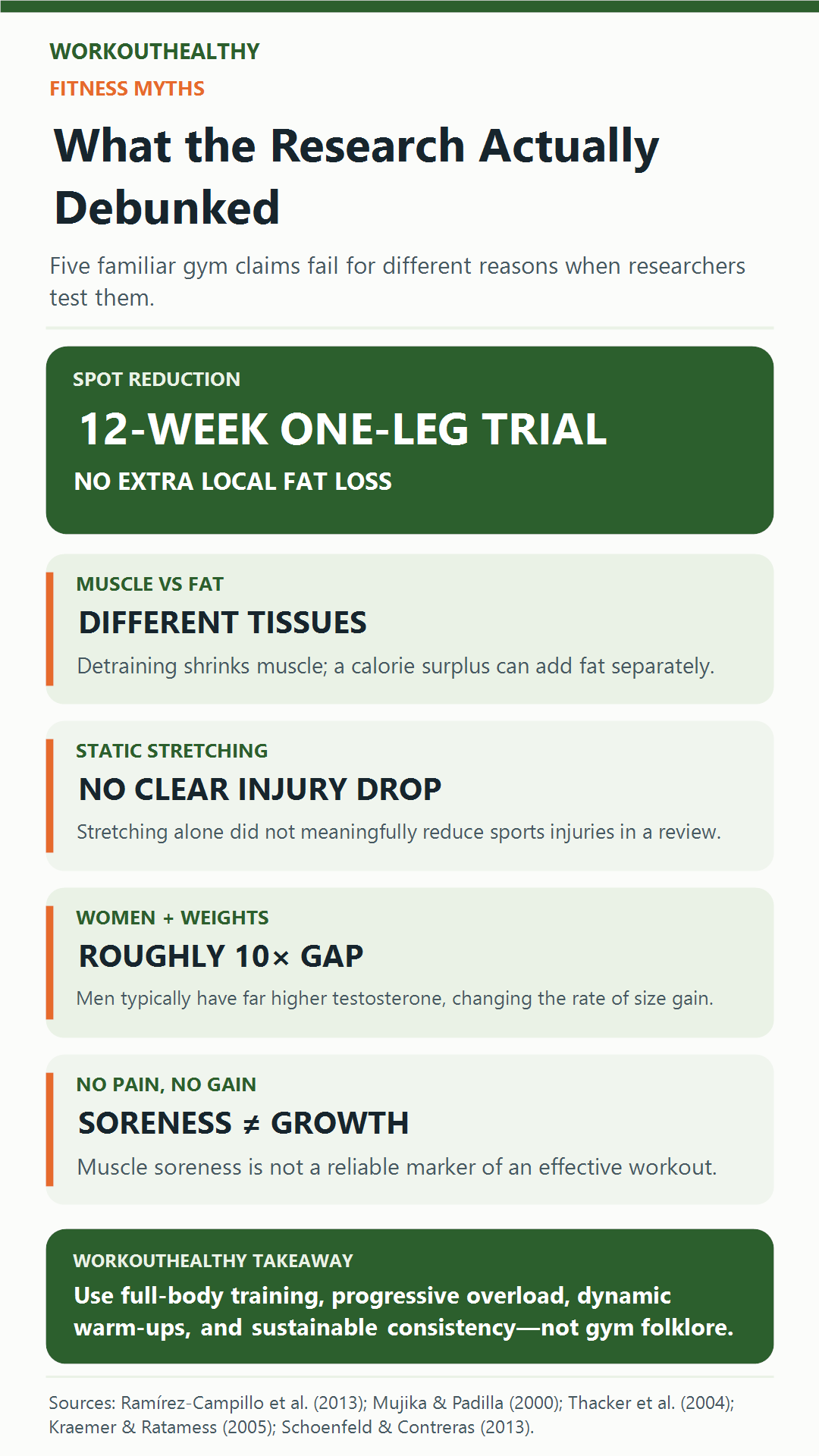
Training one leg for 12 weeks built real strength and muscle in that leg, but it did not burn fat from that leg any faster than from the rest of the body.
The trained leg gained strength and muscle, just as expected.
But it did not lose more fat than the untrained leg or the rest of the body (Ramírez-Campillo, Andrade, Campos-Jara, Henríquez-Olguín, Alvarez-Lepín, & Izquierdo, 2013).
Fat loss happened more evenly across the whole body instead, which matches how the body actually mobilizes stored fat during a calorie deficit.
That means targeted exercises can absolutely strengthen and tone a specific muscle.
They just cannot be counted on to melt fat from that exact spot.
What Real Research Shows About Muscle Turning Into Fat
A lot of people worry that if they stop lifting weights, their muscle will somehow turn into fat.
Muscle tissue and fat tissue are completely different types of tissue, made of different cells.
One cannot physically convert into the other, no matter how long someone stays inactive.
What actually happens is less dramatic but easy to misread.
Muscle fibers shrink from disuse, a well documented process researchers call detraining (Mujika & Padilla, 2000).
At the same time, many people keep eating the same amount even though they are now burning fewer calories.
Smaller muscles plus a growing calorie surplus can add up to a softer looking body.
That combination just looks like a transformation from one tissue into another, when really two separate processes are happening side by side.
Our article on losing weight and muscle mass breaks down why muscle loss and fat gain often happen together without one causing the other.
What Real Research Shows About Stretching and Injury Prevention
Gym culture often treats static stretching before a workout as mandatory injury protection.
A major systematic review looked at the actual evidence behind that belief.
Public health researchers reviewed the available studies on stretching and sports injury rates.
They found the evidence did not support a meaningful drop in injury risk from pre-workout stretching alone (Thacker, Gilchrist, Stroup, & Kimsey, 2004).
That does not mean stretching is pointless, since flexibility still matters for some sports and goals.
It means the specific claim that stretching before exercise prevents injury is not well supported by the data researchers actually collected.
A proper warm up that raises heart rate and rehearses the movement pattern appears to matter more for injury prevention than static stretching alone.
What Real Research Shows About Lifting Weights Making Women Bulky
Many women avoid heavier weights because they worry lifting will make them look bulky.
Muscle growth depends heavily on hormone levels, especially testosterone.
Research on hormonal responses to resistance training shows that men typically carry testosterone levels roughly ten times higher than women (Kraemer & Ratamess, 2005).
That hormonal gap gives men a much bigger built in advantage for adding large amounts of muscle mass.
Without that same hormonal environment, most women who lift heavy weights build strength and lean, toned muscle rather than bulky size.
Noticeable size gains for women typically take years of deliberate training, usually paired with a calorie surplus and heavy progressive overload on purpose.
Our piece on whether lifting weights keeps your brain young covers other research backed benefits of resistance training that have nothing to do with size at all.
What Real Research Shows About No Pain No Gain
The phrase “no pain no gain” suggests a workout only counts if you feel sore afterward.
A widely cited review in the Strength and Conditioning Journal examined whether muscle soreness actually predicts muscle growth.
Soreness is not a reliable marker of muscle growth, and some of the most effective training sessions produce very little soreness at all.
The review found soreness is not a reliable marker of how much a workout actually helped someone build muscle (Schoenfeld & Contreras, 2013).
Some of the most effective, well structured training sessions produce very little soreness at all.
Soreness mostly reflects an unfamiliar movement pattern or a sudden jump in training intensity, not the quality of the workout itself.
Chasing soreness on purpose can even backfire by pushing people toward overtraining or excessive muscle damage.
The Mechanism Behind Why These Myths Survive
Fitness myths like these persist because they are simple, intuitive, and easy to repeat.
“Crunches burn belly fat” sounds logical even though fat loss does not actually work that way.
Gym culture also passes information down like folklore, from one person’s personal experience to the next.
A story told with confidence can spread just as fast as a study, even when the study says something different.
Our breakdown of Jay Cutler’s famously extreme 1993 diet shows how specific numbers can circulate for decades with very little outside scrutiny.
Social media speeds up that spread even further, since a confident short video often travels farther than a careful study summary ever will.
What This Evidence Does Not Prove
None of these five studies prove that training method never matters at all.
The spot reduction study only tested one specific protocol on one specific muscle group in one specific population.
The stretching review focused on injury prevention, not on flexibility, performance, or the other benefits stretching might offer.
The hormone research explains a population level pattern, not a guarantee about any one individual’s exact response to training.
The detraining research describes an average pattern over weeks, not an exact timeline for any one specific body.
None of this research proves that any single approach works identically for every single person, since individual response to exercise always varies somewhat.
Common Mistakes
One common mistake is assuming a myth is true just because it feels true based on personal experience.
Another is training only one body part and hoping to lose fat there, instead of combining full body training with a real calorie deficit.
Skipping strength training entirely out of fear of getting bulky is another common mistake, especially for women chasing a toned look.
Treating soreness as the actual goal of a workout, rather than progressive overload, is a mistake that can quietly lead to overtraining.
Relying only on static stretching for injury prevention, while skipping a proper dynamic warm up, is another gap worth closing.
Comparing your own body to someone else’s progress, instead of tracking your own consistency, is a mistake that fuels several of these myths at once.
Who Should Be Extra Careful
Anyone recovering from an injury should not use “no pain no gain” as a training philosophy.
Sharp pain or joint pain during exercise is a signal to stop, not a sign to push through.
People newer to strength training should learn proper form before chasing heavier weights, regardless of gender.
Anyone with a heart condition, joint disease, or a recent surgery should talk to a doctor before starting an intense new lifting or stretching routine.
Older adults starting a new resistance program should also check in with a doctor first, especially if balance or bone density is already a concern.
A Practical Takeaway
Focus on full body strength training two to three times a week rather than isolating one area for fat loss.

Pair training with a real, sustainable calorie deficit if fat loss is the actual goal, since spot reduction does not work.
Warm up with light dynamic movement instead of relying only on static stretching to prevent injury.
If bulk is the worry, remember that noticeable size takes years of deliberate training on purpose, not a few months of consistent lifting.
Our reader survey on weightlifting versus running shows how many people already lean toward lifting once they understand what it actually does to the body.
Judge a workout by consistency and progressive overload over time, not by how sore you feel the next morning.
Watch the video
Want more like this? Subscribe to WorkoutHealthy Insider for practical explanations behind popular fitness claims.
References
Kraemer, W. J., & Ratamess, N. A. (2005). Hormonal responses and adaptations to resistance exercise and training. Sports Medicine, 35(4), 339 to 361. https://doi.org/10.2165/00007256-200535040-00004
Mujika, I., & Padilla, S. (2000). Detraining: Loss of training-induced physiological and performance adaptations. Part I. Sports Medicine, 30(2), 79 to 87. https://doi.org/10.2165/00007256-200030020-00002
Ramírez-Campillo, R., Andrade, D. C., Campos-Jara, C., Henríquez-Olguín, C., Alvarez-Lepín, C., & Izquierdo, M. (2013). Regional fat changes induced by localized muscle endurance resistance training. Journal of Strength and Conditioning Research, 27(8), 2219 to 2224. https://doi.org/10.1519/JSC.0b013e31827e8681
Schoenfeld, B. J., & Contreras, B. (2013). Is postexercise muscle soreness a valid indicator of muscular adaptations? Strength and Conditioning Journal, 35(5), 16 to 21. https://doi.org/10.1519/SSC.0b013e3182a61820
Thacker, S. B., Gilchrist, J., Stroup, D. F., & Kimsey, C. D. (2004). The impact of stretching on sports injury risk: A systematic review of the literature. Medicine & Science in Sports & Exercise, 36(3), 371 to 378. https://doi.org/10.1249/01.MSS.0000117134.83018.F7
This article is for general information only and is not medical advice. If you have an injury, ongoing pain, or a medical condition, talk to a doctor or physical therapist before you change how you train or eat.