
A GLP-1 weight loss plan can change more than the number on the scale. Fat loss, lean tissue, food intake and physical function deserve attention together. That is the concern behind WUSA9’s August 3, 2026 report, Doctors urge focus on muscle health as GLP-1 use grows.
The useful question is how to support strength while treatment is helping someone lose weight. Two body composition analyses show why clinicians look beyond total pounds lost. They also show why a headline about “muscle loss” needs careful interpretation.
Here is what the studies measured, where protein and resistance training fit, and which questions can make a follow-up appointment more useful.
What the WUSA9 Report Actually Shows
The original report is a 2-minute, 3-second news segment, not a workout tutorial or a clinical trial. Its available transcript follows a woman using a GLP-1 medication and a physician discussing strength training and protein intake. Body composition testing is part of the patient’s program (WUSA9, 2026).
That story illustrates a clinical concern. It cannot establish how much muscle every patient will lose, or prove that a particular exercise schedule prevents the loss. A person’s experience in a news report is different from an average measured in a controlled study.
The scheduled social image is an illustration of resistance exercise. The man using a band is not identified as the patient in the report or a participant in either trial. Use the video for the original news context, then use the research below to understand the numbers.
What the Body Composition Studies Found
The exploratory STEP 1 analysis included 140 adults without diabetes: 95 received semaglutide and 45 placebo. Over 68 weeks, body weight fell 15.0% in the semaglutide group and 3.6% in the placebo group. In the semaglutide group, total fat mass fell 19.3%, visceral fat mass 27.4%, and total lean body mass 9.7%. Lean tissue nevertheless became a larger share of total body weight (Wilding et al., 2021).
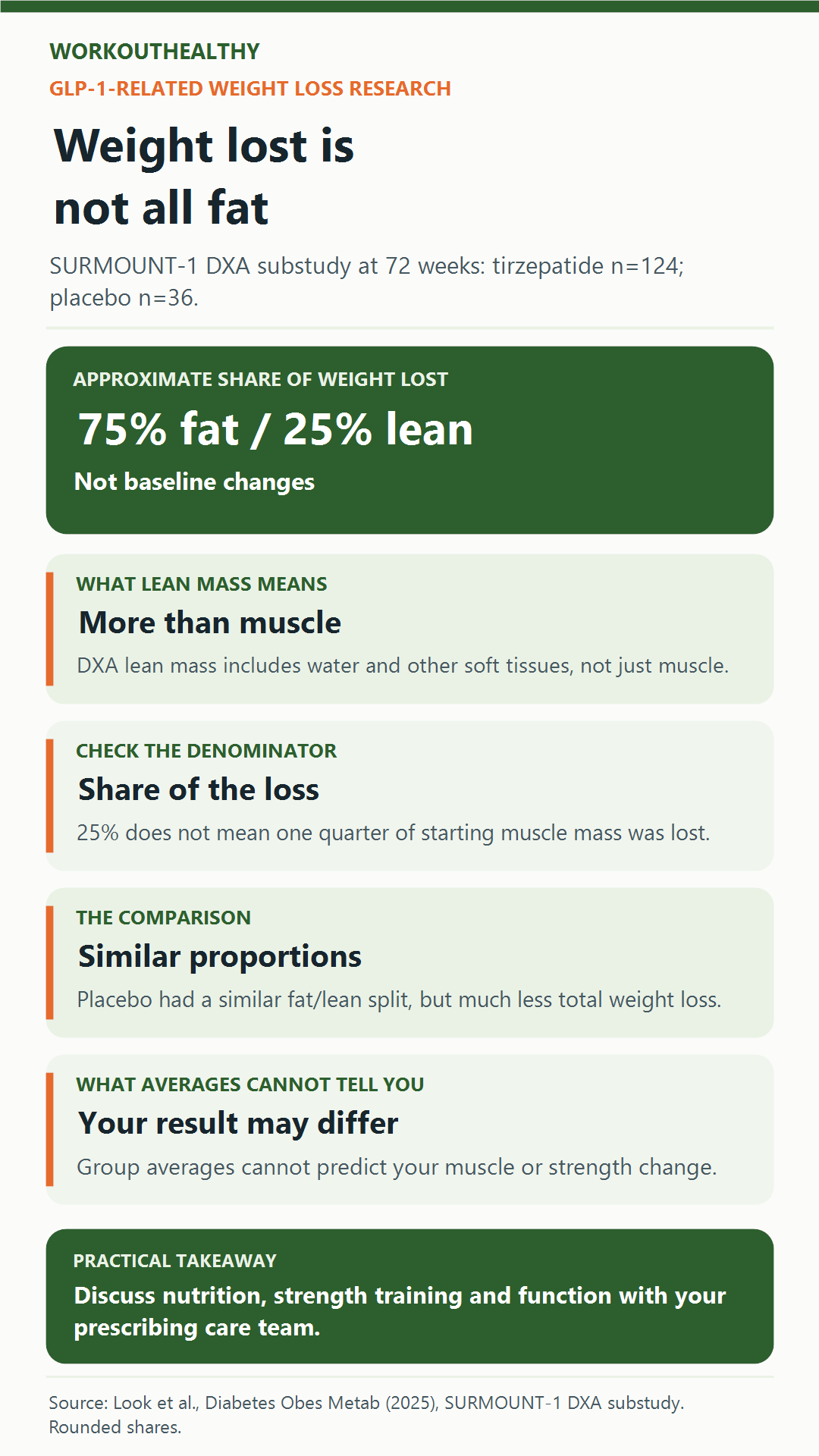
The SURMOUNT-1 DXA substudy reported complete measurements for 160 participants: 124 receiving pooled tirzepatide doses and 36 placebo. At 72 weeks, weight fell 21.3% versus 5.3%, fat mass 33.9% versus 8.2%, and lean mass 10.9% versus 2.6%. About 75% of the weight lost was fat and 25% lean mass in both groups (Look et al., 2025).
Those last percentages describe the composition of weight lost. They do not mean someone lost 25% of their starting muscle. Nor does a similar ratio mean the groups lost equal amounts of lean tissue; their total losses differed.
These are selected substudies, not measurements from every participant in the parent trials. Their findings are useful, but they do not provide a personal forecast. The medication, starting body composition, treatment duration and measurement all matter when discussing results.
Why Lean Mass and Muscle Are Different Questions
DXA divides the body into measured compartments. Lean tissue includes more than skeletal muscle, so a change in total lean mass cannot be relabeled as the same percentage change in muscle. Water and other nonfat tissues contribute to the measurement. Neither a bathroom scale nor these totals directly measure how well someone can lift, walk or manage daily tasks.
That distinction prevents two opposite mistakes. One is treating all weight lost as fat. The other is treating every kilogram of lost lean mass as a kilogram of lost working muscle. Both readings leave out information needed to interpret the studies.
The similar fat-to-lean shares in SURMOUNT-1 do not isolate the biological cause of lean tissue change. They cannot prove that medication has no direct effect on muscle, or that all weight loss methods produce the same outcome.
A clearer question for a clinician is: “What are we measuring, and how does it relate to my function?” A change in a scan is one piece of that discussion. Changes in strength, mobility, eating and symptoms supply other pieces.
The scale measures total weight. Protecting strength requires paying attention to what is changing and what the body can still do.
Where Strength Training Fits
A 2025 joint advisory from four medical and nutrition organizations emphasizes structured resistance training alongside adequate nutrition during GLP-1 therapy. It also recommends considering muscle strength, function and body composition rather than body weight alone. This is clinical guidance informed by a literature review and expert discussion, not a new trial proving complete muscle preservation (Mozaffarian et al., 2025).
For a reader planning an appointment, the practical issue is making “do strength training” concrete. Ask which movements are suitable, what equipment is accessible, how often to practice, and how progress will be reviewed. A clinician, physical therapist or qualified exercise professional can help turn that discussion into a program suited to current capacity.
Resistance can come from weights, machines, bands or body weight. The featured band exercise is one illustration of loading a movement; the news report does not establish it as the preferred exercise. A complete plan should explain what to do and how to adjust it, instead of relying on an image or a single drill.
Our guide to the fitness basics when progress stalls explains why a repeatable routine is easier to evaluate. For someone receiving medical treatment, that routine should fit the treatment plan and any relevant restrictions.
A useful exercise log can record the movement, resistance, repetitions and how the session felt. This creates specific information to discuss if performance changes. It also makes the goal more tangible than simply trying to make every workout harder.
What Protein Research Can and Cannot Tell Us
Wycherley and colleagues (2012) pooled 24 trials involving 1,063 adults. They compared energy-restricted, higher-protein, low-fat diets with standard-protein, low-fat diets. The higher-protein groups retained an average 0.43 kg more fat-free mass, with a 95% confidence interval from 0.09 to 0.78 kg. That is a modest pooled difference, not an extra kilogram for every person.
These were dietary weight loss trials, not a direct test of protein prescriptions for people taking today’s GLP-1 medications. Their result supports discussing protein as part of nutrition planning. It does not establish a universal dose or guarantee that lean tissue will stay unchanged.
Protein planning and regular muscle loading belong in the same conversation; neither promises that every change in lean tissue can be prevented.
For everyday planning, write down what a typical day of eating currently looks like before asking for a target. Include meals that become difficult to finish, foods that no longer appeal, and whether a shake replaces other food. A registered dietitian can use that detail to make advice practical.
The question is not just “Which protein powder should I buy?” It is whether the overall eating pattern meets the person’s needs. Our evidence guide to fitness supplements explains the distinction between a convenient product and a proven need. Bring any supplement list to the treatment team rather than assuming more is better.
Kidney disease, other medical conditions and dietary restrictions can change nutrition planning. A social caption or a trial average cannot replace that assessment.
What This Evidence Still Does Not Prove
The semaglutide analysis followed participants for 68 weeks; the tirzepatide substudy for 72 weeks. Those data do not establish what happens to every patient’s strength or independence many years later. They also do not show that everyone loses the same share of lean tissue.
Comparing percentages between studies requires caution. The drugs, groups, durations and measurements differ. A 9.7% change in starting lean mass and a 25% share of weight lost describe different denominators. Putting them side by side as if they were interchangeable creates a misleading comparison.
Neither substudy randomized people to the specific combination of protein planning and resistance training described here. The trial results therefore cannot supply an exact “muscle saved” figure for that combination.
It is reasonable to bring these findings into a clinical conversation. It is not reasonable to use them to diagnose muscle loss from a falling scale number, promise complete prevention, or decide independently to stop treatment.
A More Useful Follow-Up Than the Scale Alone
Prepare a short set of questions before the next appointment. What outcomes are being tracked beyond body weight? Is a strength or functional assessment appropriate? Would body composition testing add useful information? Who can help with an exercise plan or a nutrition review?
An appointment is easier to use when the observations are specific. “I struggle to finish lunch” or “the same exercise has become harder” gives the treatment team something clearer to assess than “I think I am losing muscle.” Record what changed and when, without assuming its cause.
Walking and other aerobic activity can remain part of a broader plan. Our guide to daily walking discusses manageable activity goals. A walking total, however, is not a direct measurement of muscle preservation.

Bring new or persistent problems with eating, hydration, weakness or exercise tolerance to the prescribing team. Medication changes should be discussed with that team, using the person’s full medical history and treatment response.
The practical takeaway is to agree on a plan that can be followed and reviewed. Define suitable resistance training, make nutrition advice usable, and decide how function will be monitored. Revisit the plan when circumstances change.
Weight loss and muscle health can be discussed together. The research supports looking beyond total pounds, while leaving room for individual needs and the limits of the available measurements.
Get the next evidence check.
Five practical fitness stories worth your time, every Friday.
One email a week. No product pitches. Unsubscribe in one click.
Watch the Original WUSA9 Report
References
Look, M., Dunn, J. P., Kushner, R. F., Cao, D., Harris, C., Gibble, T. H., Stefanski, A., & Griffin, R. (2025). Body composition changes during weight reduction with tirzepatide in the SURMOUNT-1 study of adults with obesity or overweight. Diabetes, Obesity and Metabolism, 27(5), 2720-2729. https://doi.org/10.1111/dom.16275
Mozaffarian, D., Agarwal, M., Aggarwal, M., Alexander, L., Apovian, C. M., Bindlish, S., Bonnet, J., Butsch, W. S., Christensen, S., Gianos, E., Gulati, M., Gupta, A., Horn, D., Kane, R. M., Saluja, J., Sannidhi, D., Stanford, F. C., & Callahan, E. A. (2025). Nutritional priorities to support GLP-1 therapy for obesity: A joint Advisory from the American College of Lifestyle Medicine, the American Society for Nutrition, the Obesity Medicine Association, and The Obesity Society. The American Journal of Clinical Nutrition, 122(1), 344-367. https://doi.org/10.1016/j.ajcnut.2025.04.023
Wilding, J. P. H., Batterham, R. L., Calanna, S., Van Gaal, L. F., McGowan, B. M., Rosenstock, J., Tran, M. T. D., Wharton, S., Yokote, K., Zeuthen, N., & Kushner, R. F. (2021). Impact of semaglutide on body composition in adults with overweight or obesity: Exploratory analysis of the STEP 1 study. Journal of the Endocrine Society, 5(Supplement 1), A16-A17. https://doi.org/10.1210/jendso/bvab048.030
WUSA9. (2026, August 3). Doctors urge focus on muscle health as GLP-1 use grows [Video]. YouTube. https://www.youtube.com/watch?v=WrPDjM9476s
Wycherley, T. P., Moran, L. J., Clifton, P. M., Noakes, M., & Brinkworth, G. D. (2012). Effects of energy-restricted high-protein, low-fat compared with standard-protein, low-fat diets: A meta-analysis of randomized controlled trials. The American Journal of Clinical Nutrition, 96(6), 1281-1298. https://doi.org/10.3945/ajcn.112.044321
Medical disclaimer: This article is general health information, not medical advice. Discuss medication, nutrition and exercise decisions with a qualified healthcare professional who knows your medical history. Do not change prescribed treatment based on this article.