

Celebrity weight-loss stories often compress years of health care into one event.
Mariah Carey’s story is a useful starting point for discussing what long-term care after bariatric surgery involves, with an important distinction about the reporting.
The original surgery account came from unnamed sources, rather than a statement confirming the procedure from Carey.
Her exact current eating plan, exercise schedule, and medical follow-up cannot be established from that report.
The broader health question can be answered more carefully: what does bariatric care involve after the operation, and how can someone build a plan with their own medical team?
The featured walking scene is an AI illustration of the topic, not documentation of Carey’s activity, treatment, or current body.
What was reported about Mariah Carey
On November 6, 2017, Page Six reported that Carey had undergone gastric sleeve surgery the previous month, citing unnamed sources (Smith, 2017).
The article also stated that her representative, Nicole Perna, declined requests for comment.
That establishes the source and limits of this particular account.
It should not be presented as Carey publicly confirming a medical procedure in her own words.
The report also does not establish that portion control and low-impact training explain her appearance today.
We can discuss those subjects as parts of general bariatric care without assigning her a documented maintenance routine.
That distinction keeps the useful health discussion grounded.
A famous person’s reported experience may prompt questions, but your answers should come from evidence and your own circumstances.
For a separate account with its own sourcing, read our look at Randy Jackson’s long-term habits after gastric bypass.
What sleeve surgery changes
The National Institute of Diabetes and Digestive and Kidney Diseases describes sleeve gastrectomy as removing most of the stomach and leaving a narrower section (NIDDK, 2020a).
That reduces how much food fits at one time and can help someone feel full sooner.
The procedure can also affect factors related to appetite and metabolism.
It is an anatomical treatment, rather than merely a reminder to use a smaller plate.
Sleeve surgery differs from gastric bypass, which also changes the route food takes through the small intestine.
The procedures have different considerations, so general weight-loss headlines should not treat their results as interchangeable.
For a patient, the useful discussion includes what procedure is being considered, why it fits their health needs, and what care follows it.
A celebrity story supplies none of the individual assessment needed to make that decision.
Ask your team to explain the benefits, limitations, and responsibilities in terms you can use in daily life.
What a long-term trial shows
Salminen et al. (2022) reported the 10-year follow-up of the Finnish SLEEVEPASS randomized trial, which originally assigned 240 adults with severe obesity to sleeve surgery or gastric bypass.
Weight and comorbidity follow-up was completed by 193 of the 228 remaining participants.
Both groups had sustained weight loss, although bypass produced greater excess weight loss and the procedures did not meet the study’s equivalence criteria for that outcome.
Esophagitis, or inflammation of the esophagus, was more common after sleeve surgery.
The study therefore looked beyond a photograph or a single weight measurement.
It measured outcomes over time and considered benefits alongside complications.
It did not test Carey’s treatment or show that one specific walking or portion-control habit caused a particular person’s result.
This is evidence that surgery can produce lasting benefits, while continued clinical assessment remains relevant.
It is also a reminder that a group outcome does not predict every individual’s experience.
A long-term health plan has room for benefits, complications, and changing needs. A single transformation picture cannot show that whole story.
Portions belong within a nutrition plan
Smaller portions can be part of life after surgery, but the amount of food is only one question.
The NHS explains that people need a postoperative eating plan, with changes to food texture and eating habits as recovery progresses (NHS, 2024).
It advises eating slowly, chewing carefully, and taking small amounts, particularly during early recovery.
The exact plan varies by person.
That is a better foundation than copying a celebrity’s rumored menu or treating an attractive meal photograph as a prescription.
Ask how your recommended portions fit the foods you can tolerate and the nutrition goals your team has set.
You may also want practical instructions for workdays, travel, and meals with other people.
If part of the plan is unclear or difficult, write down the issue for your dietitian.
A useful question is specific: which foods or meal patterns are becoming difficult, and what adjustment is appropriate for your situation?
A practical place for movement
Walking can be an accessible activity to discuss with a bariatric team.
NIDDK’s postoperative guidance recommends starting slowly and following a health professional’s advice about safe activity (NIDDK, 2020a).
The American Society for Metabolic and Bariatric Surgery also encourages exercise as part of long-term care and advises checking with the surgeon before intense exercise (ASMBS, 2021).
Those recommendations do not establish a universal timetable for everyone after surgery.
They also do not verify that a particular activity is Carey’s current routine.
The practical value of a manageable activity is that you can plan for it in your own circumstances.
Discuss a starting point that fits your recovery, mobility, and any exercise restrictions.
Then ask how to progress and what symptoms should prompt a call to the team.
Our guide to the 10,000-step target provides broader walking context, while your postoperative instructions determine what fits your care.
A public step goal is not a substitute for those instructions.
Vitamins and follow-up are part of care
ASMBS describes lifelong vitamin and mineral supplementation, with the bariatric program directing the amounts and forms a patient needs (ASMBS, 2021).
It also recommends regular long-term visits, since obesity is a chronic condition and additional treatment may become appropriate.
The NHS describes ongoing appointments that can include vitamin and mineral blood tests, physical assessment, and diet, exercise, or psychological support (NHS, 2024).
These are clinical parts of the plan, rather than details that a person can infer from how someone looks.
A useful administrative habit is to keep an up-to-date list of your appointments, prescribed supplements, and questions.
If access or cost makes something difficult, explain that to the team and ask what options are available.
Do not quietly replace the plan with a supplement promoted in an unrelated social post.
You can bring its label or recommendation to a clinician or pharmacist for an informed discussion.
This care checklist summarizes general guidance, rather than a verified account of Carey’s personal routine.
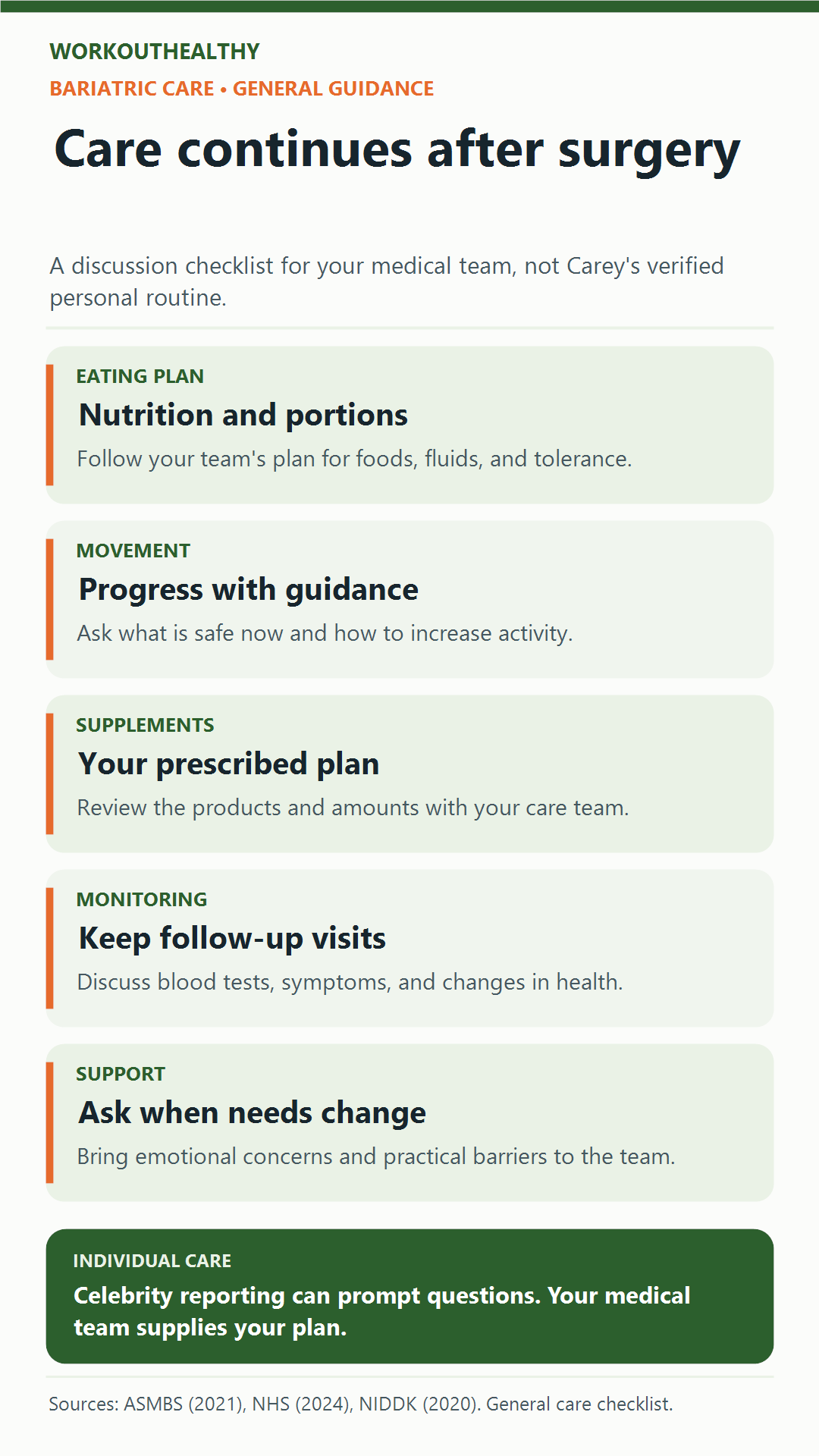
Maintenance includes getting appropriate support. Changing the plan with your medical team can be part of continuing care.
Responding when health needs change
NIDDK describes potential complications after bariatric surgery, including nutrient deficiencies, gallstones, and narrowing that can cause eating or swallowing difficulties (NIDDK, 2020b).
These concerns are reasons to keep the clinical connection active, rather than assume a smaller body proves that every health issue is resolved.
If symptoms develop, follow your team’s instructions for seeking care.
A change in weight is also a reason for a conversation, rather than a verdict on someone’s character.
ASMBS notes that long-term care may include medication, lifestyle support, or further surgery when appropriate (ASMBS, 2021).
Which option makes sense requires an individual assessment.
For your next visit, describe what has changed instead of trying to supply your own diagnosis.
Bring a list of symptoms, food tolerances, medication changes, and practical barriers you want to discuss.
A clear account of the problem can help your team decide what to investigate and how to support you.
Reading celebrity health headlines carefully
Start with the source of the information.
Was the statement made by the person, supplied by a named representative, or attributed to unnamed sources?
Next, separate a historical report from a current routine.
An account from 2017 does not tell you which activities or treatments someone uses years later.
Finally, look for the type of outcome being claimed.
A photograph shows appearance at one moment; it cannot establish blood-test results, complications, nutrition status, or the cause of a change.
Apply the same care to illustrations, including this article’s walking scene.
The image communicates the topic and supplies no evidence about Carey’s medical history.
You can keep the part of a story that prompts a useful question without adopting every implied explanation.
For example, ask what long-term care involves rather than which celebrity routine you should reproduce.
That is a question a health professional can help answer for you.
Questions for your medical team
Use the story as a prompt to make your own care plan clearer.
Choose the questions that fit your circumstances, and take them to the clinician who knows your history.
- Eating: What food textures, portions, and nutrition goals apply at my stage, and what should I do if I struggle to follow them?
- Activity: What movement is appropriate now, how should I progress, and which restrictions still apply?
- Supplements: Which products, doses, and forms do I need, and when should the plan be reviewed?
- Monitoring: Which appointments and tests are due, and who is responsible for coordinating them?
- Problems: Which symptoms need urgent attention, and how do I contact the team between visits?
- Support: What options are available if cost, confidence, emotional concerns, or daily logistics are making the plan difficult?
Keep the answers somewhere you can find them again.
A list of instructions is more useful when you also know who to contact if those instructions stop working for your circumstances.
The strongest takeaway from Carey’s surgery reports is a question about long-term health, rather than a verified formula from her private life.
For people who undergo bariatric surgery, that question belongs within ongoing, individualized care.
Want more like this? Subscribe to WorkoutHealthy Insider for careful explanations of celebrity fitness stories and the evidence behind everyday health choices.
References
American Society for Metabolic and Bariatric Surgery. (2021, February). Life after bariatric surgery. https://asmbs.org/patients/life-after-bariatric-surgery/
National Institute of Diabetes and Digestive and Kidney Diseases. (2020a, September). Types of weight-loss surgery. https://www.niddk.nih.gov/health-information/weight-management/bariatric-surgery/types
National Institute of Diabetes and Digestive and Kidney Diseases. (2020b, September). Weight-loss surgery side effects. https://www.niddk.nih.gov/health-information/weight-management/bariatric-surgery/side-effects
NHS. (2024, February 5). Recovering from weight loss surgery. https://www.nhs.uk/tests-and-treatments/weight-loss-surgery/recovering/
Salminen, P., Grönroos, S., Helmiö, M., Hurme, S., Juuti, A., Juusela, R., Peromaa-Haavisto, P., Leivonen, M., Nuutila, P., & Ovaska, J. (2022). Effect of laparoscopic sleeve gastrectomy vs Roux-en-Y gastric bypass on weight loss, comorbidities, and reflux at 10 years in adult patients with obesity: The SLEEVEPASS randomized clinical trial. JAMA Surgery, 157(8), 656-666. https://doi.org/10.1001/jamasurg.2022.2229
Smith, E. (2017, November 6). Body shamers spur Mariah Carey to have weight-loss surgery. Page Six. https://pagesix.com/2017/11/06/body-shamers-spur-mariah-carey-to-have-weight-loss-surgery/
General information: This article is not medical advice. Surgery, nutrition, supplements, medication, and postoperative exercise require guidance from qualified clinicians who know your medical history.