
Chronic stress and immunity have a more complicated relationship than the familiar image of a weakened defense system.
A 2012 study linked prolonged threatening experiences with reduced sensitivity to cortisol’s regulatory signals and a greater chance of developing a cold after viral exposure.
The useful idea is regulation: an immune response can become less well controlled, rather than simply switching off.
That finding deserves careful explanation, especially when a social post turns it into a warning about every stressful day.
It also needs a practical endpoint that does not make people anxious about being anxious.
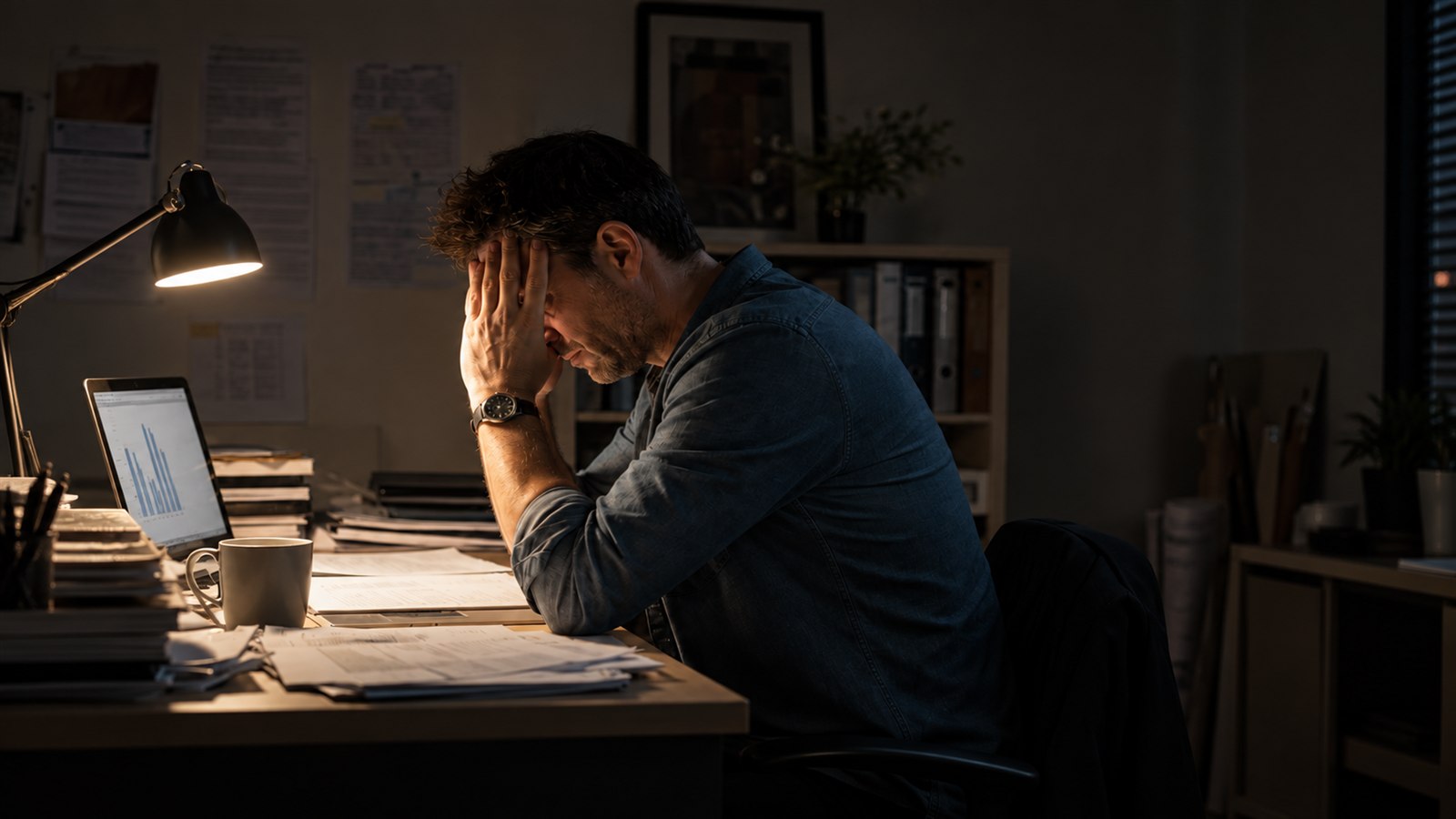
The featured desk scene is an AI illustration, not a photograph of a study participant or a diagnostic image.
Immunity needs regulation
Inflammation is part of the body’s response to infection, but keeping that response appropriately controlled matters too.
Carnegie Mellon’s explanation of the research describes cortisol as one of the signals that helps regulate inflammation (Carnegie Mellon University, 2012).
If cells become less sensitive to that signal, a stronger local inflammatory response can accompany more symptoms.
Thinking in terms of a control system is more useful than imagining that every immune function becomes uniformly weaker.
That distinction changes how we read a health headline.
More inflammatory activity does not automatically mean better protection, and less activity does not automatically mean a healthier response.
The location, timing, and purpose of the response matter.
For readers, the first question should therefore be what outcome researchers measured.
A study of cold symptoms, a wound-healing experiment, and a blood test answer different questions.
They cannot be combined into one personal score for the strength of your immunity.
This is a framework for interpreting evidence, rather than a reason to monitor every sensation after a difficult meeting.
What the cold studies measured
Cohen et al. (2012) assessed stress and biological measures in 276 healthy adults before exposing them to a rhinovirus and following them for five days.
Long-term threatening experiences were associated with a marker of reduced glucocorticoid sensitivity, which predicted a higher risk of developing a clinical cold.
The first marker was indirect, based on relationships between cortisol and circulating immune cells.
A second study of 79 adults used a laboratory assay of cells’ sensitivity to dexamethasone, a glucocorticoid medication.
Lower sensitivity predicted greater local inflammatory signaling after viral exposure, particularly for IL-6 and TNF-alpha.
This sequence matters because stress and sensitivity were assessed before the illness outcomes.
It supports the proposed mechanism, but participants were not randomly assigned to years of stressful living.
The design cannot establish that stress alone caused every later cold.
Nor does a controlled virus challenge recreate every infection or every person’s health circumstances.
Use the finding to understand a plausible pathway, while keeping its measured outcome in view.
What cortisol resistance means
The phrase “cells stop listening” is a metaphor for reduced responsiveness, rather than a claim that cells suddenly lose every function.
The university’s account explains that diminished sensitivity may leave cortisol less able to restrain an inflammatory response to a virus (Carnegie Mellon University, 2012).
It describes cold symptoms as partly arising from that inflammatory response.
The social image’s message is therefore about an altered response to a regulatory signal.
It should not be read as evidence that a stressed person has no working defenses.
It also does not supply a home diagnostic test.
Feeling tense at a desk cannot tell you whether a particular cellular pathway is resistant to a hormone.
A claim about a biological mechanism needs the study’s measurements, rather than an inference from mood or appearance.
That is the helpful boundary around the metaphor.
It can explain why simple “boost your immune system” language misses the issue without becoming another label to assign yourself.
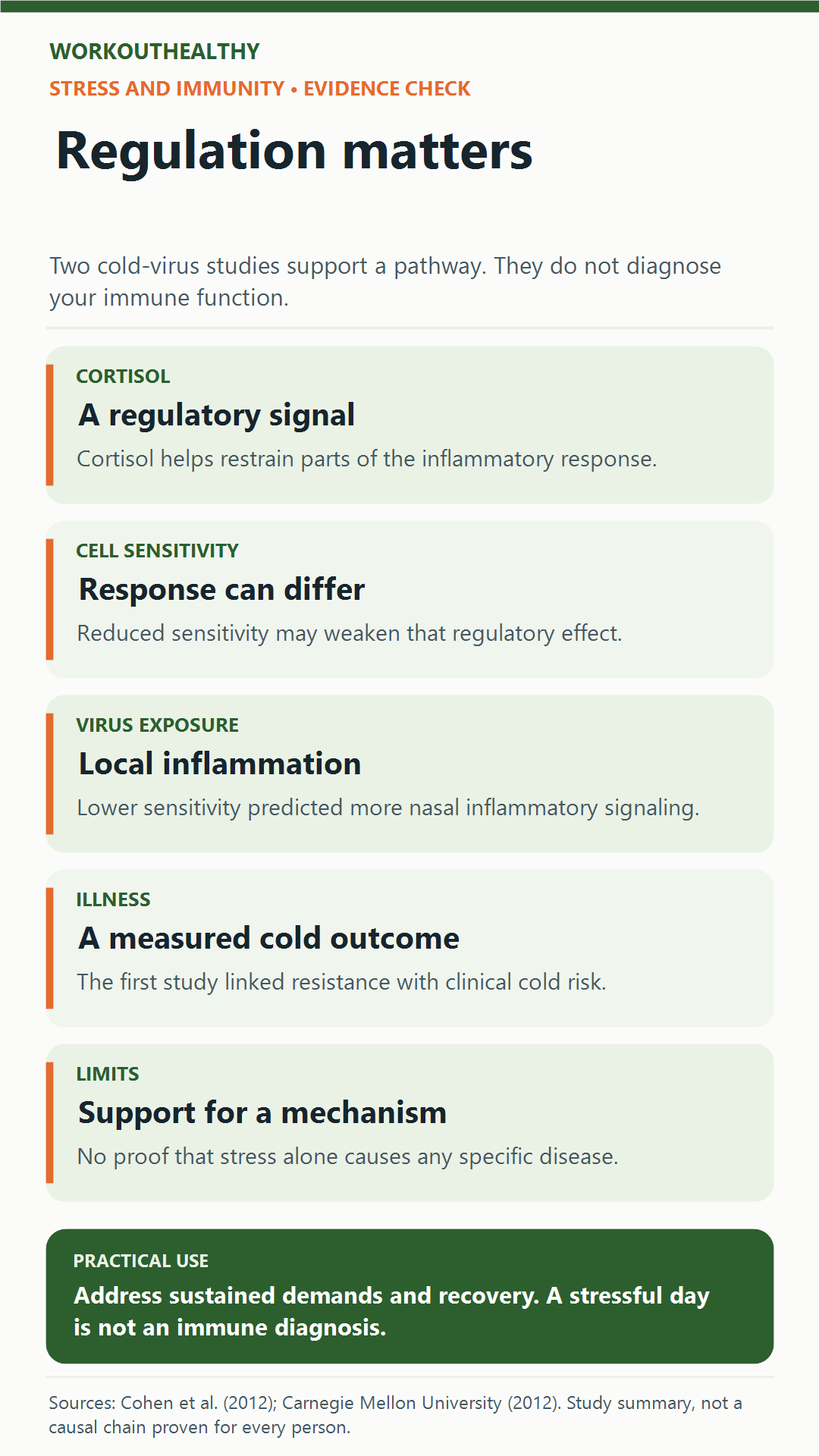
A useful immune response needs coordination. A bigger response is not automatically a better response.
Short and sustained stress differ
Dhabhar’s review separates brief stress responses from prolonged stress and explains why their immune effects can differ (Dhabhar, 2014).
Short-term stress can redistribute immune cells and enhance some responses when its timing matches immune activation.
Longer-lasting stress can suppress or dysregulate other responses, including inflammatory control.
The review also distinguishes protective responses from harmful or poorly regulated ones.
This does not make acute stress universally beneficial or turn chronic stress into a diagnosis with one fixed duration.
It means that “stress affects immunity” needs context about the stressor, timing, person, and biological outcome.
A demanding workout and a persistent unsafe situation are not interchangeable just because both involve stress.
Likewise, one difficult afternoon is not evidence that the cold-study mechanism has developed in your body.
A reasonable response is to make room for recovery and address sustained demands where possible.
Trying to eliminate every normal stress response would set an unrealistic goal.
The more useful goal is a daily routine that remains workable when life is demanding.
The wound-healing finding needs its own context
Marucha et al. (1998) studied 11 dental students, each receiving a small standardized wound on the palate during vacation and another before examinations.
Healing took about three days longer during exams, an average increase of 40 percent in the time needed for those particular wounds.
The order was not randomized, and the sample was small.
This supports concern about stress and healing while limiting how broadly the number can be applied.
“Forty percent longer to heal” is also the accurate description of the result.
It is not a universal estimate of how much slower every wound heals in every stressed person.
The study examined a different outcome from the cold-virus research and should be presented separately.
If you are recovering from a procedure, ask your clinical team how to manage the actual demands around your recovery.
A practical discussion about appointments, work, caregiving, and help at home is more useful than trying to calculate your personal healing delay from a stress rating.
What this evidence cannot tell you
These findings do not mean that becoming ill proves someone managed stress badly.
They also do not show that a breathing exercise reverses glucocorticoid resistance or prevents a cold.
A proposed mechanism and a treatment claim require different evidence.
The distinction matters when a product or program promises to repair immunity by lowering stress.
Ask whether it was tested against the outcome being advertised, rather than whether its explanation sounds biologically plausible.
Keep specific claims separate as well.
Our article on social media, stress, and immunity explains why a multitasking study cannot establish an immune effect it never measured.
That is a useful comparison: evidence about long-term threatening experiences does not automatically validate every claim about phone use or busy workdays.
A careful reading can leave you with two reasonable ideas at once.
Persistent stress deserves attention, and the explanation for an individual illness still requires appropriate medical assessment.
The research is information to use, rather than a verdict about your personal health.
Build a manageable recovery plan
Start by identifying one demand that can actually change.
That might mean discussing a deadline, sharing a caregiving task, clarifying expectations, or asking for help with a recurring problem.
Then choose one small recovery practice that fits around the demands you cannot immediately remove.
NCCIH describes relaxation approaches such as progressive muscle relaxation, guided imagery, and breathing exercises, while noting that evidence differs by condition (NCCIH, 2021).
Choose a practice you find tolerable and repeatable.
If slow breathing feels useful, try a comfortable brief practice without forcing deep breaths or difficult breath holds.
Our box-breathing guide explains the technique and its limitations.
If breath-focused practice makes you uncomfortable, another relaxation method may fit better.
You can also make the plan concrete with a time, place, and fallback.
For example, plan a quiet transition after work and decide what a shorter version looks like on a demanding day.
These are planning examples, not interventions proven to alter the cellular pathway in the cold study.
They aim to make daily recovery easier to carry out.
NCCIH cautions against using relaxation techniques to replace conventional care or postpone an assessment for a medical problem.
Track daily function without making illness the score
Give your plan a simple review point.
After a week, look at whether the practice happened and whether it helped the part of the day you wanted to improve.
You might record how easily you settled after work, whether you protected a planned break, and which demands kept interrupting the plan.
These observations can help you adjust the routine.
They cannot diagnose immune dysfunction or prove that a hormonal pathway has changed.
Use a small amount of tracking so the record itself does not become another obligation.
A short note is enough: what was difficult, what helped, and what needs a different approach?
If the barrier is practical, respond to the barrier.
A quieter room, a clearer work agreement, or help from another person may be more relevant than adding a longer relaxation session.
Judge the experiment by daily function and how workable it feels.
A cold that arrives during that week is not proof that the plan failed, and avoiding a cold is not proof that it repaired immunity.
Measure whether your recovery plan helps daily life. Illness is not a report card for how well you handled stress.
When to bring in more support
Ask for professional help when stress remains difficult to manage or interferes with daily responsibilities.
NCCIH emphasizes that complementary approaches can be part of care, with benefits and limitations that should be discussed with health professionals (NCCIH, 2024).
Bring a concrete account of what is happening rather than a self-diagnosis of cortisol resistance.
Useful details include the demands you face, how long the problem has lasted, and which parts of daily life have become harder.
You can also explain what you have tried and what made it difficult to continue.
Ask what support or assessment fits your situation, and how to follow up if the first plan is not enough.
The research does not require you to solve every source of stress before you deserve care.
Its practical message is to take sustained demands seriously while keeping individual health decisions grounded in appropriate assessment.
Understanding inflammation can improve the way you read a headline.
A manageable plan and suitable support can improve the way you respond to the demands in front of you.
Get the next evidence check.
Five practical fitness stories worth your time, every Friday.
One email a week. No product pitches. Unsubscribe in one click.
References
Carnegie Mellon University. (2012, April 2). How stress influences disease: Carnegie Mellon study reveals inflammation as the culprit. https://www.cmu.edu/news/stories/archives/2012/april/april2_stressdisease.html
Cohen, S., Janicki-Deverts, D., Doyle, W. J., Miller, G. E., Frank, E., Rabin, B. S., & Turner, R. B. (2012). Chronic stress, glucocorticoid receptor resistance, inflammation, and disease risk. Proceedings of the National Academy of Sciences, 109(16), 5995-5999. https://doi.org/10.1073/pnas.1118355109
Dhabhar, F. S. (2014). Effects of stress on immune function: The good, the bad, and the beautiful. Immunologic Research, 58(2-3), 193-210. https://doi.org/10.1007/s12026-014-8517-0
Marucha, P. T., Kiecolt-Glaser, J. K., & Favagehi, M. (1998). Mucosal wound healing is impaired by examination stress. Psychosomatic Medicine, 60(3), 362-365. https://doi.org/10.1097/00006842-199805000-00025
National Center for Complementary and Integrative Health. (2021, June). Relaxation techniques: What you need to know. https://www.nccih.nih.gov/health/relaxation-techniques-what-you-need-to-know
National Center for Complementary and Integrative Health. (2024, January). Mind and body approaches for stress and anxiety. https://www.nccih.nih.gov/health/providers/digest/mind-and-body-approaches-for-stress
General information: This article is not medical advice. Persistent stress, symptoms, and health concerns should be discussed with qualified professionals who can assess your individual circumstances.