
Hugh Jackman’s Wolverine preparation is best understood as a series of demanding projects, rather than one diet that explains a physique.
His published accounts mention resistance training, organized food and an eating window. They also describe a support team and filming conditions that differ from everyday fitness.
The useful lesson is sustained preparation with a workable plan; the public record does not prove that fasting caused his muscle gains.
Illustration note: The featured image is a 3D illustration derived from the selected Facebook creative. It does not show an actual training session, and Jackman is not affiliated with or endorsing WorkoutHealthy.
A long role, several preparation phases
Jackman first appeared as Wolverine in 2000’s X-Men and returned in 2024’s Deadpool & Wolverine, a span of 24 years (Yu, 2024).
A phrase such as nearly two decades can fit an earlier point in that career, but it does not describe the entire 2000-to-2024 interval.
The dates matter because training stories are often circulated long after the interview that produced them.
An archived TRAIN interview discusses Logan-era preparation; its webpage carries a September 2021 publication timestamp (TRAIN, 2021).
It is a historical account, not verification of his current routine.
Nor does it show that he maintained the same appearance or schedule between every production.
Preparation for a particular role has a start, a target and constraints. A long career can contain several such phases without being one continuous peak.
For a reader, the first question is therefore which phase an account describes.
A routine reported during one production should not silently become a lifetime prescription or a claim about what someone does today.
That distinction also makes the story more useful: planning can change as the job, time available and training history change.
The lifting principle behind the spectacle
In TRAIN’s interview, Jackman described progressive loading and familiar exercises including squats, deadlifts, presses and pull-ups (TRAIN, 2021).
That supports the caption’s broad reference to lifting. It does not provide a verified log of every workout or isolate which exercise created which visible result.
A named movement is only one part of a training plan.
The amount of work, load, effort, recovery and consistency affect what the plan asks of a person.
ACSM’s 2026 resistance-training guidance emphasizes regular practice, matching the plan to the goal and options that fit the individual (American College of Sports Medicine [ACSM], 2026).
It also recognizes home training, bands and bodyweight work as useful choices.
The inference for an everyday reader is that the principle can transfer without copying a celebrity’s loads.
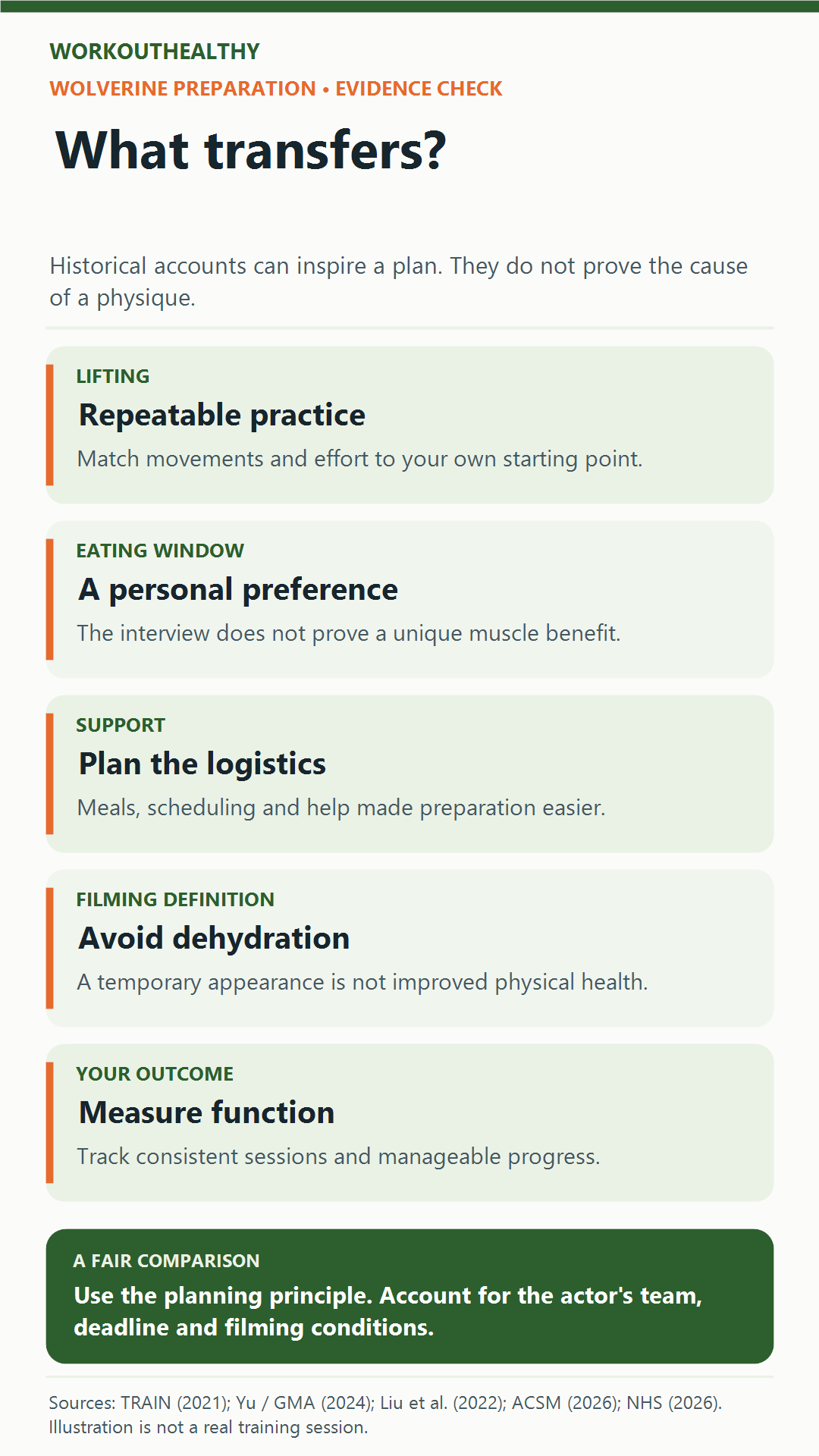
Choose movements you can perform well, repeat them and make a manageable change when the current task becomes easier.
A heavy-looking image supplies no reliable starting weight for another person.
Someone returning after a break may need a much smaller demand than an experienced performer preparing for a role.
Our five fitness basics for stalled progress explain how to judge the plan through repeatable work and recovery.
A repeatable training plan offers more useful information than a single impressive frame.
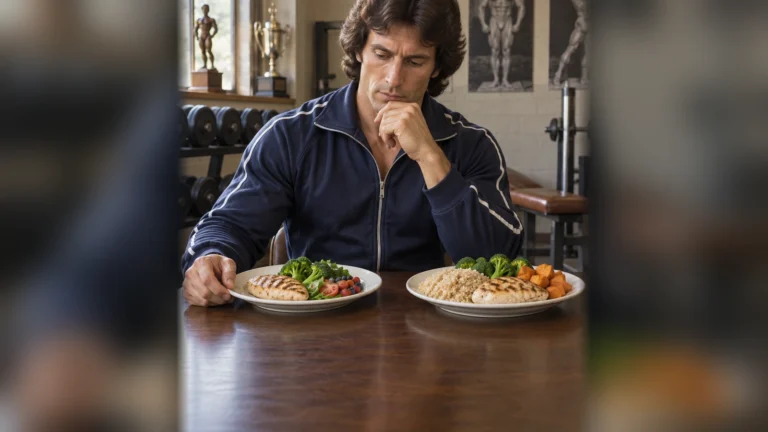
An eating window is not proof of a muscle advantage
Jackman told TRAIN that a sixteen-hour fast and eight-hour eating window suited him during the period being discussed (TRAIN, 2021).
That is a personal preference described in an interview, not an experiment identifying the cause of his physique.
Meal timing, total food, training and the production schedule were all present together.
Liu et al. (2022) randomized 139 adults with obesity to calorie restriction with an eight-hour eating window or calorie restriction alone for twelve months.
Weight loss did not differ significantly between the groups, and the added window did not establish an advantage in body fat or lean mass.
The participants were not actors building a Wolverine physique, so the trial cannot directly test Jackman’s approach.
It does, however, show why a famous person’s preference is not enough to establish that timing adds a unique effect.
An eating schedule can be a way to organize meals, yet that practical role differs from proving a muscle-building advantage.
Before adopting a schedule, consider whether it permits enough food for the activity you actually do and fits your work, family and medical needs.
People who need food with medication or have health concerns should discuss major dietary changes with their clinician.
There is no reason to turn a historical interview into a required fasting rule for everyone who lifts.
Food planning and the work behind the scenes
Jackman’s September 2024 public message credited an extensive team; Yu (2024) reported his thanks to trainers, meal preparation staff and production colleagues.
He described help organizing food and managing the demands of filming, rather than presenting his appearance as the work of one secret method.
That context changes a fair comparison.
A reader shopping, cooking, working and arranging childcare is solving a different logistical problem from someone whose training is part of a production.
The planning principle can still be useful.
Make the next session easy to start: identify a time, prepare what you need and know which part of the plan is flexible.
For food, a realistic plan can focus on meals you can obtain and enjoy regularly instead of an actor’s reported menu.
These are organizational choices, not claims that one shopping list reproduces another person’s body.
Support need not mean a large team. A calendar, a training partner or a few planned meals can reduce the decisions required on a busy day.
Ask which obstacle repeatedly interrupts the habit, then address that obstacle directly.
Our evidence review of fitness supplements offers a related reminder to judge an extra product by the problem it actually solves.
Screen definition is a different outcome
Yu (2024) also reported Jackman’s acknowledgement of filming days when he was not drinking enough water.
The accessible account does not establish a precise medical monitoring protocol for every such day.
An article should not use a phrase such as professionally monitored to imply a verified guarantee of safety.
Reducing body water for visible definition changes a short-term appearance. It is not evidence of new muscle or better physical health.
NHS guidance defines dehydration as losing more fluid than you take in and notes that it can become serious (NHS, 2026).
Thirst, dark urine, dizziness and fatigue are among the symptoms it lists.
This story therefore provides no water-cut schedule, target or procedure.
The practical distinction is straightforward: compare training progress through repeatable performance and how well you function, rather than trying to reproduce a filming-day look.
Lighting, pose, makeup and image processing can further change what a viewer sees.
A visually sharp frame cannot tell you whether someone is well hydrated or whether their routine is suitable for you.
People with symptoms of dehydration should seek appropriate medical advice; severe confusion or difficulty breathing requires urgent help.
Preparing for a date versus maintaining a habit
A date on the calendar can give a training project direction, but the habits between dates determine whether the project is manageable.
An everyday plan may alternate between building a skill, maintaining what has been built and temporarily doing less when life is crowded.
Those phases do not need to be dramatic.
A maintenance week might mean keeping familiar movements in the schedule while reducing how much work is done.
A return phase might begin with easier sessions so that the person can assess how current capacity compares with the last training period.
These examples describe ways to organize effort; they are not a reconstruction of Jackman’s private schedule.
The evidence available here cannot tell us how his work, health or body composition changed between every film.
It supports a more modest reading: preparation was repeated, and the resources and approaches discussed across time were not identical.
ACSM guidance likewise encourages a plan matched to goals and circumstances rather than treating complexity as a requirement (ACSM, 2026).
That leaves room for adapting the routine without treating a changed plan as a failure.
Consistency can mean returning to a workable structure after disruption, not demanding the same workload every week for decades.
A deadline can organize preparation; a realistic routine helps you keep returning after the deadline.
A useful goal does not need a film deadline
Start by writing down a result that can be checked without comparing your appearance with a movie still.
It could be completing the sessions you intended, improving a familiar movement or feeling more capable during a normal task.
Then separate the goal from the process.
The goal says what you hope changes. The process says what you will do this week and how you will know it was completed.
Keep the process small enough to repeat before adding more demands.
If a session is often skipped because it takes too long, a shorter version may be a better starting structure.
If a movement is uncomfortable, changing the movement or getting qualified advice is more useful than forcing it because a celebrity reportedly used it.
Review a few concrete observations: the sessions completed, the effort required and whether the next day was manageable.
These observations help you decide whether the plan fits, rather than promising a particular physique by a particular date.
Jackman’s separate invisible pull-up challenge illustrates another limit of a social clip: an impressive movement is not a complete training prescription.
Treat inspiration as a prompt to organize your own practice, not as proof that your schedule, diet or body should resemble someone else’s.
How to read this story and its image
The scheduled social image is a 3D illustration of Jackman lifting, with a small portrait inset and a headline about Wolverine preparation.
The article hero removes the social headline and inset while keeping continuity with that illustrated scene.
It is not evidence of a particular load, date or real session.
The sources do different jobs: the interview describes historical experience, reporting adds context, and research tests narrower questions in defined populations.
Keeping those jobs distinct prevents a celebrity story from becoming an unsupported health claim.
An actor’s successful transformation does not show which of several simultaneous choices caused the outcome.
Similarly, a study of adults with obesity does not establish a superhero muscle-building program.
The strongest useful conclusion is also the least theatrical: choose a plan you can follow, arrange the support it needs and evaluate it through outcomes that matter in your own life.
That respects the work behind the role while giving an everyday reader a fairer and more actionable comparison.
Get the next evidence check.
Five practical fitness stories worth your time, every Friday.
One email a week. No product pitches. Unsubscribe in one click.
References
American College of Sports Medicine. (2026). 5 things to know about creating an effective resistance training plan. https://www.acsm.org/wp-content/uploads/2026/03/Resistance-Training-Position-Stand-infographic.pdf
Liu, D., Huang, Y., Huang, C., Yang, S., Wei, X., Zhang, P., Guo, D., Lin, J., Xu, B., Li, C., He, H., He, J., Liu, S., Shi, L., Xue, Y., & Zhang, H. (2022). Calorie restriction with or without time-restricted eating in weight loss. New England Journal of Medicine, 386(16), 1495-1504. https://doi.org/10.1056/NEJMoa2114833
NHS. (2026, May 1). Dehydration. https://www.nhs.uk/conditions/dehydration/
TRAIN. (2021, September 24). Hugh Jackman workout and nutrition tips: Interview with the master. https://www.trainmag.com/fitness/hugh-jackman-workout-nutrition-tips-interview-master/
Yu, Y.-J. (2024, September 5). Hugh Jackman reveals how he got fit to play Wolverine again. Good Morning America. https://www.goodmorningamerica.com/news/story/hugh-jackman-team-helped-transform-wolverine-113413987
Medical disclaimer: This article is for general information only and is not medical advice. If you have an injury, ongoing pain, or a medical condition, talk to a doctor or physical therapist before you change how you train or eat.