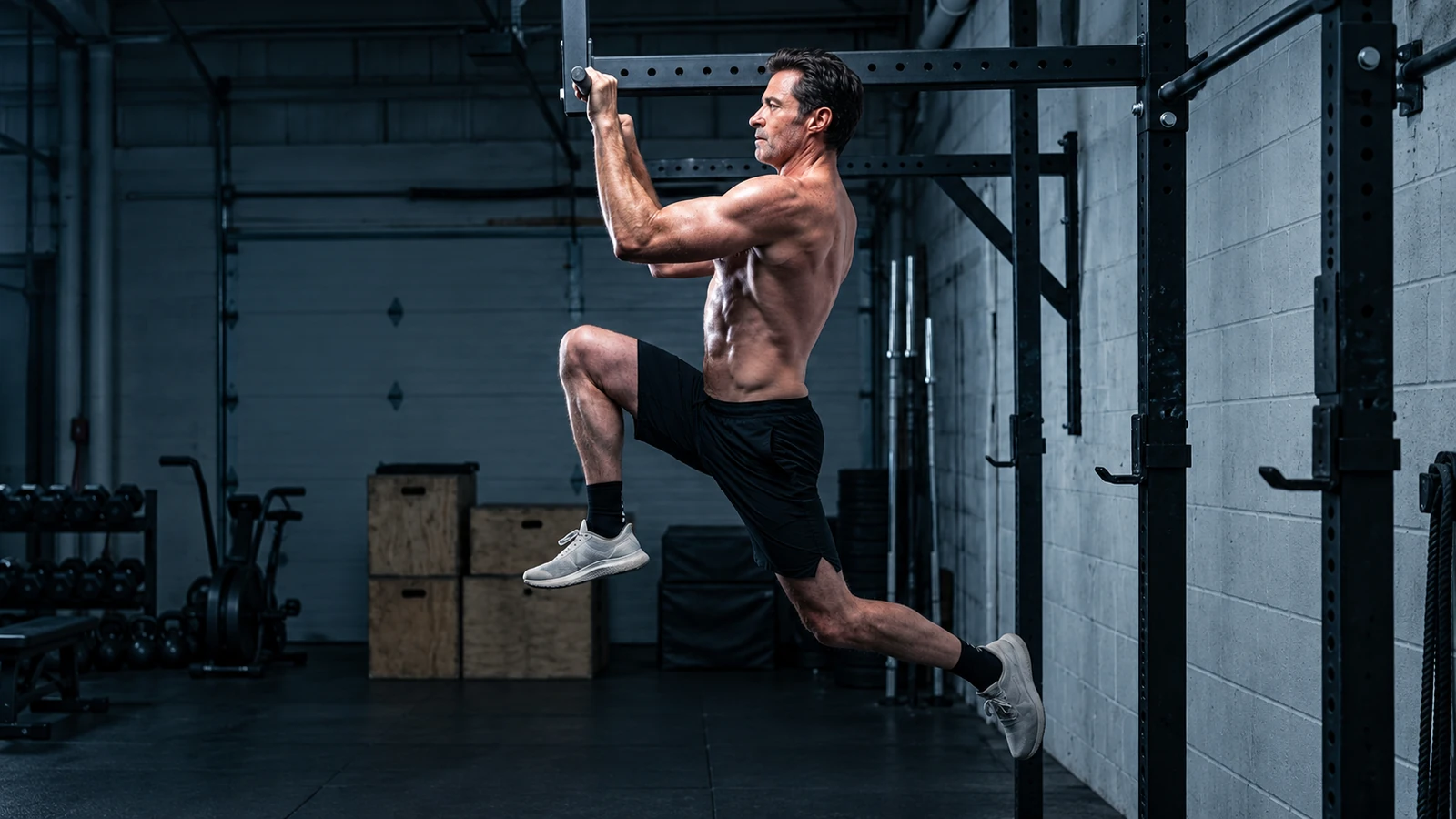

Hugh Jackman’s invisible pull-up, also called a staircase pull-up, is a striking demonstration of control. In his March 13, 2026 Instagram post, Jackman credits another challenge from trainer Beth Lewis and describes it as difficult (Jackman, 2026).
The clip shows a staged bodyweight pull with alternating leg movements. It gives us something specific to discuss: what the challenge demands, how a person might approach related practice, and what repetition speed research can actually tell us.
The article’s hero is an editorial illustration matched to the scheduled Facebook creative. It is not a still from the original clip, in which Jackman wears a dark shirt. The original video is linked below so that readers can distinguish the illustration from the documented performance.
What the Video Actually Shows
Jackman starts from a hang, raises one knee as though placing a foot on an invisible stair, and pulls his body upward in small stages. He alternates the legs while continuing the pull, clears the bar, then reverses the stepping pattern during a controlled descent. Felstead (2026) also describes that staged ascent and lowering.
Dabbs (2026) estimates each repetition at around 15 seconds, with close to 10 seconds spent ascending. That is a report about the performance, not a prescribed tempo or a laboratory measurement. The original March 13 reel provides the direct context.
The stepping motion is partly theater, but it adds a coordination demand because the legs move without a real surface providing support. The arms and upper body still produce the force that raises him against gravity.
Calling it an ultimate test would go too far because fitness has many qualities. The challenge demonstrates pull-up strength, grip, trunk control, coordination, and tolerance for a prolonged repetition, but it does not measure lower-body strength, aerobic fitness, speed, or every other form of function.
Strict Pull-Ups and Control
The viral caption contrasts Jackman’s challenge with a standard pull-up and says momentum does part of the work in the regular exercise. That can happen during a kipping pull-up or a poorly controlled repetition, but it is not a required feature of a strict pull-up.
A strict repetition can begin from a stable hang, use controlled shoulder-blade movement, and continue until the chin clears the bar without a leg swing. The descent can also be controlled until the elbows return to a comfortable extended position.
Moving faster does not automatically mean cheating because a trained athlete can intentionally accelerate while keeping the body organized. Power training depends on producing force quickly, while a slower tempo emphasizes a different skill and usually reduces the load or repetitions a person can complete.
Jackman’s variation makes sense as an advanced challenge after strict pull-ups are already established. It is a poor starting point for someone who cannot yet hold a comfortable hang or control the lowering phase.
What Time Under Tension Really Means
Time under tension is simply the time a muscle spends producing force during a repetition or set. A slow staircase pull-up increases that time within one repetition, especially when the athlete pauses at several positions.
A 2015 review of eight studies found similar hypertrophy outcomes across repetition durations of 0.5 to 8 seconds in training taken to failure. Its findings suggested that deliberately very slow repetitions exceeding 10 seconds might be less favorable, but the authors emphasized the lack of controlled research on that extreme tempo (Schoenfeld et al., 2015).
The video can be interesting as a display of skill or variety. A single performance cannot establish which tempo produces the greatest muscle growth over a training program.
A longer repetition is a change in the task, not a measurement of how much muscle it will build.
Total challenging work, range of motion, exercise selection, progression, and recovery all influence adaptation. A long single repetition can feel intense while providing less total productive work than several strong controlled repetitions.
The same principle appears in our explanation of low repetitions versus high repetitions. Muscle can grow across a broad loading range when effort and programming are appropriate, while heavier practice remains especially useful for maximal strength.
Coordinating the Trunk and Legs
The trunk helps limit unwanted swinging and transfers force between the upper and lower body. In Jackman’s video, the alternating leg action changes the distribution of mass, so the abdominal wall, hip flexors, spinal stabilizers, and surrounding muscles must coordinate to keep the illusion clean.
A cue such as brace the core can help, but describing the torso as a vice may encourage unnecessary breath holding and stiffness. The useful amount of tension is the amount that keeps the movement controlled without creating pain, dizziness, or a loss of position.
The lats, biceps, brachialis, forearms, and upper-back muscles remain major contributors to the pull. The shoulder complex must also tolerate the overhead hang, which is why existing shoulder pain or limited range deserves more care than a viral challenge usually mentions.
Our planche lean progression uses the same broader idea: advanced bodyweight skills should be built from positions a person can already own. Control grows through scaled practice, not through an all-or-nothing attempt.
A Progression Toward the Staircase Pull-Up
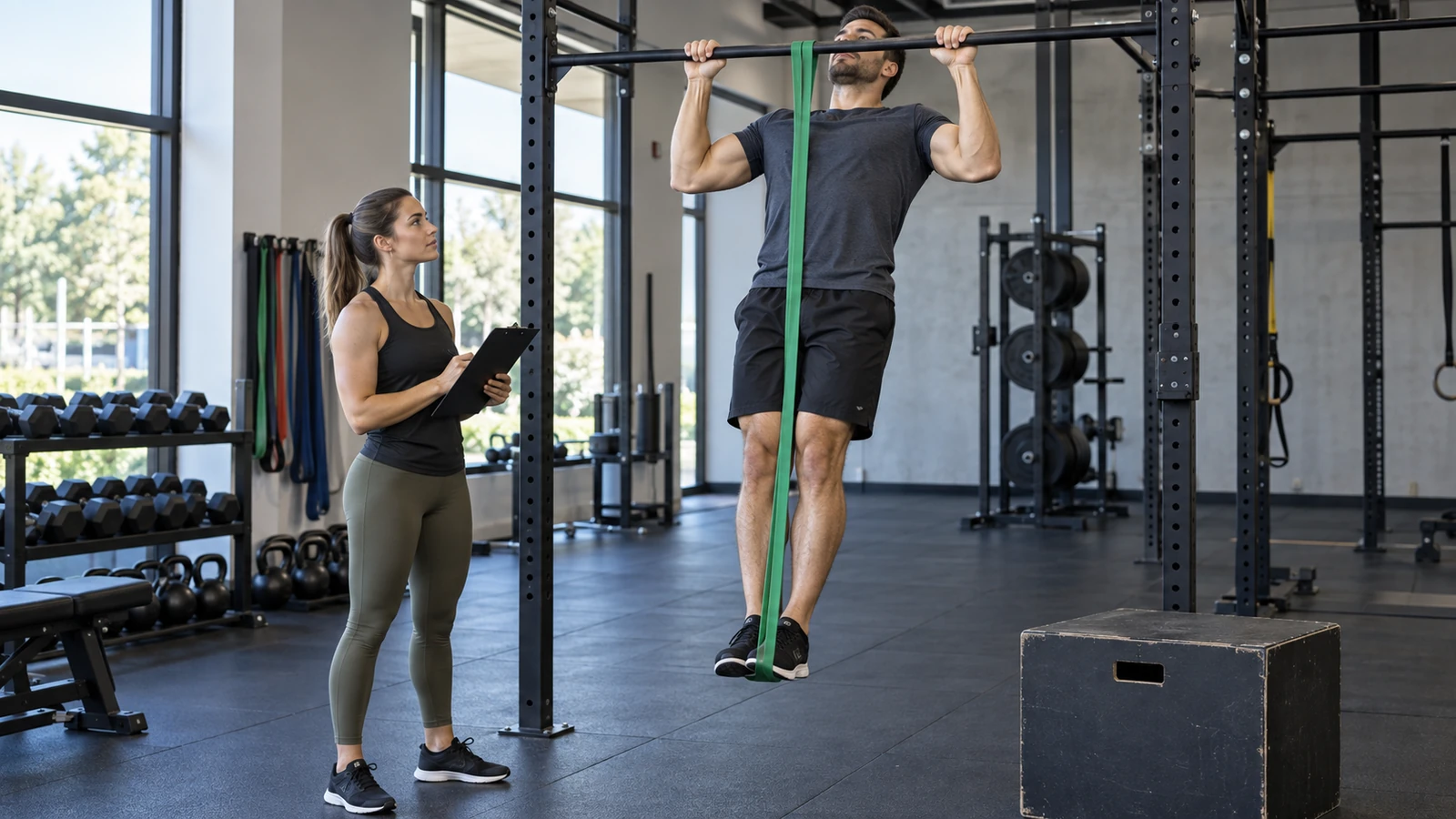
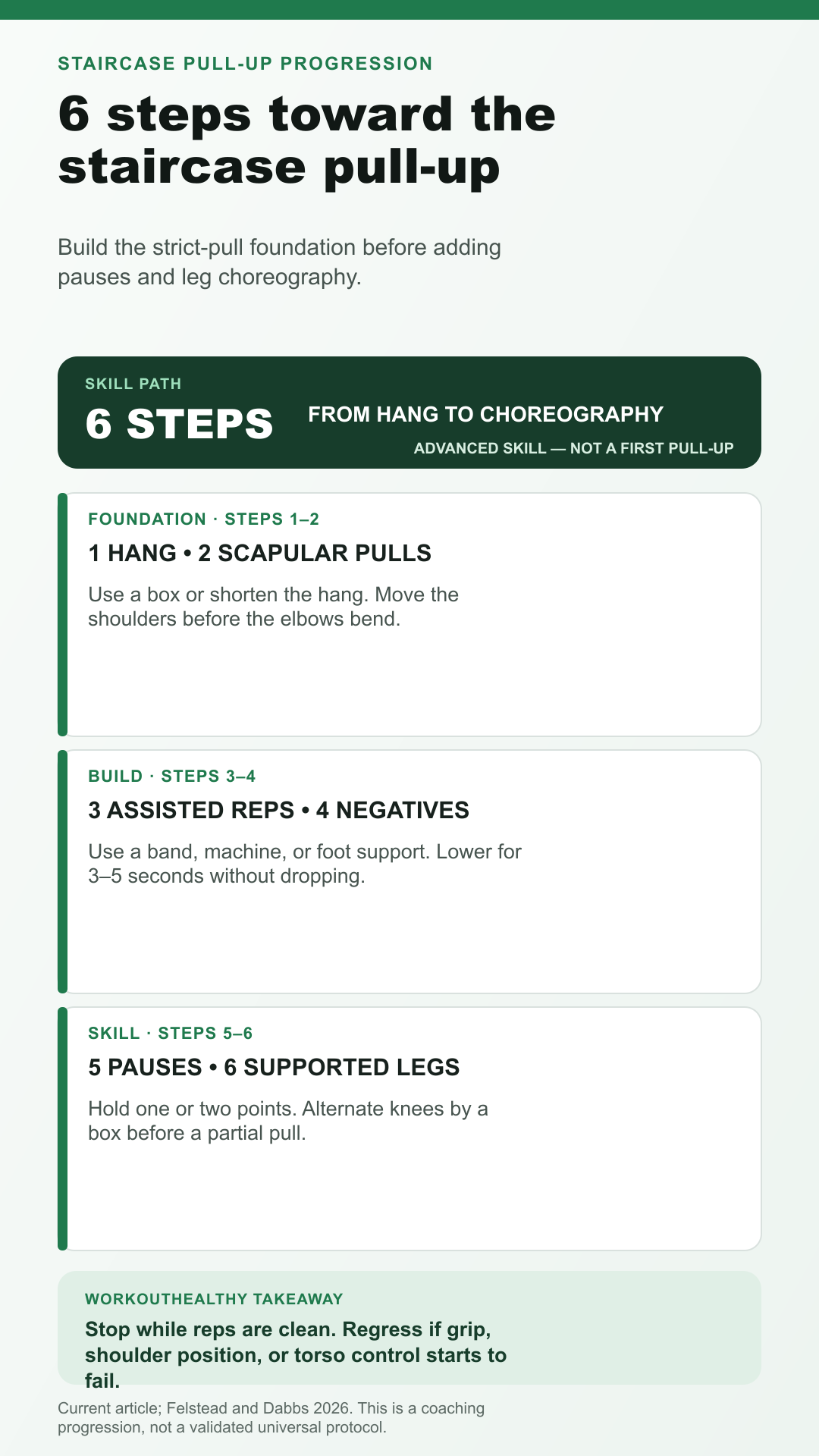
- Build a comfortable hang. Use a box for support or shorten the duration until the hands and shoulders tolerate the position.
- Practice scapular pulls. Move the shoulder blades without bending the elbows to learn the start of a controlled pull.
- Use assisted strict pull-ups. A machine, band, or foot support can provide enough help to keep the torso quiet.
- Control negatives. Step to the top and lower over three to five seconds without dropping into the bottom.
- Add pauses. Hold one or two positions during a strict repetition before attempting leg choreography.
- Rehearse the legs with support. Practice alternating knees while hanging with feet near a box, then combine the action with a partial pull.
This six-step outline is an editorial coaching progression, not Jackman’s confirmed training program or a validated universal protocol. Choose the starting exercise and any timing with a qualified coach, particularly if a supported hang or controlled lowering is unfamiliar. You can remain with an assisted version without needing to complete the staircase challenge.
Failure Is Not Required for Every Set
The challenge looks dramatic because it approaches the edge of Jackman’s current ability. Regular training does not need that level of struggle on every set.
Grgic et al. (2022) pooled 15 studies conducted in young adults and found no significant overall difference in strength or hypertrophy between failure and non-failure training. A trained-participant subgroup favored failure for hypertrophy; the authors called for more research in older and highly trained adults. The findings do not prescribe the same effort for every person or exercise.
ACSM’s 2026 guidance also reports that momentary failure did not consistently affect outcomes for the average healthy adult. It emphasizes regular participation and tailoring training to individual goals (American College of Sports Medicine, 2026).
Skill practice benefits especially from quality because the goal is to repeat the intended pattern. Once grip opens, the shoulders shrug uncontrollably, or the body swings, another attempt may reinforce the wrong movement and raise the chance of a fall.
Grip fatigue deserves special attention because the movement happens above the floor. Chalk can improve friction, but it does not replace sufficient hand strength, a sound bar, or a plan for stepping down safely before the fingers peel away.
Assistance is not a lesser version of the exercise. A resistance band, counterweighted machine, or foot-supported setup can keep the same pulling pattern challenging while reducing the body weight that must be moved, and assistance can be decreased as strength improves.
People who cannot comfortably hang can build the pattern with rows and pulldowns first. Those movements do not recreate every demand of a pull-up, but they allow progressive loading without forcing the shoulder into a position it cannot yet tolerate. Progress can be real even when it is less dramatic than Jackman’s reel.
Use a secure bar, clear the floor, and avoid an unstable stool beneath the athlete. Anyone with ongoing elbow, wrist, shoulder, or neck symptoms should choose a tolerable regression and get appropriate clinical guidance when needed.
A Simple Practice Review
Before adding a demanding variation, write down what you want the practice to accomplish. This is an editorial review framework, not a readiness test, injury screen or validated score.
- Name the goal. Decide whether you are practicing a strict pull-up, improving control at an assisted level, or exploring an advanced skill. A dramatic variation does not have to replace the goal you already have.
- Record the starting version. Note the equipment, assistance and movement you can repeat. If a coach recommends a different version, record that choice so later comparisons refer to the same task.
- Choose one change. Changing assistance, repetition count, pauses and leg motion together makes the result difficult to interpret. Discuss a manageable adjustment and keep the other details reasonably consistent.
- Describe what happened. Record the planned work, the work completed and why it stopped. Include any symptom or unexpected difficulty rather than treating it as an unimportant detail.
- Review before advancing. Ask whether the chosen version remained controlled and repeatable. Keep it, adapt it, or get advice about an unclear limitation. Completion of a challenging attempt alone does not prove that a harder version is the next useful step.
A hypothetical trainee might use the same assisted setup for several sessions and discover that control changes when they rush the descent. Their next decision could be to practice that descent with coaching, rather than adding leg choreography. The value of the record is the specific observation it makes possible.
There is no universal deadline attached to this review. It does not establish a promised rate of strength gain, and it does not authorize an attempt that your present ability or health makes inappropriate. It simply helps keep the practice connected to a clear purpose.
Keep the Challenge in Context
The verified reel shows that Hugh Jackman has maintained a high level of bodyweight pulling strength and motor control in his late fifties. It also shows the value of a coach choosing a novel test that is challenging for a specific athlete.
It does not prove that control is the only metric that matters, that normal pull-ups are explosive cheats, or that an extra-slow repetition creates denser tissue. Muscle density is not a separate training product that can be read from the speed of one rep.
The useful lesson is to build related skills from a level you can repeat, connect practice to your goal, and keep research claims separate from the appearance of a single performance. Jackman’s invisible staircase is entertaining because it combines pulling strength with a carefully controlled illusion.
Choose the next progression for the skill you are building, not for the drama of the clip.
Get the next evidence check.
Five practical fitness stories worth your time, every Friday.
One email a week. No product pitches. Unsubscribe in one click.
References
American College of Sports Medicine. (2026, March 17). ACSM unveils landmark 2026 resistance training guidelines: First update in 17 years. https://acsm.org/resistance-training-guidelines-update-2026/
Dabbs, R. (2026, March 23). Hugh Jackman, 57, shows elite upper-body strength with ‘staircase’ pull-ups: Here’s how to master them. Men’s Health, republished by Yahoo Life UK. https://uk.style.yahoo.com/hugh-jackman-57-shows-elite-122800116.html
Felstead, S. (2026, March 19). Hugh Jackman’s viral pull-up challenge is harder than it looks. Muscle & Fitness. Article and embedded original reel
Grgic, J., Schoenfeld, B. J., Orazem, J., & Sabol, F. (2022). Effects of resistance training performed to repetition failure or non-failure on muscular strength and hypertrophy: A systematic review and meta-analysis. Journal of Sport and Health Science, 11(2), 202-211. https://doi.org/10.1016/j.jshs.2021.01.007
Jackman, H. [@thehughjackman]. (2026, March 13). Another @bethlewisfit challenge [Video]. Instagram. https://www.instagram.com/reel/DV0n3XEkbJG/
Schoenfeld, B. J., Ogborn, D. I., & Krieger, J. W. (2015). Effect of repetition duration during resistance training on muscle hypertrophy: A systematic review and meta-analysis. Sports Medicine, 45(4), 577-585. https://doi.org/10.1007/s40279-015-0304-0
Medical disclaimer: This article is general product information, not medical advice. The equipment described here is not a treatment for any condition. If you have an injury, ongoing pain, or a medical condition, talk to a doctor or physical therapist before using any of it.