
Fitness supplements are not all useful for the same person or the same goal.
This guide checks the ten products in the accompanying Facebook post against human research and official nutrition guidance.
Some have direct performance evidence, while others deserve consideration only for a particular dietary gap, medical need or studied formulation.
The short answer
Creatine and caffeine have stronger direct performance evidence than most products here, although they serve different goals (Kreider et al., 2017; Guest et al., 2021).
Whey is useful when food does not supply enough protein conveniently (Jäger et al., 2017).
Electrolytes deserve an individual plan based on sweat losses and the session, rather than an automatic daily scoop (Sawka et al., 2007).
Treat the remaining products as conditional options: match the nutritional gap, specific outcome and person before deciding whether to buy.
These ten verdicts are an editorial synthesis of the sources below, not a head-to-head trial of ten finished products.
A supplement needs a specific job. An impressive ingredient list is not a reason to buy it.
1. Creatine monohydrate: the best all-around pick
Creatine monohydrate increases muscle creatine stores and supports repeated hard efforts and resistance-training adaptations (Kreider et al., 2017).
Government guidance describes 3 to 5 grams daily as a maintenance approach for adults (National Institutes of Health Office of Dietary Supplements [NIH ODS], n.d.).
An optional loading approach uses about 20 grams daily in divided doses for five to seven days; loading speeds saturation rather than being necessary (NIH ODS, n.d.).
These are published research approaches, not a personalized prescription.
Early weight gain can reflect water retention, and higher-priced creatine forms have not established an advantage over monohydrate (NIH ODS, n.d.).
Standard supplementation is generally well tolerated in healthy people (Kreider et al., 2017).
Discuss medical conditions, kidney disease and medications with your clinician before adding it.
Verdict: consider plain monohydrate if repeated hard efforts are part of your training, rather than buying a proprietary blend because the packaging looks more advanced.
2. Whey protein: convenient food, not a shortcut
Whey supplies all essential amino acids and plenty of leucine, making it a convenient high-quality protein source (Jäger et al., 2017).
The International Society of Sports Nutrition suggests about 1.4 to 2.0 grams of protein per kilogram daily for most healthy exercising adults (Jäger et al., 2017).
Our guide to how much protein people actually need explains why the total matters more than the logo on a tub.
Food can meet those needs; supplements mainly offer convenience when meals are difficult to organize (Jäger et al., 2017).
Before buying, write down a few typical days of eating and estimate whether a gap actually exists.
Then compare cost, tolerance and practicality with an ordinary protein-containing meal.
Verdict: useful when it closes a measured gap; an extra shake is not automatically necessary just because another person at the gym uses one.
3. Omega-3 fish oil: useful for some goals, not a recovery guarantee
EPA and DHA are long-chain omega-3 fats available from seafood and fish-oil or algal-oil supplements (NIH ODS, 2025a).
That nutritional role does not make every capsule a performance enhancer.
A review of athlete trials reported some favorable findings for reaction time, mood, selected cardiovascular measures and recovery markers (Lewis et al., 2020).
It found no clear effect on endurance performance, lung function, muscle force or training adaptation (Lewis et al., 2020).
Those results do not establish a recovery guarantee for every exerciser or every formulation.
Fatty fish can supply EPA and DHA, and supplement formulations vary substantially in their amounts (NIH ODS, 2025a).
Verdict: potentially useful for dietary coverage or a clinician-directed goal; check EPA plus DHA on the label rather than equating total fish-oil weight with the active amount.
4. Vitamin D3: correct a shortfall instead of guessing
Vitamin D supports calcium absorption, bone health, and normal muscle and nerve function (NIH ODS, 2022).
People with limited sun exposure, darker skin, or impaired fat absorption can have greater difficulty getting enough (NIH ODS, 2022).
Those biological roles alone do not establish a performance benefit from adding more when intake and status are already adequate.
Ask a clinician whether your circumstances warrant testing and how to interpret the result.
Very high supplemental intakes can raise blood calcium and cause harm, including kidney problems (NIH ODS, 2022).
Consider existing fortified foods and other supplements before adding another bottle.
Verdict: correct a real intake or status problem with appropriate guidance; avoid treating a high-dose capsule as a general solution for unexplained fatigue.
5. Magnesium: essential mineral, conditional supplement
Magnesium participates in energy production, nerve signaling, muscle function and many enzyme reactions (NIH ODS, 2026).
That makes adequate nutrition important; it does not by itself prove that extra magnesium improves performance or sleep in everyone.
Foods such as nuts, seeds, legumes, whole grains and leafy vegetables provide magnesium (NIH ODS, 2026).
Start by reviewing the diet rather than assuming that soreness after training demonstrates a deficiency.
Supplemental magnesium can cause diarrhea and can interfere with some antibiotics and other medications (NIH ODS, 2026).
The Supplement Facts panel lists elemental magnesium, which differs from the weight of the whole compound (NIH ODS, 2026).
Verdict: investigate dietary coverage and medical context before buying it for recovery; the form, dose and interaction check should be part of the decision.
6. Caffeine: effective, but the tradeoffs are real
Caffeine can improve several exercise outcomes, with the most consistent evidence in aerobic endurance and meaningful variation between individuals (Guest et al., 2021).
Common study doses are 3 to 6 milligrams per kilogram, often about 60 minutes before exercise, although lower doses can work (Guest et al., 2021).
This research range is not a recommendation to start at its upper end.
Our article on caffeine timing before a workout explains the practical timing questions.
Anxiety and sleep disruption are important tradeoffs, and very high doses increase side effects without being required for benefit (Guest et al., 2021).
Make one list covering coffee, pre-workout, gels, gum, energy drinks and pills so the decision uses total caffeine rather than separate allowances.
Verdict: an effective option for selected sessions when your dose, timing and tolerance fit; assess the next night’s sleep as well as the workout.
7. Electrolytes: situational hydration support
Exercise fluid replacement should account for considerable differences in sweat rate and sweat electrolyte content (Sawka et al., 2007).
Long sessions, heat and heavy sweating are reasons to assess your needs, rather than proof that everyone needs the same powder.
Electrolyte and carbohydrate drinks can outperform water alone in some circumstances, but the replacement plan should be individualized (Sawka et al., 2007).
A short indoor lift does not automatically justify a specialized drink.
Assess a mix’s carbohydrate and stimulant ingredients separately from its electrolyte label.
Body weight before and after comparable sessions can help estimate sweat losses; replacing a deficit also depends on how soon recovery is needed (Sawka et al., 2007).
Verdict: use it when the session and losses justify it; avoid translating a teammate’s scoop instruction into your own universal rule.
8. Probiotics: the strain is the product
Probiotics are live microorganisms with benefits that depend on the organism, strain and indication (NIH ODS, 2025b).
A result for one product cannot be transferred automatically to another blend.
A 2026 review of Lactiplantibacillus plantarum trials found strain-specific performance and recovery signals, alongside study-quality and generalizability limits (Yanyi et al., 2026).
The authors highlighted small studies and geographic concentration, which restrict confidence in broad athlete recommendations.
That is a reason to read the strain name and study population, not just the total number of organisms printed on the box.
People with serious underlying illness or compromised immunity need medical guidance because probiotic use requires particular caution (NIH ODS, 2025b).
Verdict: consider a strain with human evidence for the exact problem; a broad “gut health” claim does not establish better recovery or performance.
9. Collagen peptides: promising support, incomplete proof
A systematic review of 15 randomized trials found the clearest signals for joint function and pain, with some findings for body composition and recovery (Khatri et al., 2021).
The authors called for larger studies and more precise measurements, so the evidence supports qualified possibilities rather than guaranteed protection.
Collagen did not perform like higher-quality protein sources for muscle protein synthesis in that review (Khatri et al., 2021).
If muscle growth is your main goal, do not treat it as interchangeable with the high-quality protein discussed above.
A powder also cannot diagnose why a joint hurts or determine which rehabilitation exercises are appropriate.
Discuss persistent pain and a loading plan with a qualified clinician rather than using a supplement trial to delay that assessment.
Verdict: an optional adjunct for a specific joint or connective-tissue goal, with modest expectations and a defined exercise or rehabilitation context.
10. Multivitamin: backup for gaps, not a performance stack
A multivitamin can raise nutrient intake when diet alone is insufficient, including in some restricted diets or medical circumstances (NIH ODS, 2024).
Products vary widely because there is no standard regulatory definition of their nutrient combinations and amounts (NIH ODS, 2024).
Routine use has not reliably reduced cardiovascular disease or mortality, and evidence does not establish a universal chronic-disease prevention benefit (NIH ODS, 2024).
That is different from addressing a specific nutritional gap.
Combining multis, fortified foods and separate nutrient pills can produce excessive intakes of vitamin A, iron, zinc, niacin or other nutrients (NIH ODS, 2024).
Lay the labels side by side rather than judging each bottle in isolation.
Verdict: consider targeted dietary coverage with appropriate guidance; choose a product for an actual need rather than treating a longer ingredient list as proof of better nutrition.
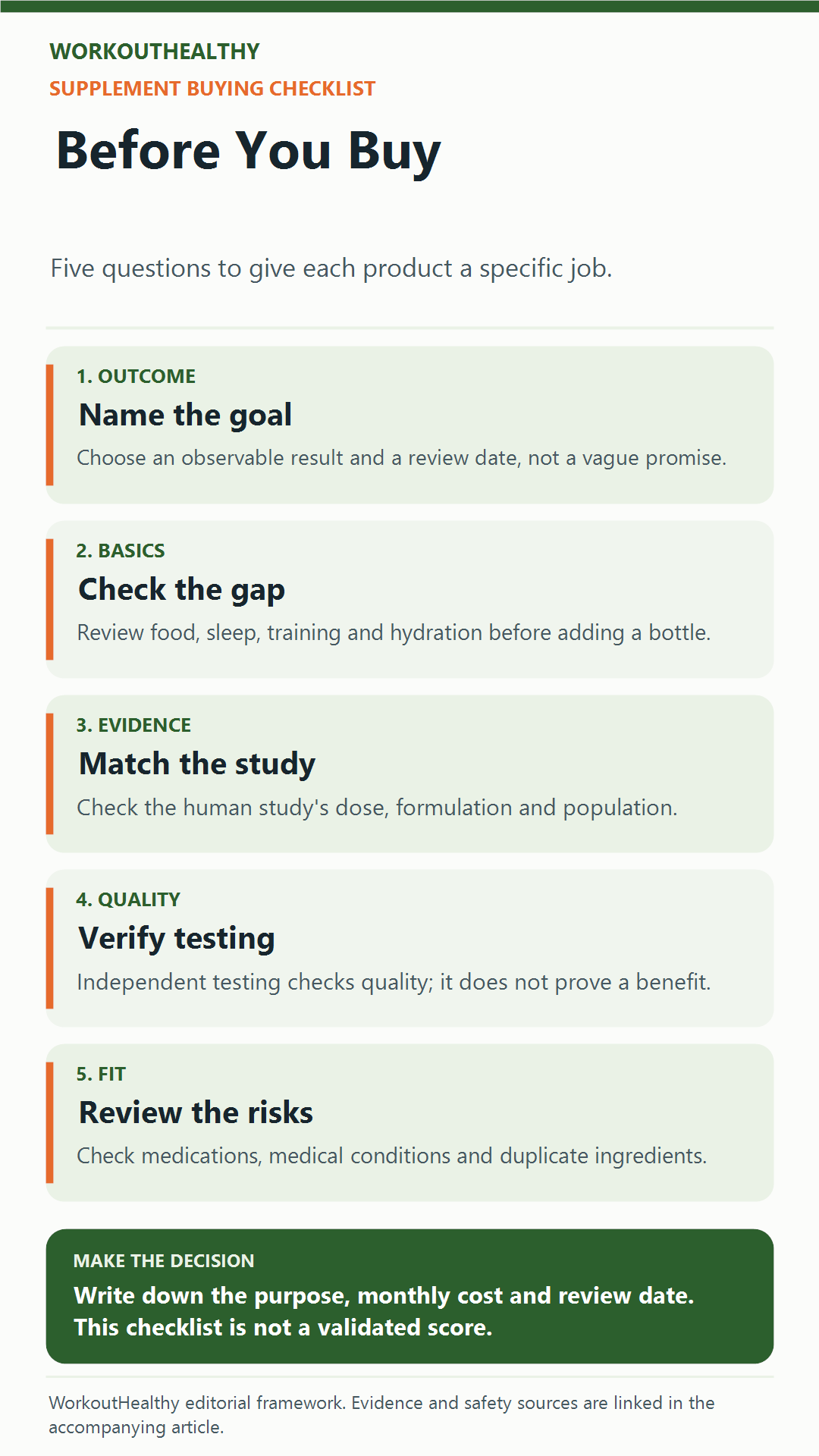
A five-question buying test
This is WorkoutHealthy’s editorial buying checklist, not a validated scoring system or a medical assessment.
First, name the outcome in measurable terms: what would you observe, and over what period?
“Recovery” is vague; fewer gastrointestinal problems on comparable runs is a more specific question.
Second, ask whether a food, sleep, training or hydration change addresses the same problem.
Our guide to rest days and muscle recovery gives useful context for that review.
Third, compare the dose and finished formulation with the human research; a familiar ingredient name is not enough.
Fourth, check independent testing, particularly if banned substances are a concern.
NIH lists programs such as NSF Certified for Sport and Informed-Choice as quality checks; these do not establish that a supplement improves performance (NIH ODS, n.d.).
Fifth, review side effects, medical conditions, medication interactions and duplicated ingredients with a clinician or sports dietitian when appropriate.
Record the reason for buying, monthly cost and review date before starting.
Change one product at a time so you can describe what changed, while recognizing that an informal personal trial cannot establish causation.
Write down the gap before buying the bottle. Then decide what evidence would make you keep it.
The bottom line
Start with the goal, the gap and the evidence, then decide whether a product deserves a place in your routine.
These verdicts favor a smaller, better-justified list over a stack assembled from ten appealing labels.
An ingredient’s biological role, a finding in a deficient population and a result from one strain or dose answer different questions.
Use the references to check which question was actually studied.
If your outcome is vague, your baseline is missing or you cannot explain the product’s purpose, pause the purchase and clarify the plan.
A supplement earns its place through a specific reason, not through the number of bottles in the cabinet.
Get the next evidence check.
Five practical fitness stories worth your time, every Friday.
One email a week. No product pitches. Unsubscribe in one click.
References
Guest, N. S., VanDusseldorp, T. A., Nelson, M. T., Grgic, J., Schoenfeld, B. J., Jenkins, N. D. M., Arent, S. M., Antonio, J., Stout, J. R., Trexler, E. T., Smith-Ryan, A. E., Goldstein, E. R., Kalman, D. S., & Campbell, B. I. (2021). International Society of Sports Nutrition position stand: Caffeine and exercise performance. Journal of the International Society of Sports Nutrition, 18, Article 1. https://doi.org/10.1186/s12970-020-00383-4
Jäger, R., Kerksick, C. M., Campbell, B. I., Cribb, P. J., Wells, S. D., Skwiat, T. M., Purpura, M., Ziegenfuss, T. N., Ferrando, A. A., Arent, S. M., Smith-Ryan, A. E., Stout, J. R., Arciero, P. J., Ormsbee, M. J., Taylor, L. W., Wilborn, C. D., Kalman, D. S., Kreider, R. B., Willoughby, D. S., … Antonio, J. (2017). International Society of Sports Nutrition position stand: Protein and exercise. Journal of the International Society of Sports Nutrition, 14, Article 20. https://doi.org/10.1186/s12970-017-0177-8
Khatri, M., Naughton, R. J., Clifford, T., Harper, L. D., & Corr, L. (2021). The effects of collagen peptide supplementation on body composition, collagen synthesis, and recovery from joint injury and exercise: A systematic review. Amino Acids, 53(10), 1493-1506. https://doi.org/10.1007/s00726-021-03072-x
Kreider, R. B., Kalman, D. S., Antonio, J., Ziegenfuss, T. N., Wildman, R., Collins, R., Candow, D. G., Kleiner, S. M., Almada, A. L., & Lopez, H. L. (2017). International Society of Sports Nutrition position stand: Safety and efficacy of creatine supplementation in exercise, sport, and medicine. Journal of the International Society of Sports Nutrition, 14, Article 18. https://doi.org/10.1186/s12970-017-0173-z
Lewis, N. A., Daniels, D., Calder, P. C., Castell, L. M., & Pedlar, C. R. (2020). Are there benefits from the use of fish oil supplements in athletes? A systematic review. Advances in Nutrition, 11(5), 1300-1314. https://doi.org/10.1093/advances/nmaa050
National Institutes of Health Office of Dietary Supplements. (n.d.). Dietary supplements for exercise and athletic performance: Fact sheet for health professionals. Retrieved September 29, 2026, from https://ods.od.nih.gov/factsheets/ExerciseAndAthleticPerformance-HealthProfessional/
National Institutes of Health Office of Dietary Supplements. (2022, November 8). Vitamin D: Fact sheet for consumers. https://ods.od.nih.gov/factsheets/VitaminD-Consumer/
National Institutes of Health Office of Dietary Supplements. (2024, July 17). Multivitamin/mineral supplements: Fact sheet for health professionals. https://ods.od.nih.gov/factsheets/MVMS-HealthProfessional/
National Institutes of Health Office of Dietary Supplements. (2025a, August 22). Omega-3 fatty acids: Fact sheet for health professionals. https://ods.od.nih.gov/factsheets/Omega3FattyAcids-HealthProfessional/
National Institutes of Health Office of Dietary Supplements. (2025b, March 25). Probiotics: Fact sheet for health professionals. https://ods.od.nih.gov/factsheets/Probiotics-HealthProfessional/
National Institutes of Health Office of Dietary Supplements. (2026, January 6). Magnesium: Fact sheet for health professionals. https://ods.od.nih.gov/factsheets/Magnesium-HealthProfessional/
Sawka, M. N., Burke, L. M., Eichner, E. R., Maughan, R. J., Montain, S. J., & Stachenfeld, N. S. (2007). American College of Sports Medicine position stand: Exercise and fluid replacement. Medicine & Science in Sports & Exercise, 39(2), 377-390. https://doi.org/10.1249/mss.0b013e31802ca597
Yanyi, J., Xingzhi, W., & Chow, D. H. K. (2026). Effects of Lactiplantibacillus plantarum supplementation on exercise performance and recovery: A systematic review and narrative synthesis. Frontiers in Nutrition, 13, Article 1881322. https://doi.org/10.3389/fnut.2026.1881322
Medical disclaimer: This article provides general fitness and nutrition information, not medical advice. If you have a medical condition, an injury or concerning symptoms, discuss suitable training, diet and supplement choices with a qualified healthcare professional before making changes.