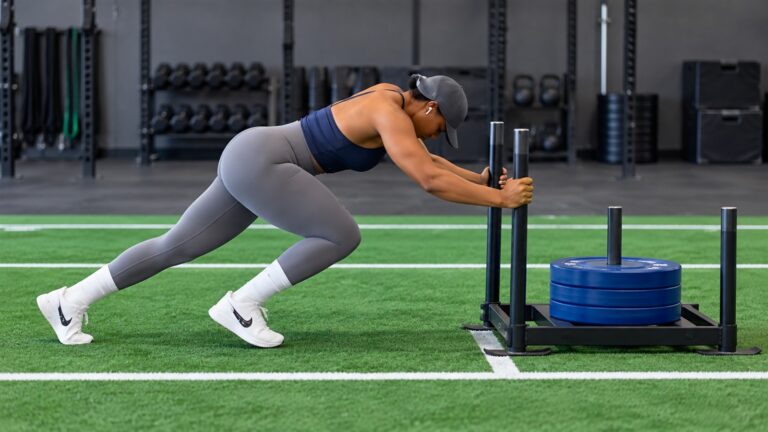

A YouTube channel called Roberta’s Gym just posted a 30 minute cardio workout.
The video makes a specific promise.
It says the routine burns fat in your legs, hips, and belly.
That claim shows up on fitness videos all the time.
It taps into something almost everyone has wondered about at some point.
Can you actually choose where your body loses fat first, or is that just marketing?
What the Video Claims
The video’s title is direct: “30 Min Cardio Workout, Legs + Hips + Belly Fat Loss Exercises.”
Roberta’s Gym is a fitness channel built around home workout videos for a general audience.
Videos like this one tend to move through standing cardio drills for the lower body.
They often add core focused segments near the end, aimed at the stomach.
The framing suggests those specific areas will slim down faster than the rest of the body.
Nothing about that structure is unusual or deceptive on its own, since most cardio and core workouts are built this way.
That framing, the part promising targeted fat loss, is what we tested against the research.
What the Real Research Shows on Spot Reduction
The idea that you can burn fat from one exact spot on your body is called spot reduction.
It has been tested directly in controlled studies, more than once.
In one study, a group of adults did abdominal exercises five days a week for six weeks, with no other change to their diet or activity (Vispute et al., 2011).
Their abdominal muscles got noticeably stronger.
Their abdominal fat did not shrink any more than fat anywhere else on their body.
The researchers found no evidence that training the abs preferentially burned fat from that specific area (Vispute et al., 2011).
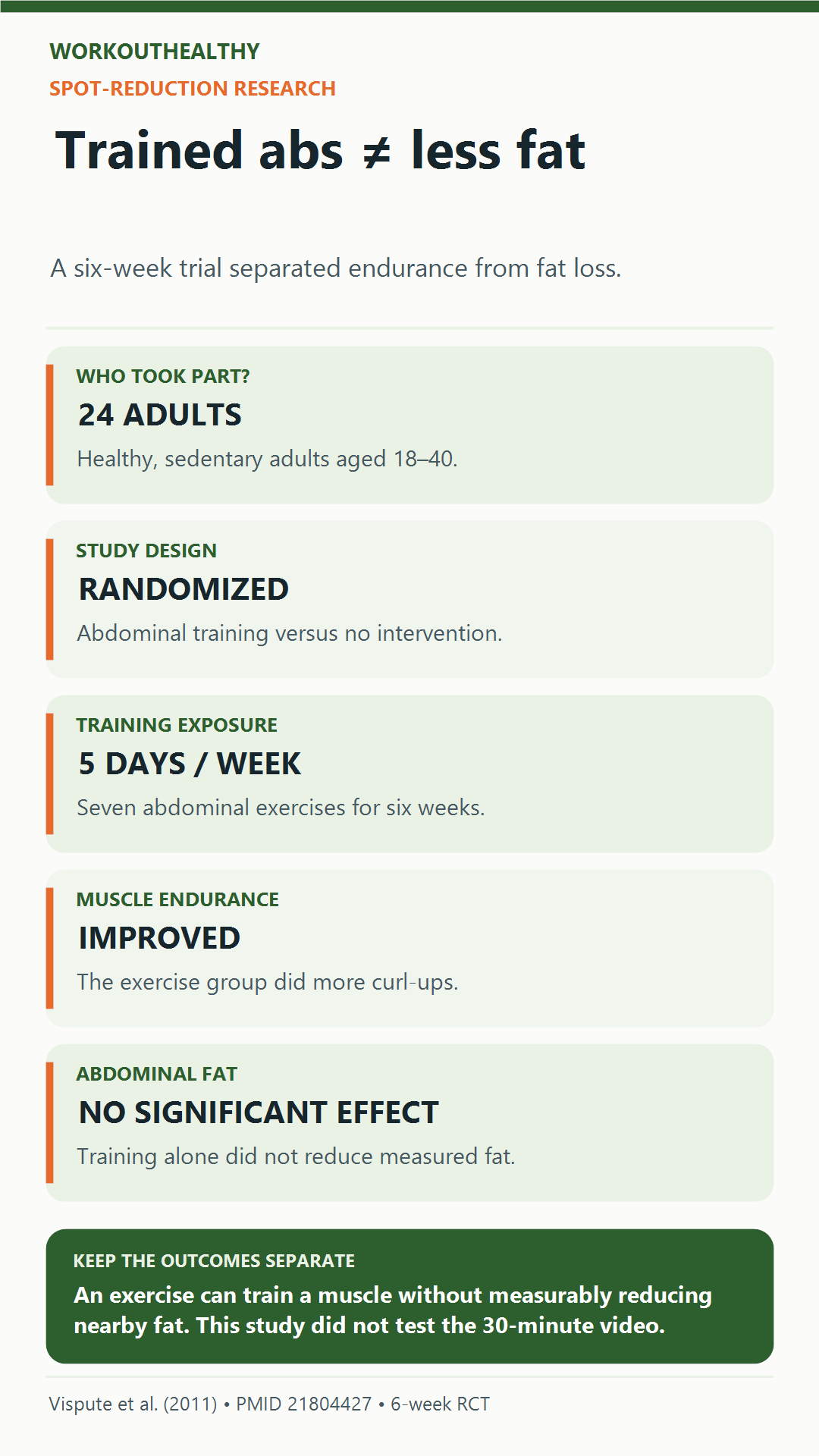
Doing hundreds of ab exercises will build stronger, more toned abdominal muscles, but the research shows it will not selectively strip away the layer of fat sitting on top of them.
A separate study tested the same question on the arms.
Researchers had participants do resistance training on one arm only, for weeks, while the other arm stayed untrained (Kostek et al., 2007).
They measured the fat sitting under the skin on both arms before and after.
The trained arm got stronger and more muscular.
The fat covering that trained arm did not shrink more than the fat on the untrained arm (Kostek et al., 2007).
Both studies were designed the same way on purpose.
Researchers picked one body part to train in isolation and left everything else, diet included, unchanged, so any local fat loss could only be explained by that exercise.
If spot reduction were real, these are exactly the studies that should have found it.
They did not.
The myth persists partly because of how muscle and fat sit right next to each other under the skin.
When a muscle tightens or grows under a layer of fat, people notice the shape change and give the credit to fat loss.
What actually changed in that moment was muscle tone, not the fat layer covering it.
Why Cardio Still Burns Fat, Just Not in One Spot
None of this means the cardio in this video is pointless for fat loss.
It means the fat loss does not follow whichever muscle is doing the work.
During cardio, hormones like epinephrine signal fat cells across the whole body to release stored fat into the bloodstream (Ohkawara et al., 2007).
That released fat travels through the blood and gets used as fuel wherever the body needs it, not just at the muscle that is contracting.
That is why an area that barely moves during a leg focused workout can still lose fat over time.
That is also true in reverse: an area that gets worked the hardest is not guaranteed to be the first to slim down.
Genetics, hormones, and where your body already stores fat decide which areas shrink first, not which exercise you picked.
Two people doing the identical workout can lose fat from different areas first, based on their own biology.
What actually drives total fat loss over time is a calorie deficit, burning more energy than you take in, built through both diet and consistent activity like managing weight loss without losing muscle mass.
A large randomized trial backs this up directly.
The STRRIDE trial split inactive adults into three exercise groups plus a control group and tracked body composition over six months (Slentz et al., 2004).
One group did a low amount of moderate intensity exercise, a second did a low amount of vigorous exercise, and a third did a high amount of vigorous exercise (Slentz et al., 2004).
None of the groups did exercises aimed at just one body region.
The high amount group still lost the most total fat and saw the biggest drop in waist size (Slentz et al., 2004).
A separate review pooled results from multiple clinical trials on aerobic exercise and visceral fat, the fat that sits deep around the belly’s organs (Ohkawara et al., 2007).
It found a clear dose response pattern: more total aerobic exercise volume tracked with a bigger drop in that visceral fat (Ohkawara et al., 2007).
A calorie deficit drives fat loss across the whole body at once. No amount of squats, jumping jacks, or crunches changes which fat cells your body decides to use first.
A cardio circuit that works the legs and hips still raises your heart rate and burns real calories.
It builds endurance in muscles you use every day, from walking to climbing stairs.
Consistent movement like this adds up over a week, the same way steady daily walking does, as covered in our guide to how many miles you should walk a day.
Circuit style cardio can also fit into a busy schedule better than a long gym session.
That consistency, showing up several times a week, matters more for fat loss than any single move in the routine.
What the Evidence Does Not Prove
The research above rules out spot reduction, but it does not rule out everything.
It does not prove that 30 minutes of cardio, on its own, is enough for meaningful fat loss without attention to food intake.
It does not prove every body loses fat in the same order or at the same speed.
Genetics plays a real role in where fat tends to show up last.
The studies cited here used structured, supervised programs, not a single home workout video watched once.
It also does not prove high-impact cardio is the best or only way to build a calorie deficit for every person.
Walking, cycling, swimming, and strength training can all create that same deficit with less joint stress for some people.
It does not prove that this specific 30 minute routine outperforms any other cardio workout of similar length and intensity.
Real results still depend on consistency across weeks and months, not one session.
Common Mistakes and Who Should Check With a Doctor First
The biggest mistake is doing only cardio while ignoring food intake entirely.
A calorie surplus stalls fat loss no matter how good the workout is.
Another common mistake is choosing cardio over strength training completely, expecting faster results.
Readers on this site have actually leaned the other way, with most surveyed readers favoring weightlifting over running for long term body composition.
A third mistake is expecting visible abs from ab exercises alone, without ever lowering total body fat.
A fourth mistake is judging progress only by the scale, since water weight and muscle gain can hide real fat loss.
Anyone with existing hip, knee, or back pain should be cautious with high-impact cardio moves.
Jumping jacks, high knees, and quick lateral steps put real load through the hips and knees.
Recovery from a hip injury or hip replacement requires a much slower pace than a standard cardio circuit.
People with heart conditions, uncontrolled blood pressure, or a long break from exercise should get medical clearance first.
Pregnant women should check with a doctor before starting any new high-impact cardio routine.
None of that means this workout is unsafe for a healthy adult.
It just means the usual caution applies before jumping into 30 minutes of continuous movement.
How to Actually Use This Workout for Fat Loss
Start by pairing this cardio session with two or three strength training days each week.
Strength training helps preserve muscle while you are in a calorie deficit, which keeps your metabolism higher.
Track your food intake for at least a week to know your real starting point.
Aim for a modest calorie deficit, not an extreme one, so the habit actually sticks.
Do this cardio workout two to four times a week, not every single day.
Warm up for five minutes before the faster paced segments begin.
Give your joints rest days between high-impact sessions, especially if you are new to this style of training.
Stop and modify any move that causes sharp pain in your knees, hips, or lower back.
Expect fat loss to show up gradually and unevenly across your body, not in the exact order you would choose.
Track waist measurements and progress photos, not just the scale, since muscle and fat change differently.
Increase the workout’s difficulty over time by adding a few more rounds, not by rushing through each move.
Pay attention to how your knees and hips feel the next day, not only during the workout itself.
Drink water before and after the session, since a 30 minute cardio circuit like this one adds up to real sweat loss.

Keep a simple log of the workouts you complete each week, since consistency is what actually compounds over time.
Watch the Original Video
Want more like this? Subscribe to WorkoutHealthy Insider for practical explanations behind popular fitness claims.
References
Kostek, M. A., Pescatello, L. S., Seip, R. L., Angelopoulos, T. J., Clarkson, P. M., Gordon, P. M., Moyna, N. M., Visich, P. S., Zoeller, R. F., Thompson, P. D., Hoffman, E. P., & Price, T. B. (2007). Subcutaneous fat alterations resulting from an upper-body resistance training program. Medicine & Science in Sports & Exercise, 39(7), 1177 to 1185. https://doi.org/10.1249/mss.0b0138058a5cb
Ohkawara, K., Tanaka, S., Miyachi, M., Ishikawa-Takata, K., & Tabata, I. (2007). A dose response relation between aerobic exercise and visceral fat reduction: Systematic review of clinical trials. International Journal of Obesity, 31(12), 1786 to 1797. https://doi.org/10.1038/sj.ijo.0803683
Slentz, C. A., Duscha, B. D., Johnson, J. L., Ketchum, K., Aiken, L. B., Samsa, G. P., Houmard, J. A., Bales, C. W., & Kraus, W. E. (2004). Effects of the amount of exercise on body weight, body composition, and measures of central obesity: STRRIDE, a randomized controlled study. Archives of Internal Medicine, 164(1), 31 to 39. https://doi.org/10.1001/archinte.164.1.31
Vispute, S. S., Smith, J. D., LeCheminant, J. D., & Hurley, K. S. (2011). The effect of abdominal exercise on abdominal fat. Journal of Strength and Conditioning Research, 25(9), 2559 to 2564. https://doi.org/10.1519/jsc.0b013e3181fb4a46
This article is for general information only and is not medical advice. If you have an injury, ongoing pain, or a medical condition, talk to a doctor or physical therapist before you change how you train or eat.