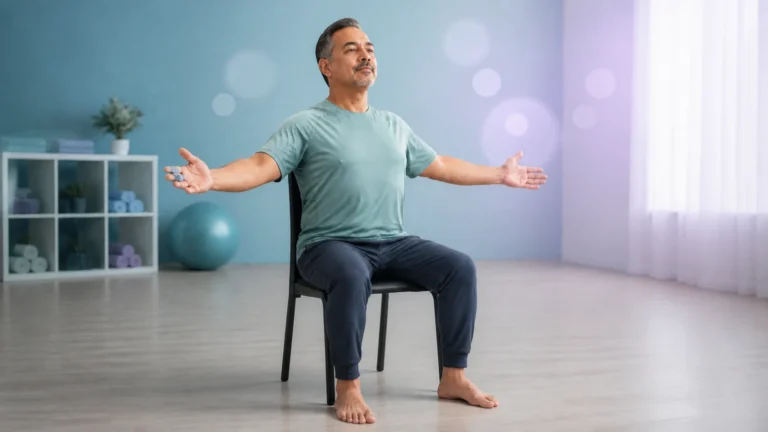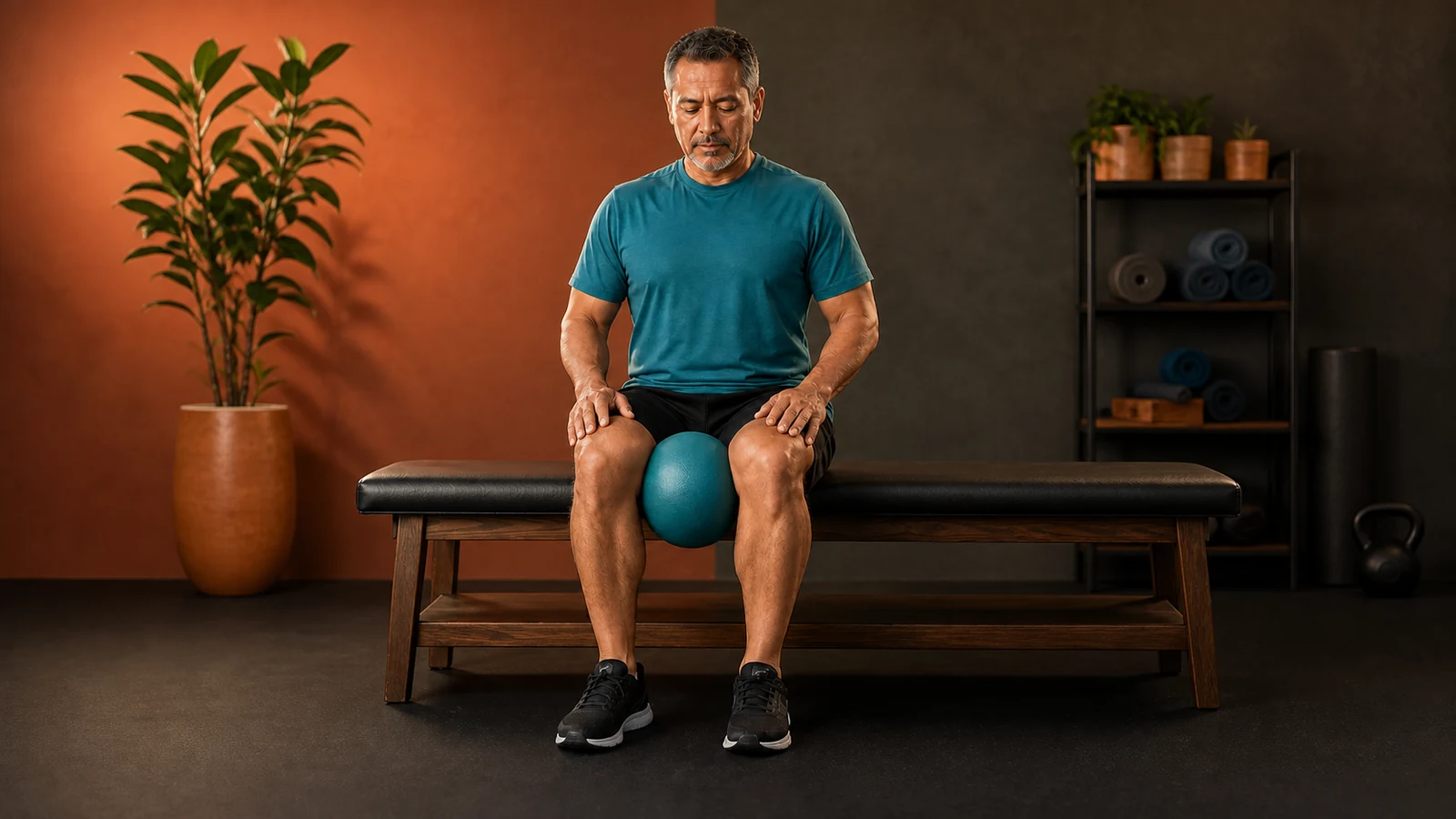

A physical therapy video from Brazil shows a simple knee alignment exercise.
The video targets a very common problem called patellofemoral pain.
Doctors sometimes just call it runner’s knee.
It causes an ache around or behind the kneecap, often during stairs or squats.
The video suggests that certain exercises can fix how the kneecap tracks.
So what does the actual research say about that idea?
What the Video Claims
The video’s title points to a knee alignment exercise for the patellofemoral joint.
That joint is where the kneecap, known as the patella, meets the thigh bone.
The channel focuses on physical therapy content aimed at everyday viewers, not other clinicians.
Based on the title, the exercise likely targets muscles that help control kneecap position.
Many videos on this topic focus on the hip muscles, the front thigh muscles, or both.
We were not able to verify every specific technical claim made inside the video itself.
Instead, this article checks the underlying idea against published, peer reviewed research.
That idea is whether targeted exercise can change knee alignment and reduce pain.
What the Research Actually Shows About Hip and Knee Strengthening
Patellofemoral pain is one of the most studied problems in sports medicine.
A 2018 systematic review with meta-analysis looked closely at exercise therapy for it (Nascimento et al., 2018).
The researchers pooled results from many randomized controlled trials.
One approach in those trials trained only the muscles around the knee.
The other approach added specific exercises for the hip muscles too.
Programs that included hip strengthening produced bigger drops in pain scores.
They also produced bigger gains in daily function, like managing stairs.
The review pooled data across multiple trials and hundreds of total participants.
Most of the hip exercises used simple equipment, like resistance bands or plain body weight.
This is one of the stronger pieces of evidence available on this exact topic.
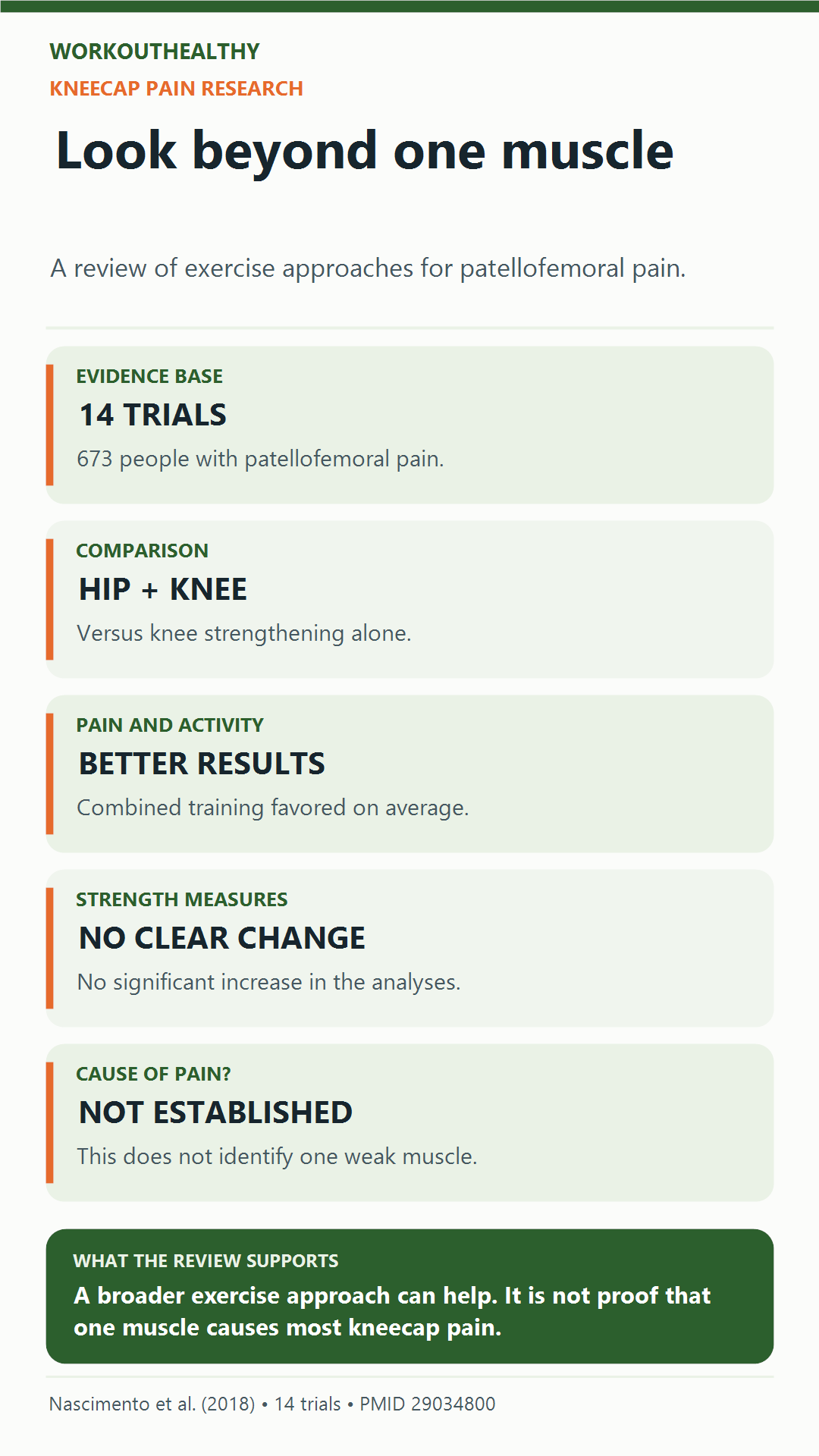
Adding hip strengthening to a knee training program produced better pain and function results than training the knee muscles alone.
A separate Cochrane review looked at exercise therapy for this condition more broadly (van der Heijden et al., 2015).
Cochrane reviews are known for strict, cautious evidence standards.
This review also found that exercise therapy reduced pain compared with no treatment or minimal treatment.
The authors noted that trial quality varied quite a bit across the individual studies.
Even with that caveat, the overall direction of the evidence favored exercise.
The Cochrane authors also noted that exercise therapy appeared to be safe.
Few side effects were reported across the included trials.
That safety profile matters for a condition that can otherwise linger for months untreated.
The quadriceps muscle at the front of the thigh plays a major role in this picture too.
We have looked at how loading similar knee extensor muscles supports strength elsewhere, including in our look at box jumps and muscle growth.
Everyday tasks like climbing stairs often get easier as this kind of strength improves, a pattern we also touched on in our piece on the four-flight stair test.
Why Strengthening Can Change How the Kneecap Tracks
The mechanism behind this is not just about the knee joint itself.
A widely cited biomechanics paper explains how hip weakness affects knee movement (Powers, 2010).
Weak hip abductor and hip external rotator muscles can let the thigh bone rotate inward during activity.
That inward rotation changes the angle between the thigh bone and the shinbone.
It can increase pressure on one side of the groove the kneecap glides through.
Stronger hip muscles help control that inward rotation during movement.
Better control at the hip can mean steadier tracking through the kneecap groove.
That is the proposed reason hip strengthening helps, not stronger knees alone.
The quadriceps muscle also helps stabilize the kneecap directly during bending and straightening.
A weak or imbalanced quadriceps can let the kneecap drift slightly off its normal path.
Building balanced strength at both the hip and the knee addresses both problems at once.
What a Clinical Practice Guideline Adds
In 2019, a team of physical therapy researchers published a full clinical practice guideline for this condition (Willy et al., 2019).
The guideline reviewed the best available evidence and ranked it by strength.
It gave exercise therapy, especially combined hip and knee strengthening, a strong recommendation.
It also supported combining exercise with foot orthoses or knee taping in some specific cases.
But exercise remained the central, most strongly supported treatment overall.
This guideline is meant to be used by real clinicians treating real patients, not just cited in papers.
A clinical practice guideline built from the best available evidence gave combined hip and knee strengthening a strong recommendation for treating this condition.
Why This Matters for Runners
Patellofemoral pain shows up often in people who run regularly.
Running adds repeated, high impact loading through a bent knee, over and over.
Weak hip muscles can become more obvious under that kind of repeated demand.
Some runners notice knee pain only after increasing mileage or speed too quickly.
Strengthening work does not replace smart training load management for runners.
Both approaches together tend to work better than either one alone.
What This Evidence Does Not Prove
This research does not prove that one specific exercise, like the one shown in the video, is essential.
The studies tested full exercise programs, not single moves in isolation.
No study can confirm that any single video demonstrates the ideal form for every viewer.
The evidence also does not prove that alignment itself is fully correctable through exercise alone.
Some contributing factors, like natural bone shape or old injuries, are not changed by strength training.
Response to exercise also varies quite a bit between individual people.
Some people improve within a few weeks, and others need a longer, more gradual program.
None of the cited research followed people for many years, so long-term effects are less certain.
The research also cannot confirm that one video creator’s specific cueing is the correct one.
Individual anatomy, like the shape of the kneecap groove, still varies from person to person.
Common Mistakes People Make
One common mistake is jumping straight to advanced exercises without building a base first.
Another is training only the knee muscles and skipping the hip work entirely.
Some people push through sharp pain instead of adjusting the exercise or the load.
Sharp pain is a signal to change the movement, not a sign of progress.
Doing too much volume too soon, without a proper warm up, is another frequent error.
People often quit after a week or two because they expect instant results.
Real muscle and movement adaptation usually takes several weeks, not days.
Knee pain also pushes some people to quit an activity entirely rather than adjust it.
That pattern showed up clearly when readers described switching from running to weightlifting because of joint pain.
A guided strengthening plan is often a better first step than simply avoiding the painful activity for good.
Comparing your own pace of recovery to a stranger’s video result is another common trap.
Recovery timelines differ widely based on how long the pain has already been present.
Who Should Check With a Doctor or Physical Therapist First
Anyone with a swollen, locked, or unstable knee should see a doctor before starting a new program.
Sudden, severe pain after an injury needs medical evaluation, not a home exercise routine.
People with a history of knee surgery should get guidance specific to their own case.
Pain that does not improve after several weeks of sensible exercise deserves a professional look.
A physical therapist can also test whether hip weakness or knee weakness is the bigger driver.
Not every case of knee pain shares the same underlying cause.
A locked knee that will not fully straighten is never something to just stretch through.
Numbness, tingling, or a feeling of the knee giving way also warrants medical attention.
How to Approach These Exercises Safely
Start with basic hip strengthening moves, like side-lying leg raises or clamshells.
Add simple quadriceps work, like straight leg raises or short-arc knee extensions.
Progress toward closer-to-function moves, like partial squats, once the basics feel steady.
Keep the knee tracking in line with the toes during any squatting or stepping motion.
A mirror or a phone video can help you check your own form from the front.
Two to three sessions a week is a reasonable starting frequency for most people.
Two to three sets of ten to fifteen repetitions is a common general starting point.
Rest a day between sessions early on to see how your knee responds.
Mild soreness after a session is normal, but sharp pain during a set is not.
Increase resistance or repetitions gradually over time, not all at once.
Pair strength work with sensible walking or other low-impact movement rather than resting completely.
Our guide to setting a daily walking target is a reasonable place to start for that kind of low-impact activity.
Keep a simple log of pain, sets, and reps so you can track real progress.
Small, steady increases usually beat trying to do too much in the first week.
Give any new program at least six to eight weeks before judging the results.
A physical therapist can turn this general outline into a specific plan built around your own case.
Watch the Original Video
Want more like this? Subscribe to WorkoutHealthy Insider for practical explanations behind popular fitness claims.
References
Nascimento, L. R., Teixeira-Salmela, L. F., Souza, R. B., & Resende, R. A. (2018). Hip and knee strengthening is more effective than knee strengthening alone for reducing pain and improving activity in individuals with patellofemoral pain: A systematic review with meta-analysis. Journal of Orthopaedic & Sports Physical Therapy, 48(1), 19 to 31. https://doi.org/10.2519/jospt.2018.7365
Powers, C. M. (2010). The influence of abnormal hip mechanics on knee injury: A biomechanical perspective. Journal of Orthopaedic & Sports Physical Therapy, 40(2), 42 to 51. https://doi.org/10.2519/jospt.2010.3337
van der Heijden, R. A., Lankhorst, N. E., van Linschoten, R., Bierma-Zeinstra, S. M. A., & van Middelkoop, M. (2015). Exercise for treating patellofemoral pain syndrome. Cochrane Database of Systematic Reviews, 2015(1), Article CD010387. https://doi.org/10.1002/14651858.CD010387.pub2
Willy, R. W., Hoglund, L. T., Barton, C. J., Bolgla, L. A., Scalzitti, D. A., Logerstedt, D. S., Lynch, A. D., Snyder-Mackler, L., & McDonough, C. M. (2019). Patellofemoral pain. Journal of Orthopaedic & Sports Physical Therapy, 49(9), CPG1 to CPG95. https://doi.org/10.2519/jospt.2019.0302
This article is for general information only and is not medical advice. If you have an injury, ongoing pain, or a medical condition, talk to a doctor or physical therapist before you change how you train or eat.