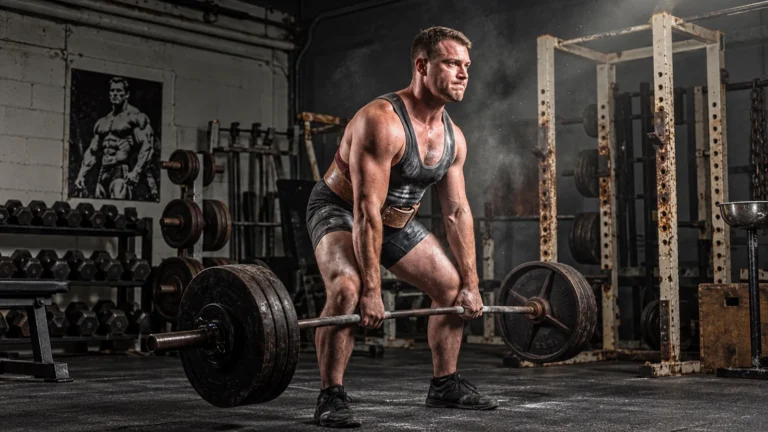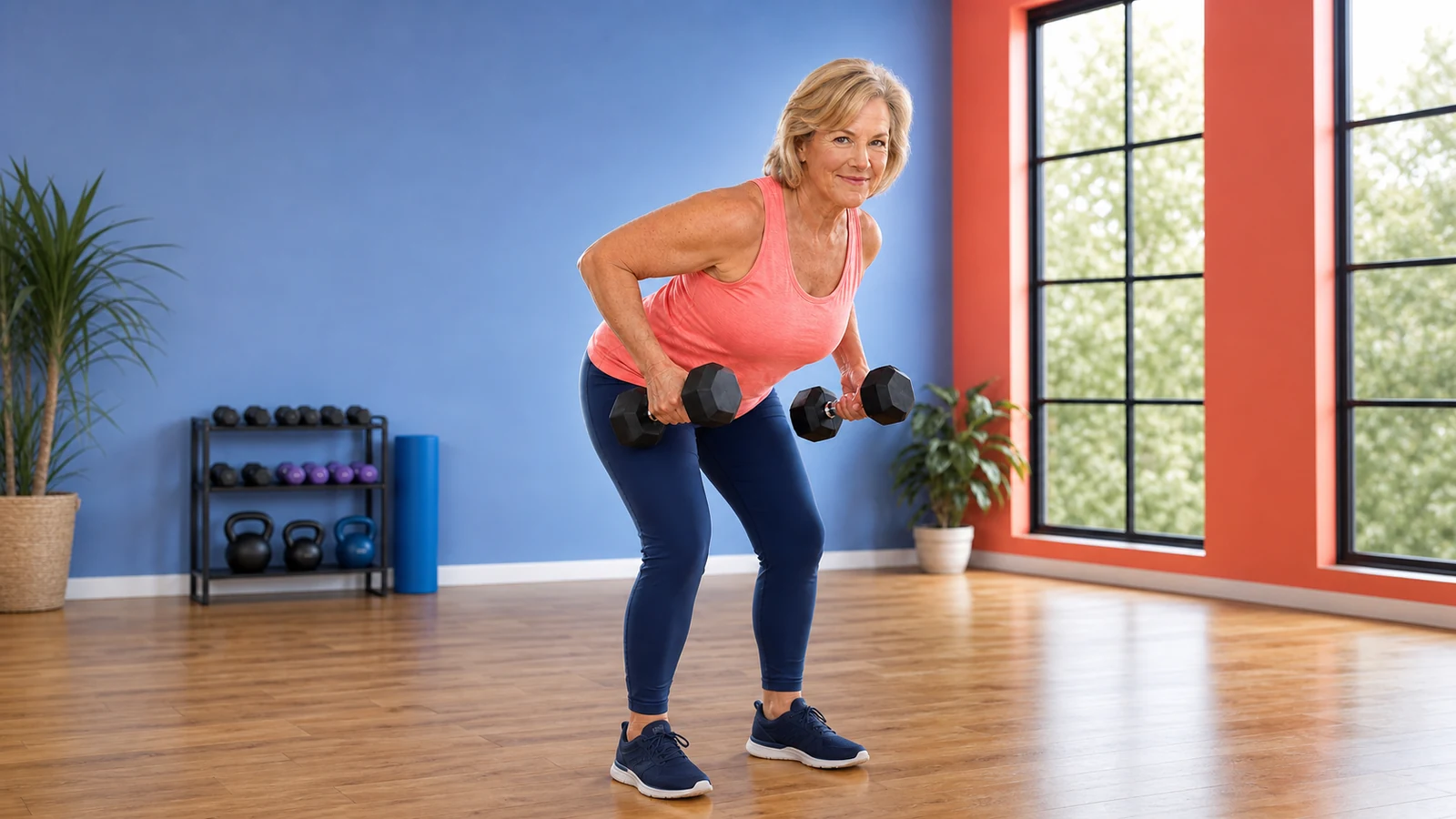

A YouTube channel called Improved Health posted a 30 minute standing dumbbell workout aimed at women over 50.
The video promises a full body routine you can do at home with just a pair of dumbbells.
That raises a fair question.
Does a simple standing dumbbell routine actually do anything meaningful for a woman’s bones, muscle, and balance after 50?
We dug into the real research to find out.
What the Video Claims
The video shows a standing, no bench routine built entirely around dumbbells.
It moves through squats, presses, rows, and lunges, one after another, for about 30 minutes.
The channel frames it as a workout built specifically for women 50 and older.
It suggests the routine can build strength, protect joints, and help keep muscle as you age.
Those are reasonable goals.
The video itself does not cite a specific study or number to back up those claims.
So we treated its claims as a starting point for research, not as settled fact.
What the Research Actually Shows
The strongest evidence for women over 50 doing resistance training comes from bone health research.
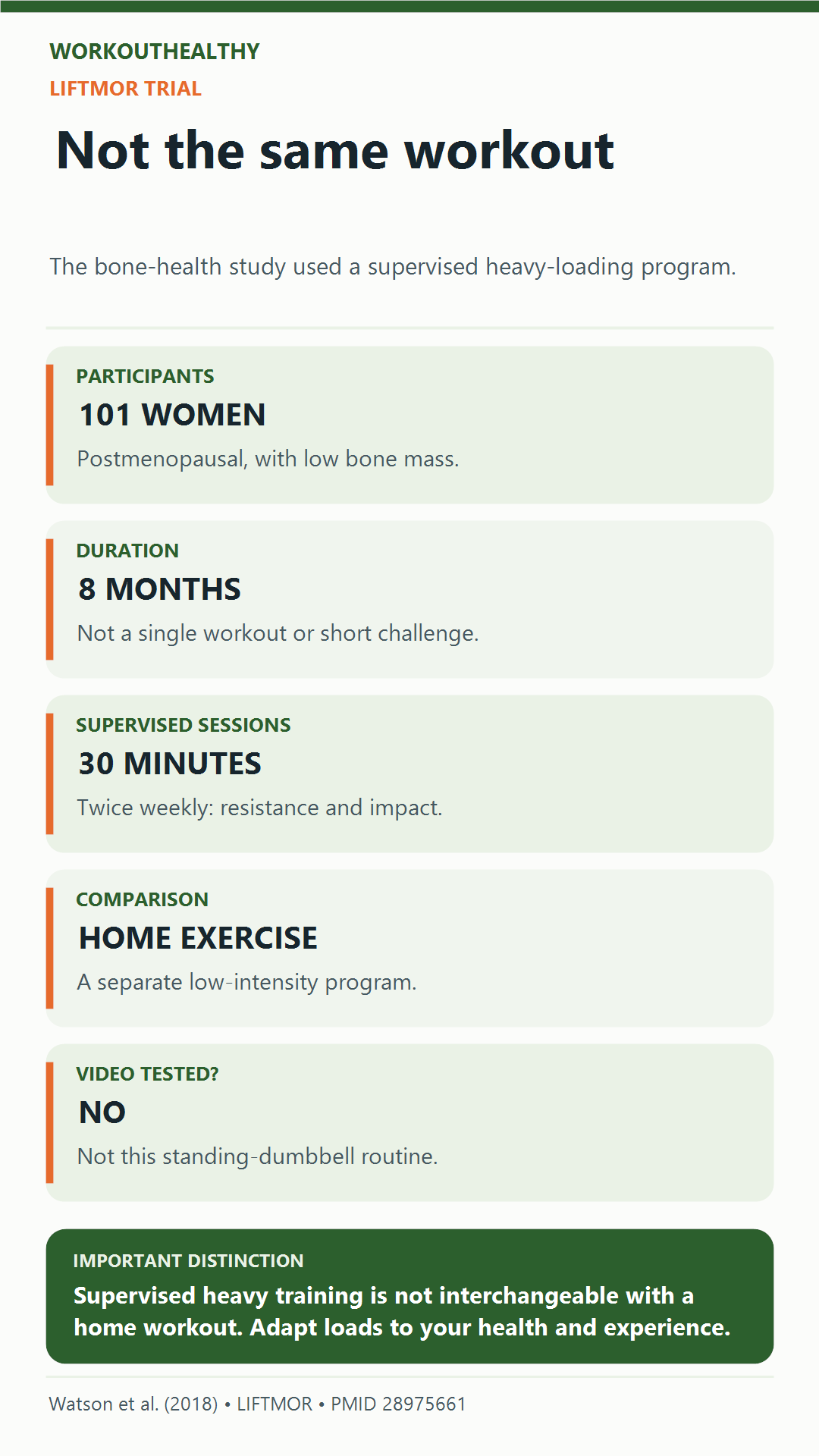
A randomized controlled trial called LIFTMOR followed postmenopausal women with low bone density through eight months of supervised heavy resistance and impact training.
The women who trained with challenging loads, on standing exercises like deadlifts and overhead presses, gained bone density at the spine and hip (Watson et al., 2018).
Their posture and functional performance improved too.
That matters because bone loss speeds up after menopause and raises the risk of fracture.
Muscle loss follows a similar pattern around the same life stage.
Research tracking women through the menopause transition found measurable drops in muscle mass and strength during and after that transition (Maltais et al., 2009).
This decline is not just about how a person looks.
Less muscle means a slower resting metabolism and less strength for everyday tasks like carrying groceries or climbing stairs.
We cover why age related muscle loss speeds up, and what actually slows it down, in our guide to losing weight and muscle mass.
Resistance training is one of the most consistent tools for fighting that decline.
A meta-analysis pooling dozens of resistance training studies in older adults found it reliably increases lean body mass, even in people who start later in life (Peterson et al., 2011).
The effect in any single study was modest, but it held up across a large number of trials, which is exactly what makes a meta-analysis meaningful.
Strength training may also lower fall risk, which matters a great deal after 50.
A large Cochrane systematic review looked at nearly 13,000 older adults across 59 exercise trials.
It found that structured exercise programs cut the overall rate of falls by about 23 percent (Sherrington et al., 2020).
Falls are one of the leading causes of injury and lost independence after 50, and a large systematic review found that structured exercise programs cut the rate of falls by roughly a quarter.
Put together, this research supports the general idea behind the video.
Standing dumbbell exercises that challenge major muscle groups can support bone density, help preserve muscle, and lower fall risk in women over 50.
That does not mean this exact 30 minute routine was tested in a lab.
It means the type of training it uses lines up with what the research shows actually works.
The benefits are not limited to bones and muscle either.
We break down the brain health angle of lifting weights separately in what the research actually shows about lifting weights and brain health.
What This Evidence Does Not Prove
None of these studies tested this specific video or its exact sequence of exercises.
LIFTMOR used barbells and heavier loads than most people lift with a pair of home dumbbells.
The Cochrane review on falls combined many types of exercise programs, not just standing dumbbell workouts.
So we cannot say this particular video will cut your personal fall risk by a fixed percentage.
The research also cannot promise results on any specific schedule, including three 30 minute sessions a week.
Study participants trained under supervision, with real attention paid to form and progressive overload.
A home workout without that structure may progress more slowly, or stall out sooner.
None of this research shows that strength training cures osteoporosis or reverses sarcopenia completely.
It shows that consistent, sufficiently challenging training can slow the decline, and in some cases partly reverse it.
That is a real, meaningful benefit.
It is not a cure.
This research does not prove that following one YouTube workout for a month will change your bone scan. It shows that consistent, sufficiently heavy strength training tends to move those numbers in the right direction over time.
Common Mistakes Women Make With Home Dumbbell Workouts
The most common mistake is picking dumbbells that are too light.
The research behind these bone and muscle gains used genuinely challenging loads, not easy ones.
If the last two reps of a set feel easy, the weight is probably too light to drive real change.
Another common mistake is skipping progression entirely.
Using the same light dumbbells for months gives your muscles no reason to adapt further.
A third mistake is rushing through reps just to finish the video on time.
Slower, controlled reps protect the joints and work the muscle harder through the full range of motion.
Some people also skip a warm up because the workout itself is only 30 minutes.
Standing moves like overhead presses and reverse lunges challenge balance, so a short warm up still matters.
Finally, plenty of people train straight through pain instead of adjusting the exercise.
Sharp or joint pain is a signal to modify the movement, not push through it.
Age itself is not the barrier some people assume it is.
Our profile of Edith Connor, who set a Guinness World Record for oldest female bodybuilder at 75, is a reminder that starting strength training later in life still works.
Who Should Check With a Doctor First
Most healthy women can start a standing dumbbell routine safely on their own.
A few groups should talk to a doctor or physical therapist before starting one, though.
Anyone with diagnosed osteoporosis should get individual guidance first.
Some spine and hip positions carry more risk when bones are already fragile.
A physical therapist can show you which standing exercises are safe and which ones need modifying.
Anyone with a joint replacement, a herniated disc, or a recent surgery should check first too.
People with uncontrolled high blood pressure or existing heart disease should also get medical clearance.
Standing strength moves can briefly raise blood pressure during the lift.
Anyone who has had a recent fall, or who feels unsteady while standing, should start near a wall or a sturdy chair for support.
If you feel dizzy, short of breath, or have chest pain during exercise, stop right away and get it checked out.
How to Get Real Results From a Routine Like This
Start with a weight that makes the last two reps of each set genuinely hard.
For most women beginning strength training, that often means starting heavier than instinct suggests.
Aim for two to three sessions a week.
Leave at least one rest day between sessions that train the same muscles.
Add a small amount of weight or a rep or two every one to two weeks, once the current load starts to feel manageable.
This gradual increase is called progressive overload.
It is the actual mechanism behind almost every bone and muscle gain in the studies above.
Keep a simple written log of the weights and reps you use each session.

It takes about thirty seconds and turns progress into something visible instead of a guess.
Pay attention to form on standing moves in particular, since balance is part of what is being trained.
A slower, controlled squat or lunge is doing more work than a fast, wobbly one.
Breathe out on the hard part of each lift, like pressing a dumbbell overhead, instead of holding your breath.
Holding your breath during a lift can spike blood pressure more than the exercise itself needs to.
A pair of adjustable dumbbells, or two or three fixed pairs at different weights, makes this kind of progression much easier at home.
As a rough starting point, many women begin around 5 to 10 pounds for presses and rows, and 10 to 15 pounds for squats and lunges.
Those are only starting numbers, not targets.
The right weight is whatever makes your last two reps genuinely hard while your form stays clean.
Pair the strength sessions with regular walking on the days in between.
Walking supports many of the same bone and fall risk goals from a different angle, and we cover realistic weekly targets in our guide to how many miles to walk a day.
Give the plan real time before judging it.
Meaningful bone density changes in the LIFTMOR trial took eight months of consistent training, not a few weeks.
Muscle and strength gains tend to show up sooner, often within the first six to eight weeks, but the bigger, longer term protective effects build slowly.
Consistency, not intensity on any single day, is what actually drives the results seen in this research.
Watch the Original Video
Want more like this? Subscribe to WorkoutHealthy Insider for practical explanations behind popular fitness claims.
References
Maltais, M. L., Desroches, J., & Dionne, I. J. (2009). Changes in muscle mass and strength after menopause. Journal of Musculoskeletal and Neuronal Interactions, 9(4), 186 to 197. https://pubmed.ncbi.nlm.nih.gov/19949277/
Peterson, M. D., Sen, A., & Gordon, P. M. (2011). Influence of resistance exercise on lean body mass in aging adults: A meta-analysis. Medicine & Science in Sports & Exercise, 43(2), 249 to 258. https://doi.org/10.1249/MSS.0b013e3181eb6265
Sherrington, C., Fairhall, N., Wallbank, G., Tiedemann, A., Michaleff, Z. A., Howard, K., Clemson, L., Hopewell, S., & Lamb, S. (2020). Exercise for preventing falls in older people living in the community: An abridged Cochrane systematic review. British Journal of Sports Medicine, 54(15), 885 to 891. https://doi.org/10.1136/bjsports-2019-101512
Watson, S. L., Weeks, B. K., Weis, L. J., Harding, A. T., Horan, S. A., & Beck, B. R. (2018). High intensity resistance and impact training improves bone mineral density and physical function in postmenopausal women with osteopenia and osteoporosis: The LIFTMOR randomized controlled trial. Journal of Bone and Mineral Research, 33(2), 211 to 220. https://doi.org/10.1002/jbmr.3284
This article is for general information only and is not medical advice. If you have an injury, ongoing pain, or a medical condition, talk to a doctor or physical therapist before you change how you train or eat.