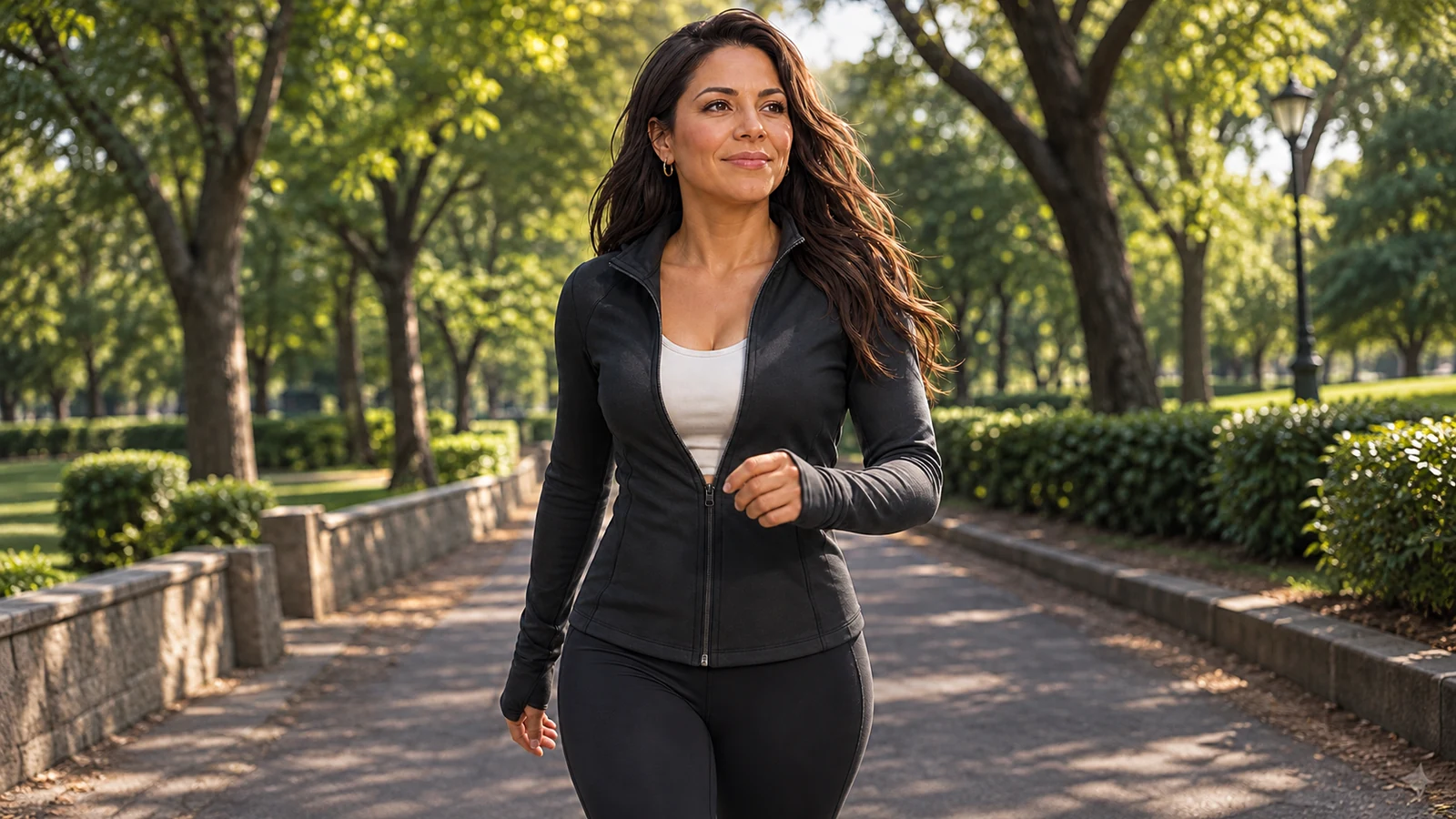

Elena Ramos Goode has a simple reason for moving her body, and it is not a before-and-after photo.
The actress told Shape that yoga, running, hiking, meditation, and breathwork help her feel present, balanced, and emotionally steady.
That makes her routine less about chasing a look and more about building a dependable way to reset.
Her approach is personal, not a prescription, but it offers a useful question for anyone whose motivation disappears when appearance changes come slowly.
Fitness From the Inside Out
Goode described a shift from exercising to change how she looked toward choosing movement for what it created internally.
She said yoga helped her ask different questions about training, including whether an activity made her feel alive and present.
“It’s really for mental and emotional fitness.”
That sentence changes the scoreboard.
A workout can matter even when the mirror looks the same, because the immediate result may be a calmer mind, a clearer transition out of work, or a stronger sense of agency.
This does not make physical goals wrong.
It simply prevents body size, weight, or appearance from becoming the only evidence that effort counted.
Goode also connected her approach with the demands of acting, where call times can be early, schedules can run overnight, and familiar routines may disappear.
A practice built around presence can travel more easily than a perfect plan that depends on one studio, one hour, or one exact sequence.
The useful lesson is not to copy a celebrity schedule.
It is to identify a benefit you can notice today, because a benefit you can feel today gives tomorrow’s session a reason to exist.
The Practices in Her Routine
Goode’s reported routine is varied rather than rigid.
Shape listed yoga, running, hiking, meditation, breathwork, Barry’s Bootcamp, and F45 among the activities she uses or enjoys.
Those choices cover several different needs.
Running and hiking can provide steady aerobic work, while yoga can combine movement, balance, breathing, and focused attention.
Group classes can add structure and social energy on days when self-directed training feels harder.
Meditation and breathwork are not replacements for physical training, but they can serve as short reset practices when a full workout does not fit.
Goode said she sometimes used a 10-minute meditation in her trailer during demanding filming schedules.
That is a practical example of reducing the size of the habit instead of abandoning it.
Someone else might use a brisk walk, a short mobility session, or the first ten minutes of a longer routine.
Our guide to daily walking distance explains why useful movement does not have to arrive in one long block.
Variety also gives a routine more than one doorway.
If weather blocks a hike, a home yoga session still works, and if solo training feels flat, a class can provide a different reason to show up.
Why Feeling Better Can Be a Stronger Goal
Appearance goals often depend on delayed changes that are difficult to measure cleanly from day to day.
Mood, focus, energy, and stress are imperfect measures too, but they can be noticed immediately after a session.
That shorter feedback loop matters.
Research on self-determination theory has repeatedly linked more autonomous motives with better exercise participation, while intrinsic motivation appears especially relevant to long-term adherence.
In plain language, people tend to persist when the activity feels personally meaningful, enjoyable, or connected to values they actually endorse.
Fear, shame, and comparison can push action for a while, but they often make every session feel like a verdict.
A personally chosen reason creates a different relationship with effort.
You may run because the rhythm clears your head, lift because competence feels satisfying, or walk because it creates time away from screens.
Those motives still support physical health without demanding that appearance become the daily judge.
“What feels good? What makes me feel present?”
The questions are useful because they direct attention toward experience rather than punishment.
They also leave room for honest answers, including the possibility that a trendy workout is simply not the right fit.
What Exercise Can and Cannot Do
Physical activity can support mental health, but it is not a cure for anxiety, depression, trauma, or another diagnosed condition.
Public health guidance recognizes that regular movement can reduce symptoms of anxiety and depression and support sleep, thinking, and overall wellbeing.
Some benefits can appear after a single moderate or vigorous session, including a short-term reduction in state anxiety.
Longer-term benefits depend on repeated activity and vary from person to person.
That distinction keeps the promise realistic.
A run may improve one afternoon without resolving the reason someone is struggling.
Yoga may create calm without replacing therapy, medication, crisis support, or medical care when those are needed.
People should also avoid turning “exercise for mental health” into another demand to perform perfectly.
Missing a workout is not a moral failure, and feeling low after exercise does not mean the session was useless.
Fatigue, illness, pain, poor sleep, life stress, and medication can all change how movement feels.
The right response may be to reduce intensity, choose a gentler activity, or rest.
If boot-camp energy sounds appealing, our guide to judging a boot camp class can help separate good coaching from avoidable pressure.
Anyone with new, severe, or persistent mental health symptoms should speak with a qualified professional rather than relying on a workout alone.
The 10-Minute Presence Check
Goode’s short meditation habit suggests a simple original framework for choosing movement on crowded days.
The WorkoutHealthy 10-Minute Presence Check uses three ratings before and after one small session.
Rate mental noise, physical tension, and willingness to continue from one to five before you begin.
Then choose ten minutes of walking, easy cycling, yoga, mobility, or another safe activity you already know.
Repeat the three ratings immediately afterward.
The formula is simple: add the three post-session ratings for calm, comfort, and willingness, then subtract the matching pre-session total.
A positive score means the activity improved your immediate state on that day.
A zero score means it was neutral, while a negative score suggests the dose, timing, or activity may need to change.
This is a personal check, not a validated clinical test.
Its purpose is to notice patterns instead of assuming that every workout helps in the same way.
Track the result for two weeks and compare activities.
You may learn that outdoor walking works best after desk-heavy days, strength training improves confidence, or intense intervals feel worse when sleep is poor.
Three rules keep the framework honest.
Do not use it to override pain, do not treat one bad score as a diagnosis, and do not force another ten minutes just to make the numbers improve.
The point is awareness, not a new form of perfectionism.
Build a Routine You Can Return To
A sustainable routine needs a floor as well as a ceiling.
The ceiling is what you do on a good day, while the floor is the smallest version that keeps the relationship with movement intact.
For Goode, that floor might be meditation or breathwork during a filming break.
For another person, it could be a ten-minute walk, two strength exercises, or a short stretch before bed.
Start by choosing one anchor that already happens, such as finishing work, drinking morning coffee, or putting children to bed.
Attach the smallest version of the activity to that anchor.
Next, keep one flexible alternative available for weather, travel, low energy, or a crowded gym.
A routine with only one acceptable version is easy to break.
A routine with several valid versions can bend without disappearing.
Intensity should also match the day.
Combining strength and cardio can work well, but it needs a realistic weekly structure rather than daily pressure to do everything.
Our guide to lifting and cardio in the same week explains how to organize both without treating every session as maximum effort.
Finish by deciding what success means before the week begins.
Three completed sessions, two walks, and one longer weekend activity is a clearer target than “be more disciplined.”
Clear targets reduce negotiation while flexible options reduce the chance that one disrupted day ruins the entire plan.
Keep Appearance Goals in Perspective
Wanting to change how you look is common, and pretending otherwise does not help anyone.
The problem begins when appearance becomes the only source of permission, worth, or satisfaction.
Photos, body weight, and clothing fit can shift for reasons that have little to do with the quality of one week of training.
Water retention, lighting, menstrual cycles, food volume, sleep, and camera angle can all change what a person sees.
Performance markers create a broader picture.
You can track consistency, energy, comfortable walking pace, repetitions with good form, balance, range of motion, or how quickly breathing settles after activity.
These measures do not need to replace appearance goals.
They keep progress visible during the long stretches when visual changes are subtle.
Social media can make that balance harder because polished images compress months of work into one swipe.
A useful filter is to ask whether a post makes movement feel more accessible or makes your body feel like a problem that must be fixed immediately.
Mute the second kind when it repeatedly damages motivation.
Your training environment should make it easier to practice, not harder to respect yourself.
Want more practical fitness stories? Subscribe to WorkoutHealthy Insider for evidence-aware ideas you can actually use.
The Takeaway
Elena Ramos Goode’s routine stands out because the goal is not a dramatic public transformation.
It is a collection of practices that help her return to presence during a demanding and unpredictable schedule.
The broader evidence supports the idea that movement can benefit mood, anxiety symptoms, sleep, and wellbeing, while more autonomous motivation can make regular activity easier to sustain.
None of that requires one perfect workout or one ideal reason.
Choose an activity that feels safe, available, and personally meaningful.
Notice what changes afterward, keep the version you can repeat, and let appearance become only one possible outcome rather than the entire purpose.
Medical disclaimer: This article is general product information, not medical advice. The equipment described here is not a treatment for any condition. If you have an injury, ongoing pain, or a medical condition, talk to a doctor or physical therapist before using any of it.