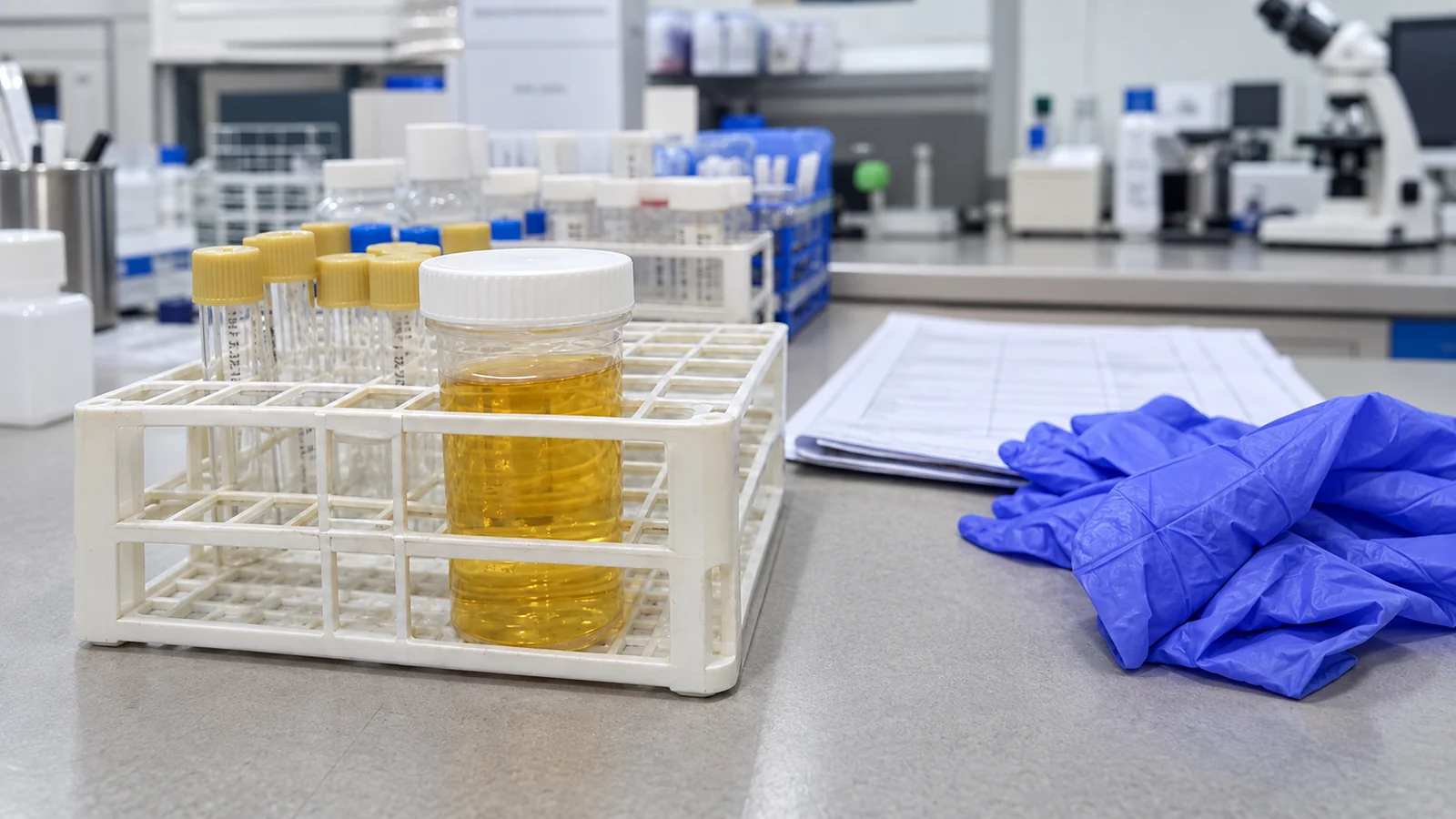

A urine sample is easy to give. That convenience has made urine-based cancer tests an appealing idea for decades.
But the word cancer covers diseases in very different parts of the body. A test that helps with bladder cancer does not automatically work for ovarian cancer.
The most useful question is not whether a urine test can detect a marker. It is whether that result improves a real decision for the person being tested.
Why the cancer’s location matters
The bladder stores urine, so its lining remains in direct contact with the sample. Cells, proteins, and genetic material released from a bladder tumor can enter that fluid.
That physical relationship gives researchers several possible signals to study. It does not mean every bladder cancer sheds enough material for every test to find it.
Other conditions can also change what appears in urine. Infection, inflammation, bleeding, and benign urinary problems can complicate interpretation (National Cancer Institute, 2024a).
The ovaries do not line the urinary tract. A signal from an ovarian tumor would need a different biological route into urine and would often be much more diluted.
That difference helps explain why one sample type can be useful for one cancer and experimental for another. Anatomy is a starting point, not proof that a test is clinically useful.
Researchers must also decide which part of the urine sample to analyze. Whole cells, cell-free genetic fragments, proteins, and metabolites answer different biological questions.
A method that works under controlled laboratory conditions may be harder to reproduce across clinics. Collection timing, storage, and processing can change what a laboratory detects.
A blood test faces a similar question. Finding a molecule in a sample is only the first step toward showing that the test helps patients.
The sample is convenient. The clinical decision still has to be earned.
What bladder urine tests actually measure
Several bladder cancer marker tests have been cleared or approved for specific uses. Examples include NMP22, BTA stat, UroVysion, and ImmunoCyt (American Urological Association, 2024).
NMP22 and BTA look for proteins associated with bladder cancer. UroVysion examines chromosomal changes in cells shed into urine, while ImmunoCyt uses fluorescent antibodies to identify certain cells.
These are not interchangeable tests. They measure different things, have different accuracy profiles, and were evaluated for particular clinical contexts.
Even a device with FDA authorization is not a general invitation for healthy people to order it. Its intended use, the patient’s symptoms, and follow-up plan all matter.
Ask whether the authorization concerns an initial evaluation, a prior cancer’s surveillance, or another narrower use. The label is more informative than a headline saying only “FDA cleared.”
For example, FDA labeling for UroVysion describes use alongside standard diagnostic procedures, not instead of them (U.S. Food and Drug Administration, 2005).
A positive result needs interpretation. It may justify more investigation, but it does not by itself establish a cancer diagnosis.
A negative result can also be misleading if someone treats it as a guarantee. Test sensitivity varies by tumor characteristics and clinical setting (American Urological Association, 2024).
Why a marker does not replace cystoscopy
Cystoscopy lets a clinician look inside the bladder and assess abnormal areas directly. A biopsy can then provide tissue for a pathologist to examine (National Cancer Institute, 2024a).
Urine cytology takes a different approach. A laboratory checks urine for abnormal cells, often as part of a broader evaluation or follow-up plan.
Neither is perfectly comfortable or perfectly accurate. Still, a convenient marker needs strong evidence before it can replace an established diagnostic step.
The American Urological Association states that urinary biomarkers should not replace cystoscopy during surveillance for non-muscle-invasive bladder cancer. Its strong recommendation reflects the risk of missing a recurrence (American Urological Association, 2024).
That does not make the markers useless. In selected circumstances, a clinician may use a marker to help interpret an equivocal cytology result or monitor response to a treatment.
The crucial distinction is between an added piece of information and a replacement decision. A test can be useful in the first role without being safe in the second.
Replacing a procedure would require evidence that the new strategy finds the dangerous cases without creating unacceptable delays. Convenience alone cannot answer that question.
The same principle applies to broader cancer screening. Our article about Olivia Munn’s risk assessment shows why one reassuring result cannot erase all other risk information.
Why ovarian urine research is different
Researchers have studied urine proteins, metabolites, and other candidate markers for ovarian cancer. A systematic review identified 27 studies published through April 2021 (Owens et al., 2022).
Some studies reported promising sensitivity and specificity. The review nevertheless called for large, prospective external validation before clinical implementation.
A result from a small study can look impressive for several reasons. Its cases may be unusually clear, its comparison group may be unlike typical patients, or its cutoff may be tuned after seeing the data.
A screening test must work in people who do not yet know they have disease. It must also show that using the result improves outcomes enough to outweigh false alarms and missed cancers.
The National Cancer Institute does not list a standard urine screening test for ovarian cancer. It explains that even established proposed screening approaches have not shown a clear mortality benefit for average-risk women (National Cancer Institute, 2025).
That is a higher bar than detecting a biomarker in a laboratory sample. It is the reason a promising discovery headline should not be mistaken for a clinic-ready test.
External validation matters because researchers cannot know whether an early result will generalize to different ages, disease stages, laboratories, and noncancer conditions. A test must survive those ordinary differences.
For another example of a cancer story where attention to symptoms matters more than a shortcut, see our report on Cameron Mathison’s kidney cancer experience.
Screening, diagnosis, and surveillance are different jobs
Screening checks people who have no symptoms. Diagnosis investigates a symptom or abnormal finding, while surveillance looks for recurrence after a known cancer.
The same assay may perform differently across those groups. Cancer is less common in an average-risk screening group, which changes how many positive results are false alarms.
Bladder cancer has no standard screening test for people at average risk, according to the National Cancer Institute (National Cancer Institute, 2024b).
Someone with visible blood in urine is not in that average-risk screening situation. The symptom needs a clinical evaluation even if the bleeding stops.
Someone who has already been treated for bladder cancer is in a third situation. A clinician may plan repeated cystoscopy and possibly additional tests based on recurrence risk.
Collapsing these three jobs into the phrase “cancer test” hides the real stakes. Before buying or interpreting any test, ask which of these decisions it was designed to support.
A test result is only useful when you know what decision follows it.
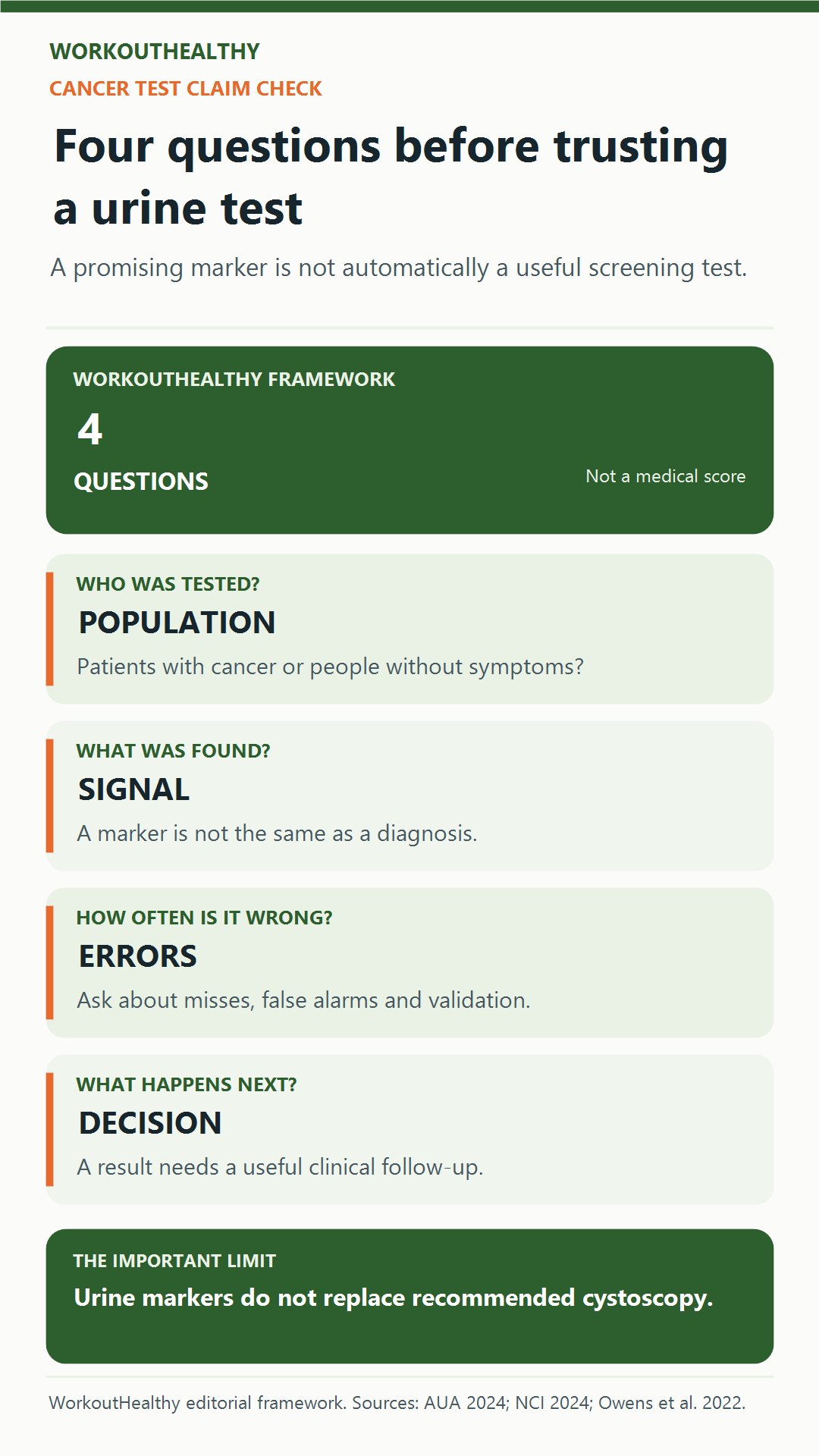
A four-question check for any cancer test claim
WorkoutHealthy uses this four-question check to separate a promising laboratory result from a practical health decision. It is an editorial framework, not a validated medical score.
First, who was tested? A study in people with confirmed advanced cancer cannot establish how a test performs in healthy people with no symptoms.
Second, what did the test detect? Detecting a signal is not identical to diagnosing a cancer, locating a tumor, or predicting a meaningful outcome.
Third, what were the errors? Ask about false negatives, false positives, and whether a separate group reproduced the result.
Fourth, what changes next? A positive test should lead to a defined and appropriate clinical step, not simply more anxiety and a repeat of the same uncertain test.
Apply all four questions to the bladder-versus-ovarian comparison. Bladder markers have specific authorized uses, but still do not replace cystoscopy.
Ovarian urine markers remain research candidates. Without prospective validation and a proven clinical pathway, a high number in one small study is not a screening recommendation.
These questions also help when a headline says a test is “accurate.” Accuracy is not one number, and its meaning changes with the population being tested.
Symptoms and sensible next steps
Blood in urine is the most common bladder cancer symptom, but infections and stones can also cause it. Frequent urination or burning can likewise have many causes (National Cancer Institute, 2023).
Do not try to sort those possibilities with a home cancer marker. Tell a clinician about visible blood in urine or persistent urinary changes so the right evaluation can be planned.
Bring a timeline: when the symptom started, whether it recurred, and whether pain or fever occurred. This practical record can help the visit, but it is not a substitute for an examination.
For a separate guide to noticing changes without self-diagnosing, read what stool color can and cannot signal.
If a clinician recommends a urine marker, ask what its result would change. You can also ask whether a normal result would alter the need for cystoscopy or other follow-up.
If a commercial test promises to screen for many cancers from one sample, look for prospective evidence in the intended population. Marketing claims should not be your only source.
The bottom line
Urine testing already has a real, limited role in bladder cancer care. It can add information, but it cannot safely replace the diagnostic or surveillance steps your clinician recommends.
Ovarian urine biomarkers are still a research question. Promising early findings have not turned them into a standard screening test.
The practical takeaway is to take symptoms seriously and judge each test by its intended use. Ask what it measures, how often it is wrong, and what happens next.
For more evidence-led health explainers, join the WorkoutHealthy email list. Keep medical decisions with your care team.
References
American Urological Association. (2024). Diagnosis and treatment of non-muscle invasive bladder cancer: AUA/SUO guideline. https://www.auanet.org/documents/Guidelines/PDF/2024%20Guidelines/NMIBC%20Amendment%2001-09-24%20Final.pdf
National Cancer Institute. (2023). Bladder cancer symptoms. https://www.cancer.gov/types/bladder/symptoms
National Cancer Institute. (2024a). Bladder cancer diagnosis. https://www.cancer.gov/types/bladder/diagnosis
National Cancer Institute. (2024b). Bladder cancer screening. https://www.cancer.gov/types/bladder/screening
National Cancer Institute. (2025). Ovarian, fallopian tube, and primary peritoneal cancers screening. https://www.cancer.gov/types/ovarian/patient/ovarian-screening-pdq
Owens, G. L., Barr, C. E., White, H., Njoku, K., & Crosbie, E. J. (2022). Urinary biomarkers for the detection of ovarian cancer: A systematic review. Carcinogenesis, 43(4), 311 to 320. https://doi.org/10.1093/carcin/bgac016
U.S. Food and Drug Administration. (2005). UroVysion bladder cancer kit: Intended use. https://www.accessdata.fda.gov/cdrh_docs/pdf3/p030052c.pdf
Medical disclaimer: This article is general health information, not medical advice. A urine marker result cannot diagnose or rule out cancer on its own. If you notice blood in urine or have persistent symptoms, speak with a qualified clinician. Follow the testing and surveillance plan you make with your care team.