

Quick take: A pharmacy insurance copay is not guaranteed to be the lowest price for a prescription. Asking for the price without insurance can reveal a better deal, particularly for some generic drugs. But an influential 2018 study of 2013 claims did not directly compare each person’s copay with the cash price posted at their pharmacy. It compared copays with a national-average reimbursement benchmark. The practical lesson is to request both current quotes for the exact same prescription, then check what paying outside your plan means for your deductible and coverage.
What did the USC pharmacy study actually measure?
Researchers Karen Van Nuys, Geoffrey Joyce, Rocio Ribero, and Dana Goldman examined claims from a large commercial insurer for the first half of 2013. Their sample represented 9.5 million filled prescriptions by 1.6 million subscribers. For each claim, they could see what the patient paid as a copayment. They combined those records with the National Average Retail Price, a then-available benchmark of average reimbursement to pharmacies for commercially insured prescriptions. Their question was whether a patient’s copay could exceed the estimated amount paid to the pharmacy for the medicine. (Van Nuys et al., 2018).
That design matters. The reimbursement benchmark was a national average for a particular drug and quantity, not the actual reimbursement on each individual claim. Nor was it a pharmacy’s publicly quoted cash price for a customer who did not use insurance. To reduce false positives, the researchers counted an apparent overpayment only when the copay exceeded the benchmark by more than $2 for drugs reimbursed below $20, or by more than 10% for higher reimbursements. Even with that buffer, the estimate could be high or low for an individual transaction because actual contracts and pharmacies vary.
The paper calls this pattern a copay clawback. In some arrangements, a pharmacy benefit manager, insurer, or contracting entity could capture the difference between what a patient paid and what the pharmacy was reimbursed. The study could identify likely overpayments but could not directly trace every dollar through every private contract. Treat the mechanism as a reason to ask questions, not as proof that your own claim involved a clawback.
What were the real numbers?
Using its conservative definition, the study estimated that 23% of the sampled commercial pharmacy claims involved an overpayment. Among those flagged claims, the mean overpayment was $7.69, not $7.49. About 28% of generic-drug claims met the definition, compared with about 6% of brand-name claims. Generic claims were more likely to be flagged, although the average dollar overpayment when one occurred was smaller for generics than for brands: $7.32 versus $13.46. The researchers estimated more than $135 million in overpayments within their 2013 sample. (Van Nuys et al., 2018).
Those figures describe a particular historical dataset and method. The 23% is not the share of prescriptions for which a shopper would have saved money with cash, because the authors did not collect cash quotes for every claim. The $135 million is an estimate for their sample, not an audited national total. The $7.69 average applies only to claims identified as overpayments, not to all 9.5 million prescriptions. Small differences in wording change the meaning of each number.
If you saw our Facebook graphic saying $7.49, the primary USC white paper reports $7.69. We use the source’s number here. The central consumer question remains useful, but the research should not be stretched into a claim about today’s prices or the exact cash deal at any one store.
Why might the cash price differ from an insured copay?
Insurance and cash purchases travel through different pricing paths. A plan may assign a fixed copay or coinsurance amount. A pharmacy may offer an uninsured cash price, a discount-card price, or a membership price. Each can be based on different contracts, fees, and eligibility rules. For an inexpensive generic, a fixed copay can exceed the price a patient could pay without using the benefit. The reverse can also happen: insurance may be much cheaper, particularly for a costly brand-name medicine or once a deductible is met.
Ask for comparable quotes on the same drug, strength, quantity, formulation, and pharmacy. Changing from a brand to a generic, a 30-day to a 90-day supply, or a retail to a mail-order pharmacy may be useful, but those changes answer a different comparison. Do not substitute medications, skip doses, or change the prescribed amount on your own to chase a posted price. Your prescriber or pharmacist can help assess therapeutic alternatives if cost is a barrier.
One well-known prescription with ongoing health discussion is metformin. Our separate metformin and exercise article is about evidence and treatment context, not pharmacy prices. It illustrates why price alone should never decide whether a person starts or stops a medication. The same principle applies to every chronic prescription.
What happened to pharmacy gag clauses in 2018?
Before federal changes, some contracts were reported to limit a pharmacist’s ability to volunteer that a customer could pay less without insurance. Two laws signed in October 2018 addressed that information barrier. The Patient Right to Know Drug Prices Act covers certain group health plans and health insurance issuers, while the Know the Lowest Price Act addresses Medicare Part D plans. They prohibit specified contractual restrictions or penalties on a pharmacy for telling a patient about a lower out-of-plan price. (U.S. Congress, 2018a, 2018b).
The laws protect price disclosure; they do not establish that cash is always cheaper, set a universal prescription price, or erase every difference among plans. The applicability of a particular protection depends on the type of coverage and contract. CMS had also publicly warned Part D plans against gag clauses in 2018. You do not need to diagnose a hidden contract to ask a straightforward question: “What would this exact prescription cost if I did not use my insurance?” (CMS, 2018).
Regulation and contracts continue to evolve, so a study from 2013 cannot establish how often any practice occurs today. The point of checking current quotes is that a historical average is no substitute for your own transaction.
How can you compare a prescription’s prices safely?
- Identify the exact prescription. Have the drug name, dosage, formulation, quantity, and pharmacy location ready. If a generic is possible, ask your clinician or pharmacist whether it is clinically appropriate.
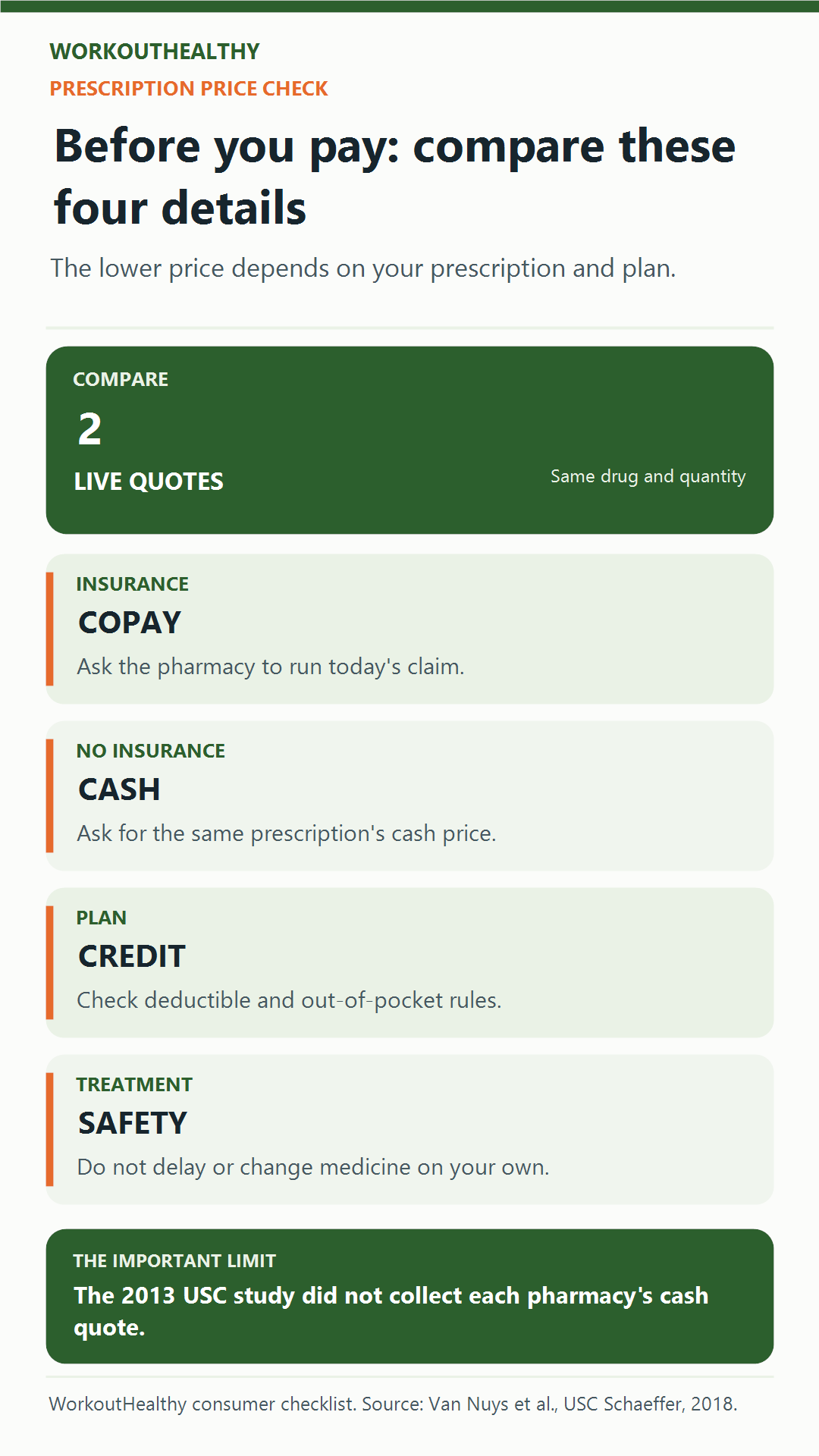
- Ask for the insured price. Have the pharmacy run the claim and tell you your actual current copay or coinsurance. A website estimate can differ from the final claim.
- Ask for the cash quote. Request the price for the same prescription without billing insurance. If you have a discount card, ask for that quote separately and check its terms.
- Compare total costs. Include any membership or card fee, dispensing charge, shipping cost, and extra travel. For ongoing medicines, compare the expected cost over several fills, not only one visit.
- Check plan consequences. Ask your insurer whether a cash purchase can be submitted for reimbursement or counted toward a deductible or out-of-pocket limit. Do not assume that it will.
- Choose with continuity in mind. Make sure the pharmacy can fill on time and that your care team has a current medication list. Ask about assistance programs if neither price is affordable.
It can help to write the two quotes down with the date. Prices can change between calls and fills. If the pharmacist cannot quote both paths until a prescription is on file, ask what information is needed and whether the comparison can be made before you complete the purchase.
When might paying cash be a poor trade?
A lower cash price today may not be the cheapest choice over an entire plan year. Money paid outside your insurance may not count toward your prescription deductible or out-of-pocket maximum. If you expect expensive medications later, that accounting can matter. A cash purchase may also mean your insurer does not see the claim in its records. Pharmacies and clinicians can still maintain medication lists, but it is wise to tell your care team about every prescription you fill.
For Medicare Part D or other programs, specific rules can differ from a commercial plan. Ask the plan directly how a non-covered, cash, or discount-card transaction is treated. The USC authors separately looked at a Medicare sample and noted that Part D rules differ. Do not transplant the commercial study’s percentage to Medicare beneficiaries. (Van Nuys et al., 2018).
Do not delay an urgent or essential medication merely to optimize an online quote. If a price makes treatment unaffordable, tell the pharmacist and prescriber promptly. They may know of covered alternatives, a different supply size, assistance programs, or a way to avoid an interruption. A small per-fill saving should be weighed against clinical safety and reliable access.
What can the study not tell us about today’s market?
The data were from the first half of 2013, one large insurer, and a national-average reimbursement survey that was available only briefly. The authors explicitly warned that an individual copay above the national benchmark does not prove it exceeded the actual negotiated payment on that claim. They could not observe the cash price each person would have been offered. They also could not establish who ultimately retained each apparent overpayment under every contract. (Van Nuys et al., 2018).
Pharmacy markets, benefit designs, laws, and pricing programs have changed since then. A present-day shopper can learn more from two live quotes than from a decade-old prevalence estimate. The historical paper is valuable because it revealed a design problem with apparently simple copays. It is not a calculator for your next prescription. Likewise, its average is not a promised saving, and a higher price at one pharmacy says nothing certain about another pharmacy.
Health research often has this split between a useful population-level insight and a person’s next action. Our article on urine cancer tests makes the same distinction in a different setting: a promising signal is not a stand-alone answer. Here, the stand-alone answer is a current, apples-to-apples quote with the plan implications spelled out.
The bottom line
Ask your pharmacist to compare the insured price and cash price for the same prescription before you pay. The USC study found likely copay overpayments in a substantial share of its 2013 commercial sample, with an average of $7.69 among flagged claims, but it did not directly measure what those patients could have paid in cash. Federal laws now restrict certain gag clauses, making it easier to discuss a lower out-of-plan price. Your best choice still depends on today’s quotes, your benefit rules, and safe, uninterrupted treatment.
Health and financial information disclaimer: This article is general information, not medical, legal, insurance, or financial advice. Do not change a prescribed medication without speaking to your care team. Confirm pricing and benefit consequences with your pharmacy and insurer.
References
- Van Nuys, K., Joyce, G., Ribero, R., & Goldman, D. (2018). Overpaying for prescription drugs: The copay clawback phenomenon. USC Schaeffer Center for Health Policy & Economics.
- U.S. Congress. (2018a). Patient Right to Know Drug Prices Act (Public Law 115-263).
- U.S. Congress. (2018b). Know the Lowest Price Act (Public Law 115-262).
- Centers for Medicare & Medicaid Services. (2018). CMS sends clear message to plans: Stop hiding information from patients.