

Cameron Mathison built a career on daytime television, first as Ryan Lavery on All My Children and later as Drew Cain on General Hospital, a role he has held since 2021.
In September 2019, he shared something with fans that had nothing to do with a script.
He disclosed a diagnosis of renal cell carcinoma, the most common form of kidney cancer, and stepped away from work for several weeks to undergo surgery and treatment.
Mathison has said that paying attention to a small change in his body made a real difference in catching the disease.
He has described noticing something felt subtly off, following up on it rather than assuming it was nothing, and encouraged fans to be their own best health advocate in the years since.
That message, about noticing small changes and acting on them, has become a consistent thread in how he talks about the experience publicly.
Mathison is a Canadian born actor who built his broadcast career largely in the United States, working across daytime drama, entertainment news, and lifestyle television for more than two decades.
That long public career is part of why his 2019 disclosure resonated so widely with a loyal, longtime audience that had followed him for years.
What Actually Happened
Mathison disclosed his diagnosis and treatment publicly in September 2019, sharing that he would be taking time away from his hosting and acting work to receive care.
Kidney cancer, and renal cell carcinoma specifically, often develops with few obvious warning signs in its early stages, which is part of why routine attention to unusual physical changes matters so much.
Mathison has continued his acting career in the years since, taking on the role of Drew Cain on General Hospital starting in 2021, a demanding, ongoing role on a daily production schedule.
He has also continued his work as a television host and correspondent, including past hosting duties on Hallmark’s Home & Family and entertainment reporting for outlets including Entertainment Tonight.
Beyond his acting career, Mathison has faced other significant personal challenges in recent years, including losing his home during the January 2025 Los Angeles area wildfires.
Through those challenges, his public comments about the kidney cancer diagnosis have remained centered on one consistent message: pay attention to your body, and do not brush off something that feels different.
In His Own Words
Mathison has described his experience with the diagnosis as an ongoing health journey, one that changed how closely he listens to his own body.
He has publicly encouraged people to advocate for themselves with doctors, rather than assuming a subtle symptom is nothing worth mentioning.
That framing, noticing something small and choosing to get it checked, mattering more than it seems in the moment, has become the throughline of how he discusses the diagnosis publicly.
Exact wording from his interviews has varied across the years he has spoken about this experience, so this article paraphrases his general message rather than presenting a single quote as verbatim.
The consistent theme across his public comments is straightforward.
Small changes are worth mentioning to a doctor, and early attention can change the entire trajectory of a diagnosis.
What the Research Says About Kidney Cancer and Early Detection
Renal cell carcinoma accounts for roughly nine out of every ten kidney cancer diagnoses, making it by far the most common form of the disease.
A comprehensive epidemiological review in European Urology examined incidence patterns, risk factors, and detection trends for renal cell carcinoma across multiple countries and populations (Capitanio et al., 2019).
The researchers noted that a meaningful share of kidney cancers are now found incidentally, often during imaging done for an unrelated reason, rather than through symptoms alone, which reflects both the disease’s often quiet early course and the value of not ignoring imaging or lab findings that turn up unexpectedly.
A cancer that often develops quietly makes a person’s own attention to their body one of the most practical tools available for catching it early.
Surgery remains the primary treatment for localized kidney cancer, typically either a partial or full nephrectomy, removal of part or all of the affected kidney.
A study in the journal Urology tracked kidney function outcomes over time in patients who underwent partial versus radical nephrectomy, finding that preserving as much healthy kidney tissue as possible during surgery was associated with better long term kidney function (McKiernan et al., 2002).
That research underscores why the specific type of surgery a person receives, and how much healthy tissue is preserved, matters for long term health beyond simply removing the cancer itself.

Exercise and Life After a Cancer Diagnosis
Physical activity has an established, evidence backed role in life during and after cancer treatment, though the right approach depends heavily on the type of cancer, treatment received, and individual recovery.
A consensus statement from an international multidisciplinary roundtable, published in Medicine & Science in Sports & Exercise, reviewed the evidence on exercise for people who have had cancer and issued specific guidelines by cancer type and treatment stage (Campbell et al., 2019).
The panel found that regular exercise is generally safe and beneficial for most cancer survivors, supporting physical function, quality of life, and in some cases reducing the risk of certain cancers returning, though the specific type, intensity, and timing of exercise should be tailored to the individual and their treatment history.
For someone who has had kidney surgery specifically, exercise guidance would reasonably need to account for how much kidney function remains and any surgical recovery considerations, which is why this kind of planning works best in partnership with a treatment team rather than through generic advice.
What This Evidence Does Not Prove
None of the research cited here describes Mathison’s specific case, treatment, or current health status in detail.
Public reporting on his diagnosis has centered on the September 2019 disclosure and his general message about self advocacy, without publishing detailed medical specifics about his particular surgery or ongoing monitoring.
This article does not make any claim about his current cancer status beyond what is publicly documented, and it deliberately avoids speculating about remission, recurrence, or any other medical detail that has not been part of his own public statements.
What is documented is that he returned to a demanding acting career in the years following his diagnosis and has continued speaking publicly about the experience.
Who Should Talk to a Doctor First
Anyone noticing blood in their urine, even a single occurrence, should see a doctor promptly, since this is one of the more common signs of kidney cancer, though it has many other possible causes as well.
Persistent back or side pain that does not have an obvious explanation is also worth mentioning to a physician, particularly if it does not improve with rest or over the counter care.
Unexplained fatigue, unintended weight loss, or a lump or mass felt in the abdomen or side are all reasons to schedule an evaluation rather than waiting to see if symptoms resolve on their own.
People with a family history of kidney cancer, or with certain inherited conditions linked to higher kidney cancer risk, should talk to a doctor about whether additional screening makes sense for them.
Anyone who has had kidney surgery and is considering starting or returning to an exercise program should talk with their surgical or oncology team first, since safe activity levels depend on individual kidney function and recovery status.
Routine physical exams and basic bloodwork, even without specific symptoms, remain a reasonable part of general preventive care, and unexpected findings on those tests are worth following up on rather than dismissing.
Practical Steps for Paying Attention to Your Body
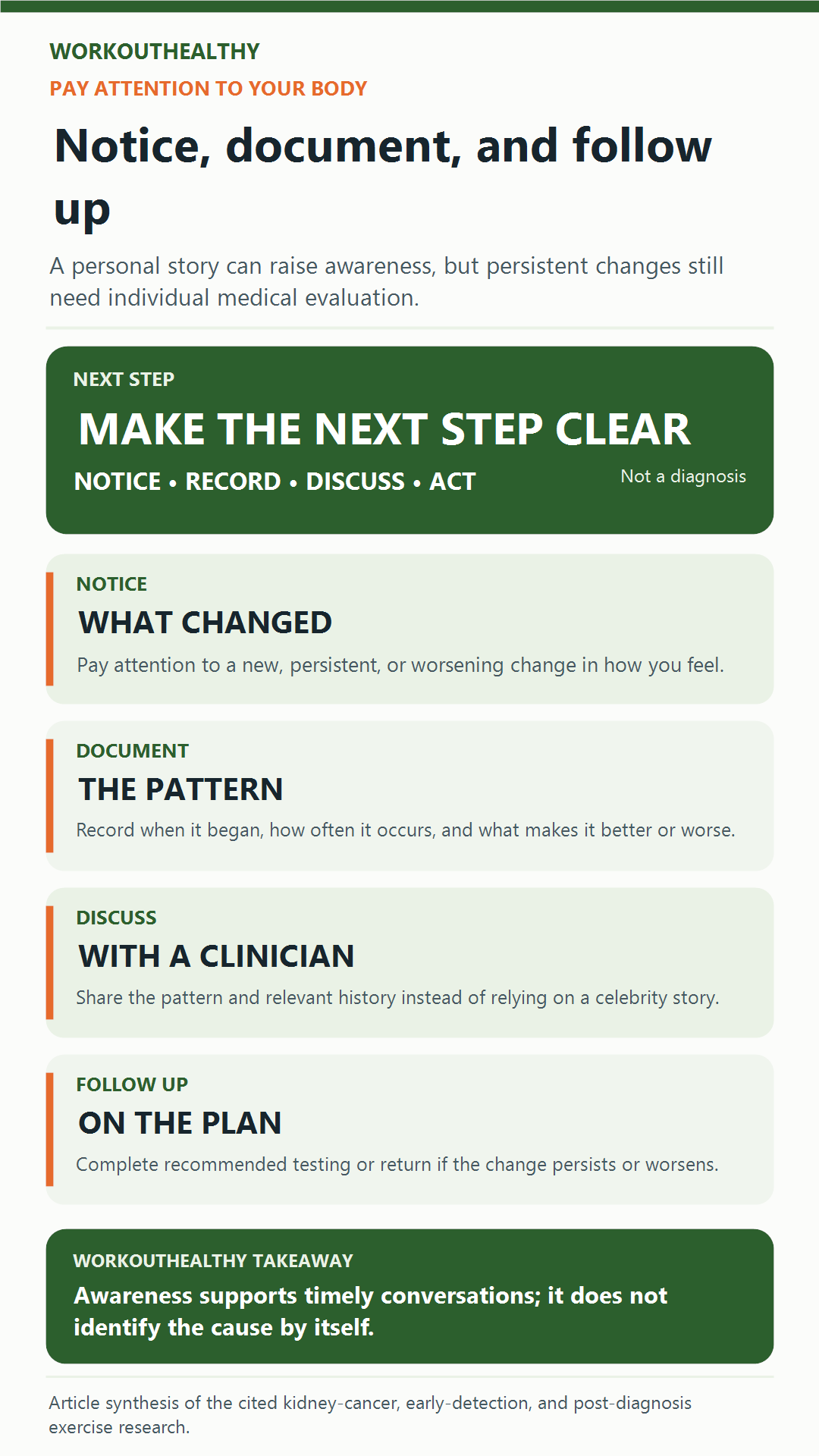
Keep a simple, honest habit of noticing changes rather than rationalizing them away.
A new symptom that lasts more than two weeks, or one that feels genuinely different from anything you have experienced before, is worth mentioning to a doctor.
Schedule routine physical exams even when you feel healthy, since some of the most useful early findings come from routine bloodwork and imaging rather than from a specific complaint.
Write down symptoms as they occur, including when they started and whether anything makes them better or worse.
That kind of specific detail helps a doctor evaluate a concern far more efficiently than a vague description recalled weeks later.
Do not let embarrassment or a busy schedule delay a conversation about something that feels off.
A five minute conversation with a doctor costs far less time than a delayed diagnosis ultimately does.
Pay attention to family health history as well, and share it with your doctor, since some kidney cancer risk factors run in families even without a formally inherited condition.
Lifestyle factors including smoking and long term high blood pressure are also linked to higher kidney cancer risk, and addressing both is part of general preventive care regardless of personal or family history.
If you have already had a cancer diagnosis and treatment, keep up with recommended follow up screenings and imaging, even years after treatment ends.
Our guide on unexpected weight and muscle loss covers another set of body changes worth mentioning to a doctor rather than dismissing.
Build a relationship with a primary care physician you trust and see regularly, rather than only seeking care when something feels seriously wrong.
Our guide on what a simple stair climbing test can and cannot tell you is a reminder that informal self checks are useful starting points, not replacements for real medical evaluation.
References
Capitanio, U., Bensalah, K., Bex, A., Boorjian, S. A., Bray, F., Coleman, J., Gore, J. L., Sun, M., Wood, C., & Russo, P. (2019). Epidemiology of renal cell carcinoma. European Urology, 75(1), 74-84.
McKiernan, J., Simmons, R., Katz, J., & Russo, P. (2002). Natural history of chronic renal insufficiency after partial and radical nephrectomy. Urology, 59(6), 816-820.
Campbell, K. L., Winters-Stone, K. M., Wiskemann, J., May, A. M., Schwartz, A. L., Courneya, K. S., Zucker, D. S., Matthews, C. E., Ligibel, J. A., Gerber, L. H., Morris, G. S., Patel, A. V., Hue, T. F., Perna, F. M., & Schmitz, K. H. (2019). Exercise guidelines for cancer survivors: Consensus statement from international multidisciplinary roundtable. Medicine & Science in Sports & Exercise, 51(11), 2375-2390.
This article is for general educational purposes and is not a substitute for personalized advice from a qualified medical professional.
Anyone with symptoms of concern, a personal or family history of cancer, or questions about exercise after cancer treatment should speak directly with their own doctor or oncology team.