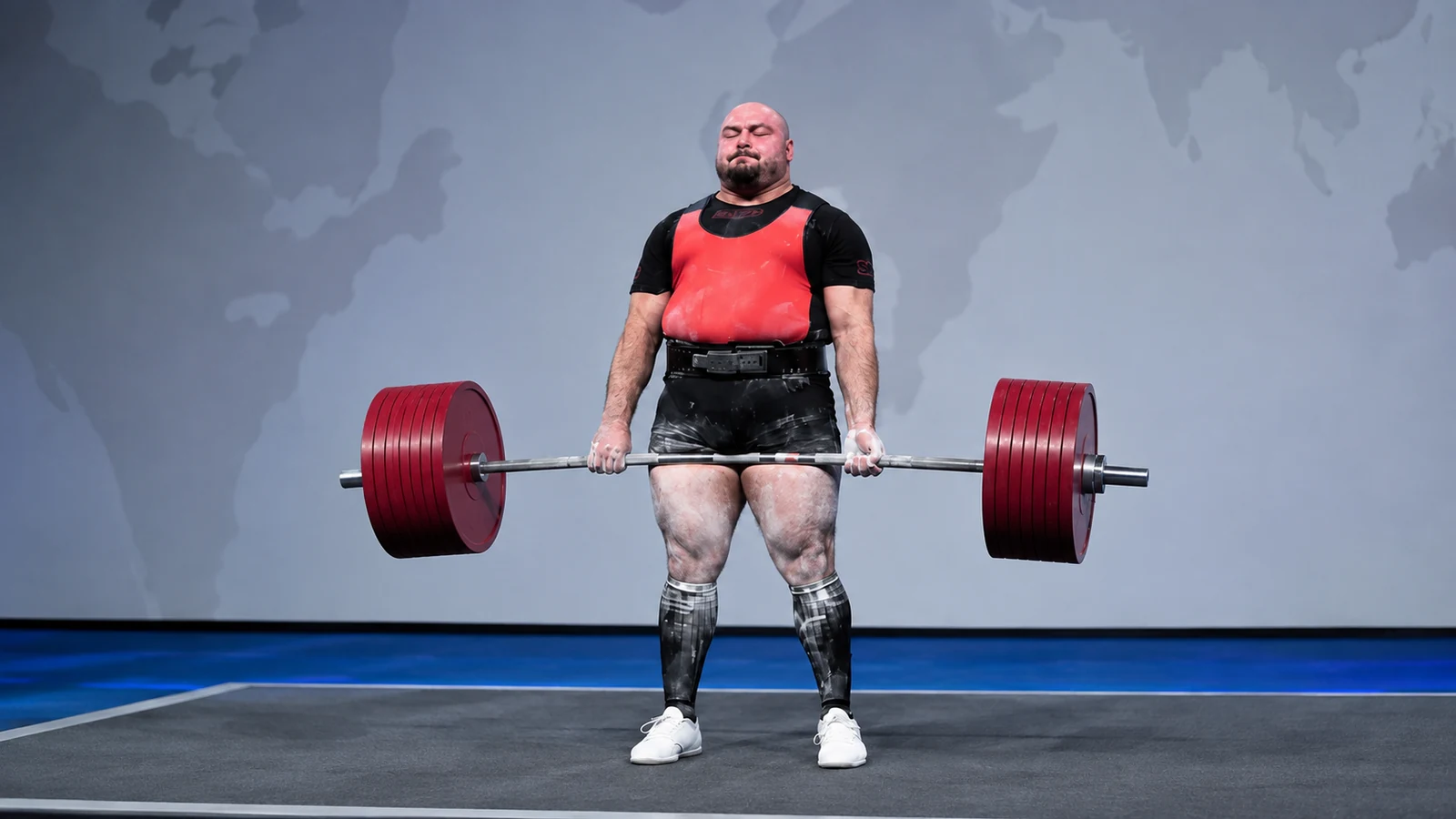

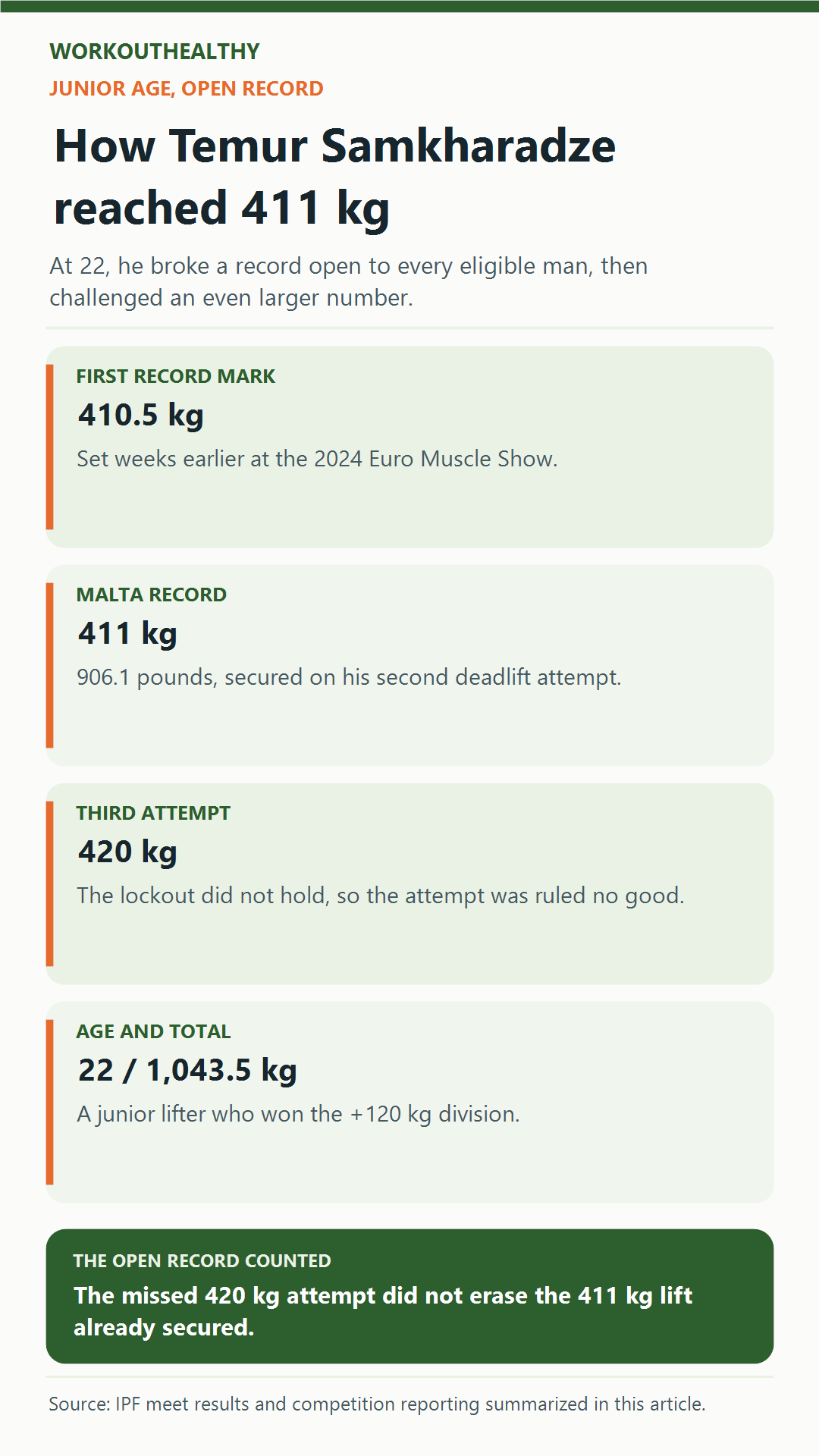
Temur Samkharadze pulled 411 kilograms off the platform in Malta.
That is 906.1 pounds, lifted off the floor to full lockout in one motion.
The number alone would turn heads at any powerlifting meet.
What makes it extraordinary is the record it broke.
Samkharadze did not just win his weight class or set a junior mark.
He set the IPF Open World Record for the raw deadlift in the super heavyweight division, a record open to every eligible man on earth, regardless of age.
He did it at 22 years old, while still competing in the junior category.
What Actually Happened in Malta
The lift came at the 2024 IPF World Junior and Sub-Junior Classic Powerlifting Championships, held in Malta in late August 2024 (FitnessVolt, 2024).
Samkharadze, competing for Georgia in the +120 kilogram super heavyweight class, opened his deadlift at 370 kilograms.
His second attempt was loaded to 411 kilograms, and the bar came all the way up to lockout.
He then tried a third pull at 420 kilograms, but the lockout did not hold and the attempt was ruled no good.
The 411 kilogram pull still counted, and it was heavy enough to break the existing Open World Record, not just a junior or sub-junior mark.
His total for the day reached 1,043.5 kilograms across squat, bench press, and deadlift, enough for first place in his division (FitnessVolt, 2024).
It was also not his first attempt at the record.
A few weeks earlier, at the 2024 IPF Euro Muscle Show in the Netherlands, he had already pulled 410.5 kilograms to set a slightly lower mark.
In Malta, he broke his own record again, this time by half a kilogram.
Junior on Paper, Open Record in Reality
Powerlifting record books separate lifters by age group as well as by weight class.
The IPF junior category covers lifters age 19 through 23, and most junior meets crown a junior champion against other young lifters in that same age band.
A junior record usually only has to beat other juniors.
Samkharadze’s 411 kilogram deadlift did something different.
It beat every man’s raw deadlift in the super heavyweight class, at any age, in any division, anywhere in the world.
That is what makes it the IPF Open World Record, the top of the entire category, not a separate junior ranking sitting underneath it.
Sports outlet FitnessVolt (2024) described it as the “+120KG IPF Open World Record,” language that specifically distinguishes it from a junior-only mark.
A junior lifter setting an outright open record is unusual enough that it makes headlines inside the sport.
Most competitive powerlifters spend a decade or more building toward their strongest pulls, and their most competitive years typically arrive well into adulthood.
Age-defying strength performances are not limited to young lifters chasing early records either.
DonnaJean Wilde set a push-up world record at 59 years old, and Edith Connor became a Guinness World Record holder for bodybuilding in her seventies.
Samkharadze’s record runs in the opposite direction from those two, arriving years earlier than expected instead of decades later.
Why This Almost Never Happens
Powerlifting performance generally follows a predictable arc tied to age.
A large analysis of USA Powerlifting competition results, covering nearly 48,000 individual results between 2012 and 2016, found that the peak age range for lifting power sits between 24 and 49 years old (Ball & Weidman, 2018).
Samkharadze set his open record at 22, several years before that typical peak window even begins.
He was competing against fully matured adult lifters, many well into that peak age range and carrying a decade or more of additional training history, and he out-pulled all of them.
That gap matters because raw deadlift strength depends heavily on total muscle mass, connective tissue strength, and neuromuscular efficiency, all of which typically keep improving well past a lifter’s early twenties (Ball & Weidman, 2018).
A 22-year-old is usually still years away from his physical strength ceiling in this sport.
Samkharadze appears to have already reached, or come very close to, an all-time ceiling for his weight class.
A 22-year-old outlifting an entire adult field, in the single heaviest raw deadlift class in the sport, is the kind of result that normally takes another decade of training to reach.
What a 411 Kilogram Pull Does to the Body
A deadlift at this weight is not simply a bigger version of a gym deadlift.
Research on elite powerlifters performing near-maximal deadlifts has measured extreme compressive and shear forces on the lower spine during these lifts.
A classic biomechanics study using elite lifters found that spinal compression forces during maximal deadlifts can approach levels once thought to sit near the structural limits of the lumbar spine (Cholewicki et al., 1991).
That research helped explain why proper bracing, a neutral spine position, and years of progressive loading matter so much at the elite level.
The body does not build the tissue tolerance for a 411 kilogram pull overnight.
It takes years of incrementally heavier training, paired with real recovery, for the spine, hips, and grip to adapt to loads like this one.
What This Record Does Not Prove
A single world record deadlift proves that one lift, on one day, under one set of competition rules, was successful.
It does not prove that heavy raw deadlifting is safe for everyone, or that younger lifters should chase maximal loads the way Samkharadze did.
Elite powerlifters like him train under close coaching, follow structured programming for years, and are assessed regularly for readiness before attempting a competition max.
The video and the number on the bar are the visible part of the record.
The invisible part is the years of technical coaching, gradual loading, and recovery management that came before it.
None of that context means an average lifter should copy the load, only the process behind it.
How a Lift Like This Gets Confirmed as a World Record
A single heavy pull does not become a world record just because it looked impressive on video.
IPF competitions require three white lights from a three-judge panel for a lift to count, confirming that depth, lockout, and control all met the rules.
Samkharadze’s 411 kilogram attempt passed that standard in front of the judging panel in Malta.
IPF-sanctioned meets like the World Junior and Sub-Junior Championships also run under the federation’s anti-doping program, since the IPF is one of the few strength federations that drug tests raw lifters at this level.
Record claims are then checked against the federation’s official records database before they are recognized as standing marks.
That database is maintained through the IPF’s own competition software and is publicly searchable by weight class, sex, and equipment category.
Samkharadze’s more recent meet results help confirm the record is still current.
Through his competitions in 2025 and 2026, he attempted to break his own mark several times and came close, missing at 411.5 kilograms and again at 413.5 kilograms, but the original 411 kilogram lift from Malta has continued to hold as of his most recent results (OpenPowerlifting, n.d.).
Common Mistakes Lifters Make Chasing a Heavier Pull
Most lifters who get hurt chasing a heavier deadlift make the same handful of mistakes.
They add weight faster than their technique can actually support.
A rounding lower back under load is one of the most common breakdowns, and it usually shows up first near lockout, which is exactly where Samkharadze’s failed 420 kilogram attempt fell apart.
Skipping a proper warm-up is another common error, since cold connective tissue tolerates sudden heavy loading far worse than warm tissue.
Many lifters also test personal records too often, without enough lighter, technique-focused training in between attempts.
Grip failure is a quieter but frequent problem, since a bar that slips mid-pull can end a lift before the legs or back are ever fully tested.
Who Should Be Extra Cautious Before Loading the Bar
Younger lifters and teenagers should be especially careful about chasing maximal single-rep loads.
Bone, tendon, and growth plate tissue can still be developing into a person’s early twenties, and coaches generally recommend a longer runway of technique work before testing a true one-rep max.
Anyone with a history of lower back pain, disc issues, or a previous training injury should talk to a doctor or physical therapist before attempting heavy deadlifts.
The same caution applies to anyone returning to training after a long break, since strength can return faster than the tissue tolerance needed to support it safely.
A qualified coach can help decide when someone is actually ready to test a true max, rather than leaving it to guesswork, and that guidance is part of what you are paying for when you hire a personal trainer.
How to Build Toward a Heavier Deadlift Safely
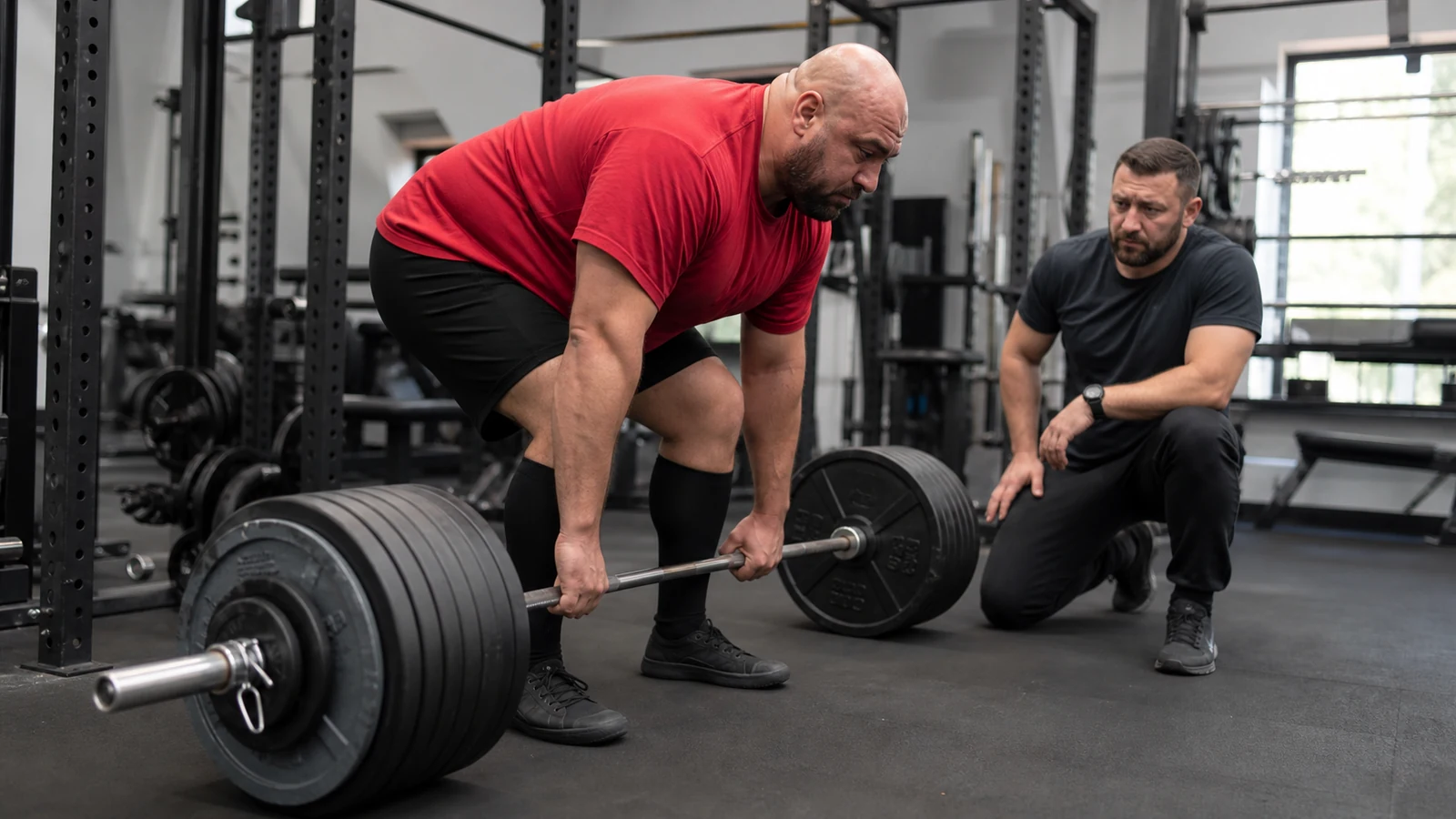
Building a bigger deadlift starts with consistent technique work at manageable weights, not with testing a max every week.
A structured program that increases load gradually over months, rather than jumping weight from session to session, gives connective tissue time to adapt.
Accessory work for the hamstrings, glutes, and upper back builds the supporting strength that a heavy pull actually depends on.
Grip training matters too, since a strong back is not much use if the bar slips out of your hands first.
Recovery is not optional at this level, and that includes sleep, since poor sleep timing can blunt the recovery a hard pulling session requires, which is one reason late-day caffeine can work against a lifter chasing a bigger total.
Most lifters see faster, safer progress by adding small amounts of weight over a long stretch of consistent training than by trying to force a personal record on a single big day.
Watch the Original Video
Want more verified strength feats like this one? Subscribe to WorkoutHealthy Insider for practical explanations behind popular fitness claims.
References
Ball, R., & Weidman, D. (2018). Analysis of USA Powerlifting Federation data from January 1, 2012–June 11, 2016. Journal of Strength and Conditioning Research, 32(7), 1843–1851. https://doi.org/10.1519/jsc.0000000000002103
Cholewicki, J., McGill, S. M., & Norman, R. W. (1991). Lumbar spine loads during the lifting of extremely heavy weights. Medicine & Science in Sports & Exercise, 23(10), 1179–1186. https://doi.org/10.1249/00005768-199110000-00012
FitnessVolt. (2024, August 27). Temur Samkharadze (+120KG) sets 411-kg raw deadlift IPF Open World Record. https://fitnessvolt.com/temur-samkharadze-411-kg-raw-deadlift-ipf-open-world-record/
OpenPowerlifting. (n.d.). Temur Samkharadze competition results. Retrieved September 3, 2026, from https://www.openpowerlifting.org/u/temursamkharadze
This article is for general information only and is not medical advice. If you have an injury, ongoing pain, or a medical condition, talk to a doctor or physical therapist before you change how you train or eat.