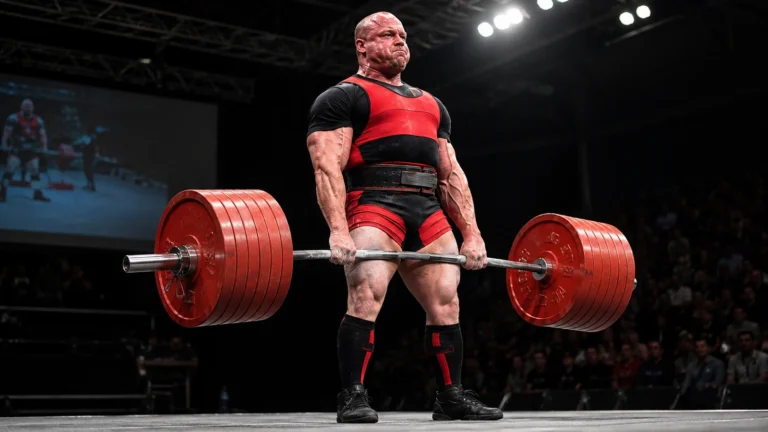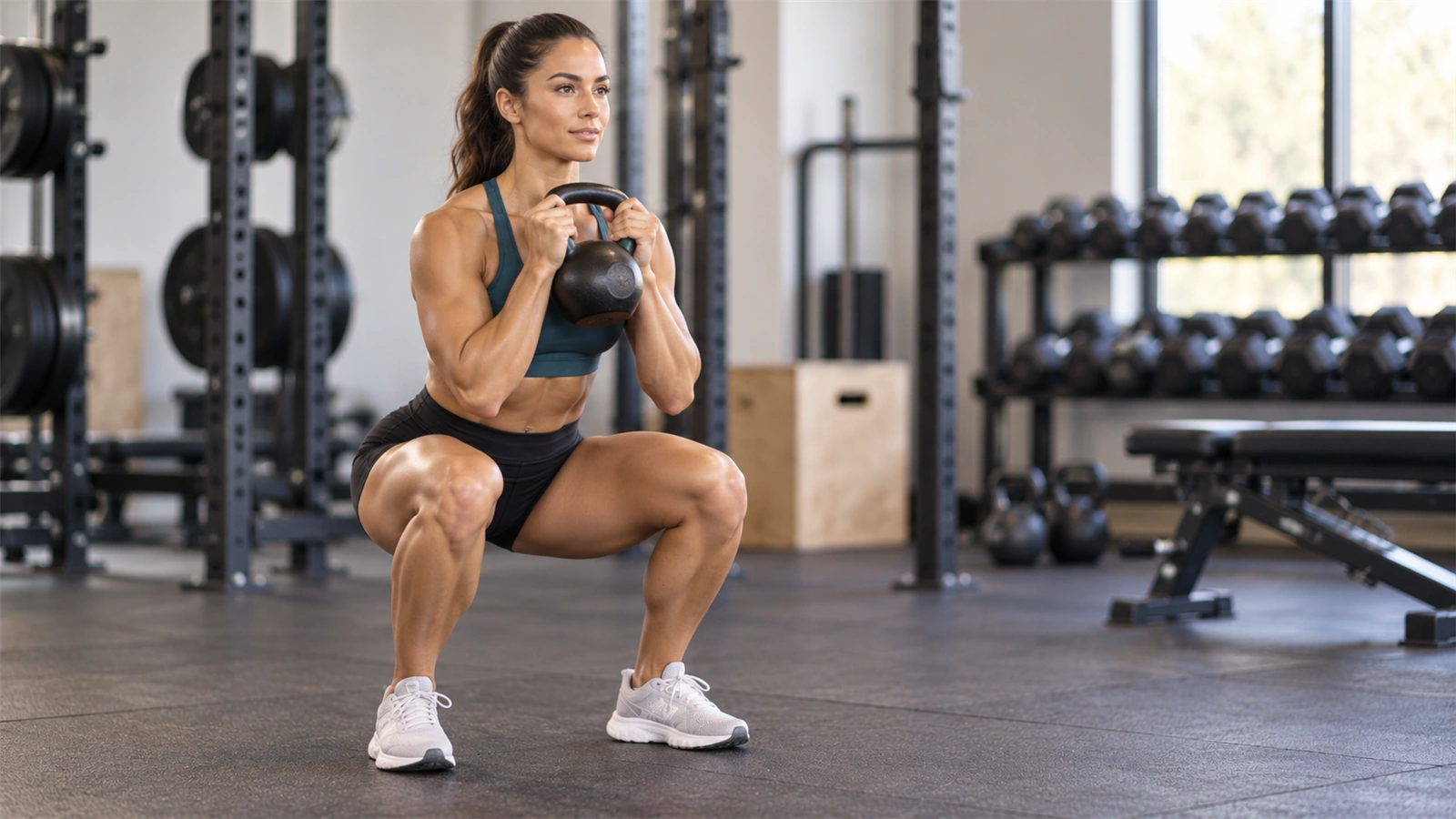

The best quadriceps workout is not one magic squat variation. It is a short list of knee extension exercises that you can perform through a useful range, train hard enough, recover from, and progressively load.
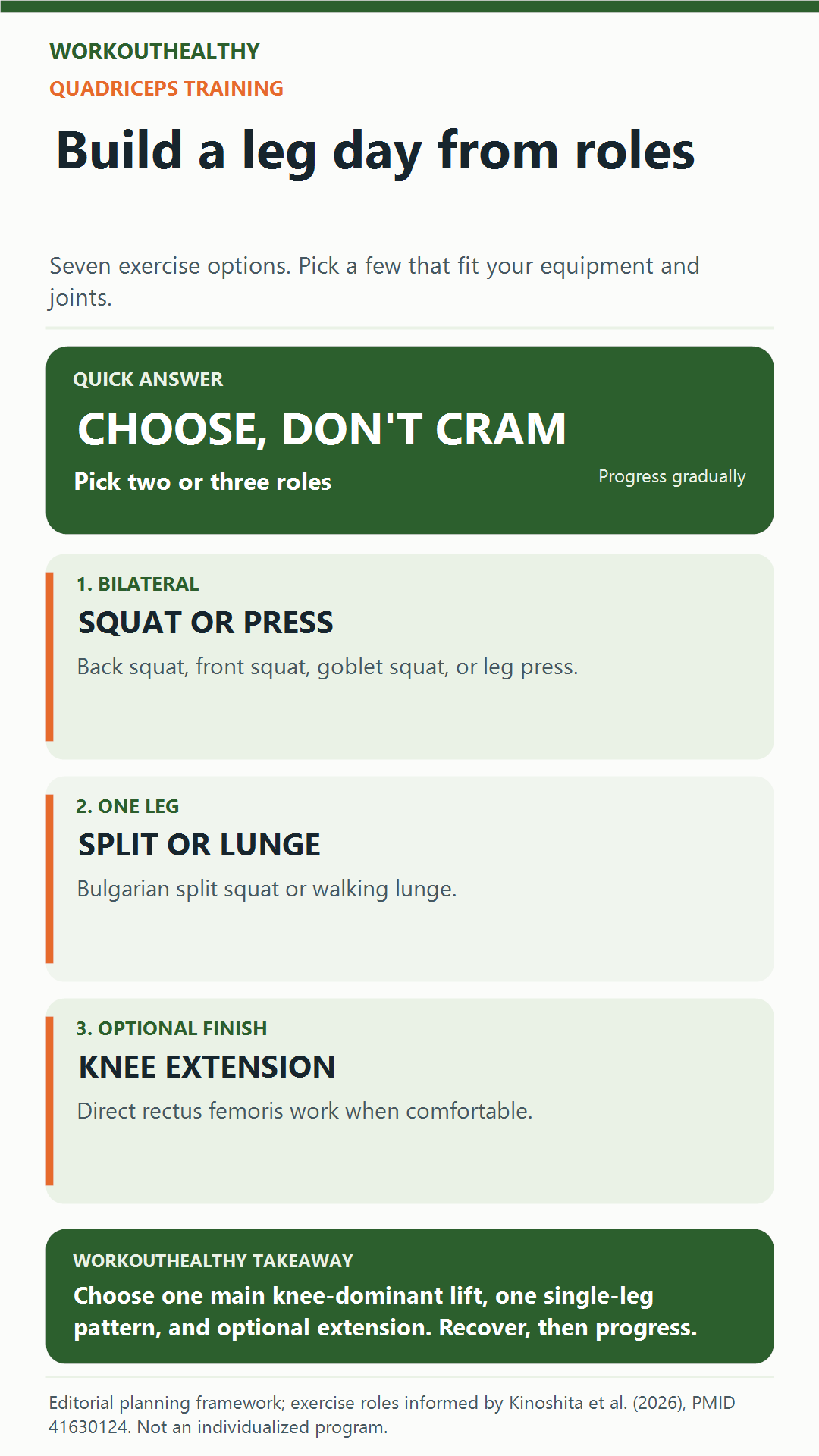
Back squats, front squats, Bulgarian split squats, leg presses, knee extensions, walking lunges, and goblet squats can all contribute. They are options to combine selectively, not seven exercises you must cram into every session. Their value comes from useful knee extension, repeatable effort, and progression, not a claim that one movement isolates the quadriceps completely.
The Short Answer
Train the quadriceps twice per week with a manageable starting dose of eight to 12 challenging direct sets. Use one stable bilateral squat pattern, one unilateral pattern, and an optional knee extension exercise if equipment and joint comfort allow it.
Keep most working sets about one to three good repetitions short of failure. Add repetitions first, then increase the dumbbell load when you reach the top of the range with the same depth and control.
What the Quadriceps Actually Do
The quadriceps include the vastus lateralis, vastus medialis, vastus intermedius, and rectus femoris. All four extend the knee, while the rectus femoris also crosses the hip and helps flex it.
That second role matters for exercise selection. Squats and leg presses reliably grow the vasti, but several training studies have found little or no rectus femoris growth from those movements alone.
A 2026 within person trial compared knee extensions with leg presses for 12 weeks. Both grew the vasti and the quadriceps overall, but rectus femoris volume increased 13.2 percent with knee extensions and only 1.1 percent with leg presses.
This does not make the leg extension superior for every purpose. The leg press also grew the gluteus maximus and adductor magnus, while the isolated knee extension offered a more specific rectus femoris stimulus.
Seven Quad Exercises and What Each Contributes
A complete quad lineup can include seven familiar movements. Here is how to choose among them without mistaking a social-media cue for a universal prescription.
- Barbell back squat: A loadable bilateral squat that trains the quadriceps along with the glutes, adductors, and trunk. Use a controlled depth you can repeat; it is not automatically the best option for every knee or back.
- Front squat: The front-loaded bar changes the balance challenge and often permits a more upright torso. It can be a useful quad-focused option, but it does not guarantee less spinal loading or eliminate the need for good technique.
- Bulgarian split squat: A unilateral squat that challenges each leg and can be loaded with dumbbells. Hold a stable support if balance prevents the working leg from getting a useful stimulus.
- Leg press: A stable, highly loadable machine exercise that grows the vasti and also trains other lower-body muscles. A 2026 direct comparison found similar overall quadriceps growth with leg press and knee extension, but the leg press did not grow the rectus femoris as much. It is not a pure quadriceps isolation exercise.
- Leg extension: An actual knee-extension isolation movement. It can complement squats and presses when the machine fits and the knee tolerates it; the same trial found greater rectus femoris growth with this movement.
- Walking lunge: A moving single-leg pattern that adds coordination and conditioning demands. Begin with a shorter route or stationary split squat if stride control is the limiting factor.
- Goblet squat: A front-loaded dumbbell squat that is easy to scale and useful for learning a repeatable depth. Advanced lifters may outgrow the load they can comfortably hold at the chest.
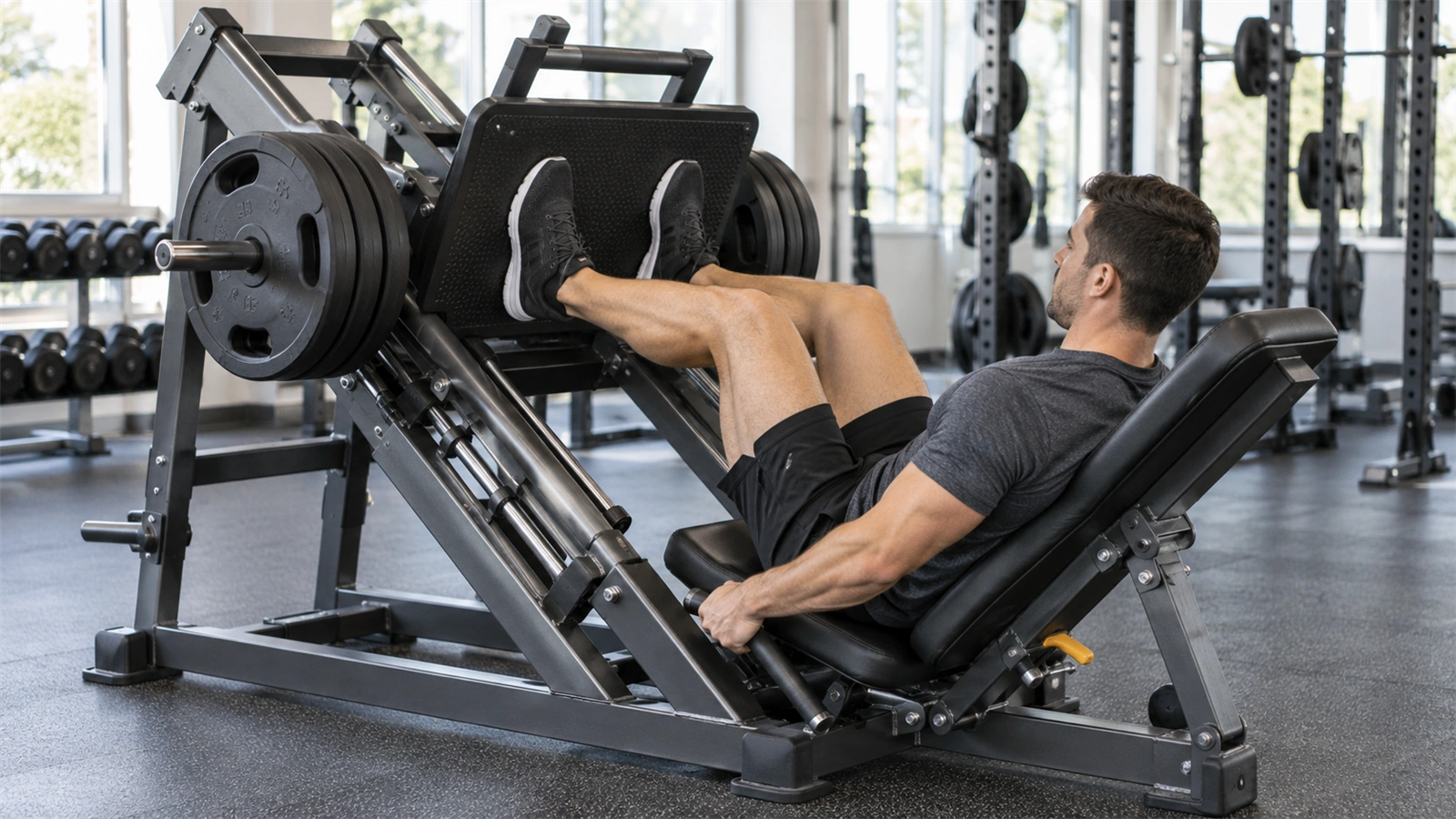
These roles explain why a “start heavy, finish with isolation” idea is an option, not a rule. A beginner may do better learning a goblet squat first, then adding a press or split squat. A trained lifter might lead with a squat or leg press and finish with knee extensions. Neither needs all seven in one workout.
How to Build a Full-Equipment Quad Day
For a simple two-day week, choose one primary bilateral pattern and one unilateral pattern per session. For example, day one could use a back or front squat for three challenging sets, a Bulgarian split squat for two sets per leg, and optional knee extensions for two sets. Day two could use a leg press for three sets, walking lunges for two sets per leg, and a goblet squat for two lighter technique sets.
Leave recovery time between hard lower-body sessions, adjust total sets for other sports and training, and progress only when your depth, control, and joint response remain consistent. The dumbbell-only plan below is an equipment-light alternative, not additional mandatory work.
Why These Dumbbell Exercises Earn a Place
A heel elevated goblet squat creates a stable front loaded squat that many people can perform with an upright torso and substantial knee flexion. Elevating the heels is an option for comfort and depth, not a requirement or a guarantee of more growth.
The Bulgarian split squat lets each leg work through a large knee and hip range with less total external load than many bilateral squats. A 2025 meta analysis found no clear hypertrophy advantage for unilateral or bilateral training, so the choice should follow comfort, balance, equipment, and the strength skill you want to build.
Walking lunges add another single leg pattern and ask you to control each transition. They train the quadriceps along with the glutes, adductors, and other muscles that stabilize the hip and trunk.
None of these exercises isolates the quadriceps. That is not a flaw, because a practical lower body movement can grow several useful muscles while still placing meaningful demand on knee extension.
If one setup does not suit your body, our guide to squat alternatives by training goal can help you choose a more repeatable pattern.
The Two Day Dumbbell Quadriceps Plan
Leave at least two days between these sessions when possible. Start at the low end of the listed sets if you are new, returning from a layoff, or already perform hard lower body work elsewhere.
Day One: Stable Strength and Control
- Heel elevated goblet squat: 3 sets of 6 to 10 repetitions.
- Bulgarian split squat: 2 sets of 8 to 12 repetitions per leg.
- Optional machine leg extension: 2 sets of 10 to 15 repetitions.
Use a stance and depth that let the feet stay planted and the knees track in a controlled path. The working range should challenge you without forcing a painful position.
Day Two: Volume and Single Leg Work
- Double dumbbell front squat: 3 sets of 8 to 12 repetitions.
- Walking lunge: 2 sets of 10 to 16 total steps.
- Supported split squat: 2 sets of 12 to 15 repetitions per leg.
Holding a rack or upright for the supported split squat is allowed. Reducing the balance demand can help the quadriceps become the limiting factor instead of turning the set into an ankle stability test.
The full plan provides 12 to 14 direct working sets across the two days, depending on whether you use the optional exercise. That is a starting framework, not a universal optimum, and sets from other squat, leg press, or lunge work also count toward the weekly dose.
Range of Motion Matters More Than an Upright Torso Cue
A more upright torso and a shorter stride can increase the knee demand in some squat and lunge setups. They do not direct 100 percent of the work into the quadriceps or remove the glutes.
Range should be judged by control, joint comfort, and whether the target muscles can keep producing force. A 2021 meta analysis found that full range training generally produced more lower body hypertrophy than final range partial repetitions.
A later review added useful detail: training at longer muscle lengths, through either a full range or certain lengthened partial ranges, often favored growth in muscles including the quadriceps. This supports using substantial knee flexion when it is tolerable rather than stopping every repetition early just to handle a heavier dumbbell.
A 10 week squat study also found that both full and half squats grew the knee extensors similarly, while full squats produced more growth in the gluteus maximus and adductors. One study cannot define the perfect depth for everyone, but it shows why deeper is not simply a quadriceps isolation trick.
Tempo Helps Only When It Improves the Repetition
A controlled lowering phase can make position and depth easier to repeat. Count about two to three seconds down if you tend to drop quickly, then stand with intent without bouncing out of a painful bottom position.
Slow motion is not automatically better for growth, and turning every repetition into a long endurance event can force the load too low. Use tempo as a consistency tool rather than a separate source of magic.
Pause for one second near the bottom when you need honest depth or want to reduce momentum. Remove the pause when it stops serving that purpose or makes the exercise unnecessarily difficult to progress.
How to Apply Progressive Overload With Dumbbells
Use double progression. Choose a repetition range, keep the same load until every set reaches the top with consistent form, then move to the next practical dumbbell increase and begin near the lower end again.
For example, perform three goblet squat sets in the 8 to 12 range. When you can complete 12, 12, and 12 with the planned depth and one to three repetitions still available, increase the load and rebuild from about eight repetitions.
If the heaviest dumbbell becomes too easy to hold at the chest, use two dumbbells, add a split squat, or make the supported single leg work harder. You can also add one set, but volume should rise only when current work is being recovered from.
The 2026 resistance training dose response meta analysis found that more weekly sets were associated with more hypertrophy on average, with diminishing returns. It did not identify one perfect set number for every person, so add work gradually and judge the result over several weeks.
Record the load, repetitions, set effort, and any change in depth. A training log that changes what you do is more valuable than relying on soreness or memory.
How Hard Should the Sets Be?
Light and heavy loads can both build muscle when sets are sufficiently demanding, although heavier loads are better for expressing maximal strength. Our guide to low versus high repetitions explains why the load should fit the exercise and goal.
You do not need to take every set to the point where another repetition is impossible. Meta analyses have not shown a consistent hypertrophy advantage for momentary failure over hard nonfailure training.
Stopping with one to three repetitions in reserve is a practical target for most sets. The final set of a stable isolation exercise can occasionally go closer to failure, but balance dependent split squats and walking lunges should end before position breaks down.
When to Add or Remove Work
Add a set only when repetitions and load have stalled for several weeks, effort is honest, sleep and food are adequate, and your knees and hips are recovering normally. More work is useful only when you can adapt to it.
Remove sets when performance drops across sessions, soreness affects the next workout, joint irritation grows, or the plan competes with running, sport, or other lower body training. The goal is the smallest dose that keeps progress moving, not the largest dose you can survive.
Keep the main exercises stable for at least six to eight weeks unless pain or equipment forces a change. Our complete training program audit can help you fit this quad work into the rest of the week.
Common Mistakes That Limit Quad Growth
- Changing exercises every week before learning or progressing them.
- Cutting every repetition short only to use a heavier dumbbell.
- Letting balance fail before the quadriceps become challenged.
- Adding sets while sleep, food, or recovery are already inadequate.
- Treating soreness as proof that a workout built more muscle.
- Ignoring the rectus femoris when machine knee extension is available and comfortable.
Who Should Modify the Plan?
Muscle effort and temporary fatigue are expected, but sharp pain, swelling, locking, repeated giving way, or pain that keeps worsening is not a hypertrophy requirement. Stop the aggravating movement and seek an appropriate clinical assessment.
People returning from knee surgery or a significant injury should use the loading and range plan given by their clinician. A generic workout cannot account for tissue healing, surgical restrictions, or the cause of current symptoms.
The Bottom Line
The best quadriceps workout combines repeatable knee dominant exercises with enough weekly work, substantial comfortable range, hard sets, and progressive overload. Dumbbells are sufficient when the exercises remain challenging and the progression is recorded.
Use squats, split squats, and lunges as the foundation, then add knee extensions when available if you want a more direct rectus femoris stimulus. Keep the plan long enough to measure it, and change the dose only when your actual results justify the change.
Get the next evidence check.
Five practical fitness stories worth your time, every Friday.
One email a week. No product pitches. Unsubscribe in one click.
References
- Kinoshita M, Maeo S, Kobayashi Y, et al. Hypertrophic Effects of Single Versus Multi Joint Exercise: A Direct Comparison Between Knee Extension and Leg Press. Medicine and Science in Sports and Exercise. 2026.
- Zabaleta-Korta A, Fernández-Peña E, Torres-Unda J, et al. The Role of Exercise Selection in Regional Muscle Hypertrophy: A Randomized Controlled Trial. Journal of Sports Sciences. 2021.
- Kubo K, Ikebukuro T, and Yata H. Effects of Squat Training With Different Depths on Lower Limb Muscle Volumes. European Journal of Applied Physiology. 2019.
- Pallarés JG, Hernández-Belmonte A, Martínez-Cava A, et al. Effects of Range of Motion on Resistance Training Adaptations: A Systematic Review and Meta Analysis. Scandinavian Journal of Medicine and Science in Sports. 2021.
- Kassiano W, Costa B, Nunes JP, et al. Which ROMs Lead to Rome? A Systematic Review of the Effects of Range of Motion on Muscle Hypertrophy. Journal of Strength and Conditioning Research. 2023.
- Kassiano W, Nunes JP, Costa B, et al. Comparison of Muscle Growth and Dynamic Strength Adaptations Induced by Unilateral and Bilateral Resistance Training: A Systematic Review and Meta Analysis. Sports Medicine. 2025.
- Pelland JC, Remmert JF, Robinson ZP, et al. The Resistance Training Dose Response: Meta Regressions Exploring the Effects of Weekly Volume and Frequency on Muscle Hypertrophy and Strength Gains. Sports Medicine. 2026.
- Refalo MC, Helms ER, Trexler ET, et al. Influence of Resistance Training Proximity to Failure on Skeletal Muscle Hypertrophy: A Systematic Review with Meta Analysis. Sports Medicine. 2023.
- Currier BS, McLeod JC, Banfield L, et al. Resistance Training Prescription for Muscle Strength and Hypertrophy in Healthy Adults: A Systematic Review and Bayesian Network Meta Analysis. British Journal of Sports Medicine. 2023.
Medical disclaimer: This article is for general information only and is not medical advice. If you have an injury, ongoing pain, or a medical condition, talk to a doctor or physical therapist before you change how you train or eat.