
From Royal Rom-Coms to a Legendary Physique
Nicholas Galitzine built his early career on romantic dramas like Purple Hearts and Red, White & Royal Blue.
He also appeared in the comedy Bottoms and the historical series Mary & George alongside Julianne Moore.
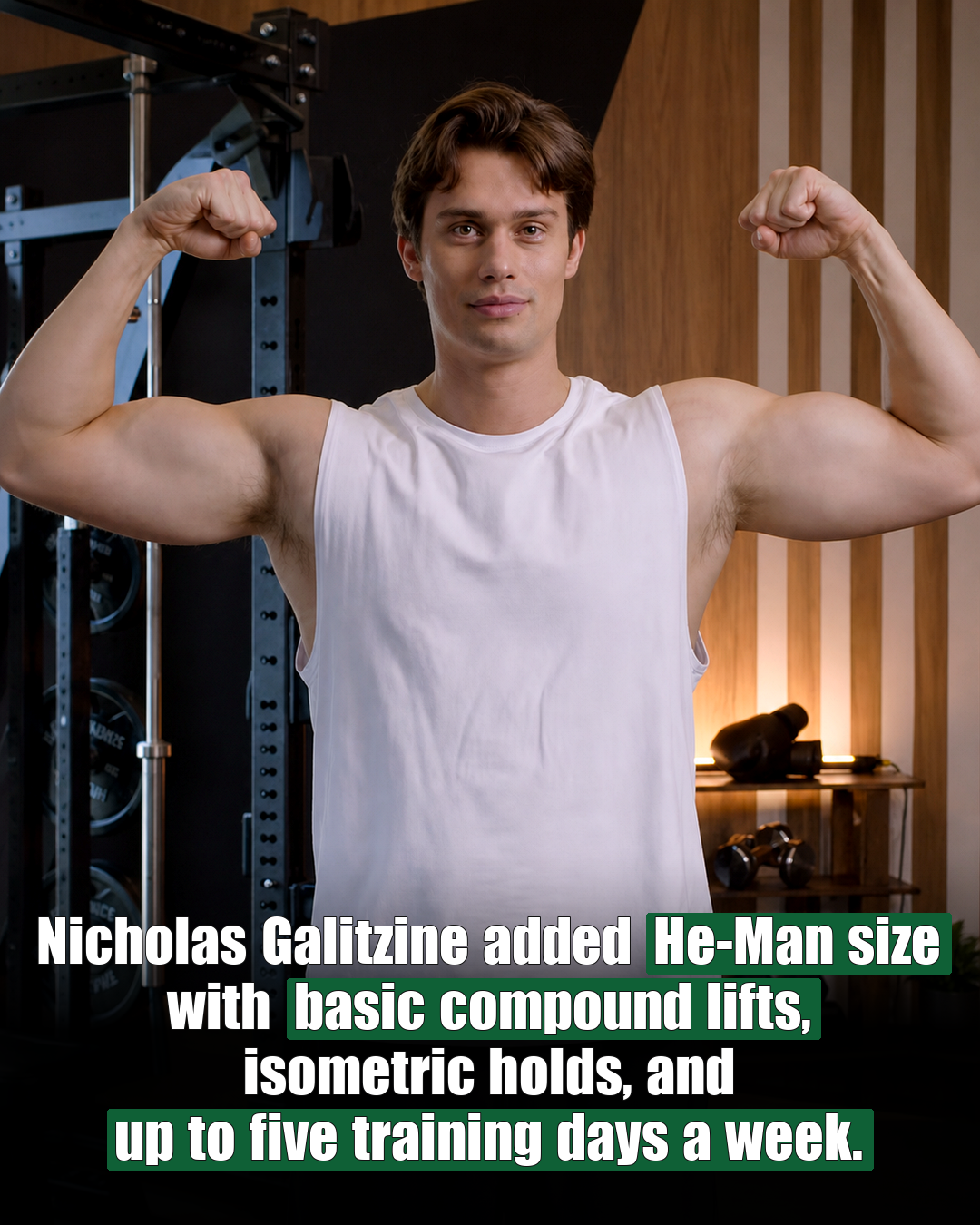
None of those roles required the kind of physical transformation that came next: playing He-Man, also known as Prince Adam, in the live action Masters of the Universe film.
He-Man is one of the most recognizable muscular physiques in pop culture history.
The character was first introduced through the 1980s toy line and cartoon, which makes the casting a significant physical commitment for any actor.
Production on the film reportedly wrapped in June 2025.
Galitzine has said he was filming another project, the indie fantasy film 100 Nights of Hero, at the same time.
He described the overlapping demands by saying he felt like he was going out of his mind.
Galitzine has also built a public facing presence beyond acting, serving as a global menswear ambassador for Fendi since 2023 and a global fragrance ambassador for Emporio Armani since 2024.
That means his physical transformation for He-Man played out with more public visibility than a typical film role change, since fans and fashion audiences were already watching him closely.
Masters of the Universe carries decades of built up expectation around what He-Man is supposed to look like, which likely added extra pressure to the physical side of preparing for the role.
What the Training Actually Looked Like
According to reports, Galitzine’s preparation centered on straightforward strength training built around heavy compound lifts.
It was not a complicated or novel workout split.
He reportedly focused on pressing, pulling, and loading patterns.
Those are the kind of basic movements that have built muscular physiques for decades, long before social media workout trends existed.
Alongside training, reports describe him eating around 4,000 calories a day to support the muscle gain the role required.
That is a significant increase over what most adults need for maintenance.
That combination, heavy basic lifts plus a substantial calorie surplus, is a well established formula in strength and conditioning circles.
It lacks the novelty of newer training trends, but it has a long track record.
A few heavy, well executed lifts beat a complicated split most people never actually stick with.
Why Basic Compound Lifts Work So Well
A widely cited 2010 review by Schoenfeld in the Journal of Strength and Conditioning Research explained the underlying mechanisms of muscle growth.
The review identified mechanical tension, the force a muscle experiences under load, as the primary driver of hypertrophy.
Compound lifts like squats, deadlifts, bench presses, and rows create high mechanical tension across multiple large muscle groups at once.
That is part of why they remain a foundation of muscle building programs, despite decades of new training trends coming and going.
These movements also tend to allow heavier total loading than isolation exercises.
Several muscle groups share the work, which means more total mechanical tension per session.
That efficiency is likely part of why a straightforward plan built around a handful of compound lifts can produce a dramatic physique change over several months of consistent training.
The Calorie Side of Building Muscle
Heavy training alone is not enough to build significant muscle mass.
The body also needs enough available energy and protein to actually build new tissue.
A 2019 narrative review by Iraki, Fitschen, Espinar, and Helms, published in the journal Sports, laid out evidence based nutrition recommendations for building muscle.
That included the role of a calorie surplus during a dedicated muscle building phase.
The review found that a moderate calorie surplus, generally in the range of 10 to 20 percent above maintenance calories, supports muscle growth while limiting excess fat gain.
It also found that adequate protein intake throughout the day matters more than precise meal timing.
A reported intake around 4,000 calories daily would represent a significant surplus for most adult men.
That lines up with the kind of aggressive but structured approach typically used for a defined muscle building phase tied to a specific goal, like a film role.
How Fast Muscle Actually Grows
A dramatic physique change on screen can make muscle growth look faster than it actually is in the body.
Research on natural, non enhanced lifters generally estimates that a well trained man can gain somewhere around half a pound to two pounds of real muscle per month under ideal conditions.
That rate is usually faster for beginners in their first year of serious training and slower for someone who has already been lifting for years.
Some of the more dramatic week to week visual change people notice during a bulking phase also comes from reduced water retention differences, better muscle fullness from consistent training, and simply carrying a bit more overall body weight, not from months of new muscle appearing all at once.
None of that contradicts what was reportedly done for this role. It just means the visible transformation likely took the full length of a structured training block, not a few dramatic weeks.
What This Evidence Does Not Prove
No published study documents Nicholas Galitzine’s individual training log.
Nothing confirms the exact numbers reported about his diet and workouts.
The research on compound lifts and calorie surpluses describes what tends to work across groups of people.
It is not a guarantee of a specific transformation timeline for any one individual.
Genetics, training experience, sleep quality, and how consistently someone actually follows a plan all significantly affect real world results.
None of those factors can be verified from press coverage of a film role.
What the research does support is that the reported approach is a scientifically sound strategy.
Heavy compound lifts paired with a substantial calorie surplus reliably builds muscle mass over several months.
How This Compares to General Muscle Building Guidance
Most strength coaches and sports dietitians recommend the same basic formula for someone trying to build noticeable muscle.
Prioritize compound lifts, train each major muscle group at least twice a week, and eat in a moderate calorie surplus with adequate protein.
General exercise guidance recommends progressive resistance training for all major muscle groups at least twice weekly for strength and hypertrophy goals.
That lines up closely with a compound lift focused program like the one reportedly used here.
Galitzine’s reported plan is not a shortcut or a secret method.
It is closer to a compressed, intensified version of standard muscle building advice, aimed at a specific deadline.
Common Mistakes People Make Trying to Build Muscle Fast
A common mistake is chasing workout variety and new exercises instead of getting stronger over time on a small set of proven compound lifts, echoing the same simplicity argument behind Mike Mentzer’s Heavy Duty training philosophy.
Another is undereating protein and total calories while still expecting significant muscle growth.
Training provides the stimulus, but food provides the raw material for growth.
People also often increase calorie intake too aggressively, gaining mostly fat rather than the moderate surplus that supports lean muscle gain.
Skipping progressive overload is another issue.
Using the same weights for months without any planned increase in load, reps, or sets stalls progress even with a good diet.
Finally, many people underestimate how much time a visible transformation actually takes.
Real results take several consistent months to build, not a few weeks.
Another mistake is judging progress purely by the mirror or the scale day to day, when both are affected heavily by water retention, sodium intake, and sleep, none of which reflect real muscle change.
People also sometimes stop a bulking phase the moment they see any fat gain at all, when a small amount of fat gain alongside real muscle gain is a normal and expected part of a calorie surplus.
A Practical Way to Train Like This
Build a program around four to five compound lifts: squat, deadlift, bench press, overhead press, and a rowing movement.
Train each one two to three times weekly across your weekly split.
Track your lifts and aim to add small amounts of weight or an extra rep every one to two weeks.
Progressive overload is what actually drives muscle growth over time.
Calculate your maintenance calorie needs, then add roughly 10 to 20 percent to create a surplus that supports muscle gain without excessive fat gain.
Aim for about 0.7 to 1 gram of protein per pound of body weight daily.
Spread that protein across three to five meals rather than concentrating it in one.
Prioritize sleep, since most of the hormonal environment that supports muscle recovery and growth happens during deep sleep, not just during training.
Give the plan at least three to four months before judging results.
Visible muscle growth takes consistent time under the bar, not a few weeks of aggressive effort.
If you are new to lifting, work with a coach for your first several weeks.
They can help you learn proper form on the major compound lifts before you add significant weight.
Take a progress photo and a rough measurement, like waist and arm circumference, every four weeks rather than relying only on the scale to judge how the plan is working.
Expect small week to week fluctuations in weight and appearance, and judge progress on the overall month to month trend instead.
References
- Schoenfeld, B. J. (2010). The mechanisms of muscle hypertrophy and their application to resistance training. Journal of Strength and Conditioning Research, 24(10), 2857 to 2872. https://doi.org/10.1519/JSC.0b013e3181e840f3
- Iraki, J., Fitschen, P., Espinar, S., & Helms, E. (2019). Nutrition recommendations for bodybuilders in the off-season: A narrative review. Sports, 7(7), 154. https://doi.org/10.3390/sports7070154
This article is for general educational purposes and is not medical advice. Talk with a qualified healthcare provider or sports dietitian before making major changes to your training volume or calorie intake, especially if you have an existing health condition.