
A video with a bold promise has been spreading online, telling older adults that eating a certain kind of breakfast can stop muscle loss in their legs.
The video credits this idea to Dr. William Li, a physician known for his research on food and disease.
That attribution is worth checking carefully before anyone changes a lifelong habit because of a video title.
So does what you eat first thing in the morning actually matter for keeping your legs strong as you age, or is timing beside the point?
What the Video Actually Claims
The video argues that leg strength starts fading years before most people notice it.
It frames breakfast as a turning point, suggesting that what you eat first thing in the morning can protect the muscle in your thighs and calves.
The video attributes this specific advice to Dr. William Li.
Dr. Li is a real physician, and he has built a public career around the idea that food can act like medicine.
His public work focuses on how certain foods may help the body fight cancer, heart disease, and other chronic illness, largely through a process called angiogenesis, which is the growth of new blood vessels inside the body.
We could not find a published study, book chapter, or interview where Dr. Li specifically addresses morning protein timing, leg muscle loss, or the biology of a condition called sarcopenia.
Sarcopenia is simply the medical word for the muscle loss that happens naturally as people age.
It is not a rare condition.
Most people begin losing muscle mass and strength sometime after age 30, and the pace often picks up after age 60.
The legs are often hit hardest, since the large muscles in the thighs and hips tend to shrink faster than the muscles in the arms.
That is likely why this video, and others like it, zero in on legs specifically rather than muscle loss in general.
Several videos online use this exact same title and premise, credited to different doctors, including at least one other well known physician.
That pattern is worth noticing on its own.
It suggests a popular video script rather than a specific finding tied to any one doctor’s own research.
None of that means the underlying idea is automatically wrong.
It means the claim needs to stand on real, checkable science, not just a recognizable name attached to a catchy title.
Why Morning Protein Might Matter for Aging Muscles
Even without Dr. Li’s name attached to it, there is real science behind the idea that protein timing matters for older adults.
Muscle is not a fixed, unchanging tissue.
Your body constantly breaks old muscle protein down and builds new muscle protein back up, a back and forth process called muscle protein synthesis.
Muscle protein synthesis is simply your body’s rebuilding process, and eating protein is one of the main triggers that turns that process on.
As people age, this rebuilding process tends to become less responsive to normal amounts of protein, a pattern researchers sometimes call anabolic resistance.
In plain terms, older muscle often needs a bigger dose of protein at one sitting to get the same rebuilding response that a smaller dose would trigger in a younger adult.
This is where a nutrient called leucine comes into the picture.
Leucine is an amino acid, one of the small building blocks that make up protein, and it acts almost like a switch that turns on muscle building inside your cells.
A 2006 study published in the American Journal of Physiology tested exactly this question in older adults.
Researchers led by Christos Katsanos gave participants meals containing different amounts of leucine and measured how much muscle building activity followed each meal.
They found that a meal needed to supply a distinctly higher amount of leucine before it fully switched on muscle building in older muscle, compared to what younger muscle required for the same response.
In practical terms, a small amount of protein, like a single egg or a splash of milk in coffee, likely is not enough to meaningfully trigger muscle building in an older adult.
A more substantial protein source, such as several eggs, a serving of Greek yogurt, cottage cheese, or a protein shake, is far more likely to cross that threshold.
Older muscle does not respond to a trickle of protein the way younger muscle does, which is why the size of a single meal can matter almost as much as the day’s total intake.
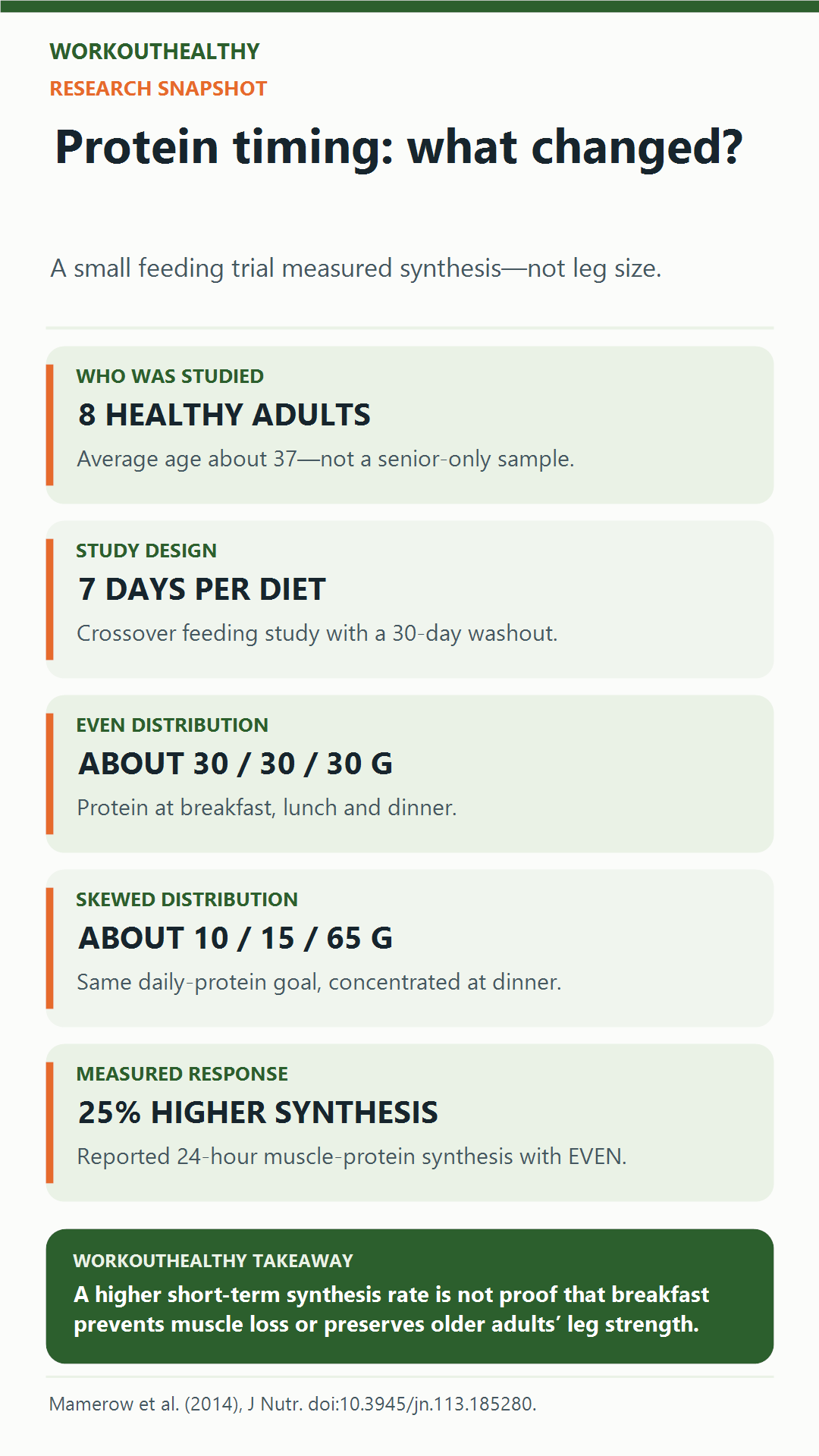
A separate study from 2014, published in The Journal of Nutrition, tested how spreading protein evenly across the day affects muscle building compared to loading most of it at dinner.
Researchers led by Madonna Mamerow had healthy adults eat the exact same total amount of protein for a day, but arranged in two different ways.
One pattern matched a common Western eating habit, with a small amount of protein at breakfast, a bit more at lunch, and the bulk of it saved for dinner.
The other pattern spread the same total protein evenly, with a moderate amount at each of three separate meals.
The evenly spread pattern produced about 25 percent more muscle building activity over a full day than the skewed pattern, even though both diets contained the identical total amount of protein.
That finding lines up closely with the leucine threshold idea described above.
A small breakfast portion of protein may simply fall below the amount needed to switch on muscle building, no matter how much protein shows up later at dinner.
What Happens When Older Adults Skip Protein at Breakfast
A 2022 study published in the journal Geriatrics, Gerontology and Aging looked at how older adults actually distribute protein across a real day, outside of a lab.
Researchers led by Luciana Bronzi de Souza found that breakfast was consistently the meal with the lowest protein intake among the older adults in the study.
Many participants ate very little protein in the morning, then tried to make up ground later at lunch or dinner, if they made it up at all.
The researchers also measured calf circumference, a simple measurement that doctors sometimes use as a marker for leg muscle mass in older adults.
A smaller calf circumference was associated with this poor protein distribution pattern.
This is an association, not proof that a low protein breakfast alone caused smaller calf muscles.
Still, it is a real, measured connection between a low protein breakfast habit and a leg specific marker of muscle mass, which lands much closer to the video’s actual claim than anything tied directly to Dr. Li.
What This Evidence Does Not Prove
None of this research proves that a single specific breakfast food stops leg muscle loss on its own.
The studies above measured muscle building activity over a matter of hours, or looked at protein patterns linked to calf size at one point in time.
Neither of those is the same as a long term trial proving that changing breakfast alone prevents sarcopenia or preserves leg strength for years.
Total daily protein intake still matters more than any single meal.
A great breakfast cannot fully offset a day that ends up far short of the protein your body actually needs.
Most expert groups recommend that healthy older adults aim for roughly 1.0 to 1.2 grams of protein per kilogram of body weight each day, and somewhat more for those managing an illness or recovering from one.
Resistance exercise, things like squats, step ups, or leg presses, also plays a bigger role in preserving leg muscle than diet changes alone.
Research on strength training in older adults consistently finds that lifting paired with adequate protein works better than either one by itself.
Diet changes without any resistance exercise generally slow muscle loss only modestly at best.
People also vary widely in how their bodies respond to protein timing, based on genetics, activity level, hormones, and overall health.
What works well for one 70 year old may matter far less for another.
No single morning meal can undo months of too little protein and too little movement, and no amount of exercise can fully make up for a diet that never gives muscle enough to rebuild with.
Common Mistakes Older Adults Make With Protein
The most common mistake is eating too little protein at breakfast, then trying to make up for it later in the day.
A slice of toast with jam, a small bowl of cereal, or coffee with a splash of milk supplies barely any protein at all.
By the time dinner arrives, most people cannot realistically fit enough protein into one meal to fully undo a day that started nearly empty.
Another common mistake is assuming a protein supplement or bar can replace real food entirely.
Supplements can help close a gap, but whole foods bring other nutrients that older adults often fall short on too, including vitamin D, calcium, and fiber.
A third mistake is focusing only on food while ignoring physical activity.
Muscle needs a reason to rebuild, and regular resistance exercise gives it that reason in a way that diet alone cannot fully replace.
A fourth mistake is not moving enough between meals.
Long stretches of sitting send a signal to the body that muscle is not needed, which works against whatever protein you have already eaten.
Simple daily movement, even something as basic as walking a reasonable distance each day, supports the same muscle building signal that protein alone cannot provide.
A fifth mistake is assuming that all muscle loss comes down to diet.
Illness, certain medications, low activity, and other medical conditions can all contribute to unexplained muscle and weight loss, so a sudden or severe change deserves a medical check rather than a dietary guess.
Who Should Check With a Doctor or Dietitian First
Higher protein intake is not automatically safe for everyone.
People with chronic kidney disease often need to limit protein, since damaged kidneys can struggle to process a high protein load.
Anyone with kidney disease should talk to a doctor or a registered dietitian before increasing protein intake, rather than following general advice meant for healthy adults.
People managing liver disease, certain metabolic disorders, or specific medication interactions should also get individual guidance before making a change.
Older adults taking blood thinners or managing heart failure sometimes need protein and fluid intake balanced carefully against their specific treatment plan.
Anyone who has lost weight or muscle quickly, without a clear reason, should see a doctor first.
Sudden muscle loss can signal an underlying illness that needs its own diagnosis and treatment, not just a dietary fix.
A registered dietitian can also help translate general numbers like grams per kilogram into an actual, personal meal plan.
Simple High Protein Breakfast Ideas
For most healthy older adults without a medical restriction, a reasonable breakfast target sits somewhere around 25 to 35 grams of protein.
Three whole eggs with a slice of whole grain toast supply close to 20 grams of protein on their own.
Adding a cup of Greek yogurt or cottage cheese on the side can push a breakfast well past the 30 gram mark.
A smoothie made with milk, plain Greek yogurt, and a scoop of protein powder is an easy option for anyone who struggles to chew or simply has a smaller appetite in the morning.
Cottage cheese with fruit, a couple of hard boiled eggs, and a slice of cheese covers a similar amount of protein without much preparation.
For anyone eating oatmeal, stirring in milk instead of water, plus a spoonful of nut butter or a scoop of protein powder, meaningfully raises the protein content of an otherwise low protein meal.
The exact food matters far less than the total amount of protein and how well it fits into the rest of the day.

Watch the Original Video
Want more like this? Subscribe to WorkoutHealthy Insider for practical explanations behind popular fitness claims.
References
Bauer, J., Biolo, G., Cederholm, T., Cesari, M., Cruz Jentoft, A. J., Morley, J. E., Phillips, S., Sieber, C., Stehle, P., Teta, D., Visvanathan, R., Volpi, E., and Boirie, Y. (2013). Evidence based recommendations for optimal dietary protein intake in older people: A position paper from the PROT AGE Study Group. Journal of the American Medical Directors Association, 14(8), 542 to 559. https://doi.org/10.1016/j.jamda.2013.05.021
de Souza, L. B., Martins, K. A., and Bomfim, R. A. (2022). Inadequate distribution of dietary protein and muscle mass in older adults. Geriatrics, Gerontology and Aging, 16, article e0220001. https://doi.org/10.53886/gga.e0220001
Katsanos, C. S., Kobayashi, H., Sheffield Moore, M., Aarsland, A., and Wolfe, R. R. (2006). A high proportion of leucine is required for optimal stimulation of the rate of muscle protein synthesis by essential amino acids in the elderly. American Journal of Physiology Endocrinology and Metabolism, 291(2), E381 to E387. https://doi.org/10.1152/ajpendo.00488.2005
Mamerow, M. M., Mettler, J. A., English, K. L., Casperson, S. L., Arentson Lantz, E., Sheffield Moore, M., Layman, D. K., and Paddon Jones, D. (2014). Dietary protein distribution positively influences 24 h muscle protein synthesis in healthy adults. The Journal of Nutrition, 144(6), 876 to 880. https://doi.org/10.3945/jn.113.185280
Paddon Jones, D., and Rasmussen, B. B. (2009). Dietary protein recommendations and the prevention of sarcopenia. Current Opinion in Clinical Nutrition & Metabolic Care, 12(1), 86 to 90. https://doi.org/10.1097/mco.0b013e32831cef8b
This article is for general information only and is not medical advice. If you have an injury, ongoing pain, or a medical condition, talk to a doctor or physical therapist before you change how you train or eat.