Lou Schuler had spent five decades lifting weights and much of his career explaining fitness to other people. Then, during an ordinary walk downstairs, both quadriceps tendons ruptured within seconds.
The injury was sudden. The story Schuler told afterward was not. In his account, years of joint pain, lost range of motion, pain that interrupted sleep, and routine ibuprofen use had formed a pattern he kept overriding.
What happened on the stairs
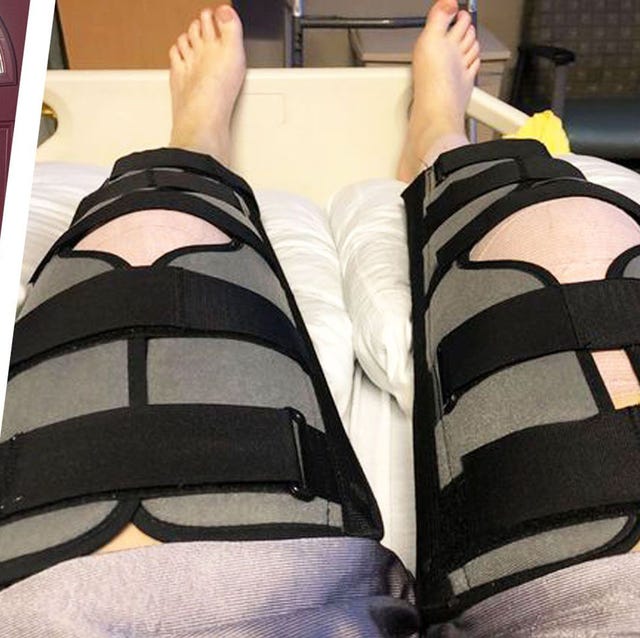
Schuler wrote that he was walking downstairs when his left quadriceps tendon appeared to rupture spontaneously. He fell past several steps and landed on his right knee, tearing that tendon too.
The quadriceps tendon connects the large muscles on the front of the thigh to the kneecap. A complete tear can make it impossible to actively straighten the knee and commonly requires surgical repair. Bilateral ruptures are uncommon, and published case reviews have associated them with several chronic conditions and medication exposures. A personal medical cause, however, cannot be inferred from a public essay.
Schuler did not claim to know which exact movement caused the rupture. He considered possibilities, including stretches and leg extensions, but kept returning to the longer history of painful training. That distinction is important. A compelling story can explain a lesson without proving a single biological cause.
It also prevents the wrong takeaway. The event was not a warning that everyone who lifts will rupture a tendon on the stairs. It was a reminder that catastrophic injuries can have complex causes, and that a long pattern of worsening symptoms deserves attention even when no one can predict the exact breaking point.
“This was on me.”
His self-judgment was severe. Readers do not need to copy the blame to use the insight. The practical question is whether a training pattern keeps producing warning signs and whether identity, habit, or gym culture makes those signs easy to dismiss.
Why expertise did not protect him
Schuler began working out in 1970, entered his first commercial gym in 1980, became a fitness-magazine writer in 1992, earned a personal-training certification in 1995, and later coauthored the New Rules of Lifting series.
That history gave him a deep library of exercise modifications and professional contacts. It also gave him strong beliefs about which exercises serious lifters were supposed to perform.
Expertise is valuable, but it can create a blind spot when experience becomes identity. If a barbell lift is part of how someone measures competence, removing it can feel like regression even when another tool trains the same pattern more comfortably.
Schuler’s account is a reminder that knowledge does not automatically defeat bias. Lifters can understand recovery in theory and still bargain with recurring pain in practice.
Hard effort and harmful signals are not the same
Effective exercise includes discomfort. Muscles burn, breathing becomes difficult, and fatigue accumulates. Those sensations are not automatically signs of injury.
Joint pain that predictably lingers for a day or two, worsening range of motion, pain that wakes you, and a need to medicate before or after routine sessions belong in a different category. They deserve investigation, not a motivational slogan.
Research on exercising with chronic musculoskeletal pain is nuanced. Some rehabilitation programs allow tolerable pain, and a systematic review found no simple rule that all painful exercise is worse. That does not validate forcing every painful movement. It means symptom type, severity, trend, diagnosis, and professional guidance matter.
The useful boundary is not “exercise should never feel hard.” It is “the same pattern should not keep making your joints and daily function worse without a response.”
The barbell is optional
One of Schuler’s strongest conclusions was that many people do not need barbell versions of the major lifts. A straight bar fixes both hands to one object and can limit how the shoulders, hips, and torso organize themselves.
That does not make barbells dangerous by definition. They are efficient, measurable tools that work well for many healthy lifters. It does mean they are options, not moral tests.
A hex-bar deadlift can shorten the range of motion when high handles are used. Goblet squats and kettlebell front squats allow a different torso position. Dumbbells let each shoulder find its own path during pressing. Machines, cables, landmine variations, and split-stance exercises add still more choices.
The best substitution is the one that preserves the training goal while reducing the aggravating feature. Our guides to squat alternatives and deadlift alternatives organize those choices by purpose.
Equipment changes are only one lever. A lifter may also respond well to fewer hard sets, a slower progression, longer rest between sessions, or a temporary shift toward movements that feel stable. The goal is to create enough training stimulus to improve without repeatedly paying for it in daily life.
The WorkoutHealthy warning-pattern audit
The following four-part audit translates Schuler’s reflections into a decision framework. It is not a diagnostic screen. Its purpose is to identify recurring patterns that should change the next training decision.
TRAINING WARNING-PATTERN AUDIT
Review: Does the same exercise repeatedly leave joint pain the next day?
Adjust: Is range of motion shrinking or are you changing daily movement to protect the area?
Escalate: Is pain persistent, worsening, or disturbing sleep?
Pause: Are you relying on pain medication to keep forcing the same training pattern?
Quick read: Change the exercise early, and seek qualified evaluation for sudden injury, loss of function, severe swelling, inability to bear weight, or persistent night pain.
A “yes” does not reveal the diagnosis. It changes the burden of proof. Instead of asking whether you can survive another session, ask why the movement deserves to stay unchanged.
“Only you can save you from yourself.”
How to modify training without abandoning strength
Start by identifying the goal of the painful exercise. A barbell back squat may be serving leg strength, quadriceps growth, a powerlifting skill, or simply tradition. The correct replacement depends on which of those actually matters.
Then change one variable at a time. Reduce load, shorten the range of motion, slow the repetition, change the implement, or choose a more stable setup. Track symptoms during the session, later that day, and the following morning.
If the movement becomes tolerable and daily function remains stable, progression can be gradual. If symptoms worsen, spread, disturb sleep, or reduce function, stop treating the gym as a diagnostic laboratory and seek a qualified clinician.
Keep notes during this process. A simple record of exercise, load, range, discomfort during the session, and symptoms the following morning can make a clinical conversation more useful and prevent memory from rewriting the pattern.
Older lifters may especially benefit from separating the movement pattern from one piece of equipment. This guide to loading a hip hinge after 50 shows how range and setup can be adjusted without giving up the goal.
Recovery after bilateral tendon rupture
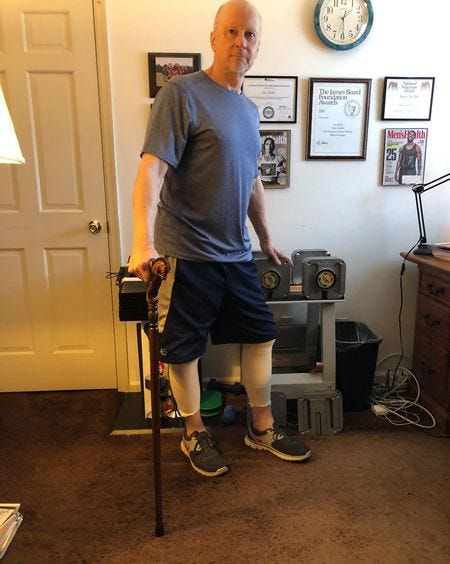
Schuler wrote about standing roughly 48 hours after surgery and later returning to his home gym with a cane. Published reviews generally report good outcomes after surgical repair, but rehabilitation is measured in months, and individual timelines vary with the injury, repair, health status, and clinical plan.
A bilateral injury also changes ordinary logistics. Stairs, chairs, bathing, transfers, and basic household movement can require assistance. Recovery is not simply a smaller version of training. It is a medical process in which protection, range of motion, strength, and confidence are restored in stages.
The emotional side matters too. An experienced lifter can understand the plan and still feel fear when standing, walking, or loading the legs again. Confidence often returns through repeated, successful exposure rather than one heroic test.
What lifters should remember
Schuler’s injury does not prove that barbells, squats, basketball, or one extra set caused two tendon ruptures. His account is more useful when read as a pattern-recognition story.
Recurring pain changes the training problem. The goal is no longer to demonstrate toughness within an unchanged plan. The goal is to find a version of training that builds capacity without repeatedly worsening the same signal.
Keep the objective and loosen your attachment to the tool. Measure progress in strength, function, and consistency, not in loyalty to one lift.
If you want a broader check of exercise balance, recovery, and progression, use our seven-point training program audit.
The takeaway
Lou Schuler’s hardest lesson was not that training carries risk. It was that experience and determination can become liabilities when they keep a lifter inside the same painful pattern.
Strength is not proven by ignoring every warning. Sometimes the stronger decision is to change the implement, reduce the stress, ask for help, and keep training in a form your body can tolerate.
This article is for general education and is not medical advice. A sudden pop, inability to straighten the knee, major swelling, inability to bear weight, or loss of function requires prompt medical evaluation. Follow your surgeon or rehabilitation professional after a tendon injury.