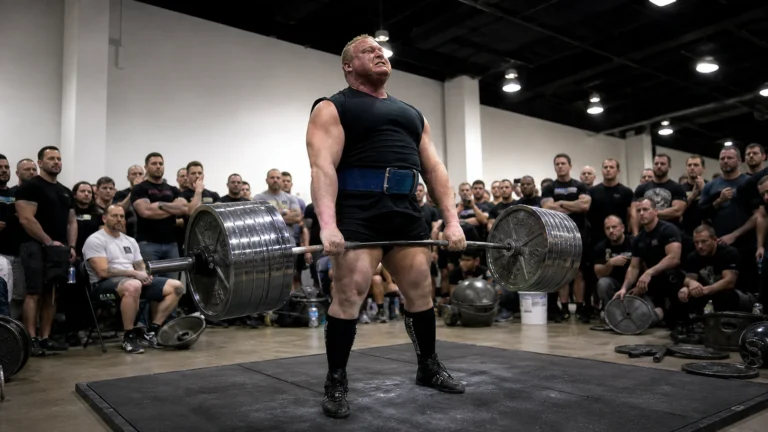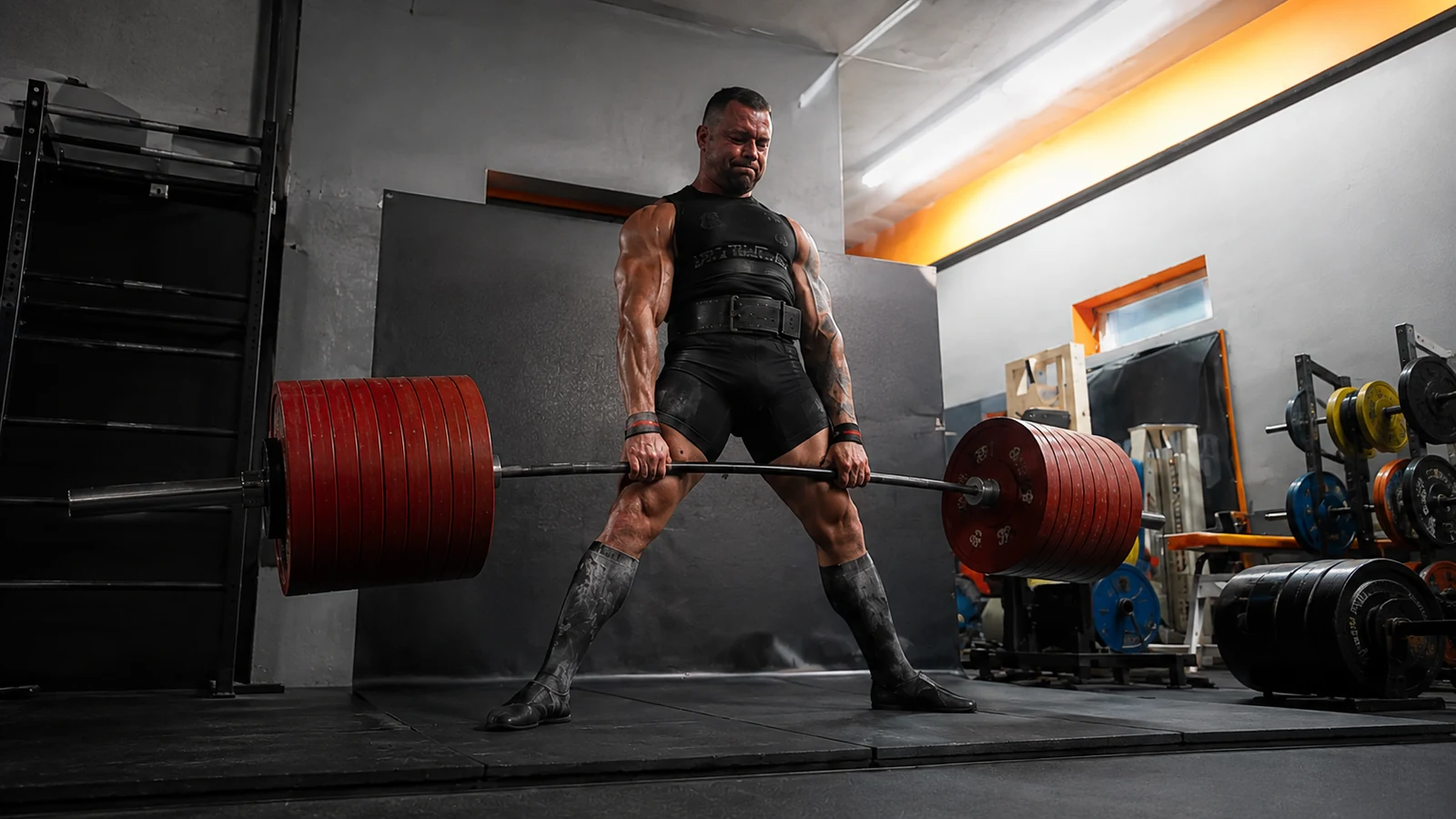

Krzysztof Wierzbicki pulled 502.5 kilograms off a gym floor in Poland on April 27, 2022.
That works out to 1,107.8 pounds.
No federation certified the lift.
No meet director signed a scorecard, and no strength sport governing body has ever entered it into an official record book.
It happened during a training session, not a sanctioned competition, and a camera happened to be running.
That distinction is the whole point of this article.
Wierzbicki’s pull gets treated online as though it settles an argument about the biggest deadlift ever completed, but the honest framing is narrower and more interesting than that.
It is the heaviest raw deadlift ever caught on video, meaning no supportive lifting suit was involved, not a certified world record in any sense that a federation would recognize.
What Actually Happened in That Polish Gym
The footage shows Wierzbicki approaching a bar loaded to 502.5 kilograms, chalking his hands, and setting up in a sumo stance with his feet turned out wide and his hands inside his knees.
He wore a lifting belt and a pair of straps looped around the bar, but no squat suit, no deadlift suit, and no other supportive gear.
He pulled the bar from the floor to full lockout, held it for a moment, and set it back down under control.
Fitness Volt, which first reported the lift, documented the date, the weight, and the setting as a training pull rather than a meet (Fitness Volt, 2022).
Wierzbicki reportedly competes in the 110 kilogram weight class, which means he moved roughly 4.6 times his own bodyweight off the floor.
That ratio puts the pull firmly in the range other elite deadlifters have reached, but almost none of them have done it without a suit.
Why This Isn’t a World Record
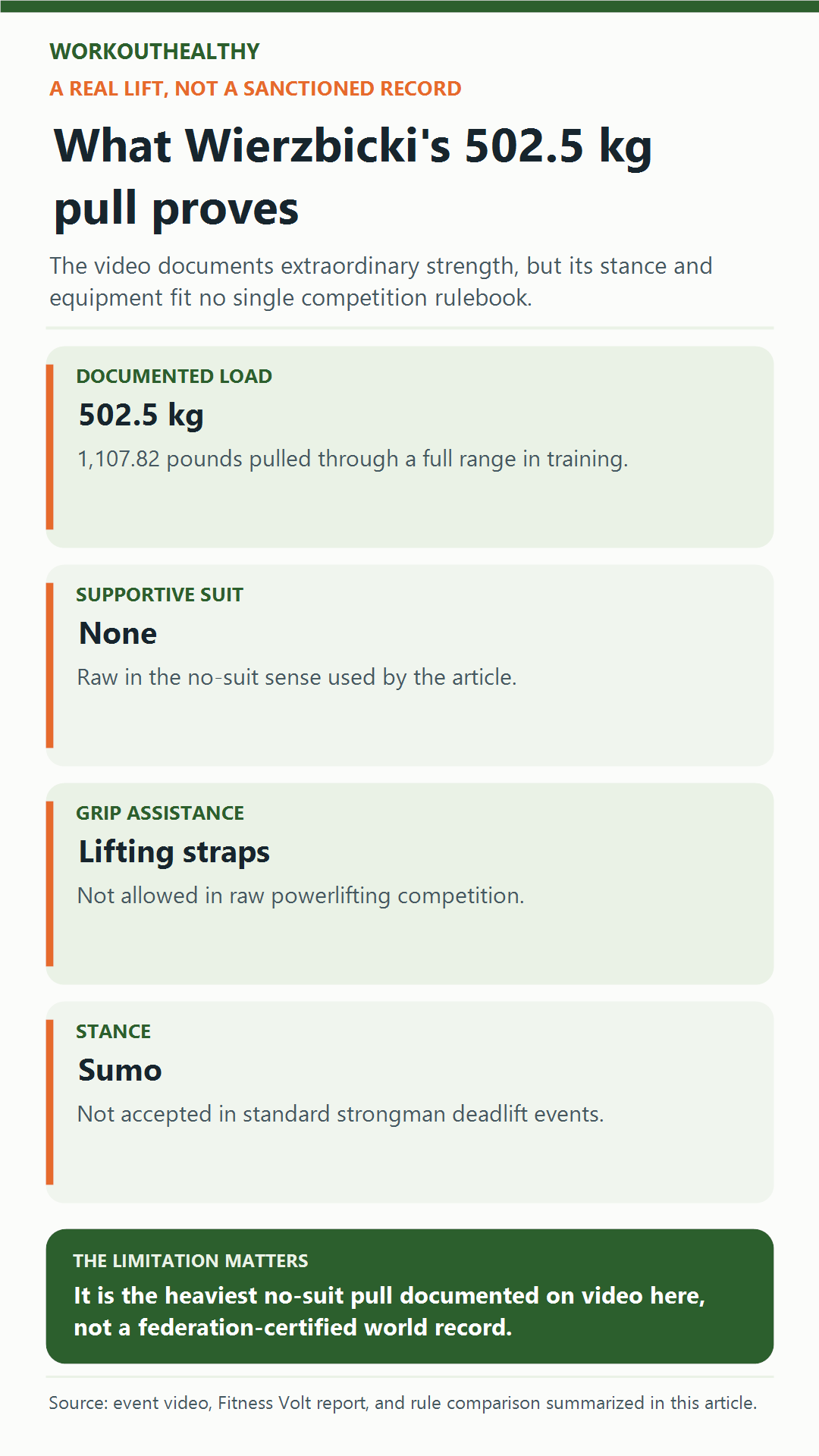
Powerlifting federations like the IPF and WRPF run raw divisions, and raw divisions do not allow lifting straps.
Straps are barred specifically because they remove grip as a limiting factor, and grip is supposed to be part of what a raw lift tests.
Strongman federations allow straps in some events, but they do not allow the sumo stance Wierzbicki used, since Strongman deadlift rules generally require a conventional or hex-bar setup depending on the event.
Wierzbicki’s pull combined a stance that is not legal in Strongman with equipment that is not legal in raw powerlifting.
That combination is exactly why no governing body has certified it, and it is also why calling it a world record misrepresents what actually happened.
The more accurate label, and the one this article uses throughout, is an unofficial training pull that has not been certified by any federation.
Other feats covered on this site, like DonnaJean Wilde’s Guinness-certified push-up record or Edith Connor’s Guinness record as the oldest female bodybuilder, went through an actual governing body’s verification process.
Wierzbicki’s pull did not.
A viral clip and a certified world record are not the same kind of claim, even when the number on the plates is the heaviest anyone has ever seen on video.
The Raw vs. Equipped Distinction That Actually Matters
Two other deadlifts get compared to Wierzbicki’s constantly: Eddie Hall’s 500 kilogram pull at the 2016 World’s Strongest Man Deadlift, and Hafthor Bjornsson’s 501 kilogram pull in 2020.
Both of those lifts are officially recognized by Strongman record keepers.
Both lifters also wore full deadlift suits, which are rigid supportive garments that store elastic energy and assist the hips out of the bottom position.
A deadlift suit changes the lift in a way that straps do not.
Straps solve a grip problem. A suit changes the mechanics of the pull itself.
That is why Wierzbicki’s pull draws comparisons despite the setting: 502.5 kilograms is heavier than either official number, and he did it with less equipment support.
Wierzbicki’s number is heavier.
It was never entered into that same certification process, though, and the equipment difference is the reason serious observers still separate the two.
His pull sits on the raw side of the comparison. Hall and Bjornsson’s pulls sit on the equipped side.
Why the Sumo Stance Made This Possible
Wierzbicki pulled in a sumo stance, with his feet set wide and his hands gripping the bar from inside his knees.
Research comparing sumo and conventional deadlift technique found that the sumo stance produces a more upright torso position and a shorter bar path than the conventional stance (Escamilla et al., 2000).
A shorter bar path means less total distance the bar has to travel from floor to lockout.
The same research found that the sumo stance places more of the work on the hips and less on the lower back compared to a conventional pull (Escamilla et al., 2000).
For an extremely heavy single pull, a shorter bar path and a more upright spine can matter, because there is simply less time and less range for the lift to break down.
That does not mean sumo is inherently the stronger stance for every lifter.
It means the stance is built around leverages that suit some bodies and some lifts better than others, and Wierzbicki’s pull is one example of it working at an extreme weight.
What Lifting Straps Actually Change
Grip is one of the first things to fail on a maximal deadlift, often before the legs, hips, or back have reached their own limit.
Straps address that specific weak link by wrapping around the bar and the wrist, transferring load through the strap material instead of relying entirely on finger and forearm strength.
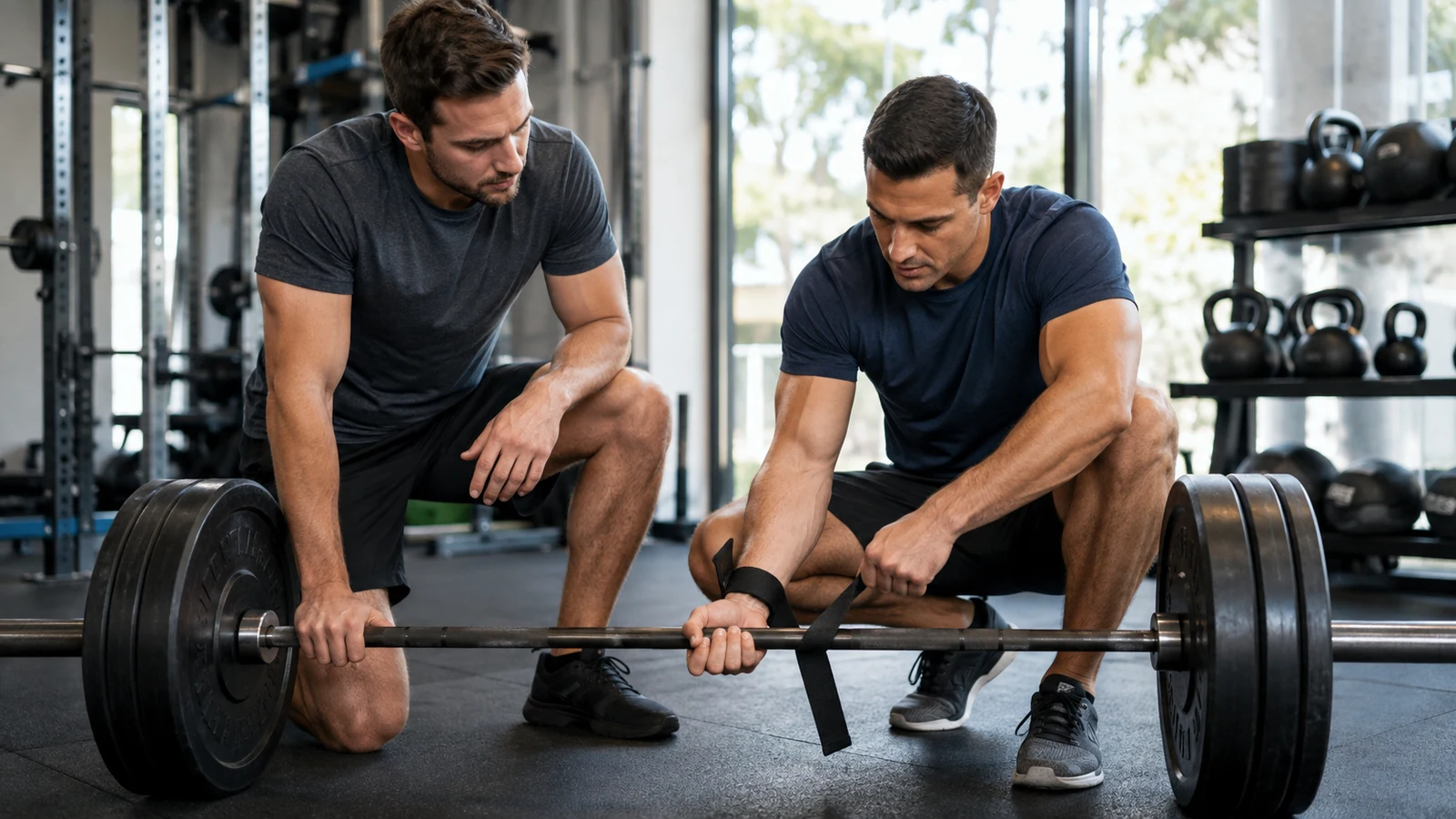
A 2020 study measured deadlift performance across a full range of loads with and without straps and found that straps changed the entire load-velocity relationship of the lift, letting lifters move heavier loads at a given speed (Jukic et al., 2020).
A related study from the same research group found that straps improved grip security and reduced how hard a set felt, without meaningfully speeding up the concentric portion of lighter reps (Jukic et al., 2021).
Put together, that research suggests straps mainly buy a lifter more usable strength at the top end of a max attempt, right where grip normally gives out first.
That is a real, measurable effect.
It is also exactly why raw powerlifting federations do not allow straps in competition, since removing the grip limitation changes what a raw pull is actually supposed to test.
Straps solve a grip problem. They do not build one, and that gap shows up the moment a lifter needs to pull without them.
Does This Pull Still Stand as the Heaviest Raw Deadlift on Video?
As of this writing, no publicly documented video shows a heavier deadlift completed without a supportive suit.
That is a meaningfully different claim than saying the record “still stands,” since there is no formal record to defend in the first place.
Strongman and powerlifting circles move fast, and unofficial pulls get filmed in gyms all over the world every year.
It is possible a heavier raw pull with straps has been filmed somewhere and simply has not reached the same viral reach Wierzbicki’s video did.
What can be said with confidence is narrower: this remains the heaviest such pull that has been widely reported and independently documented by strength sport media (Fitness Volt, 2022).
Readers should treat that as the best-known example on record today, not as a permanently settled fact.
What This Lift Does Not Prove
A single viral pull, filmed once, does not prove Wierzbicki is the strongest deadlifter alive.
Competition results are decided across weight classes, judged for depth and lockout, and repeated under standardized conditions for a reason.
None of that structure applied here.
The lift also does not prove that sumo with straps is a superior technique for every lifter chasing a heavier pull.
It proves that this technique, in this lifter’s body, on this day, moved this weight.
Genetics, years of specific training, and a favorable limb-to-torso ratio for sumo pulling all likely played a role that a single video cannot show.
Treating one clip as a training template, rather than as an impressive outlier, is where a lot of the wrong lessons get drawn from lifts like this one.
Common Mistakes People Make Chasing Heavy Pulls
The most common mistake is loading a bar toward a personal best without ever testing true grip strength separately from the pull itself.
Straps hide a weak grip.
They do not build one, and a lifter who trains exclusively with straps and later needs to pull raw and beltless in some context can be caught off guard by how much weaker their bare-hand grip actually is.
Another mistake is chasing a stance because a viral lifter used it, rather than testing conventional and sumo honestly to see which one actually fits an individual’s proportions.
A third mistake is skipping a real warm-up progression on a true maximal attempt, since a cold, unprepared spine and hip complex are far more likely to get hurt at 90 percent of a max than at 60 percent.
A fourth mistake is training max singles too often.
Recovery from a genuine one-rep max deadlift attempt is systemic, not just muscular, and repeated max testing without enough recovery time between attempts is a common way lifters stall out or get hurt chasing a number like this one.
Who Should Be Cautious Before Attempting a Max-Effort Deadlift
Anyone with a history of lower back injury, disc issues, or unresolved hip pain should talk to a doctor or physical therapist before testing a true one-rep max deadlift.
Beginners with less than a year of consistent deadlift training generally have more to gain from building technique at moderate loads than from testing a single maximal number.
Working with a qualified coach during that early technical period can catch form breakdowns before they turn into an injury, which is one reason it is worth deciding whether hiring a personal trainer makes sense rather than guessing at form alone.
Anyone managing high blood pressure or a cardiovascular condition should also check with a physician first, since a true maximal lift involves a significant, if brief, spike in intra-abdominal pressure and blood pressure.
None of this is a reason to avoid heavy deadlifting altogether.
It is a reason to test a true max carefully, with the right supervision, rather than as a spontaneous decision in a normal training session.
Building Toward a Heavier Pull, Safely
Lifters who want to chase a heavier raw pull over time generally do better with a structured approach than with repeated max-effort testing.
A common approach is training in the 80 to 90 percent range for low reps, cycling that intensity across weeks rather than testing a true max every session.
Grip work deserves its own place in that plan, separate from the deadlift itself, using dead hangs, farmer carries, or plate pinches to build raw grip strength that does not rely on straps.
Stance selection should come from an honest technical assessment, ideally on video, comparing hip drive and lockout speed in both conventional and sumo setups before committing to one.
Accessory work for the hips, upper back, and core supports the positions a heavy pull demands, and neglecting it is a common reason technique breaks down specifically at heavy loads rather than at lighter, easier ones.
Finally, a real taper before any true max attempt matters as much as the training that came before it, since fatigue built up in the days leading into a max test can turn a lift that should succeed into one that does not.
Watch the Original Video
Want the real story behind viral fitness claims? Subscribe to WorkoutHealthy Insider for practical explanations behind popular fitness claims.
References
Escamilla, R. F., Francisco, A. C., Fleisig, G. S., Barrentine, S. W., Welch, C. M., Kayes, A. V., Speer, K. P., & Andrews, J. R. (2000). A three-dimensional biomechanical analysis of sumo and conventional style deadlifts. Medicine & Science in Sports & Exercise, 32(7), 1265-1275. https://doi.org/10.1097/00005768-200007000-00013
Jukic, I., García-Ramos, A., Malecek, J., Omcirk, D., & Tufano, J. J. (2020). The use of lifting straps alters the entire load-velocity profile during the deadlift exercise. Journal of Strength and Conditioning Research, 34(12), 3331-3337. https://doi.org/10.1519/JSC.0000000000003850
Jukic, I., García-Ramos, A., Baláš, J., Malecek, J., Omcirk, D., & Tufano, J. J. (2021). Ergogenic effects of lifting straps on movement velocity, grip strength, perceived exertion and grip security during the deadlift exercise. Physiology & Behavior, 229, Article 113283. https://doi.org/10.1016/j.physbeh.2020.113283
Fitness Volt. (2022, April 27). Krzysztof Wierzbicki deadlifts 502.5 kg (1,107.8 lbs), unofficially the heaviest deadlift of all time. https://fitnessvolt.com/krzysztof-wierzbicki-deadlifts-502-5-kg/
This article is for general information only and is not medical advice. If you have an injury, ongoing pain, or a medical condition, talk to a doctor or physical therapist before you change how you train or eat.