
Broadcaster Jo Whiley has described the frustration of adjusting exercise around arthritis as she enters her sixties. Her story captures a problem many active adults recognize: the mind still wants the old routine, while a joint asks for a different dose.
The answer is usually not to stop moving. It is to change the movement, load, range, frequency, and recovery until training becomes repeatable again.
Quick answer: strength and aerobic exercise are recommended parts of arthritis care for many people, especially with knee or hip osteoarthritis. The right program is symptom-guided and progressive. Pain that rapidly worsens, follows an injury, or comes with a hot swollen joint needs medical assessment rather than a tougher workout.
Adapting a workout is not surrender. It is how consistency survives a changing body.
What Jo Whiley shared
Whiley discussed arthritis and changing exercise capacity on the Dig It podcast with Zoe Ball. She described how difficult it can be to accept that some activities no longer feel the way they once did.
That emotional part deserves attention. An exercise can carry identity, friendship, stress relief, and proof of independence.
Changing it may feel like losing more than a set of movements. People can respond by pushing through every warning or avoiding activity entirely.
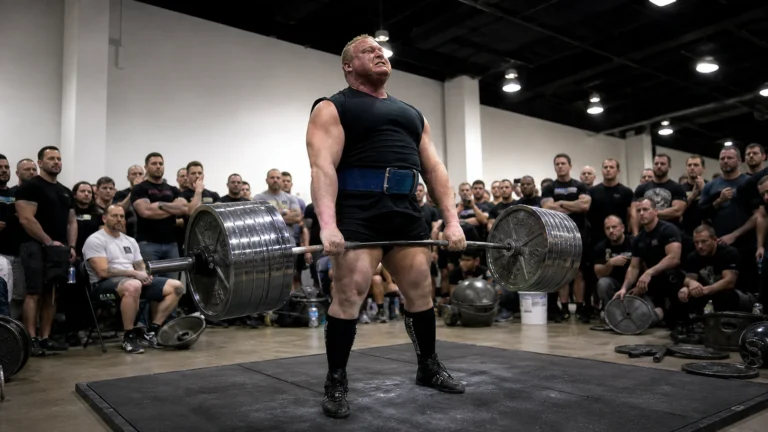
Neither extreme is required. Whiley has spoken about returning to weights and swimming, both of which can be adjusted through load, range, pace, and session length.
Her experience should not be treated as a clinical prescription. The useful lesson is that an active person can keep the purpose of training while changing its form.
That approach also fits broader recovery science. Our guide to rest days and adaptation explains why the ability to train well again matters more than winning one session.
Why movement can help an arthritic joint
Osteoarthritis involves changes across the whole joint, including cartilage, bone, synovium, muscles, and surrounding tissues. It is not simply a worn hinge that must never be loaded.
Muscles help absorb and control force. Improving strength around an affected knee or hip can make walking, stairs, and daily tasks easier.
Aerobic activity supports cardiovascular fitness, work capacity, sleep, and mood. Those benefits still matter when a joint is sensitive.
Movement also gives the nervous system repeated evidence that a task can be safe. That does not make pain imaginary; it helps explain why carefully graded exposure can improve confidence and function.
Exercise is not a cartilage regrowth treatment, and it does not work identically for everyone. Benefits depend on diagnosis, severity, other health conditions, program design, and adherence.
Inflammatory arthritis is different from osteoarthritis. Rheumatoid arthritis, psoriatic arthritis, gout, and other conditions may require medication management and different flare guidance.
A clinician or physiotherapist can help when the diagnosis is unclear, swelling is persistent, balance is poor, or normal daily activities are becoming harder.
Pain rules that are more useful than “no pain, no gain”
Pain during exercise is not automatically damage. It is also not something to dismiss.
A practical plan uses both the in-session response and the next-day response. Mild discomfort that settles quickly may be acceptable, while escalating pain that changes movement quality is a reason to modify.
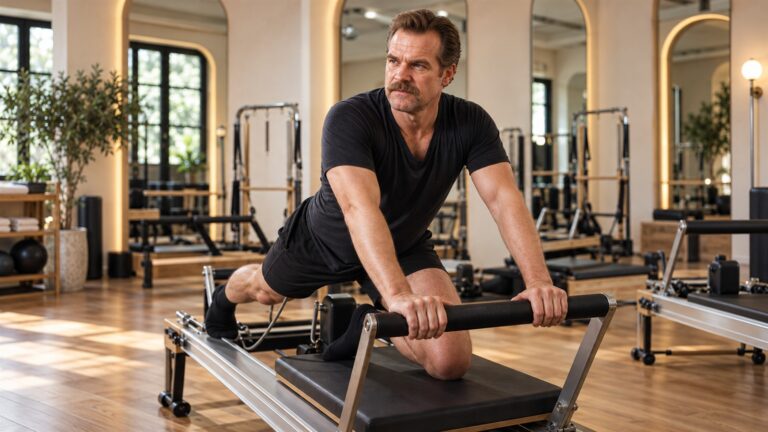
Start by reducing range. A shallower sit-to-stand may feel better than a deep squat while training many of the same muscles.
Then adjust load, speed, support, or total sets. Holding a rail, using a higher chair, or performing a supported split squat can lower the coordination demand.
Sharp pain, locking, giving way, sudden major swelling, or pain after a fall should not be converted into a “mental toughness” test.
Exercise discomfort should also be distinguished from chest pain, unusual breathlessness, faintness, or neurological symptoms. Those require stopping and appropriate medical care.
The goal is not zero sensation. The goal is a dose that improves capacity without creating a flare that disrupts the next several days.
A joint-friendly strength template
Two full-body sessions per week can be a reasonable starting structure for many beginners, assuming a clinician has not given different restrictions.
Choose one knee-dominant pattern, one hip-dominant pattern, one push, one pull, and one calf or balance exercise. Machines, bands, dumbbells, and body weight can all work.
A sample session might use a chair sit-to-stand, supported hip hinge, wall push-up, seated band row, and supported calf raise.
Begin with one or two sets of six to twelve controlled repetitions. Stop with several good repetitions still available rather than chasing failure.
Use a range that stays smooth. Add repetitions before adding weight, and change one variable at a time.
For example, a person might move from 2 sets of 8 to 2 sets of 10, then 2 sets of 12. Only after the last version is tolerated should resistance rise modestly.
This is a template, not Jo Whiley’s reported program. It illustrates how to translate the principle of adaptation into a repeatable session.
Strength work supports bone and muscle, but the dose must match current capacity. The older routine is a reference point, not a debt that must be repaid.
How to keep cardio in the week
Walking is convenient, but it is not the only valid cardio option. Cycling, swimming, water walking, rowing, or an elliptical may distribute stress differently.
Whiley’s return to swimming is a good example of changing the environment while keeping an aerobic habit. Water reduces weight-bearing load, though some strokes can still irritate a shoulder, knee, or hip.
Short bouts count. Ten minutes at a comfortable pace can be easier to recover from than one long session.
Progress duration before intensity when tolerance is uncertain. Adding five minutes is usually easier to interpret than adding hills, speed, and time together.
A talk test keeps intensity understandable. At a moderate pace, you should generally be able to speak in sentences, though not sing comfortably.
Someone returning after a long break may alternate easy movement with rest. Consistency over several weeks matters more than matching an old pace on day one.
For another example of carefully interpreting a health routine, see our analysis of sauna use and cardiovascular evidence.
The 24-hour traffic-light check
WorkoutHealthy’s traffic-light check turns vague “listen to your body” advice into a simple review.
Green: symptoms stay mild during training, normal movement returns soon afterward, and the joint is at baseline by the next day. Repeat the dose or progress one small variable.
Yellow: discomfort rises, technique changes, or stiffness is clearly worse the next morning but daily function remains intact. Repeat with 20 to 30 percent less total work.
Red: pain is sharp, swelling is substantial, the joint locks or gives way, sleep is disrupted, or symptoms worsen for more than 24 to 48 hours. Stop the provoking exercise and seek individualized assessment when appropriate.
The percentage reduction is a WorkoutHealthy starting estimate, not a validated medical threshold. It gives people a concrete adjustment while avoiding an all-or-nothing response.
Calculate total work simply: sets multiplied by repetitions. Two sets of ten equal 20 repetitions. A 25 percent reduction would bring the next attempt to about 15 repetitions, such as three sets of five.
Range and load can be reduced instead if repetition count is not the main driver. Record what changed so the next decision is based on more than memory.
Use the same exercise variation for several sessions before judging it. Constantly changing the movement can hide whether tolerance is improving.
Compare the joint with its own recent baseline, not with someone else’s pain score or training video.
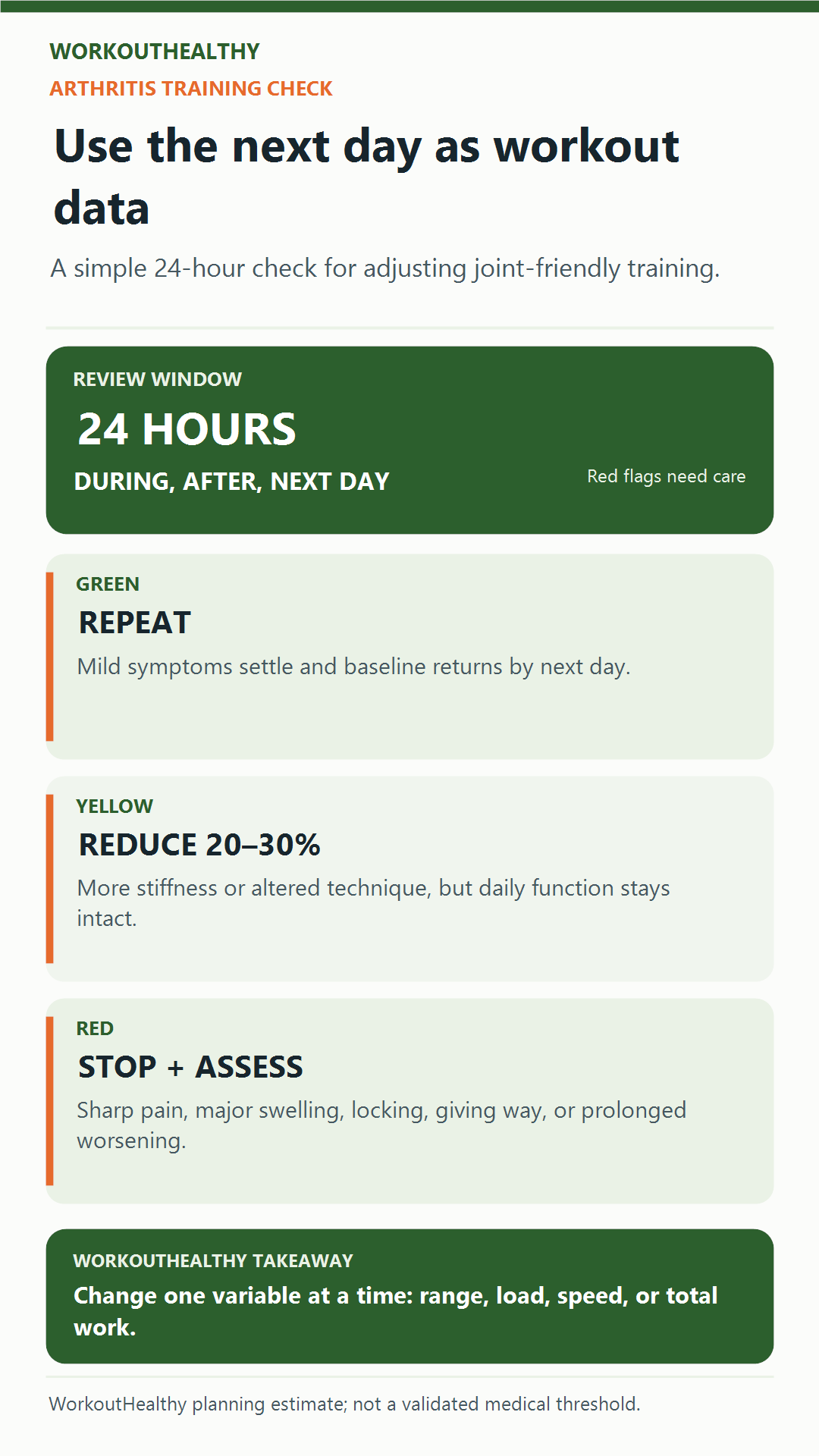
The day after a workout is part of the workout data.
What to do on flare days
A flare does not always require complete bed rest. It may call for a smaller range, lighter resistance, a different exercise, or a short easy walk.
Keep a minimum version of the routine when it is safe. Five minutes of gentle movement can preserve the habit without pretending the day is normal.
Heat or cold may help some people temporarily, depending on preference and clinical advice. Neither replaces diagnosis or a progressive plan.
Sleep and stress can change pain sensitivity. A hard week may justify a lower training target even when the joint structure has not suddenly changed.
Medication decisions belong with a qualified clinician or pharmacist. Do not increase pain medicine just to force the planned workout through.
If flares become more frequent, review the entire week. A session can be reasonable by itself but excessive when combined with work, caregiving, poor sleep, and other activity.
Protect the activities that matter most. Training should expand life, not consume every recovery resource needed to live it.
The bottom line
Jo Whiley’s experience shows the psychological challenge of changing a familiar routine, but it also points toward a workable answer. Keep moving, keep strength in the plan, and adjust the dose using both immediate and next-day feedback.
A good arthritis-aware program is neither fearless nor fragile. It treats pain as information, preserves useful activity, and progresses only when the body demonstrates that the last dose was recoverable.
Try this next: choose one lower-body exercise, one upper-body push, and one pull. Perform one easy set, then use the 24-hour traffic-light check before adding anything.
Medical disclaimer: This article is general product information, not medical advice. The equipment described here is not a treatment for any condition. If you have an injury, ongoing pain, or a medical condition, talk to a doctor or physical therapist before using any of it.