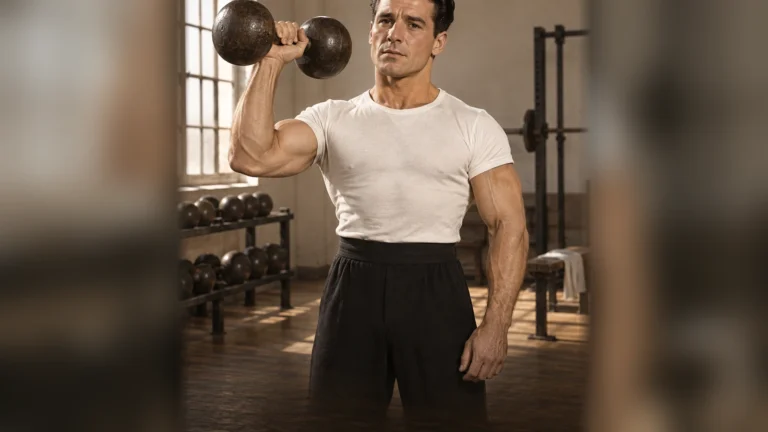

David Goggins likes to flip a common idea on its head.
Most people treat discomfort as something to get through so they can get back to feeling good.
Goggins treats it as the point. In his view, the uncomfortable part is where the growth happens.
A popular version of his message says comfort is the enemy of growth.
That idea has some research behind it. It also needs a clear line between useful discomfort and plain harm.
Did Goggins Say It on Joe Rogan’s Show?
Goggins has been a guest on The Joe Rogan Experience more than once.
His first appearance, episode 1080, aired on February 19, 2018.
Seeking out hard, uncomfortable experiences is a steady theme in his interviews and his 2018 memoir, Can’t Hurt Me.
However, we could not confirm the exact wording “comfort is the enemy of growth” in a specific episode.
So this article treats that line as a fair summary of his message, not as a direct quote.
Many similar lines circulate online with his name attached, and not all of them trace back to a recording.
What the Idea Really Asks You to Do
The message is not “suffer more.”
It is closer to this: when a task feels hard, that feeling may be a sign you are working at the edge of your ability.
Instead of backing away, you read the discomfort as progress.
For a workout, that could mean finishing the last hard minute of an interval.
Outside the gym, it could mean a hard conversation, a new skill, or a tough class.
The key word is choice.
Goggins talks about picking hard things on purpose, not waiting for life to hand them to you.
That sense of control is a big part of why the habit can feel empowering instead of draining.
Discomfort can be a sign you are growing. Pain is a sign something needs attention. Learn the difference.
What Psychology Research Shows
A 2022 paper by Kaitlin Woolley and Ayelet Fishbach tested this idea directly.
They ran five experiments with a total of 2,163 adults.
Tasks included improv classes, expressive writing about emotions, and learning about hard topics like gun violence.
Some people were told to seek out discomfort as a sign they were growing.
Those people engaged more and felt they made more progress than people given standard instructions.
The researchers also found a limit.
The strategy helped mainly in areas of growth that cause discomfort right away.
In other words, reframing discomfort works best when the discomfort is built into the task.
What About Cold Showers?
Cold showers are one of the most common ways people practice deliberate discomfort.
A large Dutch trial by Buijze and colleagues, published in 2016, tested this.
More than 3,000 adults were randomly assigned to end their usual warm shower with 30, 60, or 90 seconds of cold water.
They did this for 30 days in a row, and a control group kept showering as usual.
The cold shower groups had 29 percent less sickness absence from work than the control group.
But there was no significant difference in the number of days people actually felt sick.
The researchers also found no clinically meaningful changes in quality of life, work productivity, or anxiety.
About 79 percent of people in the cold groups completed all 30 days.
So a short cold finish is a practical way to practice discomfort. It is not a cure for much.
Where This Mindset Can Backfire
Goggins is known for extreme endurance feats, and that level of suffering carries real costs.
Treating all discomfort as good can lead people to ignore pain that signals injury.
It can also push people to stack hard sessions without enough recovery.
Our look at running with a weighted vest explains how added load raises the force your legs absorb.
Cold exposure has risks too. Sudden immersion in very cold water can trigger a dangerous shock response.
People with heart conditions should talk to a doctor before any cold plunge or ice bath.
Useful discomfort is controlled, short, and chosen. Harmful discomfort is sharp, lasting, or ignored.
Simple Ways to Add Controlled Discomfort
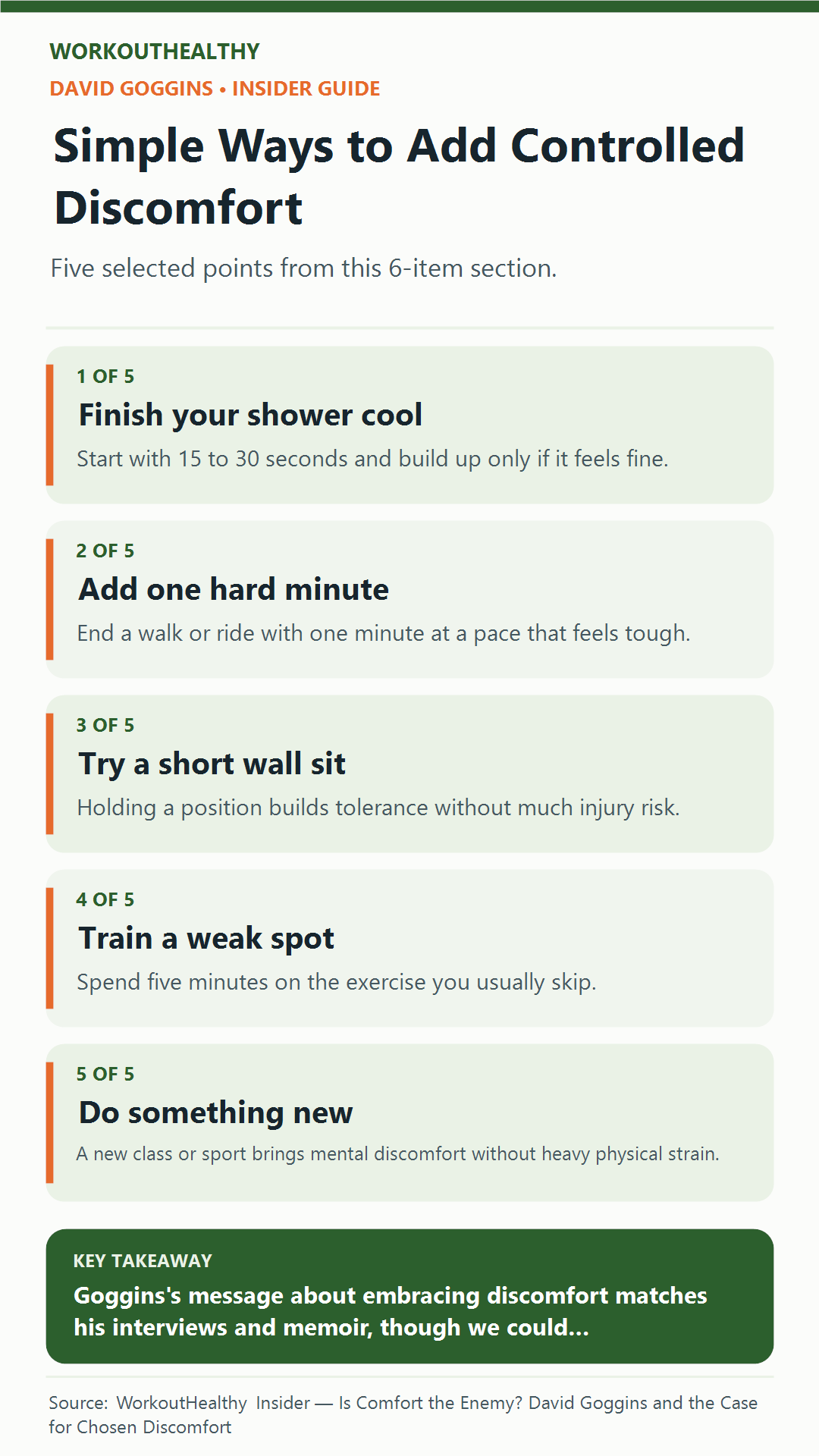
- Finish your shower cool. Start with 15 to 30 seconds and build up only if it feels fine.
- Add one hard minute. End a walk or ride with one minute at a pace that feels tough.
- Try a short wall sit. Holding a position builds tolerance without much injury risk.
- Train a weak spot. Spend five minutes on the exercise you usually skip.
- Do something new. A new class or sport brings mental discomfort without heavy physical strain.
- Keep the rest of the week easy enough. One or two hard efforts a week is plenty for most people.
If you want a low impact option, our article on whether a one minute wall sit works like cardio is a good place to start.
For hard effort with no equipment and no noise, see our guide to quiet home cardio.
Discomfort Versus Pain: A Quick Check
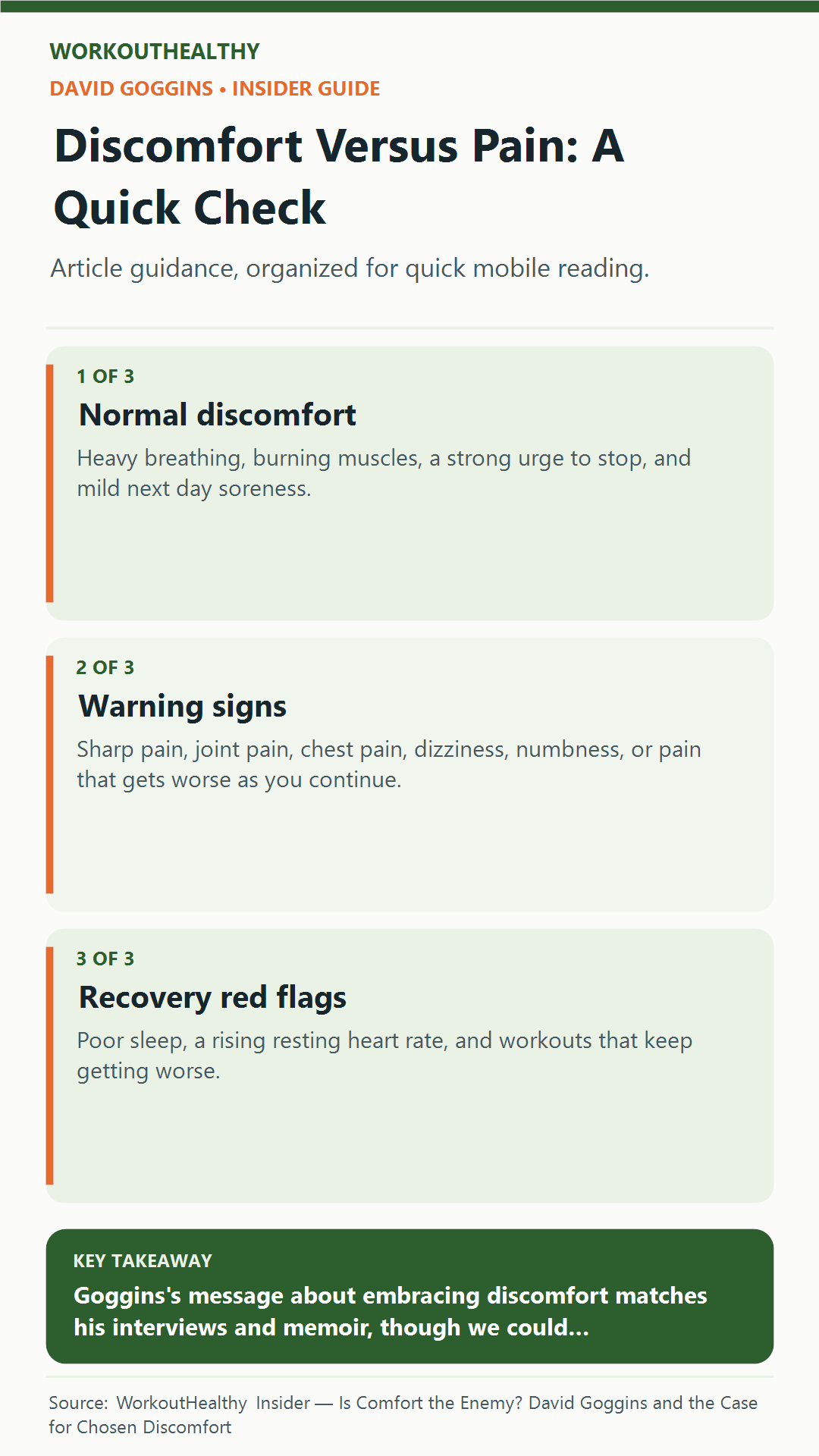
- Normal discomfort. Heavy breathing, burning muscles, a strong urge to stop, and mild next day soreness.
- Warning signs. Sharp pain, joint pain, chest pain, dizziness, numbness, or pain that gets worse as you continue.
- Recovery red flags. Poor sleep, a rising resting heart rate, and workouts that keep getting worse.
If you notice warning signs, stop. Seek medical care for chest pain or fainting.
Who Should Be Careful
People with heart disease, high blood pressure, or Raynaud’s should be cautious with cold exposure.
People recovering from injury should follow their rehab plan rather than chase extra discomfort.
Anyone with a history of overtraining or disordered exercise should build this habit with professional guidance.
The Bottom Line
Goggins’s message about embracing discomfort matches his interviews and memoir, though we could not confirm the exact “enemy of growth” wording.
Research suggests that reading discomfort as a sign of growth can keep people engaged in hard tasks.
Cold showers are a safe way for most healthy people to practice, with modest benefits.
Choose small, controlled hard things, and never treat real pain as part of the workout.
Want more stories like this? Subscribe to WorkoutHealthy Insider for practical explanations behind popular fitness claims.
References
- Buijze, G. A., Sierevelt, I. N., van der Heijden, B. C. J. M., Dijkgraaf, M. G., & Frings-Dresen, M. H. W. (2016). The effect of cold showering on health and work: A randomized controlled trial. PLOS ONE, 11(9), e0161749. https://doi.org/10.1371/journal.pone.0161749
- Goggins, D. (2018). Can’t hurt me: Master your mind and defy the odds. Lioncrest Publishing.
- Rogan, J. (Host). (2018, February 19). #1080: David Goggins [Audio podcast episode]. In The Joe Rogan Experience.
- Woolley, K., & Fishbach, A. (2022). Motivating personal growth by seeking discomfort. Psychological Science, 33(4), 510 to 523. https://doi.org/10.1177/09567976211044685
This article is for general information only and is not medical advice. If you have an injury, ongoing pain, or a medical condition, talk to a doctor or physical therapist before you change how you train or eat.