

Cocoa flavanols have a real research story behind them. Controlled trials suggest that flavanol-rich cocoa can improve a laboratory measure of blood-vessel function and produce a small short-term reduction in blood pressure.
That is much narrower than saying dark chocolate increases skin blood flow by 70 percent or protects the heart on its own. The percentage in a viral post may come from a particular protocol, population, or measurement, but it is not a reliable description of the broader evidence.
Quick answer: cocoa flavanols may modestly support endothelial function, but ordinary chocolate products vary widely in flavanol content. The trials do not turn chocolate into a treatment or prove that eating it prevents heart attacks.
A promising change in a blood-vessel test is not the same as a guaranteed change in your health future.
What cocoa flavanols are
Flavanols are plant compounds found in cocoa, tea, apples, grapes, and other foods. Cocoa can provide compounds such as epicatechin that interact with pathways involved in nitric-oxide availability and blood-vessel relaxation.
The word cocoa does not describe one standardized dose. Bean variety, fermentation, roasting, alkalization, storage, and manufacturing can all change the final flavanol content.
Dutch processing, also called alkalization, can reduce bitterness and change color, but it can also lower flavanol levels. A darker bar is not automatically a high-flavanol bar.
Cocoa percentage is also an incomplete guide. A label that says 70 percent cocoa describes the proportion of cocoa-derived ingredients, not a tested milligram amount of flavanols.
This is why research products and grocery-store chocolate are hard to compare. Trials may use a beverage, powder, capsule, or specially manufactured bar with a measured composition.
The food around the cocoa matters too. Chocolate can include substantial sugar and fat, which affect calories, taste, and how much someone is likely to eat.
What trials found for blood-vessel function
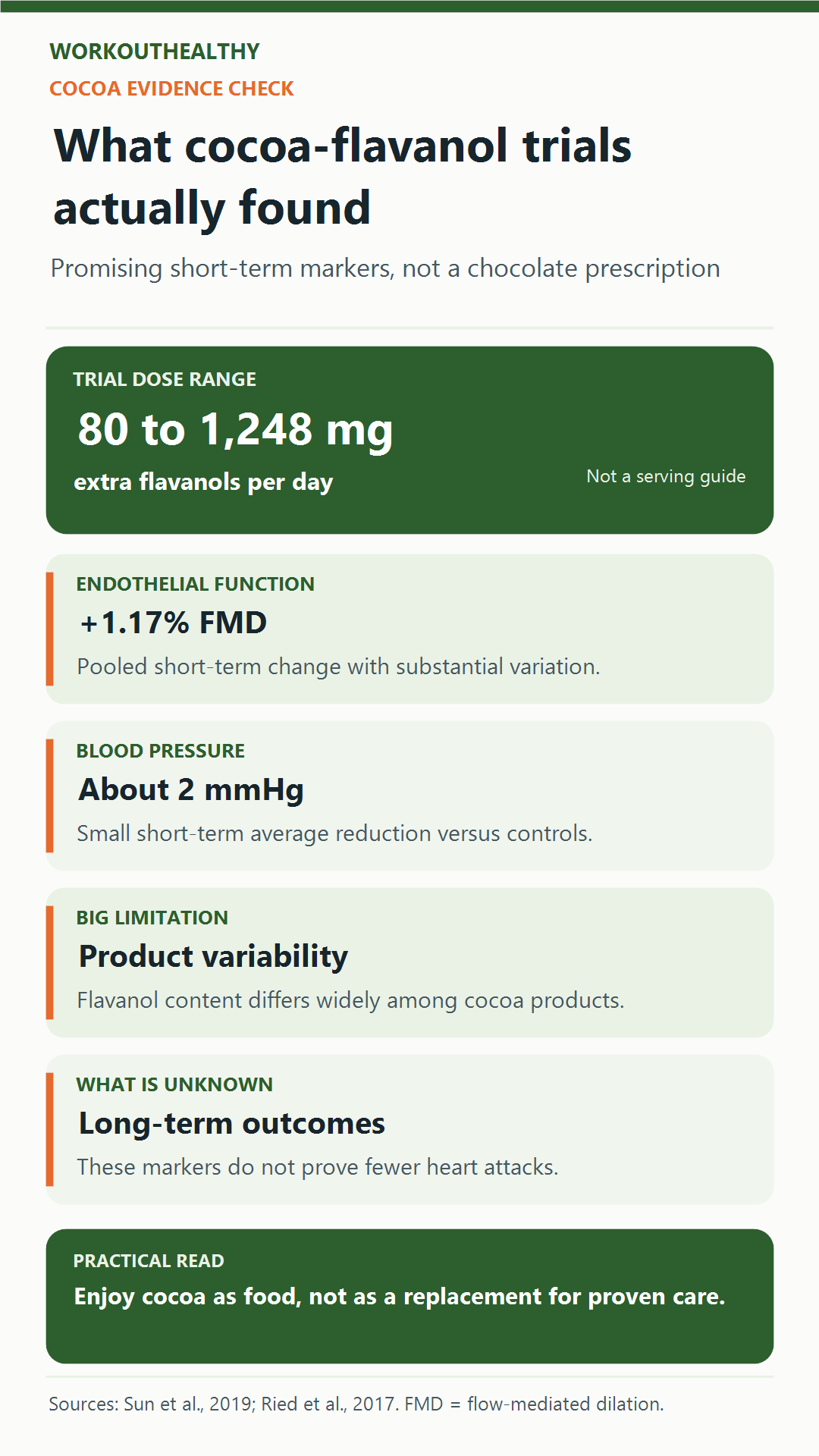
A 2019 systematic review pooled 15 publications with 18 intervention arms. Participants received 80 to 1,248 milligrams more cocoa flavanols than their control groups, with an average difference near 704 milligrams (Sun et al., 2019).
The main outcome was flow-mediated dilation, or FMD. This ultrasound-based test examines how much an artery widens after a temporary change in blood flow.
Across the included trials, cocoa flavanols improved FMD by an average of 1.17 percentage points. That supports a physiological effect on endothelial function under controlled conditions.
The dose-response pattern was not simply “more is better.” The analysis suggested an inverted U-shaped curve, with the modeled optimum around 710 milligrams of total flavanols.
The authors also found substantial unexplained variation and risk-of-bias concerns in most studies. An average effect across trials does not predict the exact response to one product or person.
FMD is a useful research marker, but it is not a heart attack, stroke, or longevity outcome. Improving the marker for a few weeks does not prove that long-term events will fall.
Relative and absolute changes also need to stay separate. A large-sounding relative percentage can describe a small movement on the original scale, while a one-percentage-point change in FMD has a particular technical meaning that cannot be translated directly into how warm your skin will feel.
Researchers standardize room temperature, fasting status, cuff placement, and imaging because the measurement is sensitive. A home observation after eating chocolate is not the same test.
What the blood-pressure evidence means
A Cochrane review included 35 randomized trials with 40 comparisons and 1,804 mostly healthy adults. The trials lasted two to 18 weeks and used products providing 30 to 1,218 milligrams of flavanols per day (Ried et al., 2017).
Compared with controls, flavanol-rich cocoa reduced systolic and diastolic blood pressure by about 1.8 millimeters of mercury on average. The review summarized the practical effect as roughly 2 millimeters of mercury.
That is a small average change, not a dramatic drop. The studies also differed in blinding, baseline blood pressure, product composition, and duration.
People with hypertension appeared to show a larger systolic reduction in a subgroup analysis, but the evidence was not strong enough to treat cocoa as a substitute for medication or clinical care.
The review found moderate-quality evidence for the short-term blood-pressure effect and called for longer trials with clinical outcomes. That is important because a marker can improve without proving fewer cardiovascular events.
The same distinction applies to other popular wellness claims. Our review of sauna use and heart health explains why association, intermediate markers, and clinical outcomes should not be blended together.
Why the 70 percent skin claim needs caution
Skin blood flow can be measured in several ways and under different conditions. A percentage change may describe one small area, one test, or a change from a low baseline rather than a whole-body cardiovascular effect.
Without the exact study, product, dose, duration, population, and measurement, “70 percent more blood flow” is not a reproducible health instruction. It is a number without enough context.
The broader meta-analyses use FMD and blood pressure because those outcomes can be pooled across multiple trials. Even then, the results vary considerably.
Skin circulation also responds to temperature, hydration, stress, exercise, and local measurement conditions. A single relative change can sound enormous while its absolute clinical importance remains uncertain.
This does not mean the claim is impossible. It means the available context is too thin to present it as what everyone should expect from a square of chocolate.
A careful summary keeps the scale honest: cocoa flavanols have shown modest short-term effects on vascular markers, with product and study limitations.
The WorkoutHealthy cocoa label translator
This is an original shopping framework, not a validated scoring system. It helps separate what a package proves from what it merely implies.
“Dark chocolate” describes a product category. It does not guarantee a tested flavanol dose, low sugar, or a clinical benefit.
“70 percent cocoa” describes cocoa-derived ingredients by weight. It is not a statement that the bar improves blood flow by 70 percent.
“Natural cocoa” usually means the powder was not alkalized. That may preserve more flavanols than Dutch processing, but the label still does not quantify them.
“Cocoa flavanols: X milligrams” is the most useful research comparison if the amount is supported by reliable testing. Few ordinary products provide this information.
“Heart healthy” is a marketing phrase unless the specific claim meets a regulatory standard and the product fits the person’s broader diet. Read the full nutrition panel and ingredient list.
The translator prevents a common category error: assuming color, bitterness, or cocoa percentage is a laboratory assay.
It also prevents dose borrowing. You cannot take the milligram amount from a standardized research product and convert it reliably into squares of a bar when that bar does not disclose flavanol content.
If a company reports flavanol testing, look for the amount per serving, the serving size, and whether the testing is independent. A front-label badge without those details still leaves the central question unanswered.
How to use cocoa without turning it into medicine
If you enjoy cocoa, use unsweetened powder in oatmeal, yogurt, smoothies, or hot drinks. That can add flavor while letting you control the added sugar.
If you prefer dark chocolate, choose a portion that fits your energy needs and enjoy it as food. Do not force a disliked product because a headline made it sound therapeutic.
Check caffeine and theobromine sensitivity, especially later in the day. Chocolate is not as caffeinated as coffee, but susceptible people may still notice effects on sleep or reflux.
Products can also vary in heavy-metal content. Rotation, portion awareness, and reputable testing are more sensible than consuming a large amount of one bar every day.
Heavy-metal risk depends on the contaminant, dose, frequency, body size, and other exposures. The presence of testing does not make a product medicinal, but transparent results can help consumers compare repeated-use options.
Cocoa can also interact with individual tolerances. Migraine triggers, reflux, milk ingredients, sugar alcohols, or allergies may matter more to a particular person than the average vascular effect in a trial.
For cardiovascular health, cocoa sits behind better-supported basics such as not smoking, managing blood pressure, staying active, sleeping consistently, and following prescribed treatment. Our review of daily steps and mortality shows how repeated movement relates to longer-term outcomes.
If cocoa becomes a reason to add hundreds of calories while expecting a medicinal payoff, the framing has gone wrong. Use the food because it fits your preferences, not because a percentage promised protection.
Enjoy the chocolate, but make the health claim earn its place.
The bottom line
Cocoa flavanols can improve endothelial function and slightly lower blood pressure in short-term controlled trials. The evidence is more credible than a wellness myth, but less dramatic than a viral “70 percent more blood flow” promise.
Ordinary cocoa products do not provide a standardized dose, and changes in laboratory markers do not prove fewer heart attacks. Treat cocoa as an enjoyable food that may offer a modest benefit, not as cardiovascular therapy.
Get the next evidence check.
Five practical fitness stories worth your time, every Friday.
One email a week. No product pitches. Unsubscribe in one click.
References
Ried, K., Fakler, P., & Stocks, N. P. (2017). Effect of cocoa on blood pressure. Cochrane Database of Systematic Reviews, 4, CD008893. https://doi.org/10.1002/14651858.CD008893.pub3
Sun, Y., Zimmermann, D., De Castro, C. A., & Actis-Goretta, L. (2019). Dose-response relationship between cocoa flavanols and human endothelial function: A systematic review and meta-analysis of randomized trials. Food & Function, 10(10), 6322-6330. https://doi.org/10.1039/C9FO01747J
Medical disclaimer: This article is general product information, not medical advice. The equipment described here is not a treatment for any condition. If you have an injury, ongoing pain, or a medical condition, talk to a doctor or physical therapist before using any of it.