
A person can spend nearly ten hours a day off their feet and still live a very different kind of day from an office worker. That is the puzzle behind a 2020 study of the Hadza, a foraging population in Tanzania. Researchers found substantial time in nonambulatory postures, yet many resting periods involved squatting or kneeling rather than sitting in a chair. In laboratory measurements, those positions kept some leg muscles more active.
The social-media takeaway often runs much farther: squatting while you rest supposedly burns fat, prevents chronic disease, and restores lost mobility. The study did not test those outcomes. Its more useful finding is about how people rest and what muscle activity looks like in different positions. Here is what the researchers measured, where the claim stops, and how to use the idea without turning your workday into a squat challenge.
What did the Hadza study actually find?
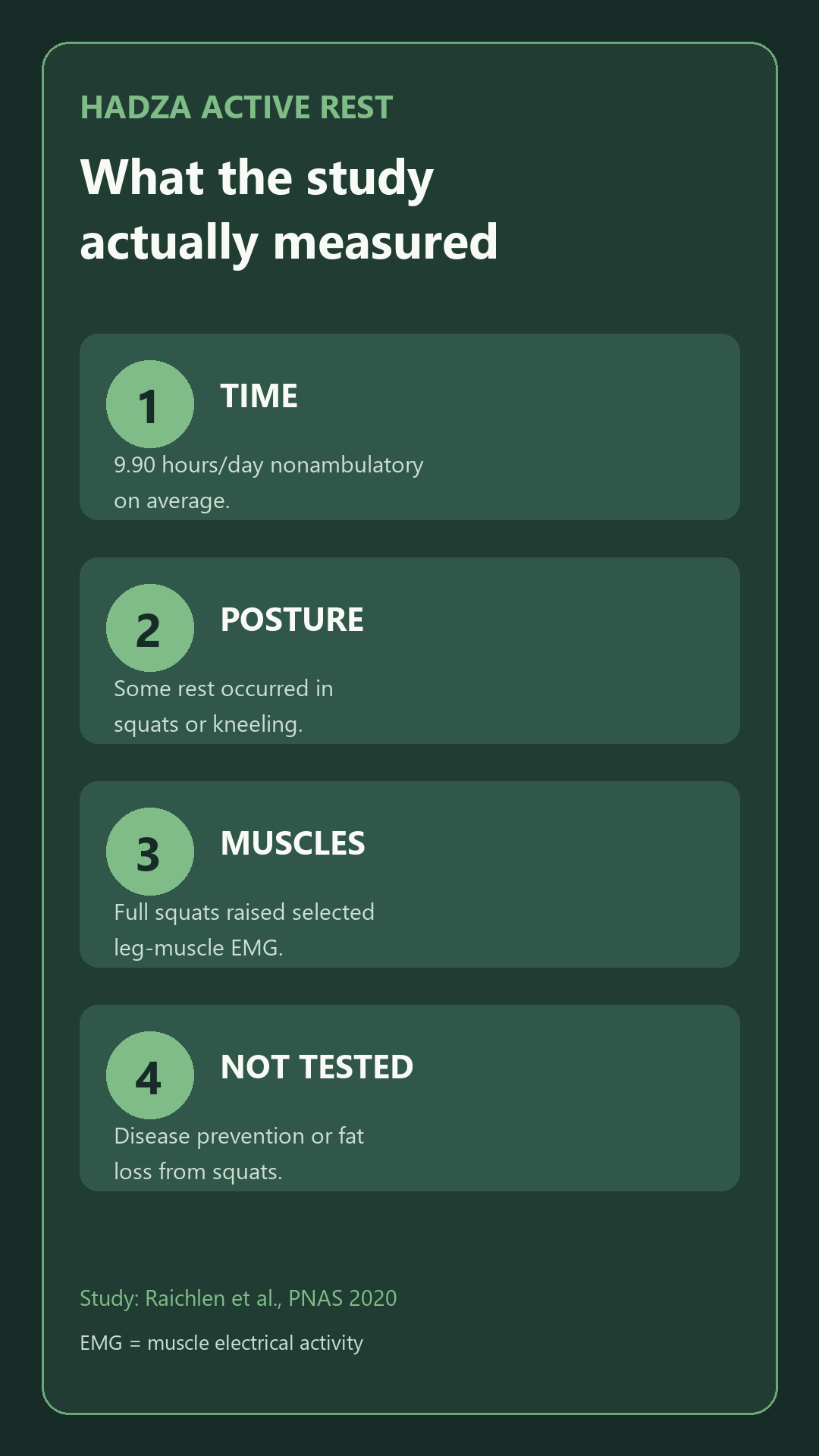
David Raichlen and colleagues combined thigh-worn activity monitors, observations of daily postures, and electromyography, or EMG, to examine inactivity among Hadza adults. Their paper reported an average of 9.90 hours per day of nonambulatory time, with considerable variation. That number is similar to sedentary-time estimates in some industrialized populations. It challenges the idea that a physically active foraging life means almost never resting.
The difference lay partly in posture. Hadza adults often rested in ground positions such as squatting and kneeling. In the researchers’ laboratory comparisons, a full squat elicited higher activity in several measured lower-leg and thigh muscles than chair sitting. Kneeling also had a different muscle-activity pattern from sitting. The authors proposed an “inactivity mismatch” hypothesis: perhaps human bodies spent much of their evolutionary history resting with some muscles still engaged.
This was observational field research paired with muscle measurements, not a clinical trial assigning people to squat for months. It did not randomize office workers to different resting postures and follow rates of diabetes, heart disease, or pain. Nor did it show that all Hadza adults squat continuously during every rest period. Cultural and individual variation matter.
The Hadza are living people with diverse routines, not a demonstration model for modern wellness advice. Their health and activity patterns reflect many factors: food access, walking and foraging, environment, age structure, and social context. Reducing that complexity to “the squat explains their health” would be a weak inference.
What does “active rest” mean here?
In this discussion, active rest means a posture that is not walking or formal exercise but still demands some muscular work to hold the body up. A free-standing squat requires the legs and trunk to manage balance. A kneeling posture can shift load and involve muscles differently from a chair. By contrast, a chair supports much of the body’s weight, allowing many postural muscles to work less.
That is a description of mechanical demand, not a new exercise category with a proven health dose. A person can sit upright and still use muscles; a relaxed supported squat can be less demanding than a deep free squat. Position, support, footwear, anatomy, and fatigue all change the effort. EMG records electrical activity in selected muscles; it does not directly measure calories burned or fat oxidized.
The Facebook post says chair sitting “shuts muscles off completely.” That is too absolute. Muscles continue to support posture, breathe, and move even while sitting, though chair support usually lowers activity in certain leg muscles compared with a full squat. Likewise, the idea that the Hadza’s lightly active muscles “burn fat even while at rest” confuses a general fact—muscles use energy—with evidence that this particular posture materially changes body-fat balance.
Active rest is a hypothesis about posture and muscle use. It is not a measured fat-loss or chronic-disease intervention.
Why do the muscle recordings matter?
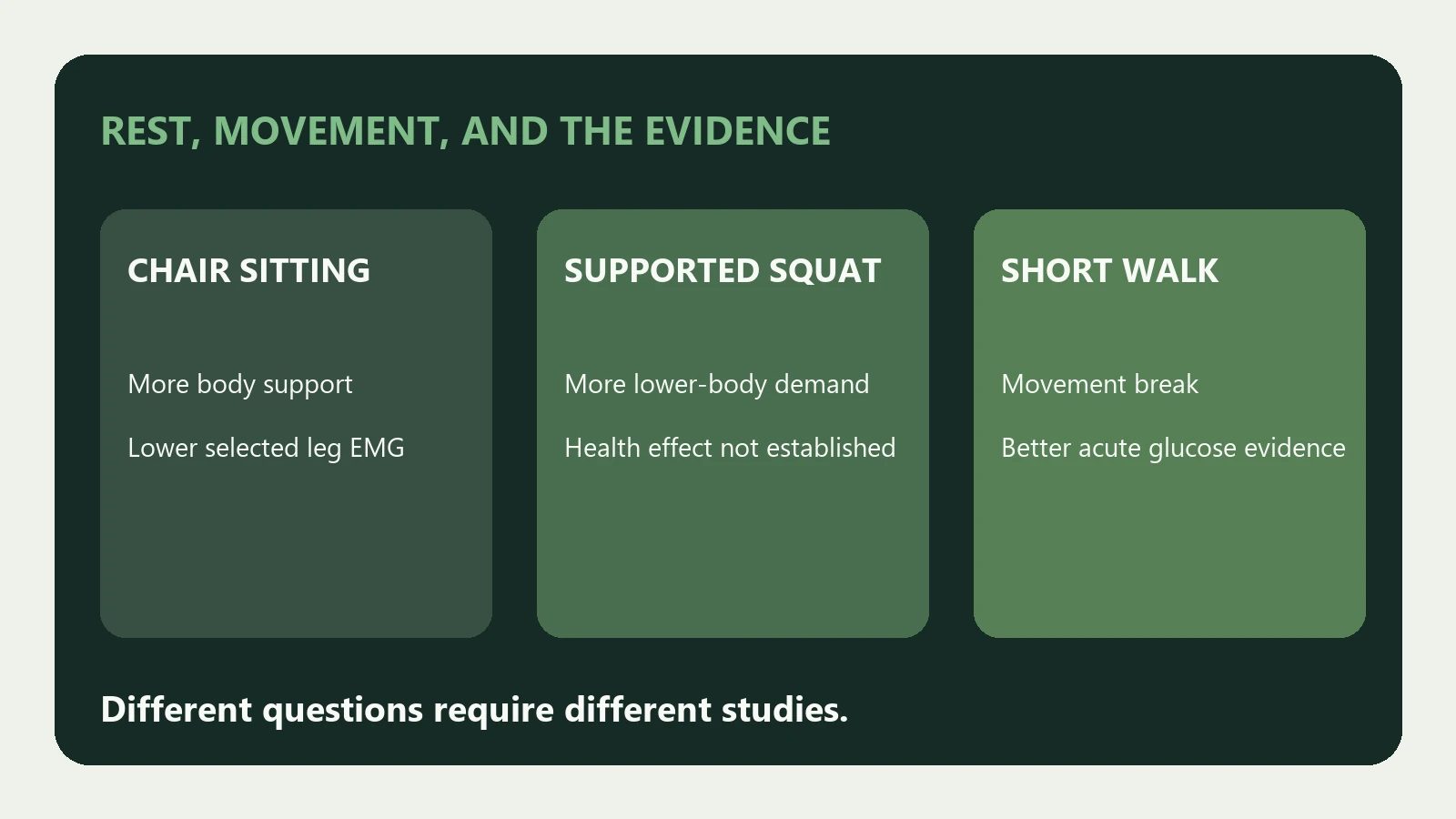
The study’s EMG comparison gives the central claim an objective basis. Full squatting showed higher activity than chair sitting in the soleus, vastus lateralis, and tibialis anterior among the measured positions. These muscles help control the ankle and knee. The finding supports the idea that a squat can be “rest” in the sense of not traveling or exercising vigorously while still demanding more lower-limb activity than a chair.
But the study does not measure a useful daily calorie difference from adopting a squat. EMG levels cannot be converted into a reliable calorie or fat-burning number without other measurements. Even if a posture costs a little more energy, the overall daily effect depends on duration, other activity, food intake, and adaptation. A brief squat between meetings is unlikely to rival a walk or strength session for energy use.
Some commentary treats the result as if it proves chair sitting is harmful specifically because it lowers leg EMG. That mechanism is plausible but unconfirmed as the explanation for long-term disease patterns. Researchers proposed a model for testing. They did not complete the outcome trial needed to demonstrate that replacing a chair with squats prevents metabolic syndrome or cardiovascular disease.
The distinction is common in fitness research: detecting more muscle activity in a movement is not the same as demonstrating better strength, mobility, or health. A measured intermediate step can guide a good experiment, but the endpoint still needs to be tested.
Does squatting explain the Hadza’s lower chronic-disease markers?
The study notes that Hadza adults in prior work generally showed low levels of some cardiovascular risk markers despite substantial nonambulatory time. That coexistence is interesting, and the authors suggest active-rest postures might be one contributing factor. It does not isolate posture from the rest of life. Their high amounts of walking and other moderate-to-vigorous activity, diet, body composition, and many other differences could influence the observed markers.
Neither low biomarkers nor lower disease prevalence in one population prove that a posture caused protection. The article’s claim that squatting and kneeling “help explain the Hadza’s low rates of chronic disease” goes beyond the 2020 data if stated as a conclusion. The paper proposes a hypothesis for future interventions. A stronger test would randomly assign realistic posture changes and follow meaningful clinical outcomes for long enough to separate posture from other habits.
Research on breaking up sitting provides a related but distinct evidence base. A 2022 systematic review of acute randomized crossover studies found that brief standing breaks attenuated post-meal glucose compared with continuous sitting, while light walking breaks did more for glucose and insulin. A 2026 review of 53 studies similarly found short walking breaks improved acute post-meal measures. These are short-term biomarkers, not proof that one break pattern prevents disease over decades.
The public-health message is less exotic and better supported: move more and sit less across the day, and meet regular aerobic and muscle-strengthening activity guidelines when you can. The U.S. Physical Activity Guidelines recommend 150 to 300 minutes of moderate aerobic activity weekly plus muscle-strengthening activity on at least two days for adults. A few comfortable squats can be part of movement variety, not a substitute for those habits.
Should you try a resting squat?
You can, if the position feels comfortable and serves a mobility goal. Start beside a stable rail, doorframe, or counter. Hold on lightly, widen the feet as needed, and lower only to a depth you can control without sharp pain. You do not need heels flat, a perfectly vertical torso, or a prescribed duration to make the movement count. Come up slowly, especially if you feel lightheaded on standing.
A brief supported squat can be a useful way to explore ankle, knee, hip, and trunk range. It is not a test of whether your body is “natural,” and not everyone needs to reach the same depth. Body proportions, joint history, footwear, and practice change what is comfortable. Our detailed resting-squat mobility guide lays out a supported progression and when to stop.
Do not force a deep, prolonged hold if your knees, hips, ankles, back, or balance object. People with recent injury, joint replacement, pregnancy-related balance changes, or conditions that limit floor transfers may benefit from individualized advice. A shallow sit-to-stand, supported mini squat, or comfortable chair-based leg exercise can be a better choice than imitating a photo.
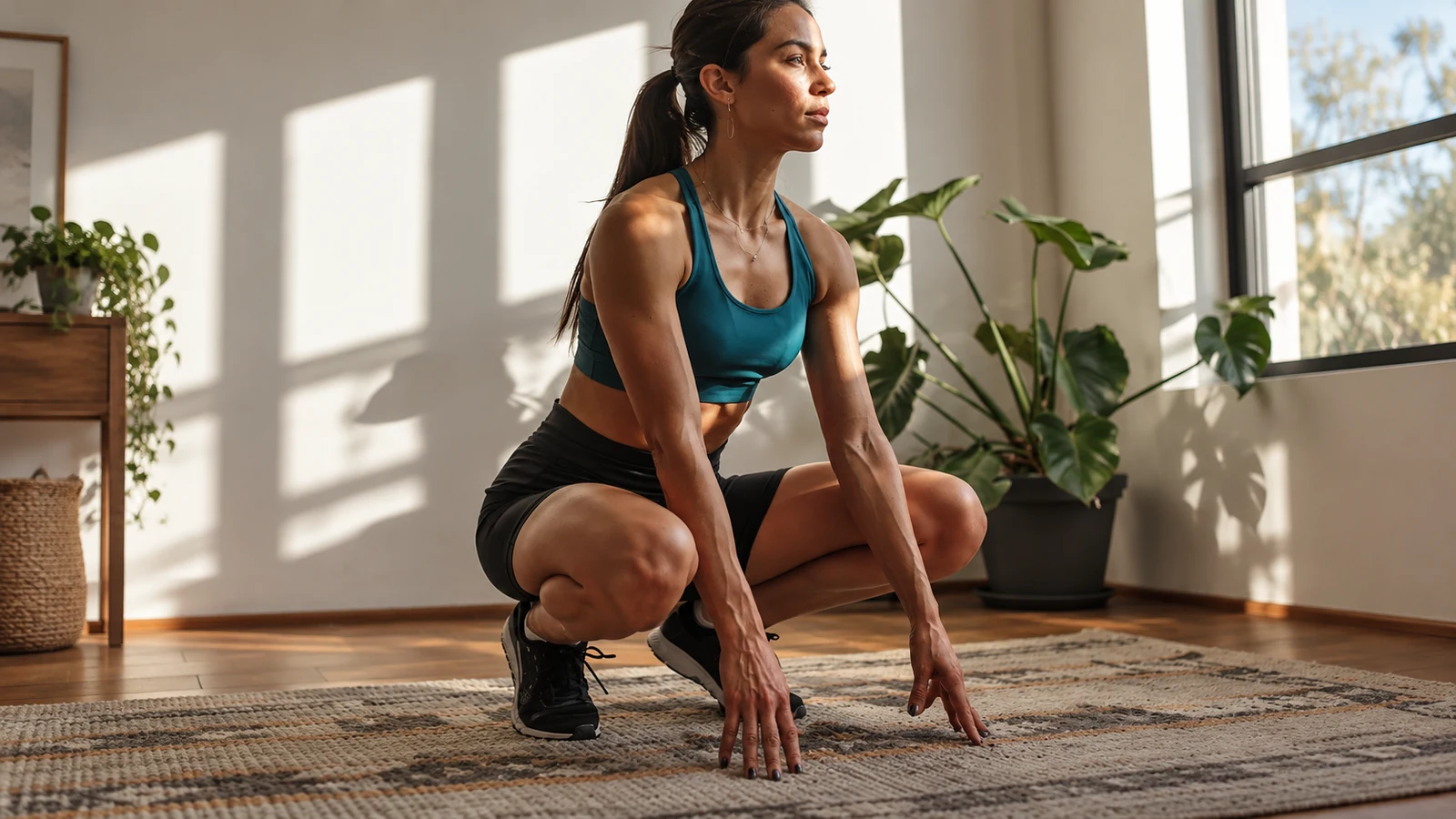
The woman in the source Facebook image is an illustrative exercise model, not a Hadza research participant. Her pose should not be treated as the study’s exact posture or as proof of the claimed benefit. Use the image as a visual prompt to consider movement, while the research provides the boundary for what we can say.
Is kneeling a necessary alternative?
No. Kneeling can change hip and ankle positions and may be comfortable for some people, especially with a cushion. For others it can irritate the knees or make getting back up difficult. The Hadza study observed kneeling as one real-world resting behavior; it did not prescribe kneeling to office workers or identify a safe, universal dose.
Even among people who enjoy ground sitting, variety may matter more than adopting a single “correct” posture. Move between sitting, standing, walking, and comfortable floor positions when practical. Use support if balance or joint comfort requires it. An ergonomic setup that lets you work without pain is compatible with regular movement breaks.
There is also no need to idealize another culture’s practices as a universal health solution. A posture can be common in one environment because of furniture, work, habits, or terrain. The research offers a biological question worth exploring; it does not create an obligation to copy daily life without its context.
What should a desk worker do with this finding?
First, make the easy movement options easy. Stand for a call. Walk to refill water. Take a short stroll after a meal. Use the stairs if appropriate. If you want mobility practice, add a few supported squats, gentle kneeling transitions, or a sit-to-stand. Choose the option that fits your joints and workday rather than the one that sounds most ancestral.
The stronger intervention evidence for post-meal markers favors light walking breaks over merely standing. That does not mean a squat break is useless, only that it has not been tested as well for that endpoint. If the goal is lower-body strength, progressive resistance training is a more direct tool. If the goal is reducing stiffness, changing position and moving through a comfortable range may feel helpful.
Our article on exercise and sitting time puts movement breaks beside weekly activity. It is reasonable to do both. Avoid treating an activity tracker’s hourly reminder as a medical threshold; studies use varied schedules, and the most sustainable break is one you can repeat.
Small changes may support comfort or help you accumulate more movement. They cannot be credited with “a real difference” to chronic-disease risk solely from this Hadza study. Keep the goal concrete: one more walk, one more position change, or a controlled squat you can exit comfortably.
The takeaway
The Hadza study found about 9.9 hours of nonambulatory time per day and more muscle activity in certain squat positions than in chair sitting. It did not show that squatting burns a meaningful amount of fat, prevents chronic disease, or makes everyone more mobile. Its best lesson is curiosity about how we rest. Mix comfortable positions, move regularly, and use walking and strength training for the health goals those interventions have actually been studied to support.
Sources
- Raichlen and colleagues, 2020, the original Hadza sitting, squatting, and kneeling study.
- 2022 systematic review, standing and walking breaks versus prolonged sitting.
- Gale and colleagues, 2026, meta-analysis of acute activity breaks and post-meal markers.
- U.S. Physical Activity Guidelines, adult movement and strength recommendations.