
Ssireum wrestling is a Korean belt-wrestling sport in which two opponents grip a fabric belt called a satba and try to bring each other to the ground. The belt, the finishing contact and the competition format are the best places to start when watching.
You do not need to memorize a catalogue of throws to enjoy a bout. First distinguish a winning fall from a reset, then follow how the wrestlers reached that moment.
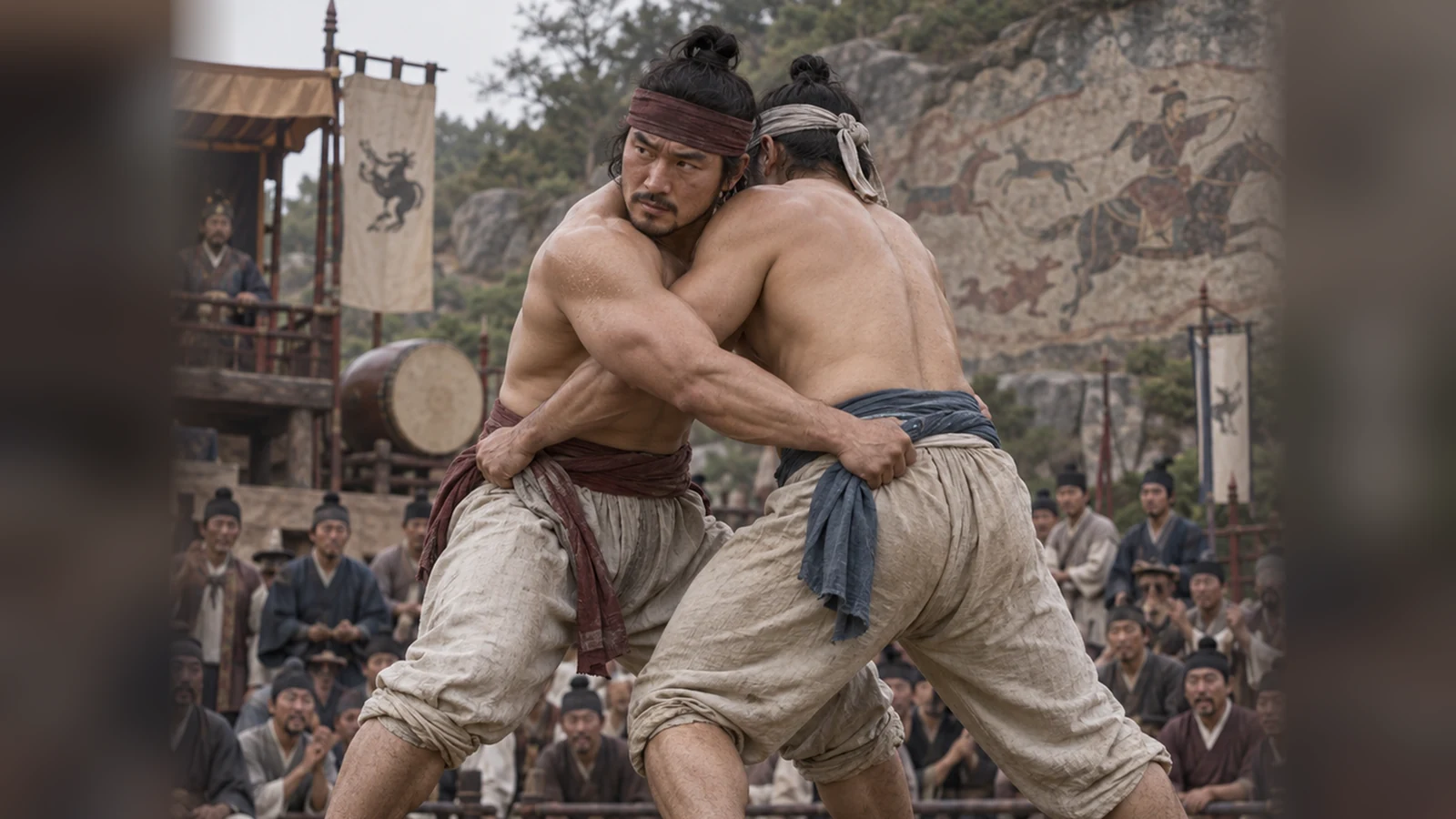
The featured image is a historical-style illustration, rather than a photograph of a documented bout or a demonstration of a modern grip.
How a wrestler wins
Korea.net’s sport explanation describes the goal as forcing a part of the opponent’s body above the knee to touch the ground. It also distinguishes ssireum from striking sports: the athletes grapple through the belt rather than exchange blows (Korea.net, 2014).
Watch the finishing contact and the referee’s decision, rather than assuming that the larger-looking throw won. A dramatic lift is an attempt; the outcome depends on how the exchange finishes under the event’s rules.
The ring boundary needs separate attention. The World Nomad Games’ ssireum summary says that pushing an opponent out brings the wrestlers back to the starting position, rather than automatically awarding victory (World Nomad Games, n.d.).
That makes the edge a poor shortcut for reading the result. If the wrestlers go out and return to the middle, follow the restart instead of counting a fall yourself.
Four checkpoints for a first-time viewer
| Checkpoint | What to follow | What to avoid assuming |
|---|---|---|
| Belt | Where each wrestler holds the opponent’s satba | A grip alone explains the whole technique |
| Exchange | Who initiates movement and how the other responds | The first attacker must win |
| Finish | The actual ground contact and referee’s call | The highest lift or loudest reaction settles the result |
| Next action | Whether the athletes reset or the score changes | Every stoppage ends the full match |
These are viewing prompts, rather than a judging system. They help you ask a more specific question when the action moves too quickly to understand on the first viewing.
What the satba does, and how a bout starts
The satba provides a grip around the waist and one thigh. In a January 2023 interview, wrestler Kim Minjae describes the standard belt around the right thigh and waist (Seong, 2023).
The World Nomad Games summary gives a useful starting sequence: the opponents kneel, establish their mutual grips, rise and wait for the starting signal. Its description places the right hand at the waist belt and the left at the opponent’s right-thigh loop.
This explains why a clip may show both athletes kneeling before the active exchange. The preparation and the live action are different parts of the sequence.
When a replay begins halfway through a throw, rewind far enough to see the start. You may understand the exchange more clearly without needing to attach a technical name to every movement.
A fall and a full match are different questions
English summaries sometimes use “bout,” “game” and “match” differently. Before watching, check both how a fall is awarded and how many falls decide that competition stage.
| Published source | What it describes | How to use it |
|---|---|---|
| Kim Minjae interview, January 2023 | Describes a one-minute match; two wins from three in Pro League preliminary rounds and semifinals, and three from five in the final | An attributed description of that league, stage and period |
| World Nomad Games sport summary | A three-minute match description | A separate event summary, rather than a replacement for the league description |
The different time descriptions are a reason to read the organizer’s information for the event you are watching. A short explanatory page cannot settle every question about time limits, penalties, simultaneous contact or disputed decisions.
For a broadcast, identify the competitors, competition stage and displayed score before concentrating on individual exchanges. After a fall, check whether the broadcast continues with the same pair or moves to another contest.
This small habit prevents a common viewing mistake: treating the end of one exchange as the end of the entire contest. It also makes a short highlight easier to place in context.
Recognize technique families before learning every name
Kim’s interview groups techniques into hand, leg and waist families. He describes deulbaejigi as a lift followed by rotation and a throw, and identifies doechigi as a counterstroke (Seong, 2023).
Use those descriptions as vocabulary for watching, rather than instructions for attempting a throw. A technique name does not supply the grip pressure, timing, footwork, landing practice or partner communication needed to perform it.
The counter is especially worth following on replay. Instead of watching only the athlete who starts the attack, give the opponent’s response a separate viewing.
You can enjoy the change in initiative without declaring that a particular angle or movement works in every exchange. One attractive finish does not establish a universal recipe.
Watch official footage with the context intact
UNESCO’s official Republic of Korea ssireum film is credited to the Cultural Heritage Administration, 2016. It presents the tradition in community and teaching settings as well as wrestling imagery, rather than serving as a current competition rulebook.
Keep that distinction when watching: a family lesson, a festival scene and a competitive exchange answer different questions. For the sport’s scoring and match structure, pair cultural footage with the relevant event information.
A three-pass replay routine
Try this viewing method on a complete exchange. It is an observation aid, rather than a coaching or referee qualification.
- First pass: establish the outcome. Watch at normal speed, then check the referee and scoreboard before deciding what happened.
- Second pass: follow the beginning. Look at the initial grips and the first movement, without trying to name everything at once.
- Third pass: follow the response. Watch the other athlete and the finishing contact, then compare what you noticed with the commentary.
If the camera hides the contact or the clip cuts away, leave that detail unresolved. Seeing a result on the scoreboard is different from being able to explain every part of the decision.
A useful viewing note has three parts: what you saw, what the broadcast identified, and what remains unclear. Keeping them separate is more informative than guessing a precise technique from one frozen frame.
Why balance does not make strength irrelevant
Korea.net’s sport explanation describes both strength and using an opponent’s movement to disturb balance. Those ideas can coexist: tactical skill does not mean that body size or physical strength stops mattering.
A smaller athlete winning one exchange would not, by itself, prove which quality caused the result. To understand the action, examine the exchange rather than turning the outcome into a promise about defeating any larger opponent.
For the same reason, general gym exercises cannot be treated as proof that someone has learned ssireum. Getting stronger and learning to wrestle are related goals with different practice demands.
A living tradition, with history in the background
UNESCO’s joint listing describes ssireum and ssirum as community traditions transmitted through families, schools and local participation. Its accounts include festivals, sand-ring games and the cultural meaning of the champion’s ox prize (UNESCO, 2018).
The ancient background matters, but it should not replace watching the present sport. Korea.net notes wrestling imagery in Goguryeo tomb paintings; a still image cannot establish a complete modern throw sequence or its effectiveness.
Anthropologist Christopher Sparks makes a useful distinction in his Korea.net interview: a living tradition changes as people continue to practice it. That is a reason to identify the setting and rules of a particular event, rather than imagine one fixed format across every period (Sohn, 2014).
If you want to try ssireum
Look for in-person instruction that actually teaches ssireum, and ask how a first lesson handles belt fitting, partner work and learning to land. Explain your experience and any relevant limitations before participating.
Leave throws and counters for that teaching environment. A spectator guide can help you understand what you are seeing without turning an online description into unsupervised partner practice.
For your next viewing, keep the task simple: identify the satba, follow the exchange and finishing contact, then check how that result fits the match score. The technical vocabulary can grow from there.
See the sport behind the highlight.
Five practical fitness stories, every Friday.
One email a week. No product pitches. Unsubscribe in one click.
References
Korea.net. (2014, November 12). Ssireum lives on. Sport explanation and historical context.
Seong, J. (2023, January). K-sports: Ssireum wrestler Kim Minjae. KOREA Webzine, Korean Culture and Information Service. Original athlete interview.
Sohn, J. A. (2014, July 3). Ssireum aficionado from US: Prof. Christopher Sparks. Korea.net. Anthropologist interview.
UNESCO. (2018). Traditional Korean wrestling (Ssirum/Ssireum). Representative List of the Intangible Cultural Heritage of Humanity. Joint listing and official films.
World Nomad Games. (n.d.). Ssirym. Organizer’s sport summary.
Medical disclaimer: This article is general fitness information, not medical advice. If you have an injury, ongoing pain or a medical condition, talk to a doctor or physical therapist before changing how you train.