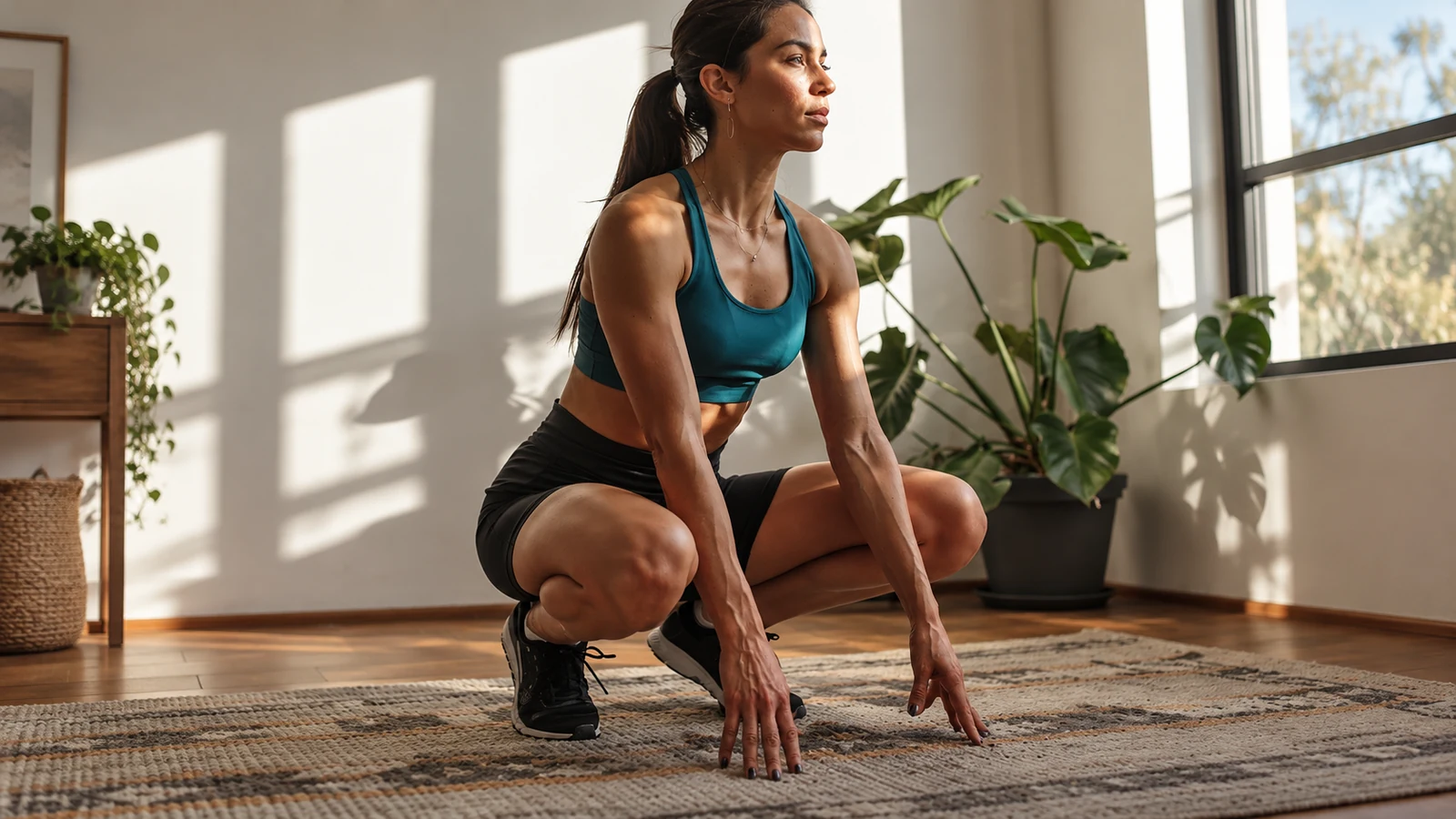

Illustration note: The woman pictured indoors is an exercise illustration, not an identified Hadza participant or a demonstration of the study’s exact test conditions.
The Hadza squatting study found that some resting postures required more leg-muscle activity than chair sitting. It did not establish that copying those postures prevents disease, produces fat loss or replaces walking and exercise.
The interesting question is how a person can spend substantial time resting while remaining muscularly active in particular ways. To understand the answer, separate three kinds of evidence: a monitor’s activity categories, an observer’s posture snapshots and short recordings from selected muscles.
What did the Hadza squatting study measure?
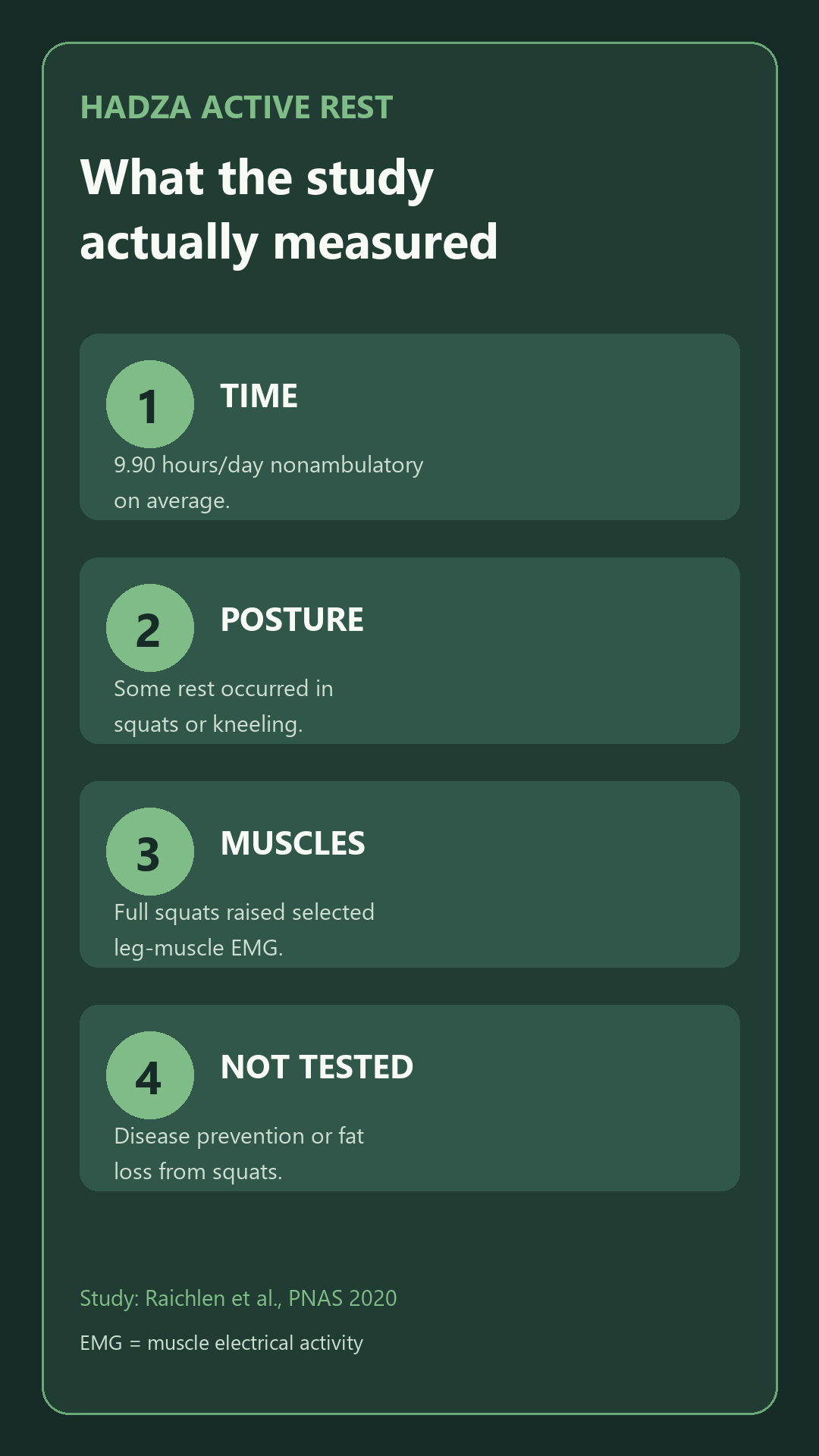
Raichlen and colleagues’ 2020 paper examined Hadza adults living in northern Tanzania. Its abstract reports about 9.9 hours of nonambulatory time daily, alongside substantial physical activity.
| Method | What was recorded | What that leaves unanswered |
|---|---|---|
| Thigh monitors | 28 adults wore monitors for eight days. | The exact posture at every moment and its health effect. |
| Camp observations | 96 scans recorded 2,396 postures; roughly 18% of nonambulatory observations were squatting and 12.5% kneeling. | An uninterrupted personal record of minutes in each posture. |
| Electromyography, or EMG | Selected leg-muscle signals during brief posture trials. | Whole-body energy expenditure, fat loss or long-term disease prevention. |
These are complementary methods, not interchangeable instruments. A time estimate, a posture share and a muscle signal each describe a different part of daily life.
That distinction matters when a headline turns a study into a routine. An observation that people sometimes rest in a squat is different from testing whether readers benefit from adding a particular number of squat minutes.
Does nonambulatory mean motionless or unhealthy?
In this paper, the nonambulatory category excluded standing and walking. It grouped resting postures that could still differ in muscular demand.
In everyday language, people often use sitting time, inactivity and lack of exercise as if they describe the same thing. For research, first check how the investigators defined and measured each term.
A person’s workday can include a planned walk and long periods in a chair. Knowing one fact does not tell you the other, and neither describes every movement that occurred between them.
Similarly, the name active rest does not create a new exercise category with an established dose. It is a way to describe the possibility that resting positions differ in how much muscular work they require.
What did the squat muscle recordings show?
Full squatting produced higher soleus, vastus lateralis and tibialis anterior activity than chair sitting. Rock-supported squatting showed a narrower soleus finding, while kneeling was observed but not EMG-tested.
The researchers analyzed a 30-second window within each two-minute trial and expressed average muscle activity relative to that muscle’s walking signal. These were not percentages of maximum strength, calories or fat burned.
That reference value is essential whenever an EMG chart uses percentages. Ask what the signal was divided by before comparing it with percentages in another study.
As a hypothetical example, a signal equal to one quarter of its walking reference would not mean that a posture supplies one quarter of walking’s health benefit. A ratio of electrical signals does not measure a ratio of clinical outcomes.
The same care applies to a statistically detectable difference. It establishes a difference in the tested measurement under the study conditions, while a practical recommendation requires additional evidence about outcomes, tolerability and the people using it.
What does supported squat mean in this research?
The study’s assisted condition supported the buttocks on a small rock. It was not a test of holding a counter, hanging from a rail or choosing an arbitrary supported exercise variation.
Those options change where the body receives support, so sharing a name does not establish identical muscular demands. A useful exercise description should identify the support rather than treating every assisted squat as the same task.
This article explains a measurement; it does not teach readers to reproduce that field setup. A photograph of a contemporary person squatting indoors cannot supply the missing details of a research condition.
Readers interested in the broader mobility question can use our resting-squat evidence guide. That is a separate question from whether the Hadza study established a health benefit of changing an office resting posture.
Why 18% is not a daily squat target
A posture share describes the observations included in its denominator. It does not automatically become a prescription for every individual represented by those observations.
Imagine a separate, fictional observation exercise in which a group is photographed at ten scheduled moments. If two photographs show a particular posture, it appears in 20% of those snapshots, but that does not reveal exactly what happened between photographs.
Nor would that percentage prove that every person used the posture for the same amount of time. Turning it into an individual daily goal adds assumptions about sampling, missing periods and differences between people.
When reading posture research, ask whether a percentage comes from continuous monitoring, intermittent observation or self-report. Then keep the conclusion matched to that method.
Does the study show that squatting protects health?
A proposed mechanism and a demonstrated health intervention are different levels of evidence. Muscle activity can motivate a hypothesis without proving that substituting one posture for another changes disease risk.
The question is especially important when comparing whole ways of life. Food, habitual movement, environment and other circumstances can vary together, making one attractive explanation difficult to isolate.
It is also important to distinguish blood markers from diagnosed disease and future health events. A population-level marker pattern does not establish that a single behavior caused that pattern.
The Hadza are contemporary people, not a universal reconstruction of ancestral life or a template that everyone must copy. Describe the actual participants and measured behavior without turning cultural practices into a test of whether a reader’s body is natural.
| Question | What to look for | Why it matters |
|---|---|---|
| What changed? | Posture, an electrical signal, a blood marker or a clinical outcome. | These endpoints do not mean the same thing. |
| What was compared? | An assigned intervention or an observed difference. | The design affects causal interpretation. |
| Who was measured? | The sample for each analysis. | A paper can contain several different samples. |
| Over what time? | A short recording, a day or longer follow-up. | A brief response cannot establish a lasting outcome by itself. |
These questions apply even when a finding sounds plausible and fits an appealing story. They help retain the useful observation while leaving the untested claim open.
How does this differ from walking-break research?
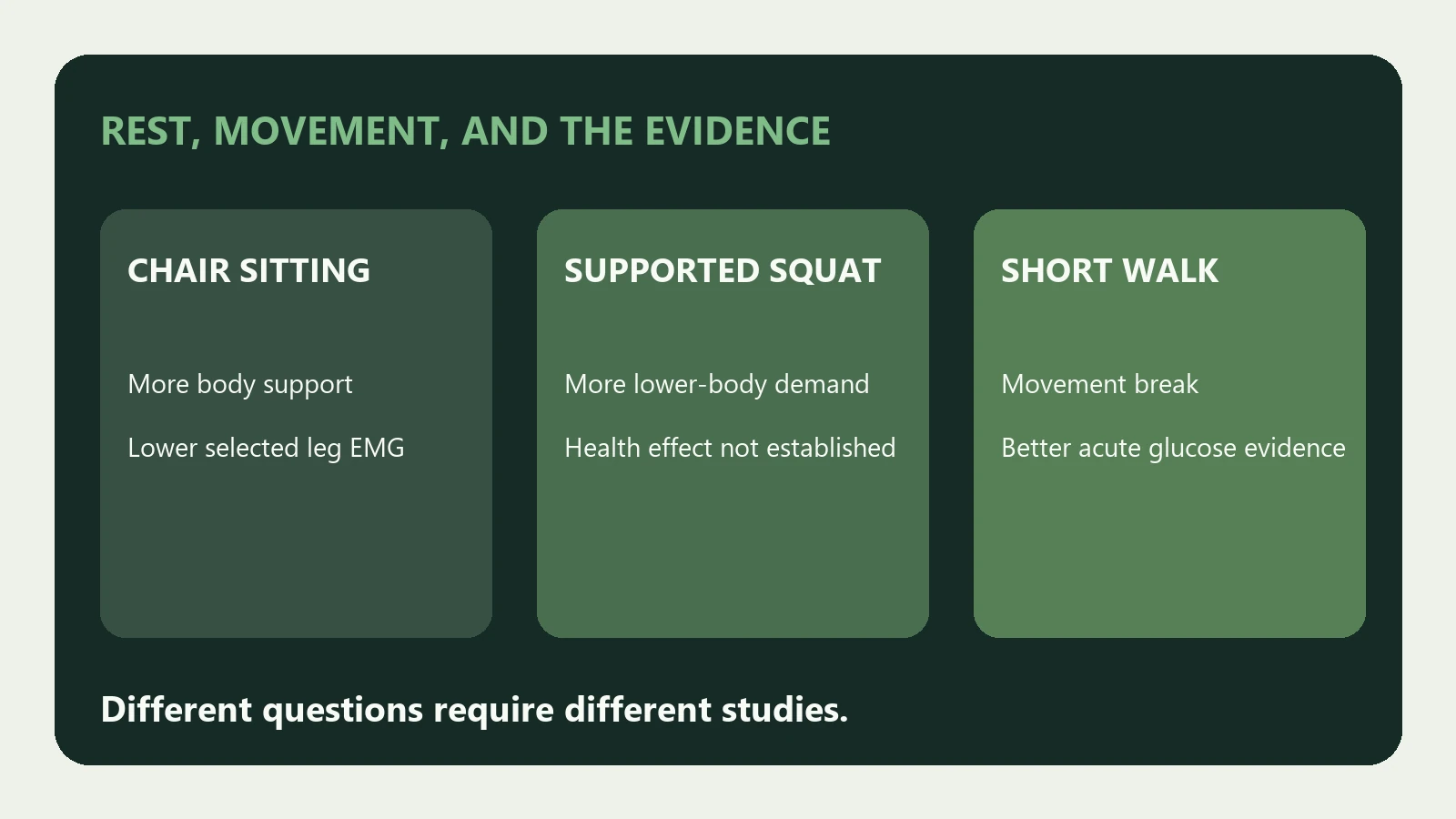
Walking-break experiments ask a more direct intervention question: what happens when researchers interrupt prolonged sitting with activity? They are related to active-rest ideas, but a walking break and a sustained resting posture are different exposures.
A 2026 systematic review by Gale and colleagues identified 53 acute laboratory studies, with 39 included in the meta-analysis. Eligible studies used randomized crossover designs lasting less than 24 hours.
Activity breaks reduced post-meal glucose and insulin responses compared with prolonged sitting, and walking breaks showed the greatest effects among the modes examined. These were acute metabolic measurements, not evidence that a squat posture prevents chronic disease.
Keep that boundary when translating the finding into a workday. A review’s experimental schedules help describe the evidence, but this study explainer does not assign a personal break interval or a blood-glucose treatment plan.
What can readers reasonably take from it?
The federal physical activity guidelines advise adults to move more and sit less. They recommend 150 to 300 minutes of moderate-intensity aerobic activity weekly, plus muscle-strengthening activity on at least two days.
The guidance also recognizes benefits from small amounts of activity and removes the old requirement that activity occur in bouts of at least ten minutes. A posture hypothesis does not replace that broader activity framework.
For a desk worker, the useful planning question is where ordinary movement can fit, rather than how to reproduce a picture of someone else’s resting position. Think about an accessible route for a brief walk, a task that can involve changing position or support needed for comfortable activity.
There is no requirement to kneel, reach the floor or force a deep squat to understand the research. If pain, balance, an injury or a medical condition limits activity, discuss suitable options with an appropriately qualified healthcare professional.
Our guide to exercise and sitting time covers the broader evidence question. The contribution of this Hadza study is narrower: it gives researchers a reason to examine how resting postures differ, without supplying a proven posture-based health routine.
References
- Raichlen, D. A., et al. (2020). Sitting, squatting, and the evolutionary biology of human inactivity. Proceedings of the National Academy of Sciences, 117(13), 7115 to 7121. doi:10.1073/pnas.1911868117.
- Gale, J. T., Martin, H., Haszard, J. J., & Peddie, M. C. (2026). The acute effects of interrupting prolonged sitting with regular activity breaks on postprandial glucose and insulin in adults: A systematic review and meta-analysis. Obesity Reviews, 27(11), e70152. Published online May 3, 2026. doi:10.1111/obr.70152.
- Office of Disease Prevention and Health Promotion. Top 10 things to know about the second edition of the Physical Activity Guidelines for Americans. Accessed October 27, 2026.
Medical information: This article provides general physical activity and research information, not personal medical advice or an exercise treatment plan. Consult an appropriately qualified healthcare professional about suitable activity if you have pain, an injury, balance difficulties or a medical condition.