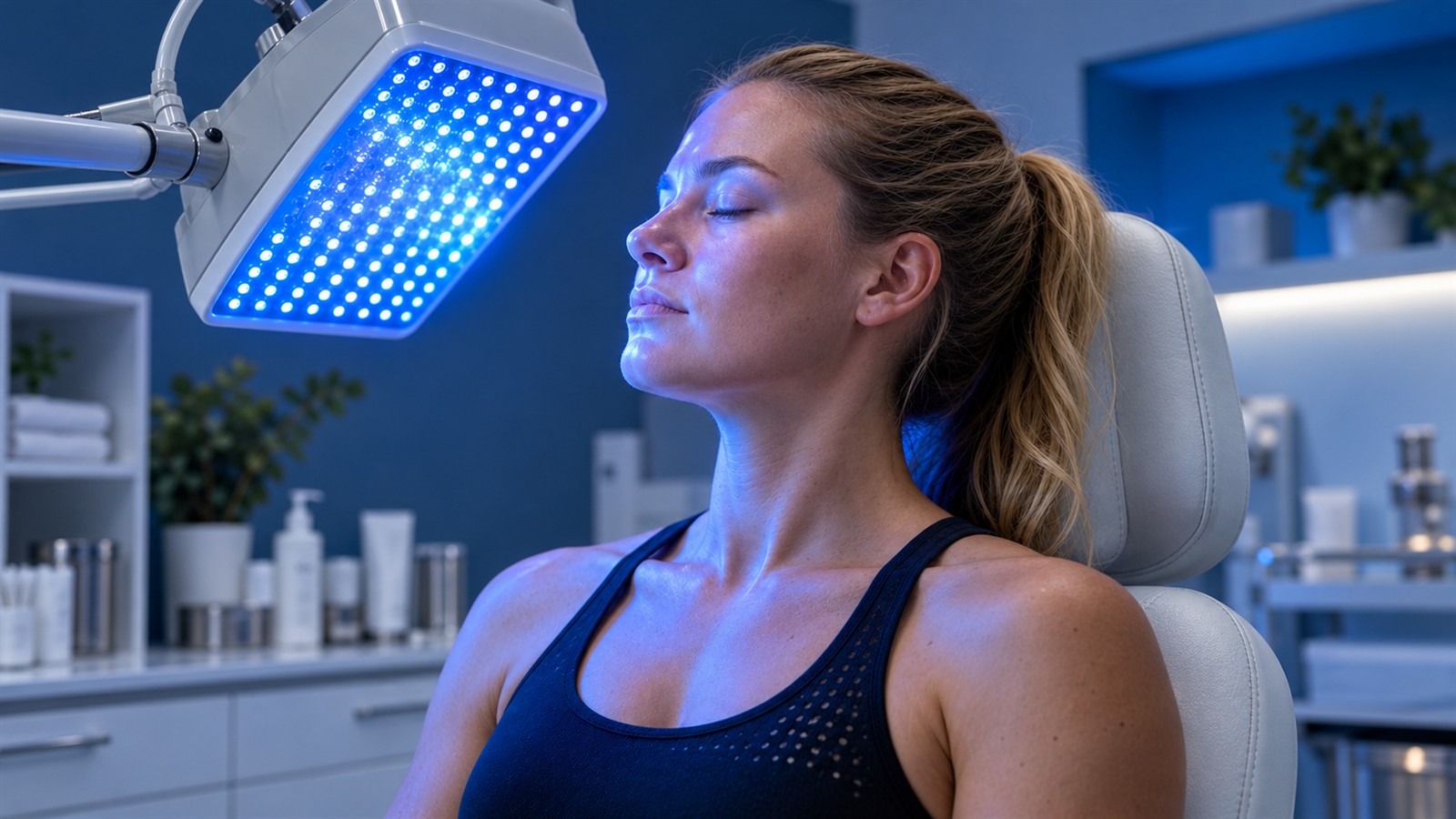

Blue light is used in some acne treatments, and a laboratory experiment reported striking suppression of Cutibacterium acnes (formerly Propionibacterium acnes). But the laboratory result is not a clinical cure rate. A social post paired with this article also says a study found roughly 65 percent improvement after just four sessions. The clinical paper closest to that figure reported 64.7 percent overall lesion improvement after eight sessions over four weeks—not four. Those distinctions change what a reader can reasonably expect from a dermatologist’s device, let alone a home light mask.
Here is the evidence without conflating wavelengths, petri dishes, people or treatment counts. Some blue-light protocols may improve inflammatory pimples, but current clinical guidance does not identify one universally effective light regimen. If you are considering it, a dermatologist can help decide whether light fits your acne type and what other treatment is still needed.
Why blue light is studied
C. acnes can produce light-sensitive compounds called porphyrins. When exposed to suitable blue light, those compounds can generate reactive oxygen species that injure bacterial cells. This gives light therapy a biological rationale distinct from an antibiotic’s biochemical target. The skin, however, is more complicated than a culture plate. Acne involves sebum, clogged follicles, inflammation, hormones and individual variation, not one microbe alone. A treatment that reduces bacteria in a dish might not clear every kind of acne lesion on a face.
Wavelength, dose, distance, treatment duration, pulse rate and skin conditions all affect what light reaches its target. The social post mentions 407–420 nanometers for porphyrin activation. That is a range used in some acne devices and studies, but the experiment behind its seven-log claim used 450 nanometers. It is not accurate to present the two as though they were the same tested protocol. Nor can the blue light from a phone or ordinary room lamp be equated with a treatment device delivering a specified dose.
What the seven-log experiment found
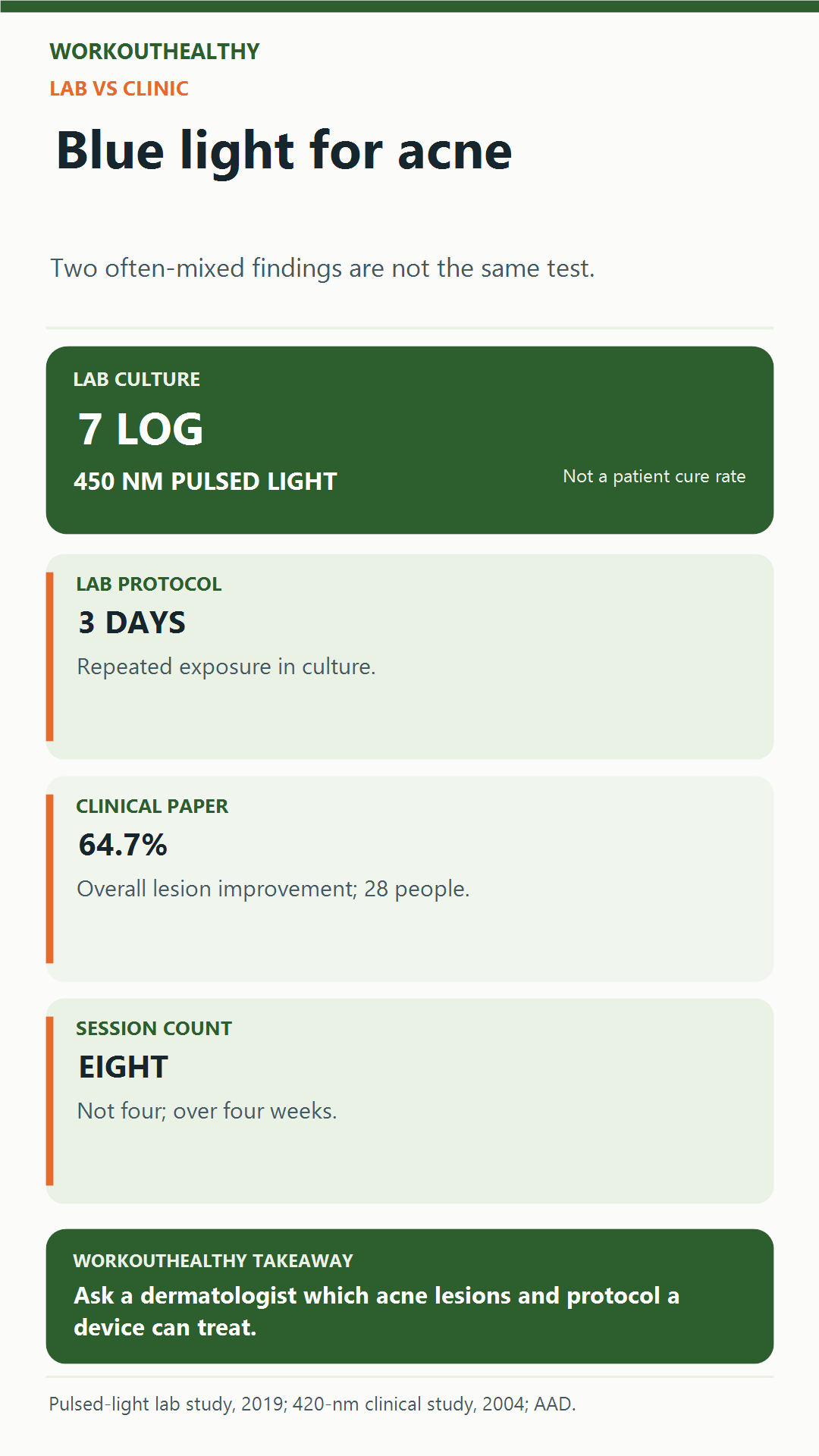
A 2019 Photodiagnosis and Photodynamic Therapy experiment exposed cultures of P. acnes to pulsed and continuous 450-nanometer blue light. The authors varied irradiance, radiant exposure and the intervals between repeated treatments. Under an optimized repeated protocol with a 33 percent pulse rate, they reported 100 percent suppression at the detection limit, described as a seven-log reduction. Another report of that protocol specifies three irradiations a day at three-hour intervals for three days.
Seven-log is an enormous reduction in a laboratory count. It does not mean “all acne-causing bacteria on a patient’s skin were eliminated,” nor does it tell us how many pimples would improve after three days. Bacteria in a controlled plate are directly accessible to light; organisms inside follicles are not exposed in the same way. The outcome was bacterial survival in vitro, not acne lesion count, scarring, relapse, quality of life or the need for other treatments.
The researchers found the 33 percent pulsed condition outperformed certain continuous-light settings in their tested system. That comparison cannot establish that every pulsed device sold to consumers is superior to every continuous device, or that either will work at an unspecified home-use dose. It is a useful engineering result and a reason for clinical trials, not a promise of complete clearance.
What the 65 percent clinical paper found
A separate study of 28 people with facial acne tested a high-intensity, narrow-band 420-nanometer light system. Participants received eight 15-minute treatments, twice weekly for four weeks. The paper reported an overall 64.7 percent improvement in acne lesions. It also examined bacterial and ultrastructural changes in subsets of participants. The study was small and open, not a large blinded randomized comparison that can establish how much improvement exceeded natural variation or changes in other care.
The social caption’s “roughly 65 percent after just four treatment sessions” appears to combine the reported percentage with a different session count. The original paper’s 64.7 percent figure follows eight sessions. Although investigators performed some ultrastructural assessments after four sessions, that is not the same as documenting 65 percent lesion improvement at that point. Readers should not be promised the eight-session result in half the treatment time.
Other clinical studies use other devices and schedules. An open study of mild to moderate acne found improvements in inflammatory lesions after eight sessions over four weeks, with little effect on noninflamed lesions and a later peak in measured response. Combining its result with the 2019 culture experiment would be another category error: one tests patient lesions, the other bacterial cultures.
Do wavelength and pulse rate matter?
Yes, but not as a simple “higher is better” rule. Different porphyrins absorb light differently, and a light source’s specifications tell us only part of the delivered dose. Energy reaching a follicle also depends on device placement, skin optics and session protocol. The 2019 pulsed study used 450 nanometers. The small clinical study reported a 420-nanometer system. One cannot transfer the seven-log laboratory effect directly to the 420-nanometer clinical device, or use the clinical percentage to validate the 450-nanometer pulse protocol.
Claims about “complete suppression” should always say where the outcome was measured. A culture dish is a legitimate research setting for mechanism; a person with acne needs a clinical outcome. That is why the most useful device questions are not simply “How blue is the light?” but “Which patients were studied, what device and dose were used, what comparison group existed, how many sessions were needed, and which lesions improved?”
What the guideline says
The American Academy of Dermatology’s 2024 acne guideline lists several well-supported topical and systemic therapies. For laser and light-based devices, including combinations that use blue light, it says available evidence was insufficient to make a general recommendation. That does not declare every light treatment useless. It means the evidence was too heterogeneous or limited to define a broad standard of care on the same footing as the recommended medications.
The AAD’s patient guidance notes that visible blue, red and combined light may treat pimples, but are not effective against blackheads, whiteheads, deep cysts or nodules. It also says more research is needed to know which approaches work best for most people. A dermatologist may recommend light alongside another treatment rather than as a stand-alone replacement. That is more restrained than “a clinical tool against acne” if that phrase implies every lesion type responds.
The antibiotic-resistance question
A light treatment does not administer an antibiotic, so using one instead of an unnecessary antibiotic could avoid that particular antibiotic exposure. But it does not follow that light therapy solves antibiotic resistance in acne care. The same patient may still need benzoyl peroxide, a retinoid, a hormonal therapy or a systemic medicine depending on severity and scarring risk. The AAD guideline specifically recommends limiting systemic antibiotic use and combining it with benzoyl peroxide when prescribed. Those stewardship practices still matter.
Nor should the culture study be read as proof that bacteria could never adapt to any light-based regimen. It compared antimicrobial effects under particular conditions, not years of real-world resistance outcomes. The honest statement is narrower: blue light has a non-antibiotic mechanism and is under study as an option or adjunct; it is not a blanket substitute for evidence-based acne treatment.
Professional versus home devices
A clinician’s device and a home LED mask can differ in energy, treatment area, timing and instructions. The AAD notes that some at-home visible-light devices have been authorized for acne treatment, but are less powerful than professional equipment and do not treat every lesion type. The exact directions and safety warnings vary by device. Do not improvise with an ordinary blue lamp or expose your eyes to bright light against instructions.
For anyone with severe, painful, scarring or rapidly worsening acne, a home device should not delay evaluation. Some medications and skin conditions can change light sensitivity. A dermatologist can identify the type of acne, discuss pigment-change risk and select a regimen with a realistic endpoint. A cosmetic before-and-after photo is weaker evidence than controlled lesion counts and long-term follow-up.
A practical decision framework
First, identify your main lesion type: inflammatory pimples, comedones, nodules or a mixture. Second, ask what established treatment has been tried consistently and whether it was tolerated. Third, if considering light, get the exact device, wavelength, session count and expected outcome from the clinician or product instructions. Finally, decide how success will be measured and when to reassess. Improvement in one inflamed area is not the same as full clearance or prevention of future scarring.
Be especially skeptical of a claim that connects a seven-log petri-dish reduction to “100 percent acne cure,” or a 65 percent clinical figure to four sessions. Both distort the underlying papers. Better questions are less dramatic: Will this help the lesions I have? What will it cost? What are the alternatives? What happens if it does not work?
Bottom line
Blue-light acne therapy has a plausible mechanism and some evidence for inflammatory lesions. The seven-log result was an optimized 450-nanometer laboratory protocol, not a patient cure. The clinical report of about 65 percent lesion improvement used eight sessions of a different light system, not four. Current dermatology guidance supports discussing light with a professional while keeping proven treatments and realistic expectations in view.
References
- Pulsed 450 nm blue light significantly inactivates Propionibacterium acnes more than continuous wave blue light. Photodiagnosis and Photodynamic Therapy. 2019. Primary laboratory study.
- 420 nm intense continuous light therapy for acne. Primary clinical study.
- An open study to determine the efficacy of blue light in the treatment of mild to moderate acne. Primary clinical study.
- American Academy of Dermatology. Acne clinical guideline; Patient guidance on lasers and lights.