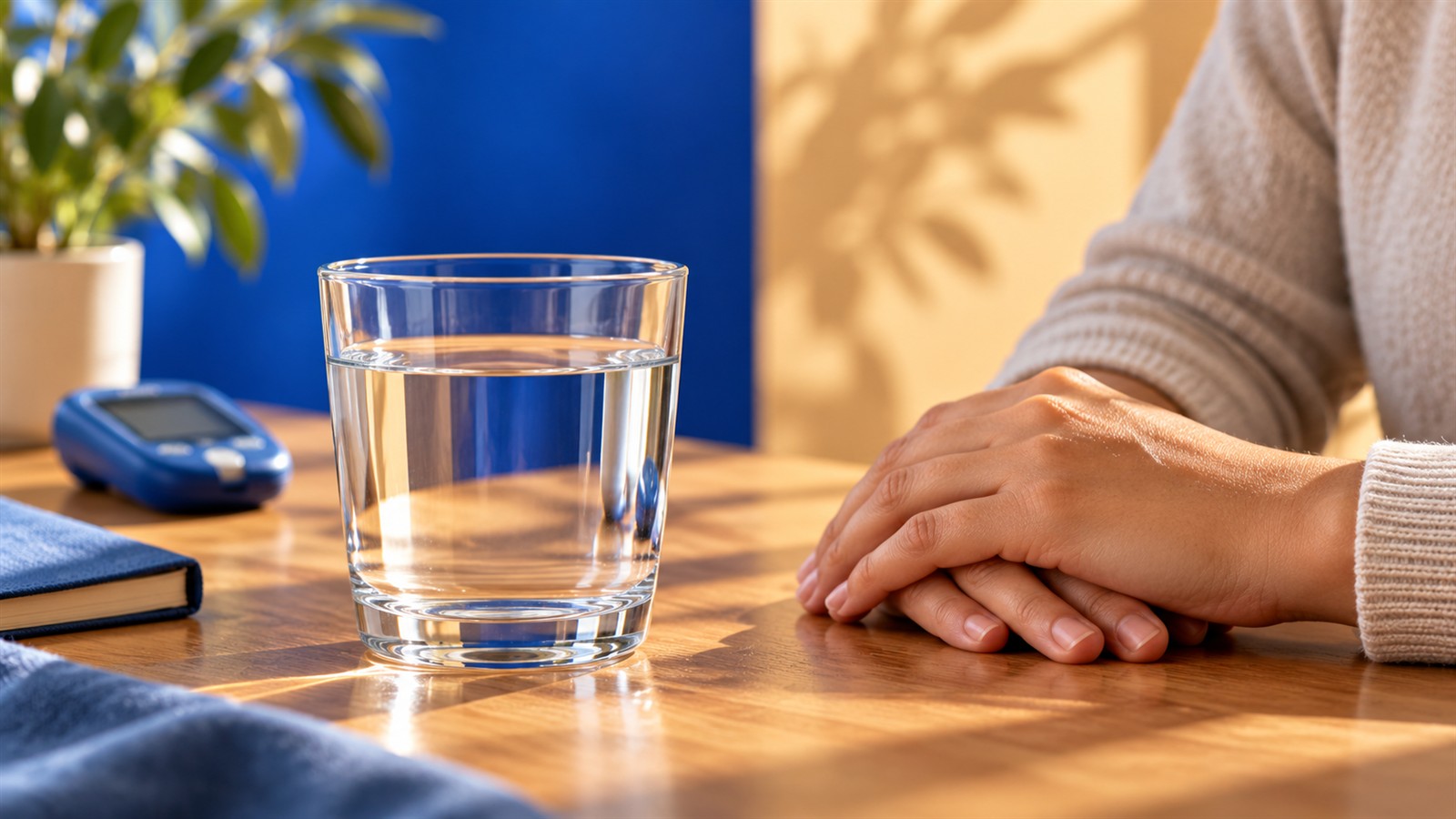

Slow breathing can make a stressful moment feel more manageable. Can it also improve blood sugar? The short answer is that small studies offer a reason to investigate, but they do not establish a reliable glucose-lowering treatment. One randomized trial combined breathing and mindfulness with aerobic exercise; another small study compared a demanding breathing practice with no breathing practice. Neither proves that a few relaxed breaths after dinner will lower an individual’s glucose reading.
That distinction matters if you live with diabetes or prediabetes. Breathing is a low-cost way to pause and recover from stress, but it belongs beside—not in place of—medication, food planning, movement, sleep, monitoring and professional care. The Facebook post paired with this article offers a comfortable four-count inhale and six-count exhale for a few minutes. Think of it as a calming practice, not a prescription for blood sugar.
Why stress and glucose are connected
Glucose is affected by more than the carbohydrate in a single meal. Illness, sleep, activity, medications and stress can all alter what a meter or continuous glucose monitor shows. Stress involves several hormonal and nervous-system responses. Cortisol is one part of that system, but it is not a single switch that can be turned off with a breath pattern. Blood sugar may rise during stress in some circumstances, yet the direction and size of a short-term response vary by person and context.
Slow breathing may influence the autonomic nervous system, which helps regulate heart rate and the body’s response to a challenge. A person might feel calmer after a few minutes and find it easier to choose a meal, take a walk or follow a care plan. That is a plausible indirect benefit. It is not the same as demonstrating that the breathing itself caused a sustained change in fasting glucose or A1c.
There is a useful practical reason to separate the two. When someone checks glucose immediately after breathwork, the number can move because of the meal, medicine, measurement noise or the passage of time. A single before-and-after reading cannot identify the cause. Repeated, well-controlled studies are needed to learn which breathing patterns, durations and populations benefit, if any.
What slow-breathing research measures
A 2018 systematic review by Zaccaro and colleagues examined breathing at fewer than ten breaths per minute and reported changes in measures such as heart-rate variability, respiratory sinus arrhythmia and brain activity. The authors saw evidence consistent with altered autonomic and emotional regulation. They also emphasized that methods were inconsistent and that longer, better-designed trials were needed to connect physiological signals with meaningful clinical outcomes. Importantly, the review was about psychophysiological correlates, not a pooled proof that slow breathing treats diabetes.
Heart-rate variability can be an informative research measure, but it is not a direct reading of blood glucose. Nor does a calmer feeling guarantee that every stress hormone falls or that insulin sensitivity changes. The pathway from a breathing rhythm to long-term glucose control contains several untested steps. It is reasonable to study it; it is premature to sell it as a replacement for established care.
What the diabetes trial found
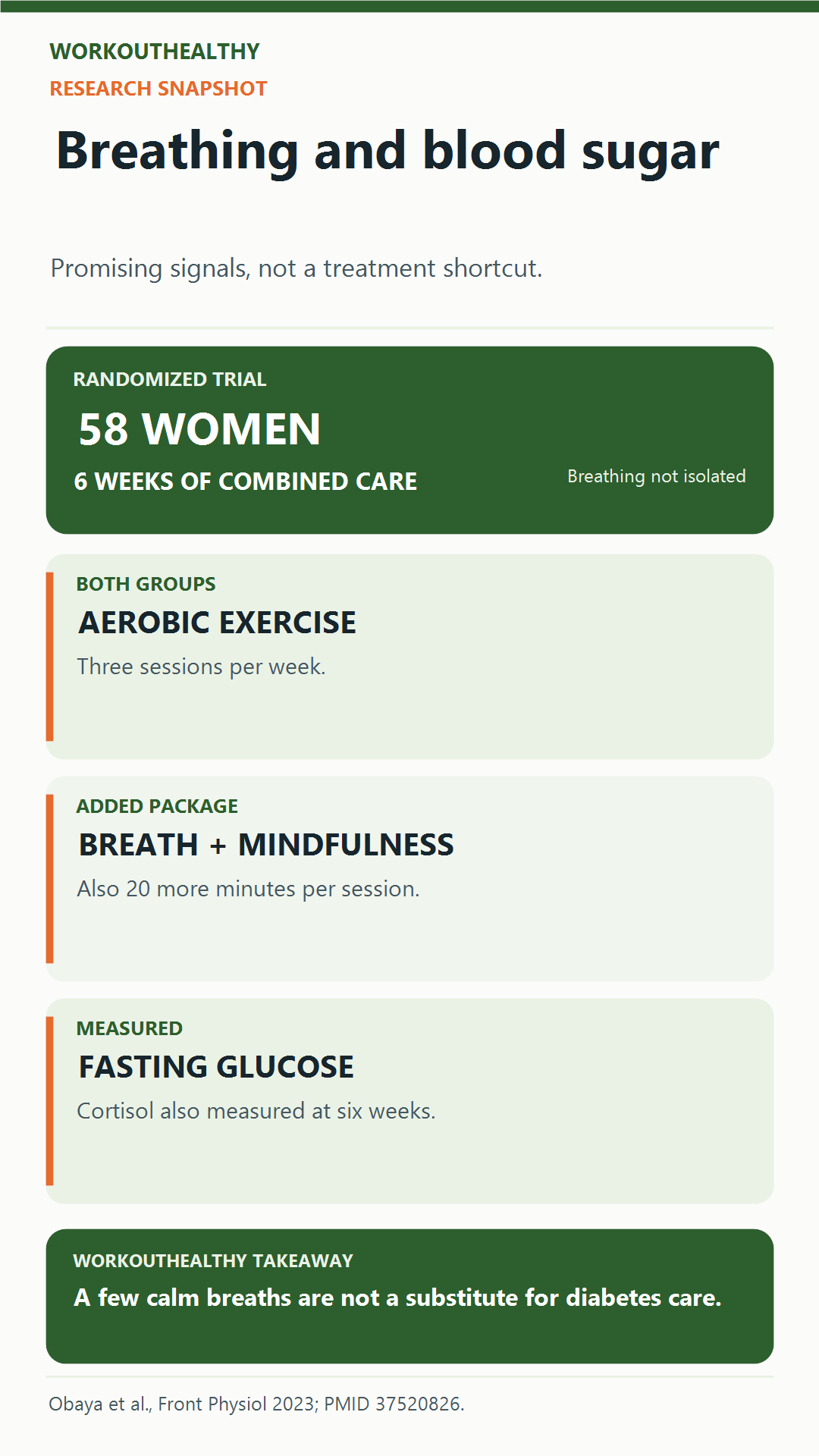
In a 2023 single-center randomized trial, 58 middle-aged women with type 2 diabetes were assigned to two six-week programs. Both groups did aerobic exercise three times weekly at 60 to 75 percent of maximum heart rate. One group did 40-minute exercise sessions; the other did 60-minute sessions that also included slow deep breathing and mindfulness meditation. Researchers measured fasting glucose and serum cortisol at baseline and after the intervention.
The combined exercise, breathing and mindfulness group had lower fasting glucose and cortisol than the exercise-only group at six weeks. That is encouraging evidence for the package as tested in that small group. It does not isolate breathing: the second group also received mindfulness and more session time. The trial did not test a few minutes of four-in, six-out breathing around meals, and its participants were women with established type 2 diabetes in one setting. Applying the result to everyone with prediabetes—or to a single reading after dinner—would go beyond the study.
There is another reason for caution: fasting glucose is only one marker. Clinicians also consider A1c, glucose patterns, symptoms, medication safety and the person’s wider health. A change in one laboratory measure after six weeks is not evidence that complications, medication needs or long-term outcomes improve. The trial can guide further research without becoming a self-treatment rule.
The other small diabetes study
A prospective study in Bangladesh recruited 60 men with type 2 diabetes aged 45 to 55. Thirty were assigned to a slow-breathing program for 30 minutes twice a day for three months, while thirty were followed without that program. The investigators measured fasting plasma glucose, two-hour post-meal glucose and A1c before and after. They reported better glycemic markers in the breathing group.
Those results are relevant but easy to overstate. The schedule was an hour of practice a day, which is quite different from the gentle few-minute suggestion in the social caption. A small, local sample and a comparison without a matched attention or relaxation program leave room for differences in adherence, other behaviors and expectations. This study does not tell us what an individual should expect from casual breathing, and it does not justify changing medication.
What those results cannot tell us
The two diabetes studies ask related but different questions. One tested a combined exercise-breathing-mindfulness package for six weeks in women. The other tested a longer, intensive breathing routine in men over three months. Together they support the idea that mind-body practices deserve more rigorous research. They do not establish an optimal breathing rate, a reliable dose-response, or a clinically important effect that generalizes across age, diabetes type and medication regimens.
We should also avoid a common leap from a plausible mechanism to a guaranteed outcome. Even if slow breathing shifts autonomic balance, a particular person’s glucose may be influenced more strongly that day by a meal, poor sleep, illness or exercise. A calm body sensation is valuable in its own right, but it is not a substitute for a measured glucose result or a care plan. This is especially important for people taking insulin or medicines that can cause low blood sugar.
Readers looking for a better-established after-meal movement strategy can see our evidence review of a gentle ten-minute walk after meals. Walking and breathing address different questions; the link is not an instruction to exercise when a care team has advised against it.
A comfortable way to try it
Choose a safe seated position. Breathe in through the nose for roughly four comfortable counts, then exhale gently for roughly six. Repeat for a few minutes while keeping shoulders relaxed. The counts are a pacing cue, not a target that must be forced. If four and six feel too long, shorten them. You should be able to breathe easily throughout. Stop if you feel dizzy, short of breath or unwell, and seek appropriate care for concerning symptoms.
Use the practice to notice how you feel, not to chase a glucose number minute by minute. For some people it can be a pause before a meal; for others it may fit after a stressful call or before bed. Consistency and comfort matter more than perfect arithmetic. If a breathing app or wearable claims to optimize glucose from a short session, ask for trials measuring meaningful outcomes in people like you rather than accepting a heart-rate-variability score as proof.
Where breathing fits in diabetes care
The American Diabetes Association’s 2026 Standards of Care emphasize diabetes self-management education and support, medical nutrition therapy, physical activity, adequate sleep, psychosocial care and individualized medication decisions. Monitoring is selected according to a person’s circumstances and treatment. A breathing routine can be one optional coping tool inside that wider plan. It should never be used as a reason to skip glucose checks, postpone treatment or alter a prescribed dose.
If you notice that stress makes self-care harder, tell your clinician. That conversation can cover sleep, anxiety, depression, work demands, food access and medicine effects, not just a breathing technique. If you use insulin or a medication associated with hypoglycemia, follow the specific monitoring and treatment instructions you received. Breathing does not treat a low or high glucose emergency.
For a separate nutrition explanation, our Fat Joe food-and-exercise fact-check examines a different kind of one-change story. The important connection is that no single lifestyle practice can replace a comprehensive, individualized plan.
Bottom line
Slow breathing may help some people manage stress and is being studied as an adjunct to diabetes care. Small trials report promising glucose-marker changes, but their designs cannot support the claim that a few minutes of breathwork directly lowers blood sugar for everyone. Try gentle breathing if it feels good, stop if it does not, and keep medications, monitoring, nutrition, movement and clinical advice in place.
References
- Obaya HE, et al. Effect of aerobic exercise, slow deep breathing and mindfulness meditation on cortisol and glucose levels in women with type 2 diabetes mellitus: a randomized controlled trial. Frontiers in Physiology. 2023. PubMed record.
- Effect of Slow Breathing Exercise on Glycaemic Status in Type 2 Diabetic Male Patients. PubMed record.
- Zaccaro A, et al. How Breath-Control Can Change Your Life: A Systematic Review on Psycho-Physiological Correlates of Slow Breathing. Frontiers in Human Neuroscience. 2018. PubMed record.
- American Diabetes Association. Facilitating Positive Health Behaviors and Well-being to Improve Health Outcomes: Standards of Care in Diabetes—2026. Diabetes Care.
- American Diabetes Association. Diabetes Technology: Standards of Care in Diabetes—2026. Diabetes Care.