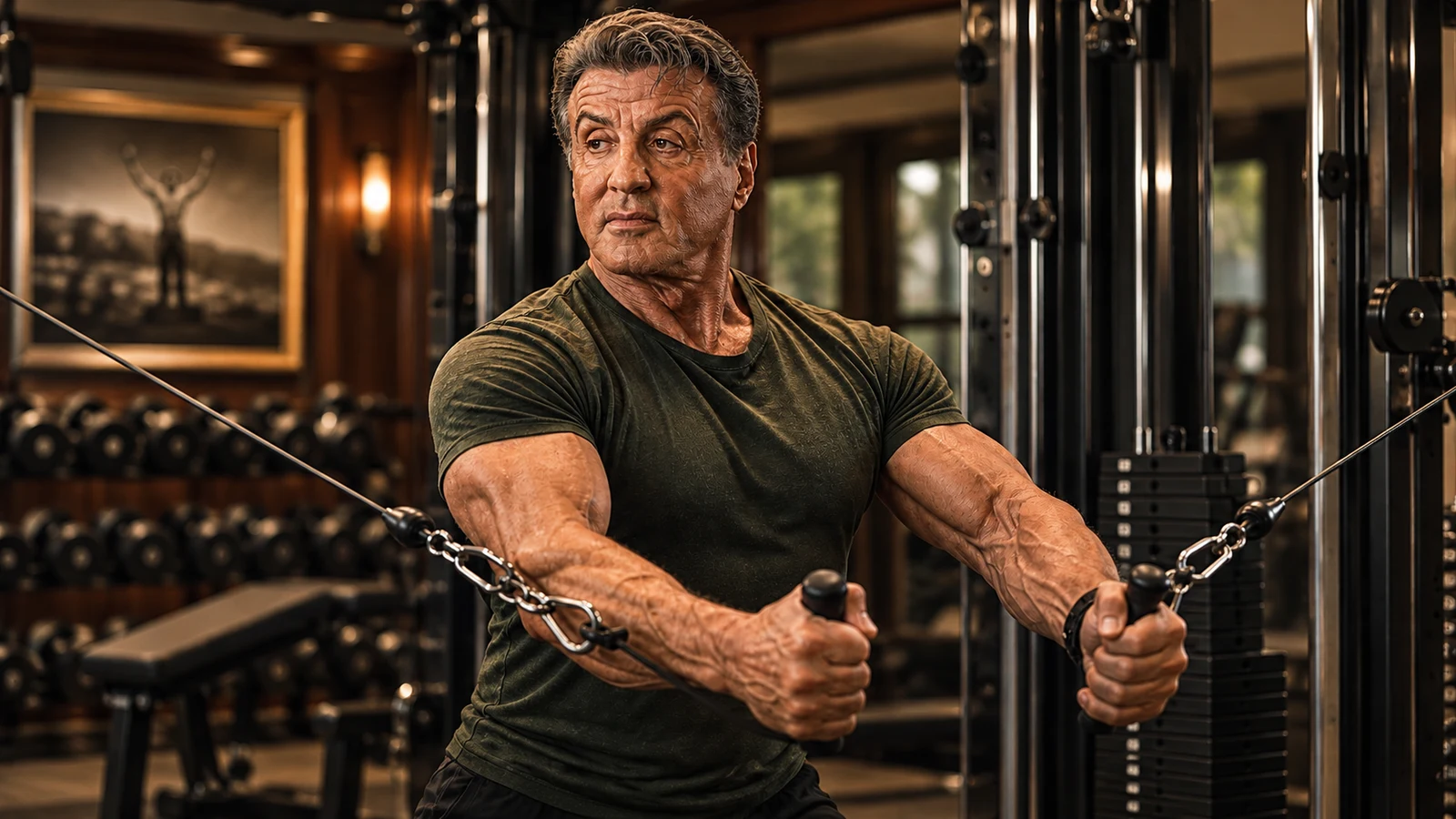

Sylvester Stallone’s decades-long action-film career makes a vivid case for staying physically engaged as you age. The WorkoutHealthy Facebook post shows an editorial illustration of him training into his 70s. But a movie star’s appearance is not an exercise prescription. His access to coaches, time, medical care and role-specific preparation differs sharply from most people’s circumstances.
The useful question is simpler: can older adults keep building strength, and how should training change when recovery or an old injury matters? Controlled trials—not a celebrity physique—offer the stronger answer. Resistance training remains effective after 60, while the right load and amount of work depend on the person.
What is documented about Stallone
Stallone has made physical preparation central to many roles, from Rocky and Rambo to later action franchises. In an interview about portraying an older Rocky, he spoke frankly about how demanding training and injuries were. Public workout footage and reporting have also shown him training with longtime coach Gunnar Peterson well into his 70s. Peterson has described a long professional training relationship with him.
Those sources establish that Stallone has continued to train, not a precise present-day program. They do not verify every social-media claim about exactly how heavy he lifts each week, his current body-fat percentage, how many recovery days he takes, or what an unnamed “age-appropriate” program contains. A still image—even a realistic one—does not prove a particular session happened. The Facebook visual is explicitly an illustration.
This distinction is not nitpicking. The difference between “Stallone keeps training” and “everyone should lift like Stallone” is the difference between an inspiring example and advice that could be unsuitable for someone with joint pain, a recent surgery, or no lifting history. A strong-looking public figure can model persistence without becoming your template.
A celebrity’s discipline may be motivating; the training prescription still has to fit your body and your history.
What older-adult trials show
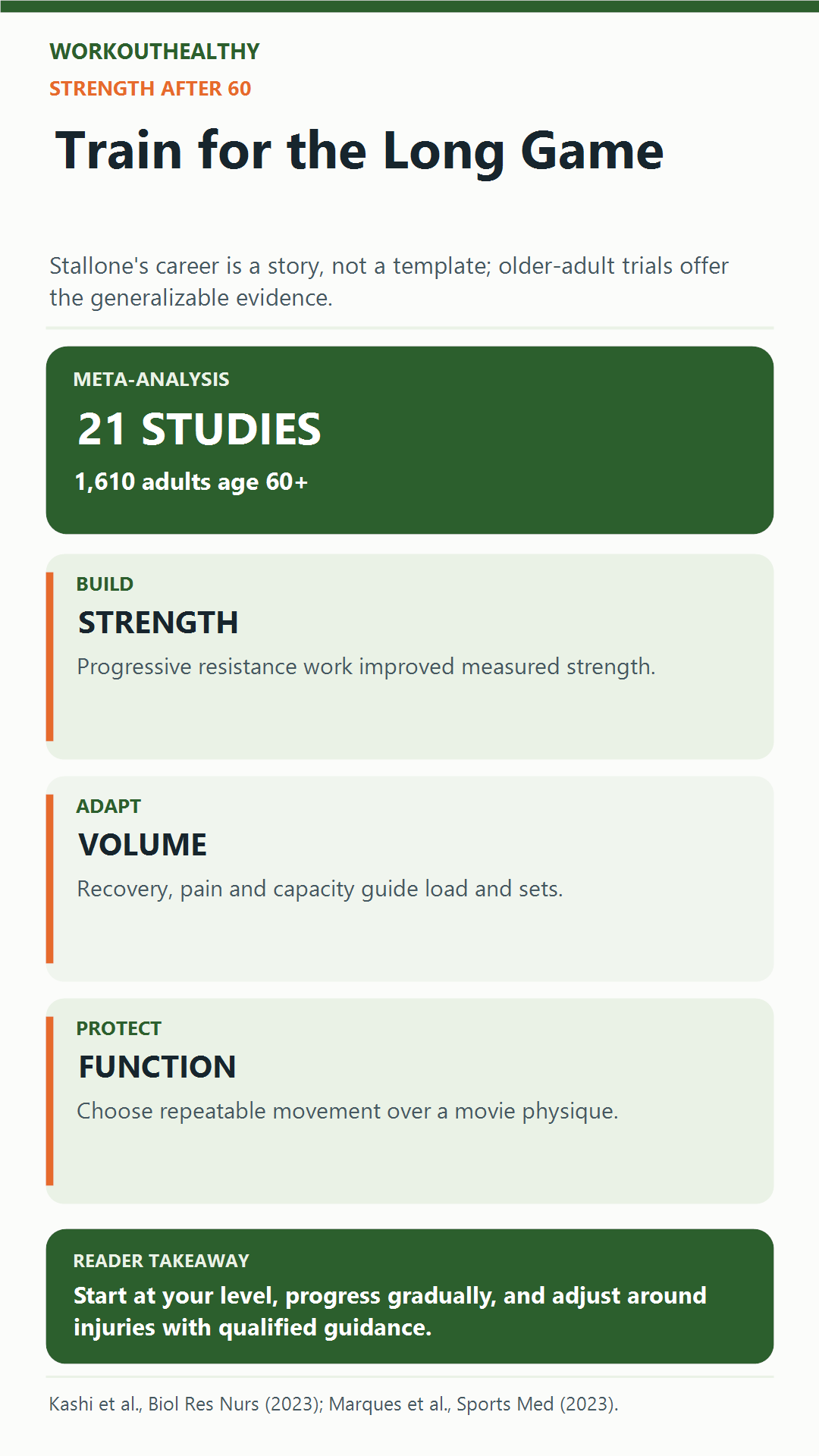
A systematic review and meta-analysis by Kashi and colleagues examined 21 studies involving 1,610 adults age 60 or older. Resistance training improved several strength outcomes, including measured upper- and lower-limb strength and handgrip, alongside some physical and mental-health quality-of-life domains. Not every outcome improved: the review did not find a benefit for every global quality-of-life score or for six-minute walk distance. The authors called the overall evidence preliminary rather than a guarantee for each person.
A separate meta-analysis by Marques and colleagues examined training volume in middle-aged and older adults. Multiple sets showed a small advantage over single sets for lower-limb strength and muscle quality, while differences were not clear across every outcome. That does not mean everyone needs a high-volume routine. A single well-performed set can be a reasonable starting point, particularly when the alternative is not training at all.
Another review of older adults found greater strength improvements with higher-volume training in some comparisons, particularly over longer programs. Again, the key word is some. Researchers compare groups under defined conditions; an individual dealing with fatigue, arthritis or an injury may progress best with a smaller dose that can be repeated consistently. Research establishes that older muscles respond to progressive resistance. It does not provide one universal weekly schedule.
Strength matters beyond appearance. It supports getting up from a chair, carrying groceries, climbing stairs and maintaining independence. Even if a person never resembles an action hero, increased capacity in those daily tasks is a meaningful result. For a broader look at aging and movement, see our guide to combining cardio and strength training for longevity.
Recovery and injury modifications
Older age is not an automatic reason to avoid resistance exercise. It does change the conversation about starting load, pain, sleep, medication, prior injuries and how quickly to increase work. A knee that feels comfortable with a supported sit-to-stand may not tolerate a deep loaded squat immediately. A shoulder with limited range may need a neutral-grip press or a cable angle that stays within a comfortable path. These are examples of options to discuss with a qualified professional, not remote diagnoses.
Distinguish effort from warning signals. Working muscles can feel challenged; sharp pain, joint instability, unusual dizziness, chest symptoms or new neurological symptoms are reasons to stop and seek appropriate assessment. Soreness alone is also a poor scoreboard. Our article on why soreness does not measure workout progress explains better ways to monitor training.
Recovery is not just counting hours between sessions. It includes enough food, adequate sleep, and a manageable total workload. For someone new to lifting, two carefully spaced sessions may be more useful than six exhausting ones. For an experienced lifter, training frequency can be higher when intensity and volume are distributed appropriately. The body adapts to a challenge it can recover from, not to a challenge that constantly outruns recovery.
“Train hard” is incomplete advice. Train hard enough to adapt, and recover well enough to return.
A practical long-game framework
Use four checkpoints to translate the evidence into a sustainable plan. They are not Stallone’s routine; they are a reader-facing framework built from the older-adult resistance-training literature and conservative coaching principles.
- Start with current capacity. Pick movements you can perform through a controllable, comfortable range. Supported squats or sit-to-stands, a row, a press, a hip hinge and carrying can cover major patterns. Machines, free weights and resistance bands are all tools; none is required in every program.
- Build repeatability before complexity. Begin with a manageable number of sets, leave some effort in reserve, and keep technique stable. A routine that can be performed twice a week for three months is more valuable than a heroic first week followed by an injury or burnout.
- Progress one variable at a time. Add a little resistance, a repetition, or a set only when the current work is controlled and recovery is acceptable. Record what you did, not just how dramatic it felt. Small, sustained progress is still progress.
- Adjust to feedback. If pain or fatigue rises and performance falls, reduce the dose and identify what changed. A clinician or physical therapist can help when symptoms or previous injuries complicate the plan. There is no prize for forcing a painful movement because a celebrity video made it look mandatory.
Food and overall activity support this framework. Older adults trying to maintain muscle should pay attention to sufficient dietary protein and energy, but “more” is not always better and needs vary. See our discussion of how much protein you actually need for context rather than a one-size-fits-all supplement rule.
Realistic expectations
Age does not erase the possibility of getting stronger. Yet response varies with training history, health status, nutrition, hormones, medication and time. A film actor’s physique may be affected by lighting, role preparation, editing, body composition and resources the public cannot see. Comparing your progress against a promotional image is a poor way to judge whether your program works.
Better benchmarks are concrete: your chosen load rises at a controlled effort; you can do more repetitions with stable form; everyday tasks feel easier; your balance and confidence improve; and you can keep training without accumulating avoidable pain. You do not need to pursue an extremely lean appearance to earn these benefits. In fact, aggressive dieting may make it harder to recover or preserve muscle, especially if you are older or already under-eating.
Stallone’s career also illustrates why public accounts need context. His work involved professional support and physical demands that are unusual. He has described the costs of extreme role preparation in other periods of his career, so the healthiest takeaway is not to copy an action-film body at any price. Make the training serve your life, not the other way around.
Bottom line
Sylvester Stallone’s long training history is a compelling example of persistence, but the details of his current program are not a verified recipe. The generalizable evidence is stronger and more encouraging: adults over 60 can improve strength with resistance training. Start at an appropriate level, progress gradually, adapt around injuries, and value functional capacity over a movie physique. If you have significant medical conditions, unexplained symptoms or a recent injury, get individualized guidance before beginning or changing a demanding exercise plan. This article is educational, not medical advice.
References
- Kashi SK, Mirzazadeh ZS, Saatchian V. Resistance training on quality of life, depression, muscle strength and functional exercise capacity in adults 60 or older: systematic review and meta-analysis. Biological Research for Nursing. 2023. PubMed.
- Marques DL, et al. Manipulating resistance training volume in middle-aged and older adults: systematic review with meta-analysis. Sports Medicine. 2023. PubMed.
- Different resistance training volumes on strength, functional fitness and body composition of older people: systematic review with meta-analysis. PubMed.
- Stallone interview about training for Rocky Balboa. Total Film.
- Gunnar Peterson on his long training relationship with Stallone. Men’s Health.