

T.J. Holmes and Amy Robach describe running as a shared habit, not simply a string of race photos. They have trained for events together, lined up together, and often chosen to finish together. In a 2025 interview they described a joint approach to training and racing; in a 2026 interview they also acknowledged that schedules, changing goals, and physical limitations sometimes make separate runs the sensible choice.
That difference is the useful part of their story. A partner can make a run easier to start and more enjoyable to repeat. Two people still have different fitness histories, paces, recovery needs, and injury risks. The strongest version of a shared running routine leaves room for those differences.
What Holmes and Robach actually said about running together
In a first-person Yahoo interview published in November 2025, Robach explained that running became a way for the pair to spend time together outside work. She described a joint philosophy of training and racing, and the two discussed questions about structure, fueling, and being running partners with coach and former Olympian Roberto Mandje. It was a conversation about choices they were still working through, rather than a claim that they had found one perfect method.
“We train together, we run together and we race together.”
Amy Robach, Yahoo interview, 2025
Their February 2026 interview added an important qualification. Robach said that they preferred to run together, but it did not always work out. She described running around four days per week, with many ordinary runs of two to four miles outside focused race preparation. Holmes described running as a regular part of his own life. Those are their self-reported routines at the time of the interview, not a prescription for everyone else or a guarantee of what they do today.
“We prefer to run together, but it doesn’t always work out.”
Amy Robach, Yahoo interview, 2026
The distinction matters because social posts can make a partnership look effortless. A shared run is still an appointment that must fit two calendars. It involves decisions about pace, route, distance, and when to turn back. When those details are negotiated openly, companionship can support training. When they are assumed, even a pleasant hobby can become a source of pressure.
What the public race record can and cannot show
New York Road Runners listed both Holmes and Robach at 4:14:39 in the 2023 New York City Marathon. The organizer listed Robach at 4:41:40 and Holmes at 4:41:41 in its 2024 report. Those paired times support the narrow claim that they completed those races in close proximity. They do not reveal every training run, whether one runner slowed for the other, or which decisions were made during either race.
Their 2024 Chicago Marathon provides another useful limit. Holmes and Robach said on their own podcast that they started the event but did not finish. An organized race can be part of a shared goal even when the planned finish does not happen. Our separate account of Holmes’s New York results and Chicago non-finish lays out that record without counting an attempt as a completed marathon.
Robach and Holmes also ran the 2024 NYC Half together. Our look at Robach’s NYC Half examines her own result and why preparation can coexist with enjoyment. The point for a new runner is not to copy celebrity race times. It is that a lasting shared habit is built through many ordinary sessions, with races serving as visible markers rather than the entire story.
Why a running partner can make consistency easier
A planned meeting removes one small decision: whether to go at all. When another person is expecting you at a set place and time, getting out the door may feel simpler. Conversation can also make an easy run more pleasant, while a common race goal gives both people a reason to protect time on the calendar. Those are practical mechanisms, not proof that every couple will train more successfully together.
Research on partner support is promising but mixed and limited. Small trials have tested couples exercising together or receiving support skills, yet they do not establish that matching every session improves adherence for all partners. A 12-week pilot comparing couples who exercised together with couples who exercised separately called for larger trials. It is therefore more accurate to treat partnership as a tool that can help when it fits the people involved, rather than a proven shortcut to fitness.
The most useful support is specific. Agree on a meeting time, check whether the run should feel conversational or demanding, and know what each person needs that day. A partner who notices that the other is tired and suggests shortening a route can be more helpful than one who insists on completing the original distance. Encouragement works best when it protects the habit without turning it into a test of loyalty.
Shared goals do not require identical paces
Two people may want the same race and still need different workouts to prepare for it. One may be rebuilding after time away; the other may be comfortable with more weekly mileage. One may need a gentle day when the other is ready for intervals. If every session is forced to match, the slower runner can be pushed too hard while the faster runner never completes the work that serves their own goal.
A practical compromise is to share selected easy runs, warmups, or a long-run route while preserving separate quality sessions. Partners can start together and turn around at different points, meet for the final mile, or run different paces on the same loop. They can also spend an hour exercising side by side without doing the same activity: one runs while the other walks, cycles, or strength trains nearby.
Both runners should be able to say, without apology, that a session does not fit their body today. The aim is a sustainable pattern, not a perfect photograph of synchronized training. Robach’s own admission that joint runs do not always happen is a more useful example than the idea that a committed pair must never run apart.
A workable week for two people starting together
Begin with current capacity, not a race date. If neither person runs regularly, a short run-walk outing two or three times a week may be more realistic than immediately adopting a marathon plan. Keep the initial effort easy enough to finish feeling that you could repeat it. A walk together still counts as shared movement, and it may be the right session when running is uncomfortable.
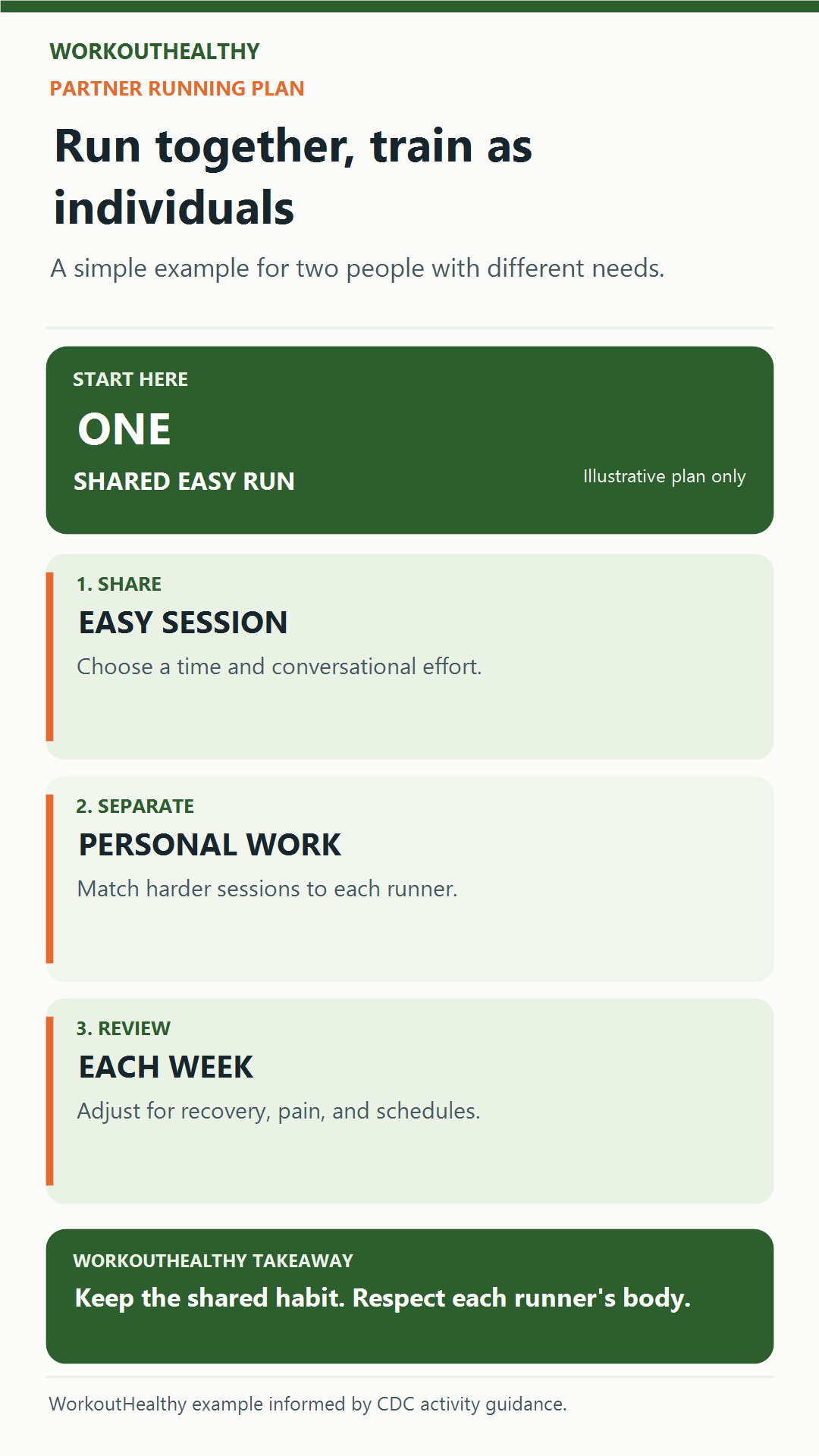
Choose one shared anchor. Put a consistent easy session on the calendar, then let other workouts reflect individual needs. A couple might share a 25-minute Wednesday run, do separate weekend long runs, and meet afterward for breakfast. Another pair may prefer one weekend route with different turnarounds. Either structure can preserve the social benefit without making each person responsible for the other’s entire program.
Review the plan weekly. Ask how each person recovered, whether work or family demands changed, and whether the next run should be shorter. Do not treat an unplanned rest day as a broken promise. A joint plan should be easy to revise. If it repeatedly creates conflict, simplify it until both people want to return.
For general health, the CDC recommends that adults aim for at least 150 minutes of moderate aerobic activity, or 75 minutes of vigorous activity, plus muscle-strengthening work on two days each week. That is a population-level target, not a starting mileage prescription. Beginners can build toward it gradually, and people with medical concerns should discuss major changes with a qualified clinician. Running is one option among many; strength work and recovery remain part of a balanced week.
What changes when the goal is a race
Before entering, decide whether the shared goal is to start together, support one another on the course, or finish side by side. Those are different commitments. One runner may have a time target while the other is running for the experience. If the plan is vague, race-day excitement can turn ordinary pace differences into frustration.
Agree ahead of time on a comfortable opening pace, how to communicate when one runner needs to slow, and whether either person may continue alone. Practice food and fluid choices during training rather than trying a new strategy at the start line. Check the event’s course, rules, aid stations, and cutoffs. Organized races require logistics as well as motivation.
There is value in celebrating a joint finish, but there is no rule that a couple must earn identical results. A runner who chooses to stop because of illness or concerning symptoms has made a responsible decision. Neither person owes the other an unsafe finish. Holmes and Robach’s documented Chicago non-finish is a reminder that real endurance stories include changed plans.
When one partner needs to back off
The 2026 interview described Holmes dealing with a foot tendon problem and running less. His description should not be used as a model for training through pain. A runner with persistent or worsening pain, altered gait, swelling, or a suspected injury should reduce or stop the aggravating activity and seek appropriate medical assessment. A partner’s role is to support that decision, not persuade them to keep a streak alive.
Sports-medicine guidance identifies rapid changes in running volume or intensity and insufficient recovery among common training errors. A missed run or a temporarily separate plan is minor compared with a prolonged injury. The uninjured partner may continue their own training while both share a lower-impact activity that is suitable for the recovering person. The choice should follow clinical advice when an injury is involved.
Emotional pressure can be subtle. If one person is worried that resting will disappoint the other, say clearly that the relationship is larger than the workout. Preserve the social ritual by meeting for a walk, stretching session, or post-run meal when appropriate. The goal is to keep mutual support while allowing each body to recover at its own rate.
The practical takeaway from their shared running habit
Holmes and Robach have publicly described running and racing together, and organizer records confirm paired New York marathon finishes. Their interviews also show the limits of a joint plan: they do not always share a run, and physical setbacks can interrupt training. That fuller picture is more valuable than a simple claim that a workout partner guarantees accountability.
If you want to run with a partner, make one easy session the starting point. Agree on its purpose and pace, keep individual goals visible, and revisit the plan when life or recovery changes. Enjoy the shared time. Let each runner make safe decisions about their own training. A routine that respects both people has a better chance of remaining something they choose to do together.
Training information here is general education, not individualized medical advice. Anyone with concerning symptoms, an injury, or a relevant medical condition should consult a qualified healthcare professional before increasing training.
Visual note: The article’s featured image is an editorial illustration based on the scheduled social creative. It does not document a specific race or depict an authenticated event photograph.