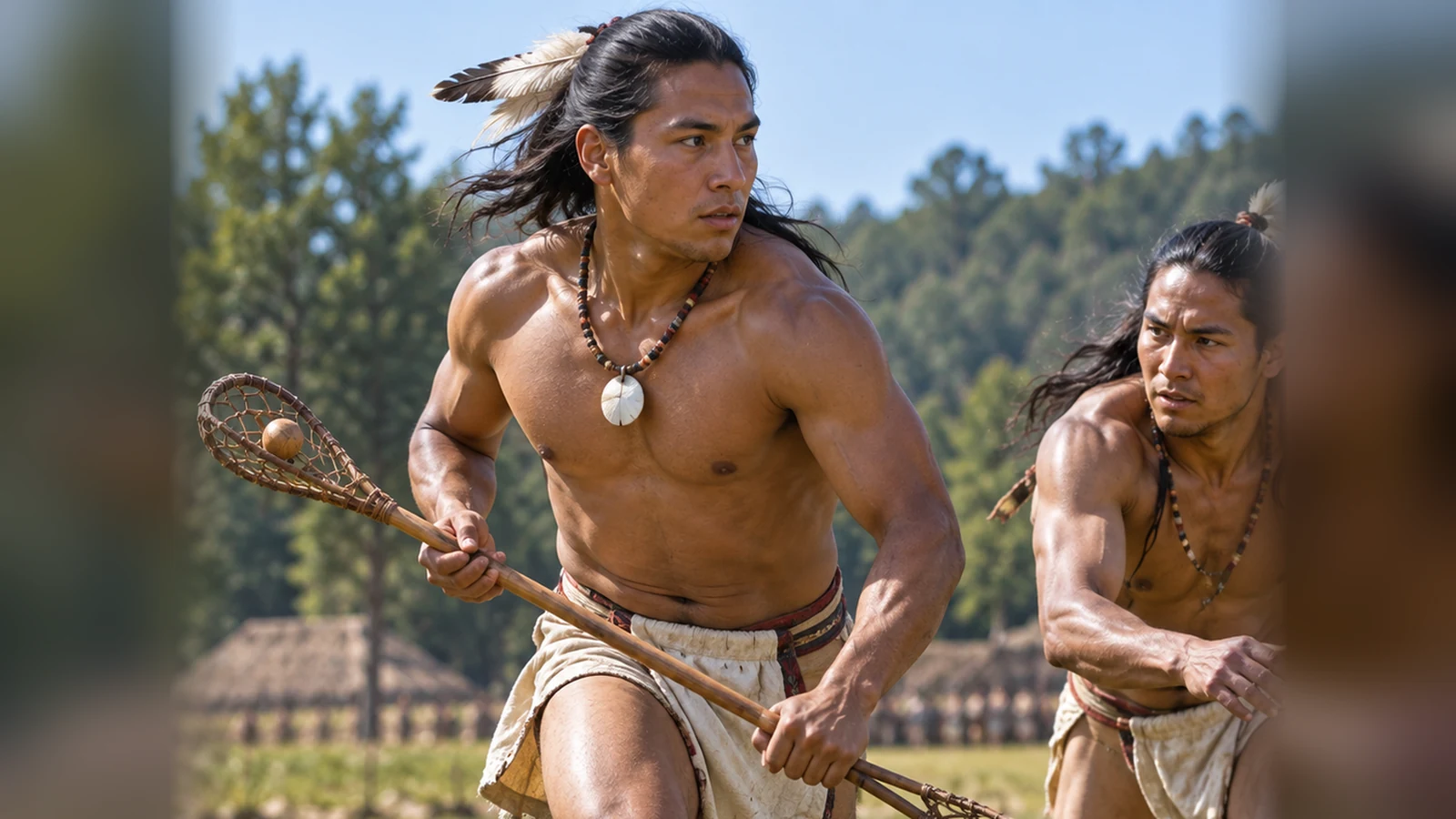

Featured image: editorial illustration, not a historical photograph or a documented Choctaw match.
Some sports are called a battle. For the Choctaw, one game was close to the real thing.
The traditional name is ishtaboli, sometimes translated as “little brother of war.”
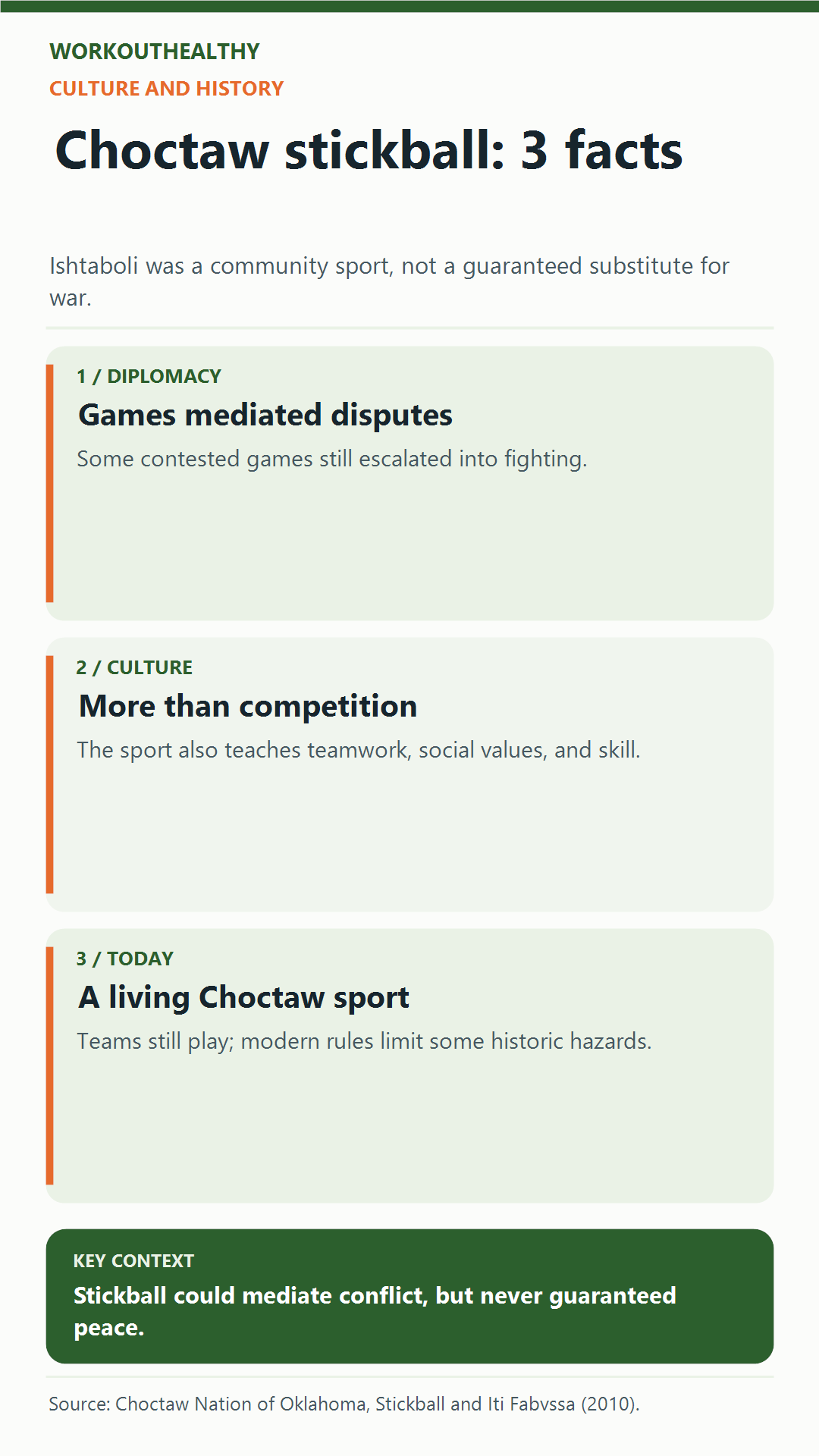
A popular post says communities once used this rough, full contact ball game to settle disputes instead of fighting.
That claim has solid support, and the game is still played today.
What Choctaw Stickball Is
Choctaw Nation cultural materials use both kapucha and ishtaboli as names for the game; kapucha also names the pair of sticks used in play. The sources reviewed here do not establish that one is simply a newer everyday name and the other an older ceremonial term.
Each player carries two sticks, one in each hand, with a small cupped end.
Players scoop, carry, pass, and shoot the ball using only those cupped ends.
It belongs to a wider family of Native American stick and ball games. That family also includes the games that became modern lacrosse.
A Game Used in Place of War
The Choctaw Nation of Oklahoma describes stickball as a way communities mediated social relationships, village conflicts and diplomatic tensions. It could provide an alternative to war when weapons might otherwise have been used. Games also helped keep warriors physically prepared. That is a more precise account than saying every dispute was peacefully settled on a field.
A Choctaw Nation history of the sport describes two late-1700s attempts to settle land disputes between Choctaw and Muscogee communities through games. Both highly contested matches escalated into actual battles. A 1903 Choctaw–Chickasaw game in Oklahoma ended in a large brawl. These examples matter: a game can offer a structured alternative to conflict, but it cannot guarantee one.
Stickball has never been merely a stand-in for warfare. Choctaw Nation cultural materials describe it as a way to teach social structure, family values and cooperation. Preparations traditionally included dancing, fasting, meditation and the guidance of community spiritual leaders. Spectators took part through cheering, singing and shared gatherings. Reducing all of that to a rough workout misses the game’s cultural meaning.
The written record reaches back nearly three centuries. The Choctaw Nation dates the first written account to 1729, while artist George Catlin documented an 1834 game involving hundreds of players. A Choctaw Nation research article also traces a touring Choctaw team in 1897, showing that the sport was publicly visible and organized long after the period often emphasized in historical summaries.
Those details come from the Choctaw Nation’s own cultural and historical accounts. The community still plays and revitalizes stickball today, so its significance is not confined to a distant past.
How Hard the Old Games Were
Historic matches were not casual.
Player numbers could run into the hundreds.
Observers in the 1700s and 1800s said town against town matches could last from sunrise to sunset.
The Biskinik describes the historic game as dangerous, and says it could last for days.
Injuries were a known part of play, which is why the game is not a model to copy as it once was.
What the Game Asked of the Body
Think about what a sunrise to sunset match would demand.
Players had to run for hours, then sprint when the ball came near.
They had to absorb contact, hold their footing, and keep control of two sticks at once.
That mix of endurance, speed, strength, and hand skill is close to what modern field sport athletes train for.
The Biskinik’s point about keeping warriors fit makes sense in that light.
A community that played often would stay in shape without a separate training plan.
Hard competition can bring people together. It works best when the rules protect the players.
Stickball Today
The game did not disappear.
The Mississippi Band of Choctaw Indians has hosted the World Series of Stickball at Pearl River every year since 1975.
The Choctaw Nation of Oklahoma now caps each team at 30 players on the field. It prohibits slamming, clothes-lining, swinging sticks at other players and hitting below the knees, while limiting tackles to the ball carrier. Those rules reduce some historic hazards, but this remains a full-contact sport; the Nation notes that players do not wear pads or helmets.
Its modern teams, tournaments, youth camps and stick-making workshops are part of a living cultural practice, not a museum reenactment. Women have played stickball for centuries, according to the Choctaw Nation’s historical account, and contemporary women’s teams compete as well.
Does Rough Sport Really Drain Away Aggression?
This is where modern research adds an important twist.
Many people believe that “letting off steam” through physical force reduces anger. Psychologists call this catharsis.
In a 2002 study, Brad Bushman angered volunteers and then had some of them hit a punching bag.
One group hit the bag while thinking about the person who angered them.
Another group hit the bag while thinking about getting fit. A third group did not hit the bag at all.
The group that focused on the person who angered them felt the angriest and acted the most aggressively.
Bushman found that doing nothing at all worked better than venting.
A punching-bag experiment cannot tell us whether a historic stickball match succeeded at diplomacy. The Choctaw record shows that games sometimes mediated conflict but could also escalate it. The comparison only cautions against treating physical exertion as an automatic cure for anger.
For modern participants, the more defensible benefits are shared purpose, skill and community connection within agreed rules. That is different from hitting something while stewing over a grudge.
What Sport Can Do for Mental Health
Sport has well documented benefits beyond venting.
A 2023 systematic review by Narelle Eather and colleagues looked at sport and mental health in adults.
It linked sport participation to better psychological well-being and lower depression, anxiety, and stress.
It also linked sport to better social outcomes, such as self control, communication, and a sense of belonging.
The authors said team sports may offer extra benefits for mental and social health across adulthood.
Those findings describe association, so they cannot prove that sport alone causes the gains.
What a Modern Fitness Reader Can—and Cannot—Borrow
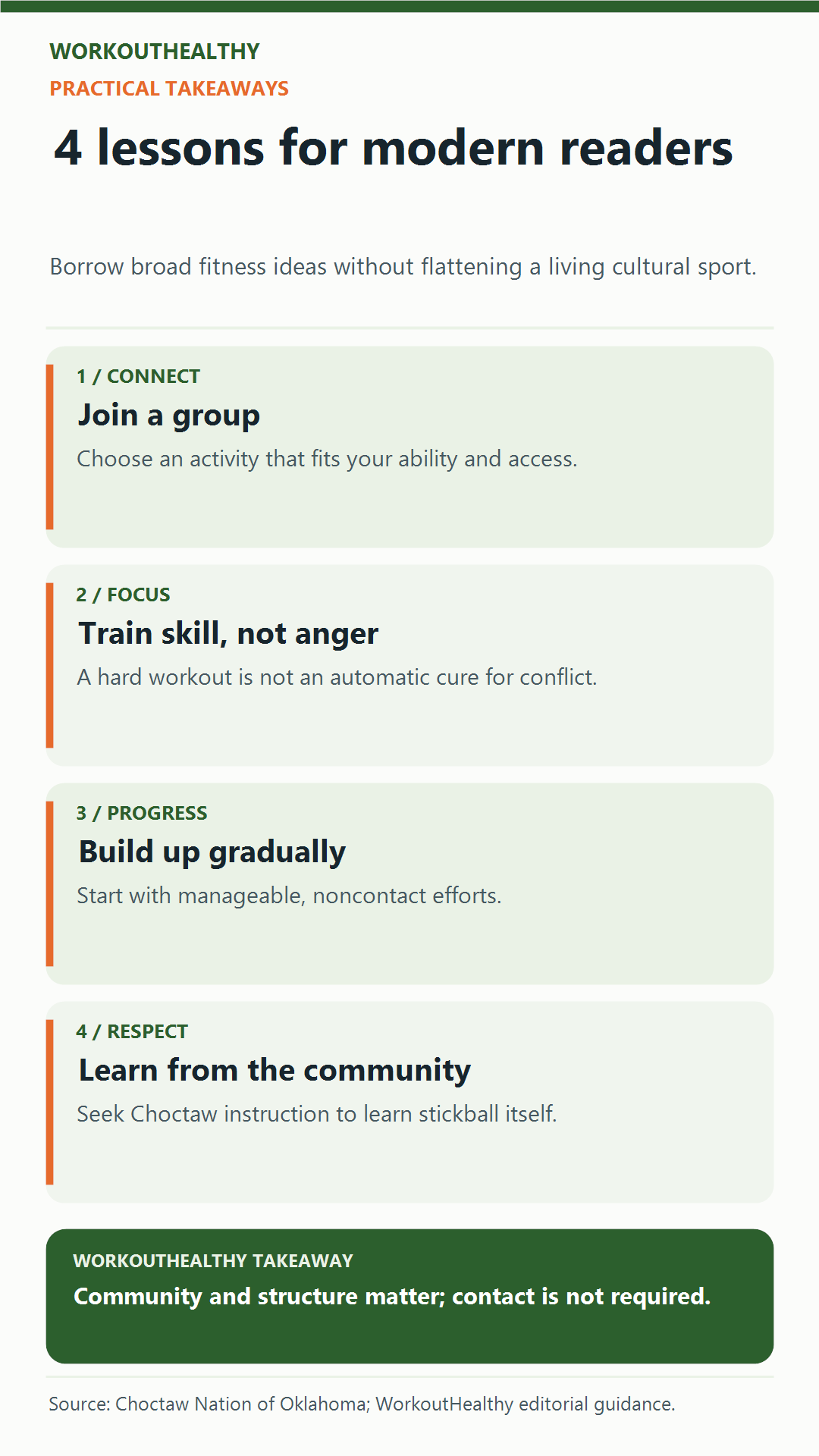
There is a useful training lesson here, but it should be separated from the sport’s cultural meaning. Running, stopping, changing direction, coordinating the hands and reacting to other players are recognizable athletic demands. A recreational athlete can develop those capacities through noncontact field games, walking or running intervals, and simple coordination drills.
That does not make a generic fitness circuit “Choctaw stickball training.” Traditional equipment, language, ceremonies and community rules belong to the people who practice and preserve the sport. If you want to learn the game itself, seek instruction through Choctaw community programs rather than copying a few dramatic clips.
Because modern play remains full contact and, according to the Choctaw Nation, does not use pads or helmets, it is not a beginner-friendly prescription for managing stress. The safer takeaway for most readers is to find a structured group activity that fits their health, skill and access. The social connection may be just as important as the physical effort.
How to Use the Idea Today
- Pick a team or group activity. Shared effort builds connection. Our look at whether a boot camp class is worth it covers one option.
- Focus on the task, not the grudge. Think about your skill and effort rather than the person who upset you.
- Train for hard efforts safely. Fighters practice working while tired, as Alex Pereira’s training shows, but they build up to it.
- Respect the rules. Rules are what turn conflict into sport.
Who Should Be Careful
Full contact sports carry a real risk of head, face, and hand injuries.
Anyone with a past concussion should get medical clearance before playing contact games.
Use protective gear where the rules allow it, and stop playing after any blow that causes headache, dizziness, or confusion.
If anger feels out of control, a counselor or doctor is a better first step than a rougher workout.
The Bottom Line
Choctaw stickball is a living cultural sport with a long history of competition, diplomacy and community gathering. It was sometimes used to mediate disputes, although documented games also escalated into violence. Its meaning is much broader than conflict management or physical conditioning.
It is still played today. Modern rules limit certain forms of contact and the number of players, but the game remains physically demanding.
Research on sport participation reports associations with mental and social well-being, while an anger-venting experiment challenges the idea that hitting something reliably reduces anger. Neither study tests Choctaw stickball itself.
Want more stories like this? Subscribe to WorkoutHealthy Insider for practical explanations behind popular fitness claims.
References
- Biskinik. (n.d.). Choctaw stickball, the game of our ancestors. https://biskinik.com/news/choctaw-stickball-the-game-of-our-ancestors/
- Bushman, B. J. (2002). Does venting anger feed or extinguish the flame? Catharsis, rumination, distraction, anger, and aggressive responding. Personality and Social Psychology Bulletin, 28(6), 724 to 731. https://doi.org/10.1177/0146167202289002
- Eather, N., Wade, L., Pankowiak, A., & Eime, R. (2023). The impact of sports participation on mental health and social outcomes in adults: A systematic review and the ‘Mental Health through Sport’ conceptual model. Systematic Reviews, 12, 102. https://doi.org/10.1186/s13643-023-02264-8
- Choctaw Nation of Oklahoma. (n.d.). Stickball. https://www.choctawnation.com/about/culture/traditions/stickball/
- Choctaw Nation of Oklahoma. (2010). Stickball the Choctaw national sport. https://www.choctawnation.com/news/iti-fabvssa/stickball-the-choctaw-national-sport/
- Lewis, J. (2022). Ishtaboli between the two removals. Choctaw Nation of Oklahoma. https://www.choctawnation.com/news/iti-fabvssa/ishtaboli-between-the-two-removals/
This article is for general information only and is not medical advice. If you have an injury, ongoing pain, or a medical condition, talk to a doctor or physical therapist before you change how you train or eat.