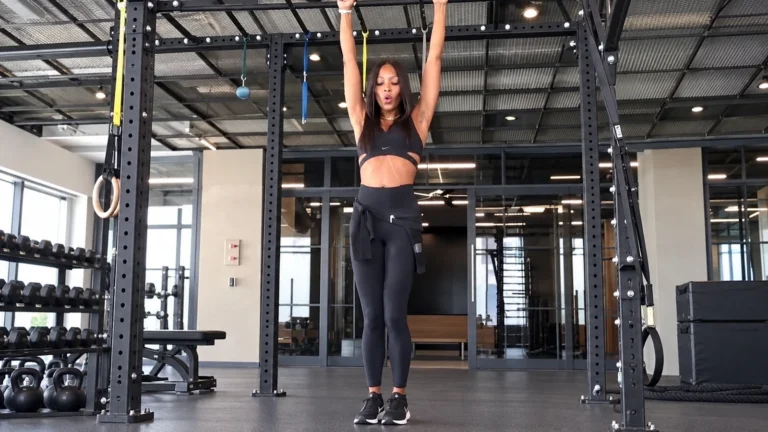

Millions of people now take GLP-1 medications for weight loss.
Drugs like semaglutide and tirzepatide can lead to dramatic drops on the scale.
Some of the measured weight loss is lean mass, a category that includes—but is not identical to—skeletal muscle.
A video from the Metabolic Health channel, hosted by Dr. Lindsay Ogle, explored this exact problem with registered dietitian Julie Przybyla.
Their conversation centered on strength training as a way to protect muscle during medication assisted weight loss.
This article looks at what the actual research says about that idea.
What the Video Claims
The video features a conversation between Dr. Lindsay Ogle and registered dietitian Julie Przybyla.
The episode identifies Julie Przybyla as a registered dietitian and personal trainer; those qualifications are background context, not evidence that every claim in the conversation is correct.
The same registry lists a Lindsay Ogle with an MD credential and a specialty of family medicine and bariatric medicine.
That specialty fits a channel built around the medical side of metabolic health.
In the video, the two discuss strength training as a tool for people using GLP-1 drugs.
Their core message is that lifting weights can help protect lean muscle during weight loss on these medications.
That claim lines up with a real and growing body of clinical research.
But the full picture is more nuanced than a short video can cover.
What Real Research Shows About Muscle Loss on GLP-1 Drugs
The concern about muscle loss on GLP-1 medications is not just internet speculation.
A 2025 study looked closely at body composition changes in people taking tirzepatide.
Researchers used a substudy of SURMOUNT-1, one of the major tirzepatide weight loss trials (Look et al., 2025).
They used DXA scans in 160 participants to estimate fat mass and lean mass. DXA does not directly isolate skeletal muscle.
After 72 weeks, people taking tirzepatide lost an average of 21.3 percent of their starting body weight.
Their fat mass dropped by 33.9 percent over that same period.
Their lean mass, which includes muscle, dropped by 10.9 percent.
Broken down differently, about 75 percent of the total weight lost was fat.
The remaining 25 percent was lean mass.
That number matters, because it is often exaggerated online.
This result should not be generalized to every GLP-1 drug, dose, study population, or individual. It also cannot tell how much of the measured lean-mass change was skeletal muscle rather than water or other non-fat tissue.
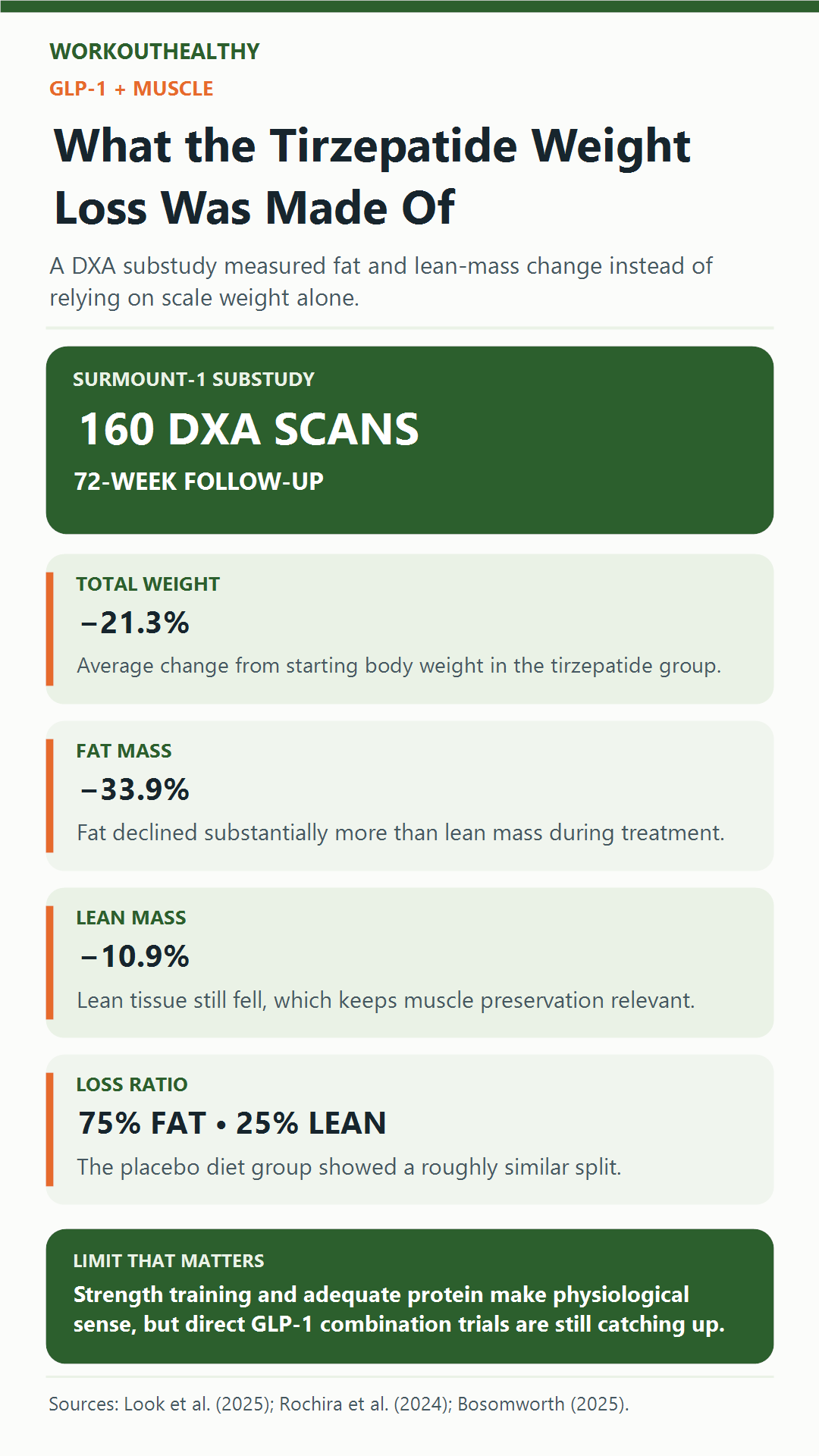
About one quarter of the weight lost on tirzepatide in this trial was lean mass, not fat.
What Real Research Shows About Comparing This to Diet Alone
A key detail often gets left out of the muscle loss conversation.
In the same trial, the placebo group also received the study’s lifestyle intervention and lost less total weight. Among participants with complete DXA data, the approximate fat-to-lean composition of weight loss was similar in the placebo and tirzepatide groups: about 75% fat and 25% lean mass (Look et al., 2025).
That comparison shows lean-mass change can accompany weight loss without the drug, but the small placebo subgroup and unequal weight loss do not prove that tirzepatide has no independent muscle-related effect.
A broader review of six randomized trials on tirzepatide reached a similar note of caution (Rochira et al., 2024).
That review found consistent fat loss across the studies it examined.
But it found the effect on fat-free mass was still unclear.
The authors described the fat-free mass findings across studies as inconclusive.
This tells us the science here is still developing, not settled.
What Real Research Shows About Strength Training’s Role
Completed large trials isolating the effect of resistance training during semaglutide- or tirzepatide-induced weight loss remain limited. A 2026 randomized-trial protocol plans to test resistance exercise and protein during these treatments, but a protocol is not an outcome result.
A 2025 narrative review looked at how blood sugar medications affect muscle outcomes in type 2 diabetes (Bujdei-Tebeică et al., 2025).
The review argued that muscle preservation deserves more direct research attention as these medications become common.
A separate 2025 clinical review made a similar case for exercise (Bosomworth, 2025).
It argued that nutrition and exercise remain essential parts of care alongside these newer drugs.
A 2026 study in JAMA Network Open compared body composition outcomes after bariatric surgery to outcomes after GLP-1 treatment (Wang et al., 2026).
That comparison adds another data point to how doctors think about muscle loss across different weight loss methods, not just medication.
WorkoutHealthy has covered the broader relationship between losing weight and losing muscle mass in more general terms.
Despite the lack of dedicated combination trials, the physiology case for lifting weights stands on its own.
Muscle tissue responds to mechanical tension by growing or holding onto its size.
Cutting calories without a reason to keep muscle tends to push the body toward breaking some of it down.
Giving muscle a reason to stick around, through resistance training, works against that pull.
This is the general logic doctors and dietitians lean on, even while GLP-1-specific trials catch up.
The Mechanism
GLP-1 drugs work partly by slowing digestion and reducing appetite.
People taking them often eat far fewer calories than they did before.
That drop in appetite does not target fat specifically.
It reduces total food intake, including protein.
Protein is the raw material muscle needs to repair and rebuild itself.
Eating less protein during a calorie deficit makes muscle loss more likely.
Resistance training sends the body a different kind of signal.
Lifting weights creates mechanical stress on muscle fibers.
That stress tells the body those specific muscles are still needed.
Paired with enough protein, that signal can help protect muscle even during weight loss.
This is likely why a registered dietitian like Julie Przybyla pairs strength training advice with nutrition guidance.
Muscle is also metabolically active tissue.
It burns more calories at rest than fat tissue does.
A large loss of body mass can lower resting energy expenditure, but this article’s DXA data do not isolate how much of that change comes from skeletal muscle or predict long-term weight maintenance for an individual.
What This Evidence Does Not Prove
This evidence does not prove that strength training fully prevents muscle loss on GLP-1 drugs.
No large trial has tested that exact question directly yet.
The tirzepatide body composition data came from a substudy of 160 people.
That is a meaningful sample, but not a huge one.
The six-trial review found genuinely mixed results on fat-free mass across studies (Rochira et al., 2024).
This evidence also does not prove that every pound of lean mass lost is muscle specifically.
Lean mass includes muscle, but also organs, water, and other non-fat tissue.
DXA scans cannot always separate muscle fiber loss from other lean tissue changes.
This evidence does not prove GLP-1 drugs are worse for muscle than other weight loss methods.
The placebo comparison does not establish whether these drugs have a separate effect on muscle apart from the weight loss they produce.
None of this proves that skipping strength training guarantees muscle loss for any one person.
Genetics, age, starting fitness level, and overall diet quality all play a role too.
Common Mistakes
People trying to protect muscle on GLP-1 medications tend to make a few common mistakes.
Skipping resistance training entirely is one of the biggest.
Some people assume walking alone is enough to protect muscle.
Walking is valuable for heart health and daily movement.
WorkoutHealthy covers that topic in its guide to how many miles a day people should aim for.
But walking alone does not create the same mechanical signal that lifting weights does.
Another common mistake is cutting protein along with everything else.
Appetite suppression from these drugs can make it genuinely hard to eat enough protein.
Skipping meals, instead of planning smaller protein-focused ones, tends to make this worse.
Some people also start a new lifting routine too aggressively.
Jumping straight into heavy weights without a plan raises injury risk, especially for beginners.
A slower, more consistent approach tends to work better over the long run.
Waiting until significant weight is already lost before starting to strength train is another mistake.
Starting resistance training early, alongside the medication, gives muscle more chances to adapt along the way.
Lean-mass loss can accompany weight loss with or without medication. The available body-composition data do not prove how much is skeletal muscle or isolate the drug’s independent effect.
Who Should Be Extra Careful
People who are new to exercise should talk to a doctor before starting any strength program.
People with joint problems, osteoporosis, or heart conditions need individualized guidance from a professional.
Anyone on a GLP-1 medication with ongoing nausea or very low food intake should raise it with their prescribing doctor first.
Low energy intake can make hard exercise unsafe until eating stabilizes.
Older adults trying strength training for the first time should consider working with a trainer or physical therapist early on.
People recovering from a recent injury need medical clearance before adding resistance work.
Anyone with a history of disordered eating should approach both the medication and any exercise changes carefully, with professional support.
The right pace and plan depends on a person’s full health history, not a one-size-fits-all rule from a video.
A Practical Takeaway
For most people on a GLP-1 medication, two to three strength sessions a week is a reasonable starting point.
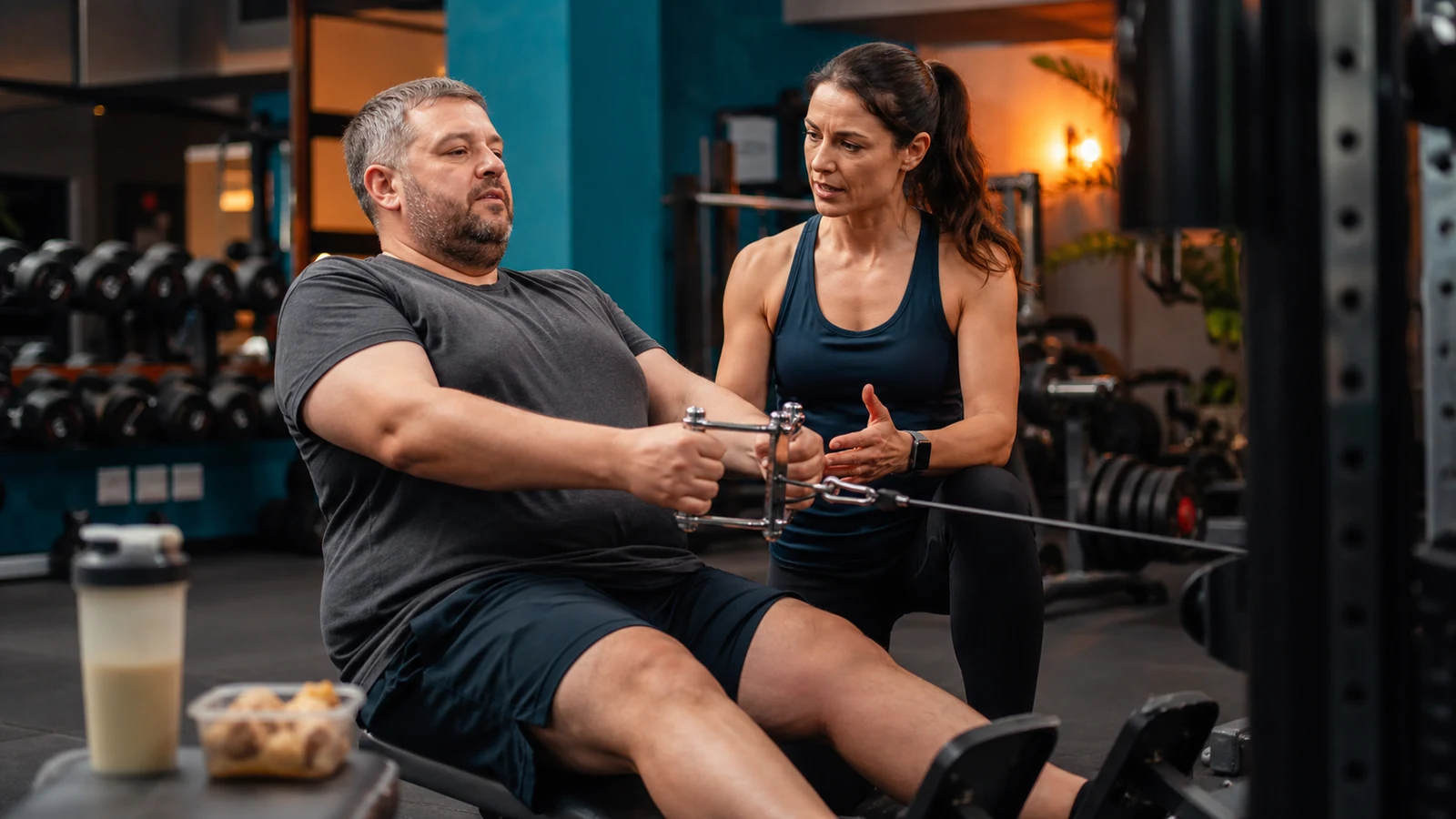
Full-body sessions that hit the major muscle groups tend to work well for beginners.
Basic movements like squats, rows, presses, and hip hinges cover most of what matters.
Adequate protein intake supports muscle during weight loss, alongside a suitable exercise plan. A dietitian can help adapt meals to a reduced appetite; these sources do not establish that protein timing matters as much as the total amount or the training program.
A registered dietitian, like Julie Przybyla in the source video, can help build a protein plan around a reduced appetite.
Strength training also comes with benefits beyond muscle preservation.
Lifting weights has been linked to better long-term brain health, an angle WorkoutHealthy explores in whether lifting weights keeps your brain young.
WorkoutHealthy readers have also shown a strong preference for weightlifting over running in past reader surveys, for related reasons.
None of this requires becoming a serious lifter overnight.
Consistency over months matters more than intensity in any single session.
Anyone starting a GLP-1 medication should raise exercise and nutrition planning with their prescribing doctor early, not as an afterthought.
This is a decision best made between a patient and their doctor, not a decision a workout article can make for them.
Watch the video
Want more like this? Subscribe to WorkoutHealthy Insider for practical explanations behind popular fitness claims.
References
Alawadhi, A. A., et al. (2026). LEAN mass preservation with resistance exercise and protein during semaglutide and tirzepatide therapy: A protocol for a randomised controlled trial. BMJ Open. https://doi.org/10.1136/bmjopen-2026-116911. Protocol only; no intervention outcomes are reported.
Bosomworth, N. J. (2025). New drugs for weight loss: Why change in body composition matters and why nutrition and exercise remain paramount. Canadian Family Physician, 71(11 to 12), 705 to 714. https://doi.org/10.46747/cfp.711112705
Bujdei-Tebeică, I., et al. (2025). Effects of blood-glucose lowering therapies on body composition and muscle outcomes in type 2 diabetes: A narrative review. Medicina, 61(8), 1399. https://doi.org/10.3390/medicina61081399
Look, M., Dunn, J. P., Kushner, R. F., Cao, D., Harris, C., Gibble, T. H., Stefanski, A., & Griffin, R. (2025). Body composition changes during weight reduction with tirzepatide in the SURMOUNT-1 study of adults with obesity or overweight. Diabetes, Obesity and Metabolism, 27(5), 2720 to 2729. https://doi.org/10.1111/dom.16275
Rochira, V., Greco, C., Boni, S., Costantino, F., Dalla Valentina, L., Zanni, E., Itani, L., & El Ghoch, M. (2024). The effect of tirzepatide on body composition in people with overweight and obesity: A systematic review of randomized, controlled studies. Diseases, 12(9), 204. https://doi.org/10.3390/diseases12090204
Wang, Z., et al. (2026). Body composition changes after bariatric surgery or treatment with GLP-1 receptor agonists. JAMA Network Open, 9(1), e2553323. https://doi.org/10.1001/jamanetworkopen.2025.53323
This article is for general information only and is not medical advice. If you have an injury, ongoing pain, or a medical condition, talk to a doctor or physical therapist before you change how you train or eat.