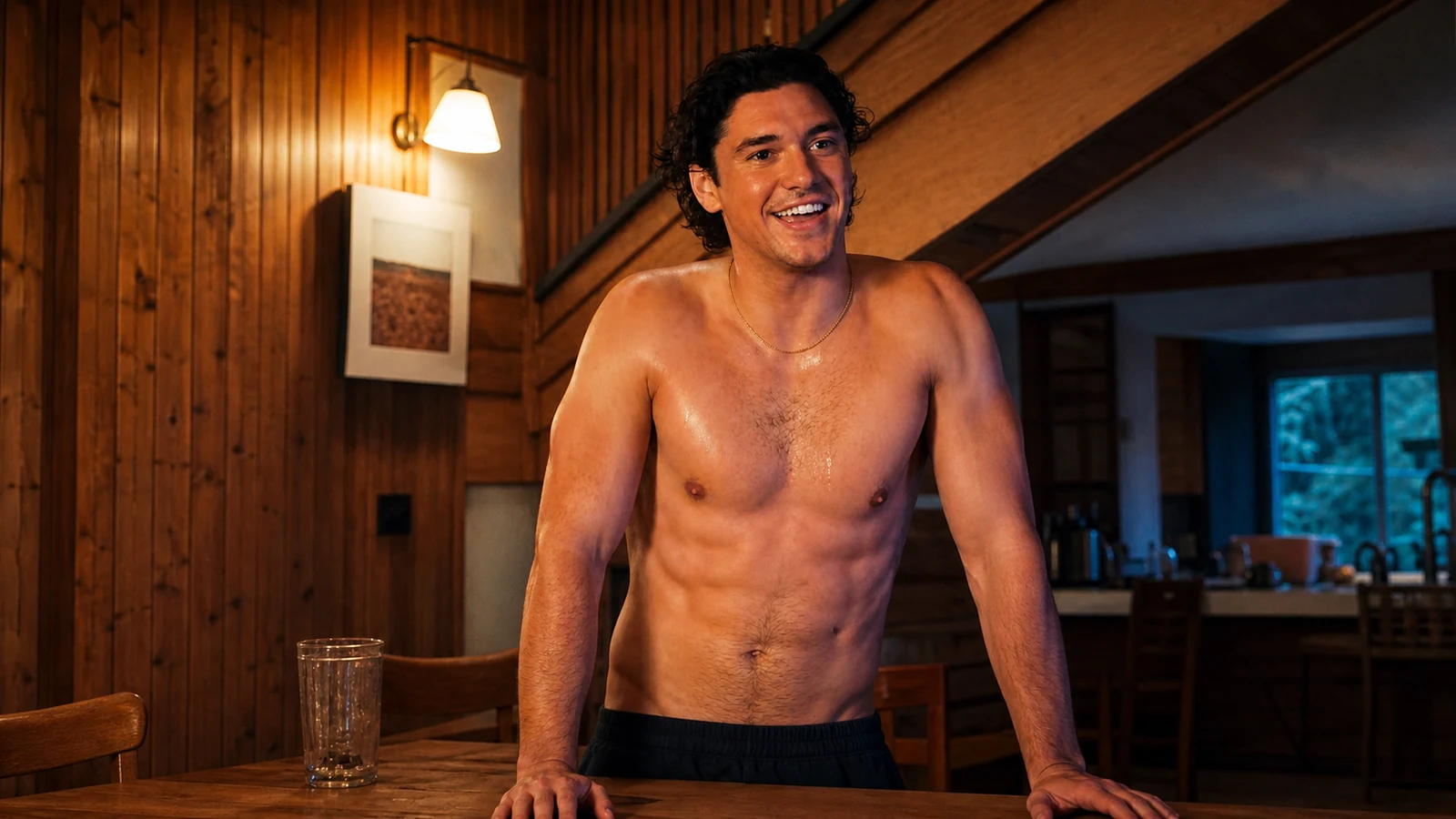

Belmont Cameli’s gym goal for his breakout role was not a six pack.
It was size.
Cameli stars in Off Campus, Amazon Prime Video’s adaptation of Elle Kennedy’s bestselling college hockey romance novels, playing hockey team captain Garrett Graham opposite Ella Bright.
According to Men’s Health, his training focus for the role has centered on building mass rather than getting lean, a deliberate choice that matches what an actual hockey player’s body needs to do.
The show has become a genuine hit, reportedly drawing tens of millions of viewers in its first two weeks and earning a second season renewal before it even premiered.
Who Is Belmont Cameli
Cameli was born in 1998 in Naperville, Illinois.
He started his acting career in 2018 with a guest role on Empire and gained wider recognition playing Jamie Spano in the Saved by the Bell reboot from 2020 to 2021.
He also starred in the Netflix film Along for the Ride in 2022.
Off Campus, based on the Off Campus book series set at the fictional Briar University, is his biggest role to date, and critics have specifically praised his on screen chemistry with co star Ella Bright.
Off Campus Became a Bigger Hit Than Anyone Expected
Off Campus is adapted from Elle Kennedy’s bestselling romance novels, a series that has sold widely around the world and built a devoted fan base long before the show existed.
The Amazon Prime Video adaptation premiered in May 2026 and quickly became one of the platform’s most watched original series debuts, reportedly reaching tens of millions of viewers within its first two weeks.
It earned a second season renewal before the first season had even finished its run, and it holds a rare 91 percent approval rating among critics.
That kind of reception raises the stakes on Cameli’s physical transformation.
A role this visible, playing a character fans already pictured from the books, puts real pressure on getting the look and the physicality right.
Why Building Mass Fits a Hockey Player’s Role
Ice hockey is a contact sport.
Players absorb checks, collisions along the boards, and puck impacts as a routine part of the game, not an occasional accident.
More lean mass gives a body more surface area and structure to absorb that kind of contact.
It functions less like decoration and more like padding the body builds for itself, which is different from the leaner, more defined look many actors chase for other kinds of physical roles.
Playing a hockey team captain convincingly on screen means looking like someone who could actually take a hit and keep skating, not just someone with visible abs under studio lighting.
Real hockey players tend to carry noticeably more upper body and core mass than athletes in many other sports, precisely because the position demands it.
A lean, sharply defined physique, the kind often chased for other roles, can actually read as unconvincing for a character meant to look like he plays a physical sport at a competitive level.
The Science Behind Building Muscle Mass
Building meaningful muscle mass generally requires two things working together: enough resistance training to signal the body to adapt, and enough food to fuel that adaptation.
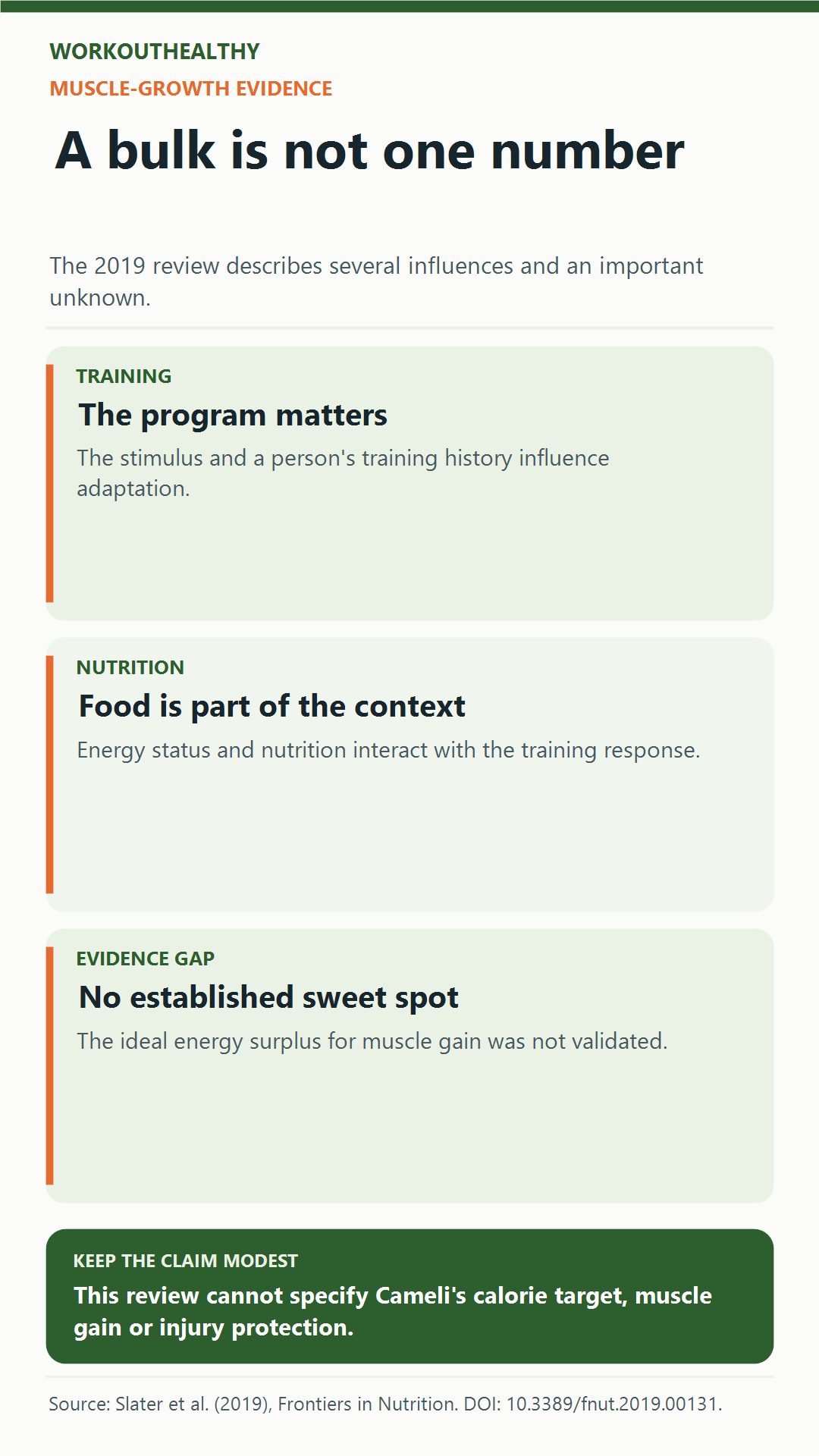
A review published in Frontiers in Nutrition examined whether a calorie surplus is actually necessary to maximize muscle growth from resistance training (Slater et al., 2019).
The researchers concluded that while some muscle gain is possible without a surplus, a modest calorie surplus generally supports faster and more consistent hypertrophy, especially for someone trying to add size within a defined timeline like a filming schedule.
That lines up with what a bulking phase for a role like this typically looks like in practice: structured strength training paired with intentionally increased food intake, not just heavier weights alone.
Why More Muscle Also Means Fewer Injuries
The protective argument behind bulking for a contact sport role is not just a talking point.
It has real support in sports medicine research.
A systematic review and meta analysis published in the British Journal of Sports Medicine looked at randomized controlled trials testing whether exercise interventions, including strength training, reduce sports injury rates (Lauersen et al., 2014).
The researchers found that strength training programs were associated with a meaningfully lower risk of sports injuries overall, including in sports involving contact and collision.
More muscle mass, built through consistent strength training, gives joints and connective tissue more support to handle sudden forces.
That is true whether the sport is ice hockey, football, or rugby.
Muscle built through structured strength training does not just change how a body looks. It changes how well that body tolerates a hit.
What This Evidence Does Not Prove
Neither study was conducted on actors preparing for a role, and neither can tell us the specific details of Cameli’s own training program, which have not been publicly detailed beyond the general mass building framing reported by Men’s Health.
The injury prevention research also comes from studies on athletes actively playing contact sports, not from people building size for a screen role who may never take an actual hit.
The protective logic still applies in principle, since the underlying tissue adaptations are the same, but the specific injury reduction numbers do not transfer directly to an acting context.
It is also worth noting that a bulking phase is not the right goal for everyone.
Someone training for endurance sports, weight class sports, or general health rather than a size dependent role would approach their nutrition and training very differently.
Bulking for a Role Versus Bulking for a Sport
An actor bulking for a specific role has a fixed deadline, usually tied to a shooting schedule, which is different from how most athletes approach an off season mass building phase.
Athletes typically have months, sometimes a full year, to build size gradually while also maintaining sport specific conditioning.
An actor preparing for a single role often works within a much tighter window, which can push a training team toward a more aggressive calorie surplus and a heavier reliance on supervised coaching to manage the tradeoffs.
That tighter timeline is also exactly why professional guidance matters more, not less, in this kind of preparation.
A rushed bulk without expert oversight is far more likely to add unwanted fat or strain joints than a properly paced one.
Common Mistakes People Make When Trying to Bulk Up
Eating in a huge calorie surplus, assuming more food always means more muscle, is one of the most common mistakes.
Beyond a modest surplus, extra calories mostly add fat rather than additional muscle.
Neglecting protein intake while chasing total calories is another frequent error.
Muscle growth needs a steady, spread out protein intake across the day, not just a large calorie total from any source.
Skipping lower body and back training in favor of visible mirror muscles is a third common trap.
A body built to actually absorb contact needs balanced development, not just a bigger chest and arms.
Rushing the timeline is a fourth mistake specific to roles with a filming deadline.
Meaningful muscle gain takes months, not weeks, and pushing too hard too fast raises injury risk without speeding up real results.
How to Train for Size the Way a Role Like This Requires
Build your training around compound lifts that load multiple large muscle groups at once, such as squats, deadlifts, presses, and rows.
Train each major muscle group at least twice a week rather than once.
Frequency matters as much as total volume for building size over a defined timeline.
Increase your calorie intake modestly, generally by a few hundred calories a day above maintenance, rather than in a large, aggressive jump.
Prioritize protein at every meal, spread across the day instead of concentrated in one large serving.

Track your strength numbers over time, not just your body weight.
Rising weights on your main lifts is a more reliable sign of real muscle gain than the scale alone.
Add mobility and stability work for the joints that take the most stress in your target sport, especially the hips, knees, and shoulders.
Sleep at least seven hours a night during a bulking phase.
Muscle repair and growth happen largely during recovery, not during the workout itself.
If you are new to structured strength training, working with a personal trainer for even a few sessions can help you learn safe technique on the compound lifts that matter most for building size.
You can also compare training approaches like the floor press and bench press to see which pressing variation fits your goals and any joint limitations.
Reassess every four to six weeks and adjust your calorie intake and training volume based on real progress, not guesswork.
A body that is gaining strength but not gaining any weight likely needs more food, while one gaining weight faster than strength likely needs a smaller surplus.
References
- Slater, G. J., Dieter, B. P., Marsh, D. J., Helms, E. R., Shaw, G., & Iraki, J. (2019). Is an energy surplus required to maximize skeletal muscle hypertrophy associated with resistance training? Frontiers in Nutrition, 6, Article 131. https://doi.org/10.3389/fnut.2019.00131
- Lauersen, J. B., Bertelsen, D. M., & Andersen, L. B. (2014). The effectiveness of exercise interventions to prevent sports injuries: A systematic review and meta-analysis of randomised controlled trials. British Journal of Sports Medicine, 48(11), 871-877. https://doi.org/10.1136/bjsports-2013-092538
- Men’s Health. Train Like a Celebrity.
This article is for general educational purposes and is not medical advice. Talk to a doctor or qualified health professional before making significant changes to your diet or training program, especially if you have an existing health condition.