

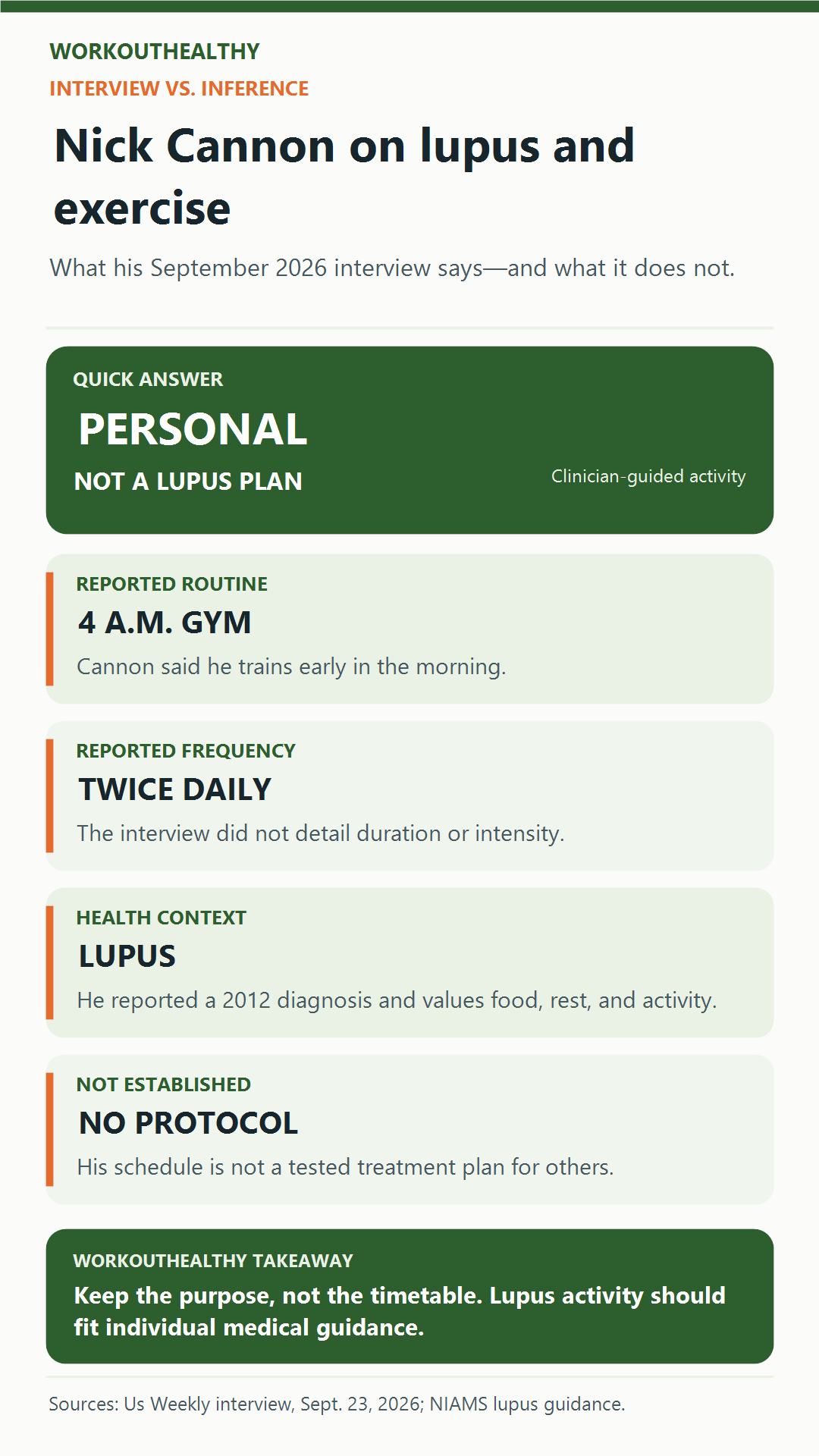
Nick Cannon describes his exercise schedule in unusually urgent terms. In a September 2026 interview with Us Weekly, the entertainer said he gets up at 4 a.m. to train and exercises twice a day. He connected that routine to living with lupus, an autoimmune disease he says he was diagnosed with in 2012. The memorable line was short: “I work out to stay alive.”
His words express how meaningful movement is to him. They are not a prescription for everyone with lupus, and the interview does not tell us the duration, intensity, or medical supervision of those sessions. To understand the story, we have to keep his personal routine separate from general health advice.
What Cannon Actually Said
The Us Weekly interview covered Cannon’s work, his family, and his health. When asked about his lupus diagnosis, he described the condition as part of his life and said that eating well, resting, and exercising are among the habits he manages. The magazine also reported that he trains twice daily. He specifically mentioned going to the gym at 4 a.m.
That establishes the routine he reported at the time of the interview. It does not establish that he performs two hard workouts every day, that he never changes his training during a flare, or that the same pattern would benefit another patient. None of those details were supplied in the interview. His own statement about exercise is best read as a description of purpose rather than a controlled test of treatment.
The surrounding context is a busy life. Cannon discussed taking Wild ’N Out on tour, managing work commitments, and attending events for his children. The interview shows why he may value a fixed early training window, but it also shows the tension between activity, rest, and family time. We should not use his timetable to judge someone whose symptoms, care duties, work, or sleep needs differ.
What Lupus Is—and Why Exercise Advice Must Be Individual
Systemic lupus erythematosus is a chronic autoimmune disease that can affect different parts of the body. Symptoms and disease activity vary. Fatigue, joint pain, rashes, and organ complications can complicate everyday life and change what is safe or realistic at a given time. Management is more than a workout: it can include regular monitoring, medication, flare prevention, and clinical care tailored to the person.
The U.S. National Institute of Arthritis and Musculoskeletal and Skin Diseases (NIAMS) advises people with lupus to exercise to help keep the body strong, while speaking with their doctor before beginning an exercise program. That is a measured recommendation. It does not say that intense training twice daily treats lupus, that exercise can replace medication, or that every person should train through fatigue or joint swelling.
The Lupus Foundation of America also emphasizes planning around fatigue and making changes to daily activities when needed. For some people, a walk or gentle movement may fit a stable period; for others, a flare or organ issue may require a different plan. The relevant question is what a particular person’s treatment team recommends, not whether they can copy Cannon’s alarm clock.
Why “Twice a Day” Is Not the Useful Takeaway
Training frequency alone tells us very little about total load. Two short, easy sessions are different from two strenuous workouts. An early session can be useful if it fits a person’s life, but it can also be counterproductive if it consistently cuts into needed sleep. The interview does not report the length, content, or intensity of Cannon’s sessions, so any exact workout plan attributed to him would be an invention.
For a reader managing a chronic condition, more sessions are not automatically better. A safe plan weighs symptoms, recent flares, medications, sleep, conditioning, joint and heart health, and any clinician guidance. The aim may be maintaining function, rebuilding confidence, or finding a tolerable amount of activity. A headline about a celebrity’s schedule cannot make those choices for a patient.
Even for a reader without lupus, “4 a.m.” is not a magic time. Consistency matters most when a routine can be sustained alongside adequate rest and other responsibilities. The calendar should serve the person, not become a badge of toughness.
The Purpose Behind His Routine
Cannon’s phrase makes sense as personal motivation: he associates movement with taking his health seriously. He also named rest and food as parts of his response to living with lupus. The combination tells a fuller story than the number of workouts alone.
There is a useful question for anyone who exercises: What does movement help you do in your life? The answer may be having energy for family, maintaining mobility, enjoying a sport, managing stress, or keeping an appointment with yourself. Purpose can make a routine feel worthwhile. It does not require intensity for its own sake.
Our Miley Cyrus running story shows a different motivation: enjoyment rather than an outcome metric. Our Nabela Noor health story similarly puts day-to-day capability ahead of one number. These are individual accounts, not universal treatment rules.
How to Build a More Flexible Version of the Idea
For people cleared to be active, a flexible routine can use the part of Cannon’s story that transfers: make space for movement that has meaning. The specific 4 a.m. time and two-a-day frequency do not need to transfer.
- Start with a reason. Choose a goal that matters to your life, such as easier stairs, more comfortable walks, or a steadier exercise habit.
- Discuss the plan when health conditions are involved. A clinician who knows your condition can advise on activity, warning signs, and when to pause.
- Match effort to the day. A light session, a shorter session, or rest may be appropriate when symptoms or recovery change.
- Protect sleep and treatment. A workout should complement, not crowd out, prescribed care and adequate rest.
- Track function, not heroics. Notice whether movement helps you participate in life without leaving you worse off.
These are planning principles, not a lupus protocol. If you are experiencing a flare, new symptoms, chest pain, unusual shortness of breath, or other concerning changes, seek medical guidance rather than using an article or celebrity routine to decide whether to push through.
What We Still Do Not Know About His Workouts
The published interview confirms Cannon’s self-reported schedule and diagnosis history. It does not provide a training log, a medical assessment, or a before-and-after health outcome. We do not know which exercises he uses, how hard he trains, how he adjusts during symptoms, or whether a specific part of the routine produced a measurable effect.
That is why the article should not be repackaged as “Nick Cannon’s lupus workout.” It is a profile of one person’s priorities. Our celebrity-fitness reporting policy explains why we separate a public figure’s words from unsupported claims about a program or endorsement.
The Bottom Line
Nick Cannon says he trains early and exercises twice daily while living with lupus. His words convey purpose and resolve, but they do not establish a regimen for anyone else. The medically sound takeaway is more modest: if you have lupus, exercise can be part of an individualized plan, with rest, symptom awareness, and your treatment team in the picture. The meaning you attach to movement can be personal; the dose should be appropriate to you.
References
- Harkin J, Williams A. Nick Cannon Gets Candid About His Hollywood Past, Life as a Father of 12 and Plans for the Future. Us Weekly. September 23, 2026.
- National Institute of Arthritis and Musculoskeletal and Skin Diseases. Lupus: Diagnosis, Treatment, and Steps to Take.
- Lupus Foundation of America. Daily Life with Lupus.
This article is for general information, not medical advice, diagnosis, or treatment. People with lupus should discuss new or changed exercise plans with their own care team.