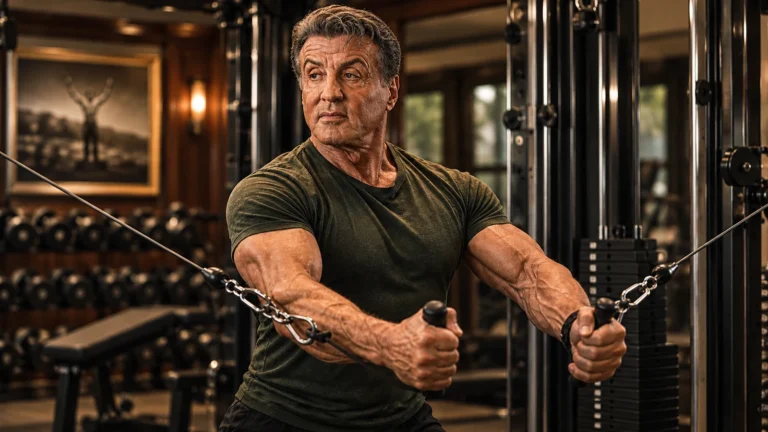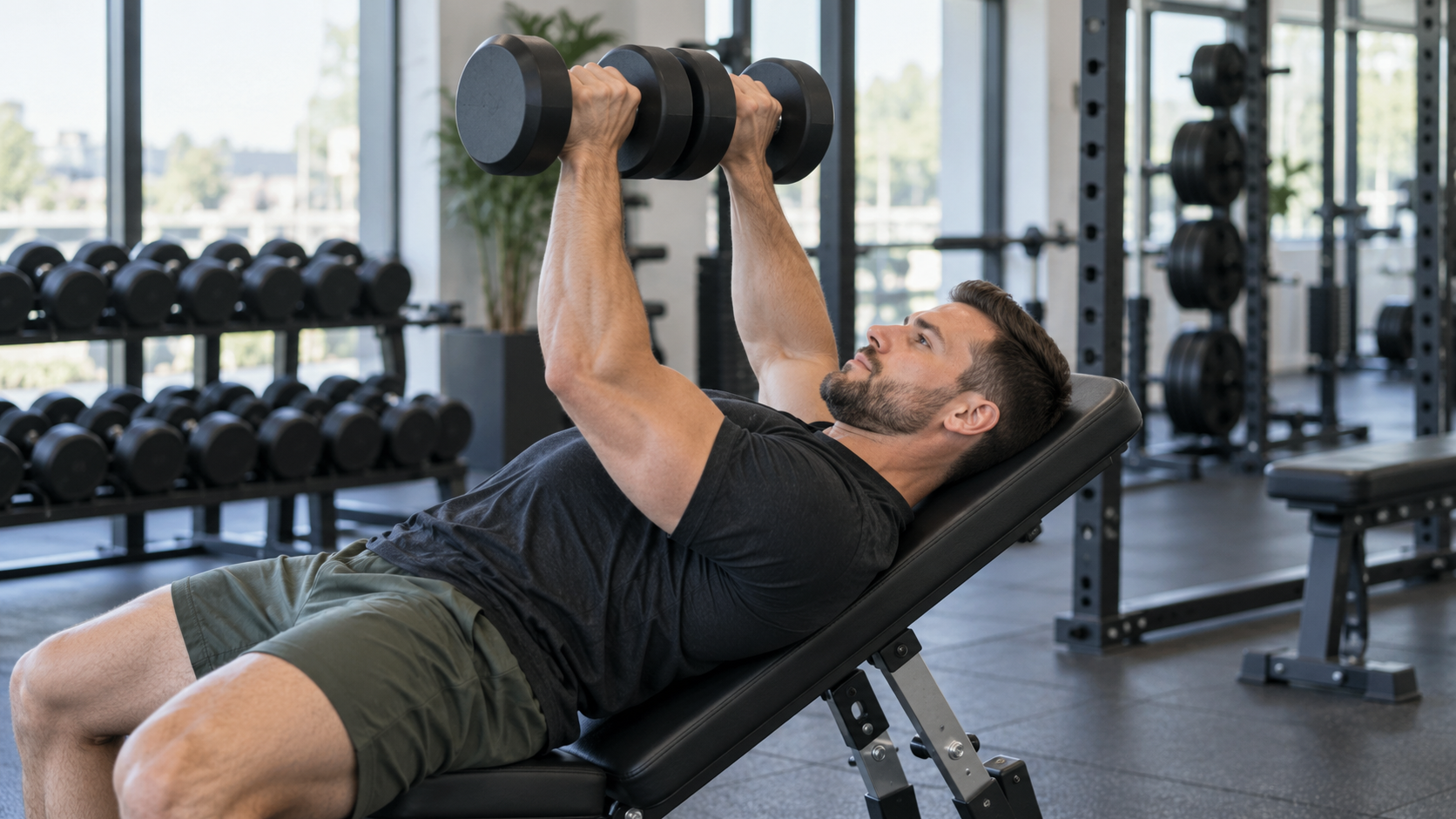

Featured image: generic editorial exercise illustration, not a photograph of Petar Klančir or his reel.
Petar Klančir’s close-grip incline press is a real dumbbell variation with a sensible setup: a modest incline, neutral hands, tucked elbows, and a controlled press toward the sternum.
It can train the chest and triceps, but it cannot isolate a separate inner-chest muscle because that muscle does not exist.
Klančir demonstrates the movement in an Instagram reel from his verified source account.
The video is useful as a technique demonstration, while the promise of filling a precise gap above the sternum needs a more careful evidence check.
The Short Answer
The exercise is best understood as an incline dumbbell squeeze press.
Holding the bells close can increase the demand on the triceps and create an isometric effort as you try to draw the upper arms toward the midline.
That effort may help some lifters feel their chest working, and the incline can change which region of the pectoralis major contributes most.
Neither feature lets a lifter carve growth into a narrow strip at the center of the chest.
A close grip changes the press, but it cannot isolate a separate inner chest muscle.
What Klančir Shows in the Reel
Klančir starts on a slightly inclined bench with two dumbbells held close together and the palms facing each other.
He keeps the elbows closer to his sides than they would be during a wide, flared dumbbell press.
He lowers the dumbbells toward the sternum with the inner ends angled slightly down, then presses upward while focusing on a hard chest contraction.
His suggested prescription is three sets of 8 to 12 repetitions taken to failure.
The demonstration is controlled, and Klančir explicitly acknowledges that the inner chest is not a separate muscle.
The disagreement is narrower: evidence does not show that this variation selectively grows fibers beside the sternum better than other well-programmed chest exercises.
Why There Is No Separate Inner Chest Muscle
The pectoralis major is a broad, fan-shaped muscle with clavicular and sternocostal heads.
Those names describe their origins near the clavicle, sternum, and ribs, while the fibers converge on the upper arm.
Anatomy does not divide the muscle into independent inner and outer heads.
The medial border of each pec sits near the sternum, but its appearance is influenced by overall muscle size, tendon structure, body-fat level, and individual anatomy.
Regional training effects are possible within some muscles, so exercise selection is not meaningless.
The useful regional distinction here is mainly between clavicular and sternocostal portions, not a detachable inner strip that one narrow grip can isolate.
What the Setup Changes
What the Incline Changes
Inclining the bench changes the direction of the upper arm relative to the torso.
That can increase the contribution of the clavicular portion of the pectoralis major, which is why incline pressing is commonly used for upper-chest training.
In one study of 30 trained adults, researchers compared barbell presses at 0, 15, 30, 45, and 60 degrees.
Upper-pectoral electrical activity was highest at 30 degrees, while the anterior deltoid became more dominant at steeper angles.
This does not make 30 degrees universally perfect, and the study used a barbell rather than Klančir’s dumbbell variation.
It does support a practical choice: use a modest incline when the goal is chest work and avoid turning the movement into a high-angle shoulder press.
What the Close Grip Changes
A close or neutral grip keeps the elbows nearer the torso and usually reduces how wide the upper arms travel.
It can feel more comfortable for some shoulders, although comfort depends on the person, the bench angle, the depth, and the load.
Grip-width studies on barbell pressing do not support a simple rule that narrower always means more chest.
Narrower positions often increase the relative work performed by the triceps, and some research has found less sternocostal pectoral activity with a narrow pronated grip.
Klančir’s movement is not identical to a close-grip barbell press because dumbbells permit a neutral wrist and an active inward squeeze.
The fairest conclusion is that the close position changes joint mechanics and muscle contribution, not that it sends growth to the middle of the pec on command.
What Squeezing the Dumbbells Can Do
Trying to press the dumbbells together creates an isometric horizontal-adduction effort.
That can make the chest contraction easier to notice and may help a lifter maintain control with lighter loads.
A strong sensation is useful feedback, but it is not a growth measurement.
Pump, burning, soreness, and mind-muscle connection can all occur without proving that one small region received a superior long-term stimulus.
Surface electromyography has the same limitation when it is used to predict hypertrophy.
It measures acute electrical activity, and researchers have warned that a higher reading during one exercise is not a validated forecast of greater muscle growth over months.
How Hard Should You Train?
Are 8 to 12 Reps the Best Range?
Eight to 12 repetitions is a practical bodybuilding range because it permits meaningful load, controlled technique, and enough repetitions to judge effort.
It is not a biological gate that opens at eight and closes after 12.
A large network meta-analysis found that many resistance-training prescriptions can produce comparable hypertrophy when the work is challenging and repeated over time.
Heavier loads remain more specific to maximum-strength gains, while moderate and lighter loads can also build muscle.
Use a load that lets you keep the dumbbells stable, control the bottom position, and complete the intended arm path.
Add repetitions or small amounts of load when you reach the top of your target range without losing those standards.
Do All Three Sets Need to Reach Failure?
No.
Meta-analyses have not found that momentary failure is required for strength or hypertrophy when training volume and effort are otherwise appropriate.
Failure can be used selectively on a stable final set, but taking every set there may add fatigue and degrade technique.
Stopping with roughly one to three good repetitions in reserve is a reasonable default for most working sets.
Dumbbells deserve extra caution because a failed repetition can leave two weights in an awkward position above the torso.
A spotter, conservative load, and a clear way to end the set matter more than forcing one final rep.
How to Try the Variation
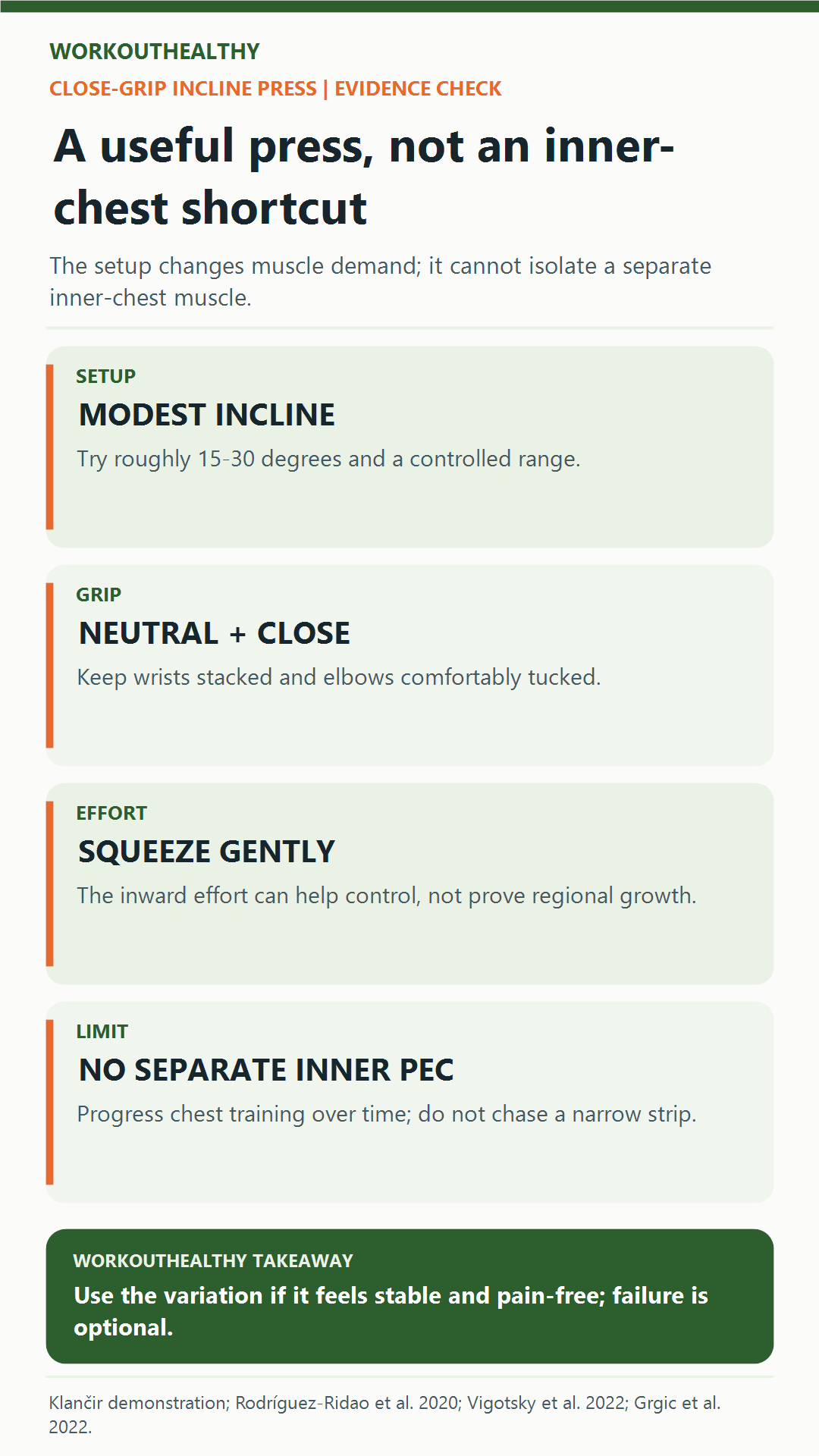
- Set the bench to a modest incline, roughly 15 to 30 degrees.
- Choose dumbbells that are lighter than your normal incline-press load.
- Plant your feet and keep your upper back supported by the bench.
- Hold the dumbbells close with a neutral grip and keep the wrists stacked.
- Lower under control toward the upper sternum without forcing extra depth.
- Press up while gently squeezing inward, then stop before the shoulders roll forward.
The dumbbells may touch, but they do not need to crush together as hard as possible.
Excessive inward pressure can limit the load and make the wrists harder to control without adding a proven hypertrophy benefit.
Record the weight, repetitions, and estimated repetitions in reserve just as you would for any other accessory press.
A better pump is optional, while steady performance across several weeks is the more useful sign that the exercise belongs in your plan.
If the front of the shoulder pinches, reduce the bench angle, shorten the range slightly, or return to a standard neutral-grip dumbbell press.
Sharp pain is a reason to stop, not a sign that the target fibers have finally switched on.
Where It Fits in a Chest Workout
Use the exercise after a standard press if you want a controlled accessory movement.
Two or three sets in the 8 to 15 rep range can supply useful work without making a single variation responsible for your entire chest program.
Pair it with a press that permits progressive loading and a fly or cable movement that trains shoulder adduction through a comfortable range.
The overall program still needs enough weekly volume, gradual progression, food, and recovery.
Celebrity demonstrations can provide good exercise ideas, but the surrounding claim must still survive basic anatomy and evidence.
Our review of Jennifer Lawrence’s strength-first training applies the same distinction between a useful routine and a dramatic interpretation.
If you need a simpler session structure, this 20-minute full-body workout shows how to organize limited training time.
Lifters who want a broader age-aware plan can also use the progression ideas in our strength plan for your 40s.
Who Should Use It
The variation may suit an experienced lifter who enjoys the neutral grip, wants a lighter accessory press, or needs a chest exercise that is easy to perform with limited equipment.
It can also be useful when a standard incline press feels unstable but the squeeze cue improves control.
It is less useful if the close position makes the movement almost entirely triceps-dominant, the dumbbells collide unpredictably, or the shoulder feels compressed.
Exercise selection should follow repeatable, pain-free training and measurable progression rather than loyalty to a viral cue.
The Bottom Line
Petar Klančir demonstrates a legitimate close-grip incline dumbbell press with clear setup cues.
The movement can train the pectoralis major, anterior deltoid, and triceps, while a modest incline can emphasize the clavicular chest region.
It cannot isolate a separate inner-chest muscle or guarantee growth beside the sternum.
Treat it as one useful accessory, keep the load controlled, progress it over time, and use failure selectively rather than automatically.
Get the next evidence check.
Five practical fitness stories worth your time, every Friday.
One email a week. No product pitches. Unsubscribe in one click.
References
- Klančir, P. (2025). Close-grip incline dumbbell press demonstration. Instagram.
- Felstead, S. (2025). Petar Klančir’s close grip incline dumbbell press hack for filling the inner chest gap. Muscle & Fitness.
- Solari, F., & Burns, B. (2023). Anatomy, thorax, pectoralis major. NCBI Bookshelf.
- Rodríguez-Ridao, D., et al. (2020). Effect of five bench inclinations on the electromyographic activity of the pectoralis major, anterior deltoid, and triceps brachii. PMC.
- Lehman, G. J. (2005). The influence of grip width and forearm pronation/supination on upper-body myoelectric activity during the flat bench press. PubMed.
- Vigotsky, A. D., et al. (2022). Longing for a longitudinal proxy: Acutely measured surface EMG amplitude is not a validated predictor of muscle hypertrophy. PubMed.
- Grgic, J., et al. (2022). Effects of resistance training performed to repetition failure or non-failure on muscular strength and hypertrophy. PubMed.
- Refalo, M. C., et al. (2023). Influence of resistance training proximity-to-failure on skeletal muscle hypertrophy. PubMed.
- Currier, B. S., et al. (2023). Resistance training prescription for muscle strength and hypertrophy in healthy adults. PubMed.
Medical disclaimer: This article is for general information only and is not medical advice. If you have an injury, ongoing pain, or a medical condition, talk to a doctor or physical therapist before you change how you train or eat.