
A 20 minute workout sounds too short to do much.
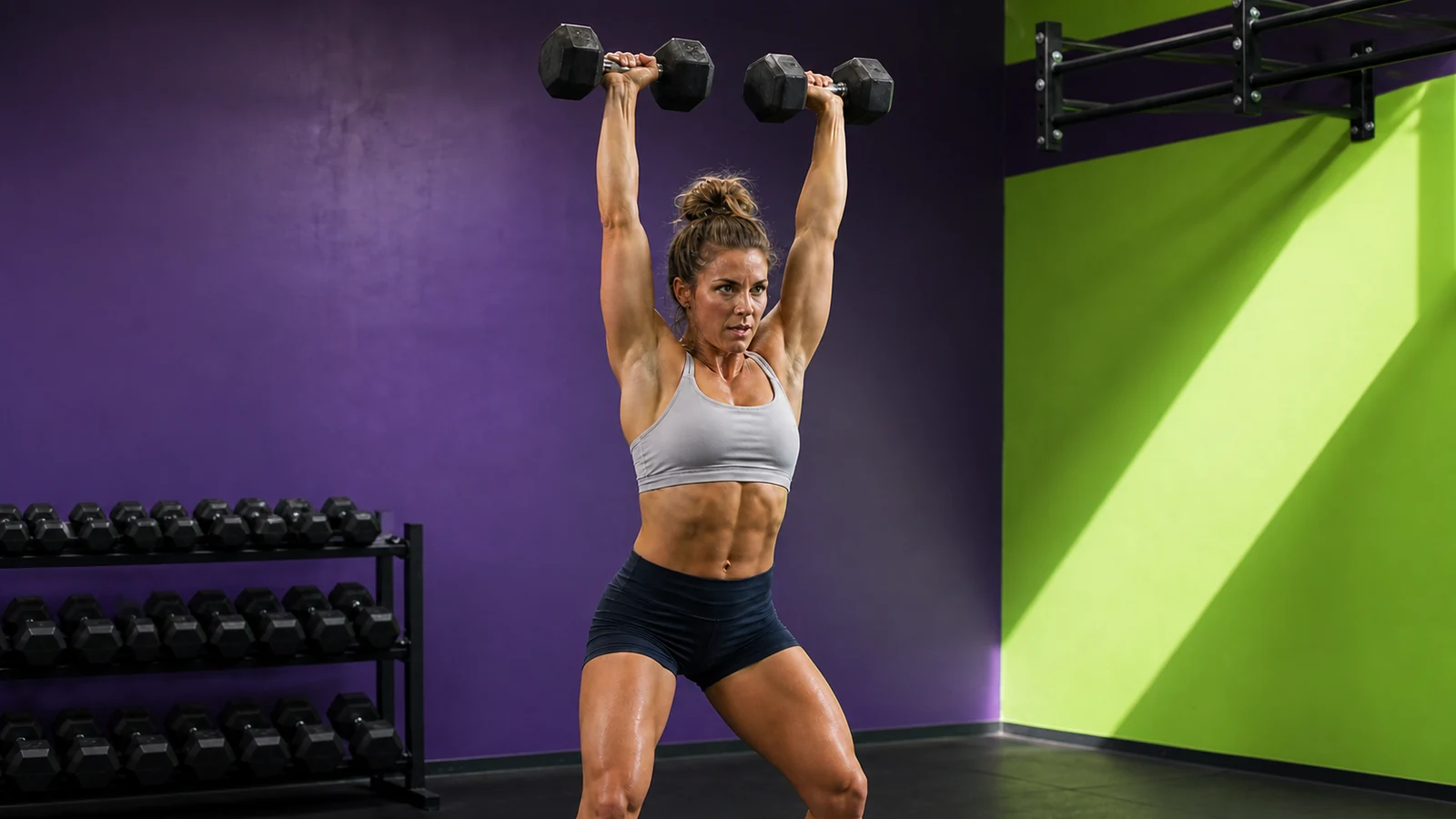
Kaleigh Cohen’s video “20 min BUILD DEFINITION Full Body & Abs Strength Training” argues otherwise.
It promises a full body strength session that also builds visible muscle definition through the midsection, all inside 20 minutes.
This article checks that promise against real exercise science, not against the video’s own marketing.
What the Video Claims
The video is framed as a strength and definition workout.
It combines full body resistance moves with dedicated ab work inside one 20 minute session.
The implied promise is that a short, well designed session can build strength and visible muscle tone across the whole body, including the abs.
Like most fitness videos, it does not cite specific studies for that promise.
That is normal for the format.
It just means the claims need outside verification before anyone treats them as settled fact.
What the Research Actually Shows About Short Full-Body Sessions
The first question is simple.
Can a short, full body strength session actually build strength and muscle, or does real training require much longer sessions?
A 2022 randomized trial gives a useful answer.
Researchers assigned 44 untrained women to either a full body program done twice a week or a split body program done four times a week (Pedersen et al., 2022).
Both groups trained each muscle group the same number of times per week.
Only the session length and layout differed.
After 12 weeks, the two groups showed no meaningful difference in bench press strength, leg press strength, jump height, or muscle mass gained (Pedersen et al., 2022).
Both groups improved by roughly similar amounts.
Notably, several participants in the four day split group dropped out, citing time pressure (Pedersen et al., 2022).
Nobody dropped out of the shorter, full body group for that reason.
A shorter full body session is not automatically an inferior session. In this trial, it was just as effective, and easier to stick with.
This does not prove that any 20 minute video works exactly as advertised.
It does support the video’s basic framing.
A short, full body session is a legitimate training format, not an automatic compromise.
For a related look at how brief, explosive training can still build muscle, see our review of box jump research.
Why Compound, Full-Body Moves Make a Short Session Work
Part of the reason a 20 minute session can work comes down to exercise selection.
Compound movements like squats, lunges, presses, and rows recruit several large muscle groups at once.
A single squat variation trains the quads, glutes, and core together, rather than isolating one small muscle at a time.
That efficiency means a short session can still expose most major muscle groups to real training stress.
Isolation exercises, like a single joint curl or a small ab movement, generally need more total sets to produce the same stimulus.
A well built full body video tends to lean on compound movements first, then use the remaining time for targeted work like ab exercises.
That structure is consistent with how the minimum effective dose research above is typically applied in real programs.
How Much Training Is Actually Needed to Get Stronger
A second useful research thread asks a related question.
What is the minimum amount of training that actually produces strength gains?
A 2021 review in Frontiers in Sports and Active Living looked specifically at minimum effective training doses for building maximal strength (Androulakis-Korakakis et al., 2021).
The reviewers focused on experienced lifters rather than complete beginners.
They found that roughly three to six working sets per week, per lift, done at high effort, was enough to produce real strength gains over six to twelve weeks (Androulakis-Korakakis et al., 2021).
That volume fits comfortably inside a 20 minute session for several exercises.
It does not require hours in a gym.
Beginners generally need even less volume than trained lifters to see progress.
That is a separate, well established pattern in strength training research, and it works in favor of shorter sessions for anyone newer to lifting.
None of this means every 20 minute video is programmed with this precision.
It means the underlying idea, that a short session can hit an effective training dose, is realistic rather than a marketing exaggeration.
The Abs Question: Can 20 Minutes Build Visible “Definition” There Too?
The video’s title promises definition specifically in the abs.
This is where the science gets more complicated.
Visible ab definition depends mostly on how much fat sits over the muscle, not only on how strong or developed that muscle is.
Doing ab exercises does not automatically melt fat from that exact spot.
This idea is often called spot reduction.
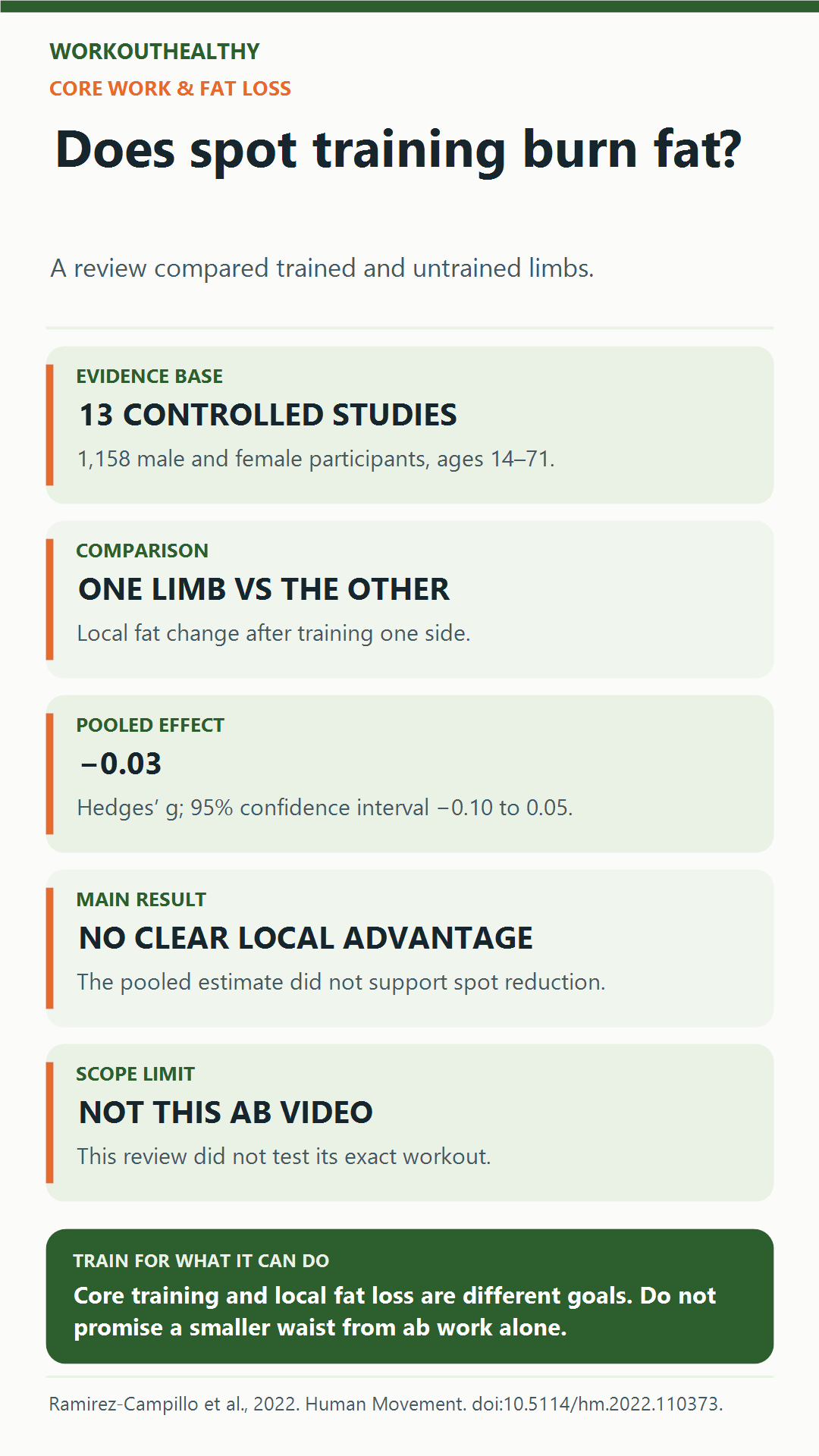
A 2022 systematic review with meta-analysis pooled 13 controlled studies and 1,158 participants testing whether targeted exercise reduces fat at that specific site (Ramirez-Campillo et al., 2022).
The pooled result showed no meaningful spot reduction effect across the combined evidence (Ramirez-Campillo et al., 2022).
In plain terms, training one area hard did not reliably strip fat from that same area faster than training elsewhere.
One earlier study complicates that picture slightly.
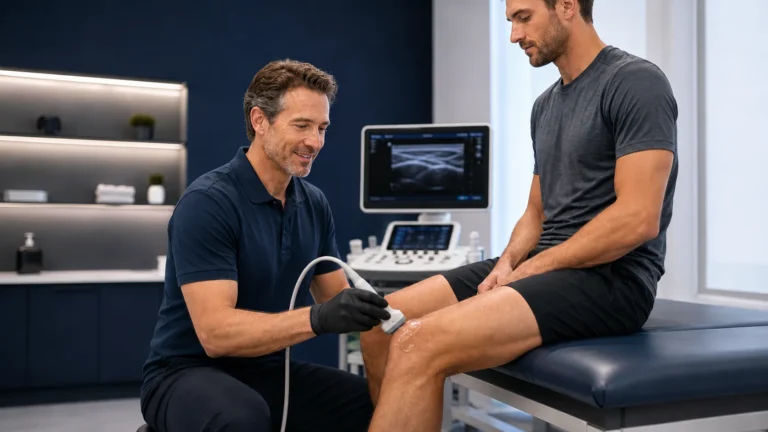
A small 2021 trial tested a circuit combining regional strength and endurance work and found a localized reduction in abdominal fat thickness after eight weeks, measured by skinfold and ultrasound (Paoli et al., 2021).
The same protocol did not produce a similar effect at the triceps (Paoli et al., 2021).
That is one small study, not a settled finding, and it sits against a much larger pooled analysis that found no effect overall.
Strengthening your abs is real training. Making them visible is mostly a body fat question, and the two should not be confused.
The honest summary is that ab training in the video can build real core strength and endurance.
It is unlikely to be the main driver of visible definition by itself.
Overall body fat, driven mostly by diet and total activity, plays the larger role.
Our article on unplanned weight and muscle loss covers why body composition changes need to be managed carefully, not chased through one body part.
What This Evidence Does Not Prove
None of these studies tested this specific video.
They tested general training formats and general questions about volume and fat loss.
The full body versus split body trial used untrained women over 12 weeks, a different population than every viewer of this video.
The minimum dose review focused mostly on experienced lifters chasing one repetition max strength, not general definition goals.
The spot reduction research measured fat thickness with specific tools in controlled settings, not how someone looks in a mirror after a few weeks.
None of this research measured “definition” as a single outcome, because that is a subjective, visual idea rather than one measurable variable.
Genetics, sleep, stress, hydration, and overall diet all affect how a trained body actually looks, and none of these studies isolated those factors from training itself.
The trials also ran for a few weeks to a few months, not indefinitely.
They say little about what happens to strength, muscle, or body composition after a year or more of consistent training.
Longer term outcomes from a habit like this are plausible based on general strength training research, but they were not the specific thing measured in the studies cited here.
Common Mistakes People Make With Short Workout Videos
The first mistake is treating a 20 minute session as a free pass to eat however you want.
Training creates the stimulus for change, but diet drives most of the visible fat loss that reveals muscle definition.
The second mistake is expecting ab exercises alone to reduce belly fat.
The research above does not support that specific expectation.
The third mistake is skipping progression.
Doing the exact same 20 minute video for months without adding resistance, reps, or difficulty eventually stalls results.
The fourth mistake is rushing through form to fit everything into the time limit.
A shorter session only works as well as the research suggests if the technique stays controlled and each set is worked hard enough to matter.
The fifth mistake is judging progress only by the mirror after a week or two.
Real strength and body composition changes from a program like this typically take several weeks to become visible.
The sixth mistake is comparing your own pace to a fitness creator’s on screen physique.
Video presenters often train for years, follow tailored nutrition, and are shown at their leanest moment on camera.
Who Should Check With a Doctor First
Anyone with an existing back, shoulder, hip, or knee injury should get individual guidance before starting a new full body strength routine.
People managing high blood pressure, heart disease, or a recent surgery should also check in first.
Pregnant individuals and people recently postpartum need guidance tailored to their specific stage of recovery.
Anyone new to structured exercise, especially with a chronic condition, benefits from a short conversation with a doctor or physical therapist before adding intense strength work.
This applies even though the video itself is a common, everyday format.
Short does not mean automatically low risk for every body.
Practical Takeaway
A 20 minute full body strength session is a legitimate, evidence supported training format.
The research on short sessions and minimum effective training doses backs that up (Pedersen et al., 2022; Androulakis-Korakakis et al., 2021).
Expect real strength and muscular endurance gains from consistent use of a session like this.
Do not expect the ab work specifically to spot reduce belly fat on its own.
Visible definition, especially around the midsection, comes mostly from overall body fat levels built through diet and total weekly activity.
Pairing a short strength session like this with a reasonable, sustainable eating pattern is a more realistic path to the look the video promises.
Resistance training also carries benefits that have nothing to do with appearance, including outcomes tied to long term brain health in research on lifting weights and cognitive function.
That is a good reason to keep a short strength habit going even on weeks when visible changes feel slow.
Watch the Original Video
Get the next evidence check.
Five practical fitness stories worth your time, every Friday.
One email a week. No product pitches. Unsubscribe in one click.
References
Androulakis-Korakakis, P., Michalopoulos, N., Fisher, J. P., Keogh, J., Loenneke, J. P., Helms, E., Wolf, M., Nuckols, G., & Steele, J. (2021). The minimum effective training dose required for 1RM strength in powerlifters. Frontiers in Sports and Active Living, 3, Article 713655. https://doi.org/10.3389/fspor.2021.713655
Paoli, A., Casolo, A., Saoncella, M., Bertaggia, C., Fantin, M., Bianco, A., Marcolin, G., & Moro, T. (2021). Effect of an endurance and strength mixed circuit training on regional fat thickness: The quest for the “spot reduction”. International Journal of Environmental Research and Public Health, 18(7), Article 3845. https://doi.org/10.3390/ijerph18073845
Pedersen, H., Fimland, M. S., Schoenfeld, B. J., Iversen, V. M., Cumming, K. T., Jensen, S., Saeterbakken, A. H., & Andersen, V. (2022). A randomized trial on the efficacy of split-body versus full-body resistance training in non-resistance trained women. BMC Sports Science, Medicine and Rehabilitation, 14(1), Article 87. https://doi.org/10.1186/s13102-022-00481-7
Ramirez-Campillo, R., Andrade, D. C., Clemente, F. M., Afonso, J., Perez-Castilla, A., & Gentil, P. (2022). A proposed model to test the hypothesis of exercise-induced localized fat reduction (spot reduction), including a systematic review with meta-analysis. Human Movement, 23(3), 1 to 14. https://doi.org/10.5114/hm.2022.110373
Medical disclaimer: This article is for general information only and is not medical advice. If you have an injury, ongoing pain, or a medical condition, talk to a doctor or physical therapist before you change how you train or eat.