

Somewhere along the way, “train to failure” became a badge of honor.
If the last rep did not stall halfway up, the set supposedly did not count.
The research does not support that rule.
Stopping a rep or two short works about as well for muscle growth, and it costs you far less.
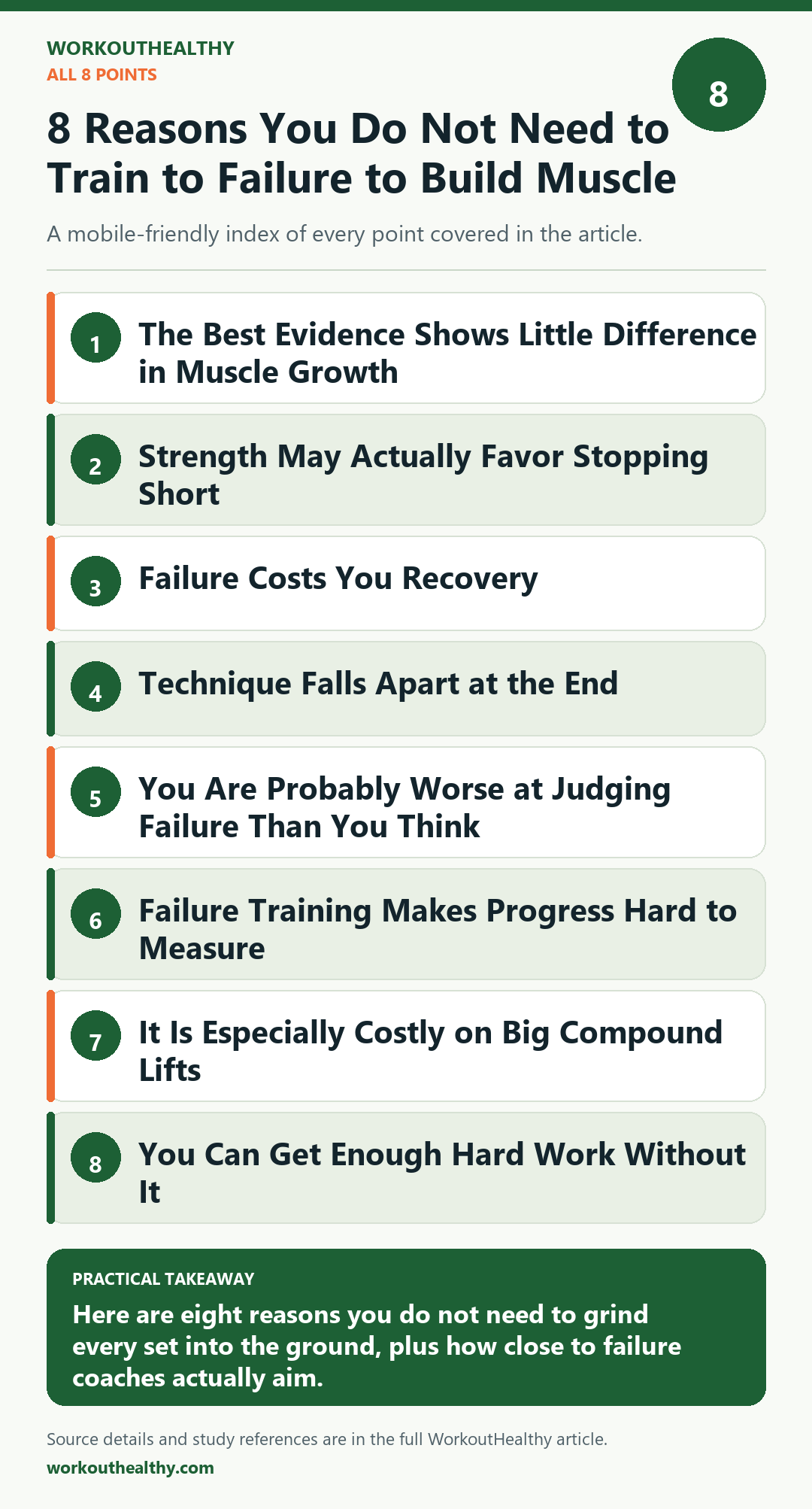
Here are eight reasons you do not need to grind every set into the ground, plus how close to failure coaches actually aim.
1. The Best Evidence Shows Little Difference in Muscle Growth
A 2023 systematic review with meta-analysis in Sports Medicine pooled 15 studies on how close lifters trained to failure.
The reviewers found no clear advantage for training to true muscular failure over stopping short of it for muscle growth.
The difference they did see was trivial in size.
That is a lot of studies to line up behind a rule that gets repeated as if it were settled.
Failure is one way to make a set hard. It is not the only way, and it is not free.
2. Strength May Actually Favor Stopping Short
A 2022 meta-analysis in the Journal of Sport and Health Science looked at both strength and size.
For muscle growth, the two approaches came out similar.
For strength, training that stopped short of failure looked at least as good, and in some comparisons better.
That fits how strength works, since heavy, crisp reps train the skill of lifting heavy better than grinding, degraded reps do.
3. Failure Costs You Recovery

A set taken to failure creates much more fatigue than a set that stops two reps short.
That fatigue shows up in the rest of the session, and often in the next one.
If your third exercise suffers because the first one wiped you out, your weekly total work drops.
Weekly work is the thing that builds muscle.
One brutal set that costs you two later exercises is a bad trade.
Three solid sets that you can repeat on Thursday are a better one.
4. Technique Falls Apart at the End
The last grinding rep is the ugliest one you will do all day.
The bar path changes, the back rounds, the hips shoot up.
That is also the rep most likely to hurt you.
Reps that look nothing like your good reps are not adding much.
5. You Are Probably Worse at Judging Failure Than You Think
Most lifters stop earlier than they believe.
Untrained and even intermediate lifters often leave 3 to 5 reps in the tank while feeling like they are at the limit.
That is an argument for pushing closer to failure, not for hitting it every set.
Filming a set now and then shows you what your true last reps look like.
A useful drill is to take one safe exercise, like a machine press, all the way to failure once a month.
That calibrates your sense of effort without wrecking your week.
6. Failure Training Makes Progress Hard to Measure
If every set ends when you physically cannot move the weight, your reps bounce around week to week with sleep, stress, and caffeine.
That noise makes it harder to see whether the program is working.
Fixed targets, like 3 sets of 8 with 2 reps left in reserve, give you a clean signal.
When those 8 reps start feeling easy, you add weight.
7. It Is Especially Costly on Big Compound Lifts
Squats, deadlifts, and heavy rows take the longest to recover from.
Taking those to failure buys a small amount of extra stimulus at a large recovery price.
Isolation work is a better place to push hard, since a failed set of curls costs you very little.
That is the split most experienced coaches use: hard but controlled on the big lifts, and closer to the limit on the small ones.
8. You Can Get Enough Hard Work Without It
The point of training close to failure is to recruit the muscle fully.
That happens in the last few reps before failure, not only at failure itself.
Stopping 1 to 3 reps short of failure captures most of the benefit.
Do that across enough sets each week and you have everything you need.
Most lifters get better results from adding a set or a session than from making every existing set more brutal.
So How Close Should You Train?
The practical answer most coaches use is reps in reserve.
- Most work sets: 1 to 3 reps in reserve. You could have done one to three more good reps.
- Big compound lifts: 2 to 3 in reserve. Especially when you are training alone.
- Isolation and machines: 0 to 2 in reserve. These are safe places to push.
- Deload weeks: 4 or more in reserve. Keep the movement, drop the effort.
If you are not sure where you are, the honest test is simple.
Ask yourself mid set whether you could do three more clean reps.
If the answer is clearly yes at the end of the set, add weight next time.
Where the “Train to Failure” Rule Came From
The rule has a real history.
High intensity training systems popular in the 1970s and 1980s argued that one all out set, taken past the point of failure, was the most efficient way to trigger growth.
That idea spread through magazines and gym culture for decades.
It was not crazy.
Hard effort does matter, and plenty of people who trained that way got big and strong.
What has changed is that we can now compare it directly with other approaches in controlled studies.
When researchers do that, the extra fatigue of constant failure work stops looking like a bargain.
How to Tell If You Are Training Hard Enough
Stopping short only works if the sets were actually hard.
Here is how to check.
- The last two reps should slow down noticeably.
- Your rep count at a given weight should climb over a few weeks.
- You should need real rest between sets, not just a scroll break.
- You should be adding weight or reps at least every two or three weeks early on.
- You should not be able to repeat the set immediately with the same quality.
If none of those are true, you are not close enough to failure.
If all of them are true, you are close enough, and hitting true failure would add fatigue more than it adds muscle.
Our 7 point program audit is a quick way to check the rest of the plan.
What This Evidence Does Not Prove
None of this says failure training is useless.
Some studies find small benefits for failure in specific situations, especially with lighter loads.
Most of the research runs 6 to 12 weeks in mostly untrained or moderately trained people.
Advanced lifters and competitive bodybuilders may respond differently, and their programs often include deliberate failure work.
Study measures of “reps in reserve” also rely on people estimating their own effort, which is imperfect.
Common Mistakes People Make
- Using “stopping short” as an excuse to end sets when they get uncomfortable.
- Taking every set of every exercise to failure and then skipping sessions to recover.
- Never adding weight, so the sets stay easy for months.
- Chasing soreness as the measure of a hard session.
- Training to failure alone on a bench with no safeties.
Our guide on what recovery science says about rest days covers the other half of this problem.
Who Should Be Extra Careful With Failure Training
- Beginners still learning technique on the main lifts.
- Anyone training alone without safety bars or a spotter.
- Older lifters and anyone returning from injury.
- People with high blood pressure, since maximal straining raises it sharply.
- Anyone in a heavy training block who is already sleeping badly.
If you have a health condition or a recent injury, ask a doctor or physical therapist before pushing sets to the limit.
A Sample Week Using Reps in Reserve
Day 1, full body.
Squat, 3 sets of 6 with 3 reps in reserve.
Bench press, 3 sets of 8 with 2 in reserve.
Row, 3 sets of 10 with 2 in reserve.
Leg curl, 2 sets of 12 with 1 in reserve.
Day 2, full body.
Deadlift or hip hinge, 3 sets of 5 with 3 in reserve.
Overhead press, 3 sets of 8 with 2 in reserve.
Lat pulldown, 3 sets of 10 with 2 in reserve.
Curls and triceps, 2 sets each of 12 with 0 to 1 in reserve.
Day 3, full body.
Repeat day 1 with slightly more weight or one more rep per set.
Progression.
When you hit the top of a rep range at the target effort, add the smallest weight increase available.
When a session feels crushing three weeks running, take an easy week.
That is the whole system, and it does not require a single set of grinding, face turning failure.
Train hard enough that the last reps are slow. Stop while they still look like reps.
Want more training rules checked against the research? Subscribe to WorkoutHealthy Insider for practical explanations behind popular fitness claims.
References
Grgic, J., Schoenfeld, B. J., Orazem, J., & Sabol, F. (2022). Effects of resistance training performed to repetition failure or non-failure on muscular strength and hypertrophy: A systematic review and meta-analysis. Journal of Sport and Health Science, 11(2), 202 to 211. https://doi.org/10.1016/j.jshs.2021.01.007
Refalo, M. C., Helms, E. R., Trexler, E. T., Hamilton, D. L., & Fyfe, J. J. (2023). Influence of resistance training proximity-to-failure on skeletal muscle hypertrophy: A systematic review with meta-analysis. Sports Medicine, 53(3), 649 to 665. https://doi.org/10.1007/s40279-022-01784-y
This article is for general information only and is not medical advice. If you have an injury, ongoing pain, or a medical condition, talk to a doctor or physical therapist before you change how you train or eat.