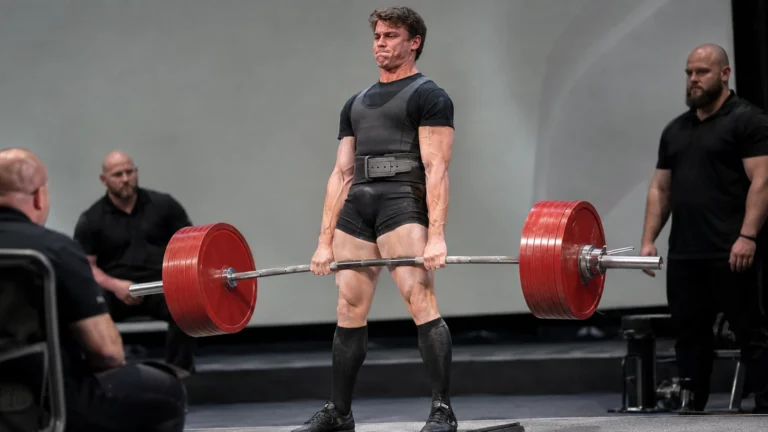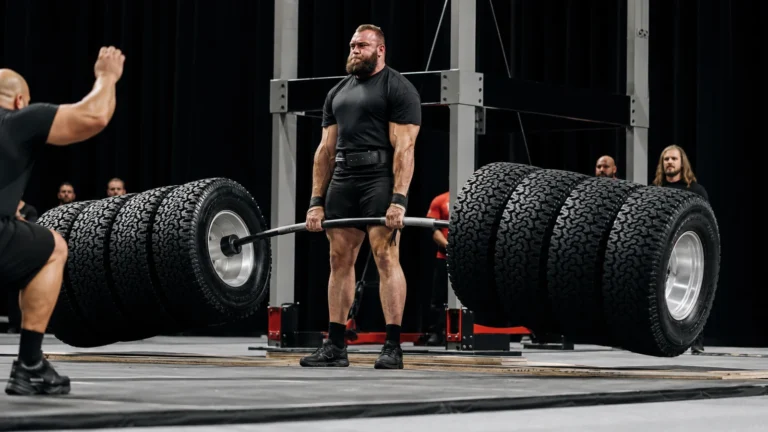

Is getting fit a private choice or a public duty?
In early 1800s Prussia, Friedrich Ludwig Jahn had a clear answer.
He built group gymnastics to make young men strong enough to help free their country.
A popular post says he saw training as a way to prepare citizens to serve.
That is accurate. It is also the most politically loaded part of his legacy.
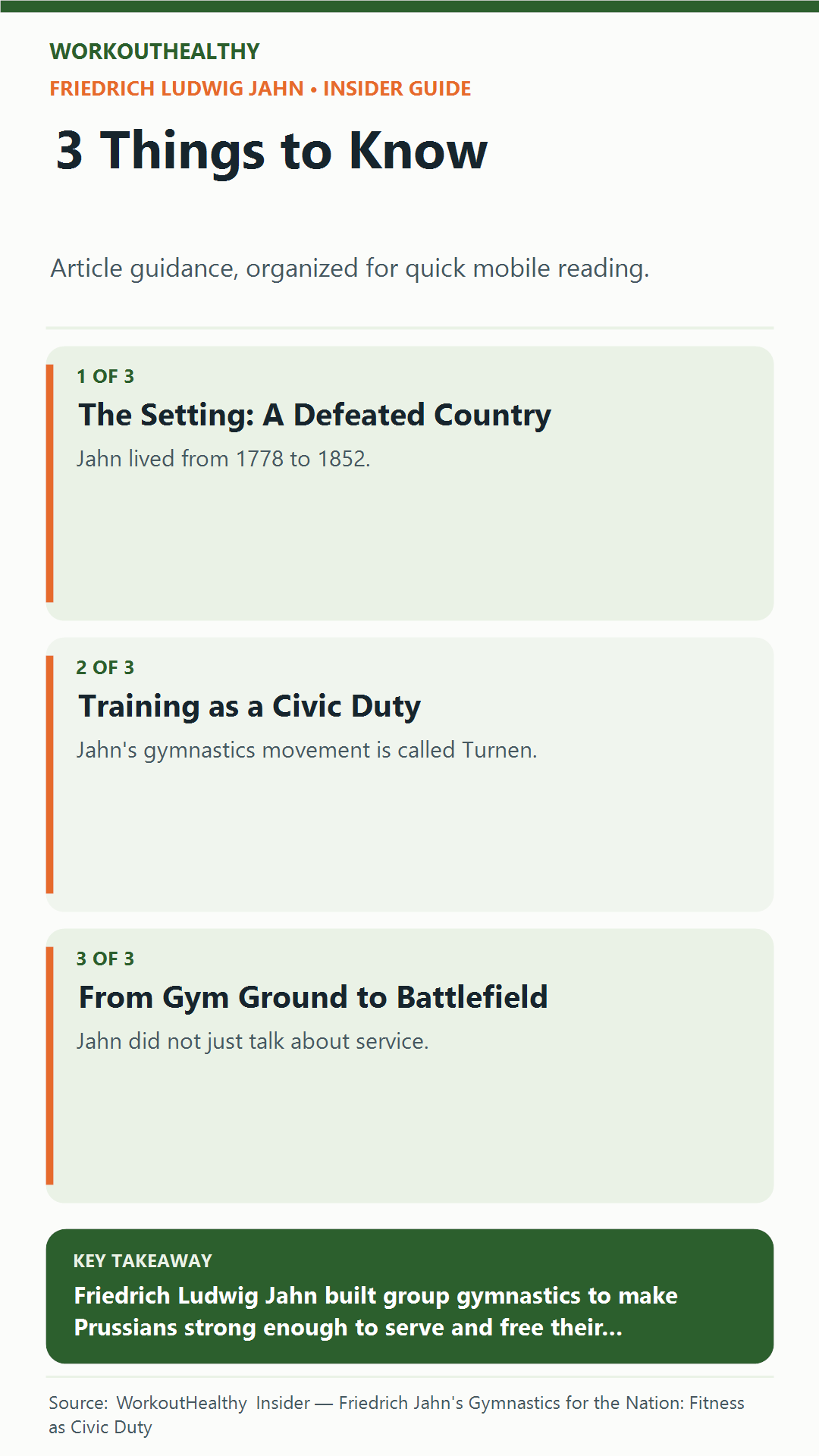
The Setting: A Defeated Country
Jahn lived from 1778 to 1852.
In his time, Napoleon’s armies had beaten Prussia.
Wikipedia says Jahn brooded over what he saw as the humiliation of his native land.
His answer was to restore his countrymen’s spirits by building their physical and moral powers through gymnastics.
So from the start, his training had a national purpose, not just a health one.
Training as a Civic Duty
Jahn’s gymnastics movement is called Turnen.
Its clubs, the Turnvereine, spread quickly after his first open air ground opened in Berlin in 1811.
Members were not simply told to get in shape.
According to Wikipedia, young gymnasts were taught to see themselves as members of a kind of guild for freeing their fatherland.
That framing made each workout part of a shared mission.
Training was done together, in public, and with a goal bigger than any one person.
That is a powerful way to build commitment, for better or worse.
A shared purpose can keep a group training together. The purpose itself still deserves a hard look.
From Gym Ground to Battlefield
Jahn did not just talk about service.
In early 1813, he took an active part in forming the Lützow Free Corps.
It was a volunteer force in the Prussian army fighting Napoleon.
Jahn commanded a battalion of the corps.
For him, gymnastics and national service were closely linked.
The Politics That Came With It
This is where a warning belongs.
Authorities came to see that Jahn wanted a united Germany and that his clubs were political.
The conflict led to the closing of his training ground in 1819 and his arrest.
His views also included open prejudice.
In 1810 he wrote that Poles, French people, priests, aristocrats, and Jews were Germany’s misfortune.
Much later, the Nazis claimed his ideas as their own.
Wikipedia says that by the mid 1930s, their equation of Jahn’s ideas with their world view was more or less complete.
So “train to serve the nation” is not a neutral slogan in his case.
Modern fitness communities can keep the teamwork and leave the nationalism behind.
What Research Says About Community Exercise
Group training does not need a political cause to work.
Take parkrun, a network of free weekly timed 5 kilometer runs in UK parks.
In a study published in the Journal of Public Health, Stevinson and Hickson surveyed 7,308 adult participants.
At registration, 25.3 percent described themselves as non runners.
That group included higher shares of women, people who were overweight, and people with a limiting disability.
Those first time runners improved their 5 kilometer times the most, by 15.8 percent versus 10.2 percent overall.
They were also more likely to report health benefits.
More regular attendance was linked with more perceived benefits.
The events also drew a wide age range.
Middle aged adults made up 60.9 percent of the sample, and older adults 14.3 percent.
That matters because a group only helps if people feel welcome to join it.
The data were largely self reported, so they show links, not proof.
Still, a free, welcoming group event pulled in people who had not been running.
What Research Says About Readiness
Jahn wanted fit citizens ready to serve. Modern militaries still worry about readiness, but the main threat looks different.
A 2020 paper by Joseph Molloy and colleagues in Military Medicine looked at injuries in the US Army.
Noncombat injuries were the leading cause of outpatient medical visits for active duty soldiers, with more than two million a year.
Musculoskeletal injuries may account for nearly 60 percent of soldiers’ limited duty days.
They may also account for 65 percent of soldiers who cannot deploy for medical reasons.
The lesson for everyday training is clear.
Being “ready” is not only about being strong. It is also about staying uninjured.
The paper also notes that some injured soldiers go on to develop chronic pain or long term disability.
For the rest of us, an injury can end a training habit just as surely.
Smart progress, rest days, and good technique are part of being ready.
What This Does Not Prove
Neither study tested Jahn’s clubs or methods.
The parkrun study was not a controlled trial.
The Army paper describes a military population, not the general public.
And nothing here supports tying fitness to nationalism or to judging others.
A shared purpose can help people train. It does not make every purpose a good one.
How to Use the Good Part of Jahn’s Idea
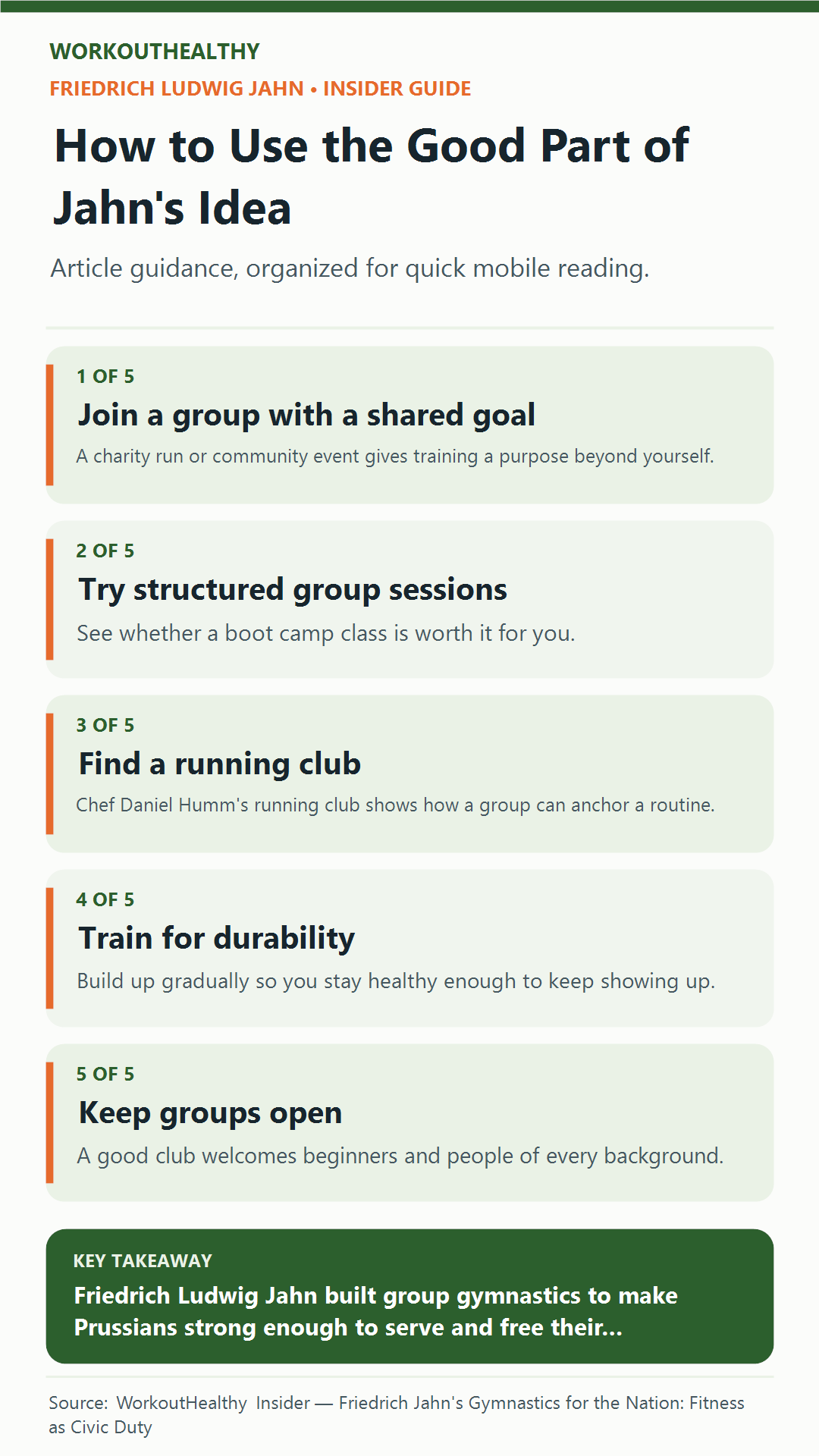
- Join a group with a shared goal. A charity run or community event gives training a purpose beyond yourself.
- Try structured group sessions. See whether a boot camp class is worth it for you.
- Find a running club. Chef Daniel Humm’s running club shows how a group can anchor a routine.
- Train for durability. Build up gradually so you stay healthy enough to keep showing up.
- Keep groups open. A good club welcomes beginners and people of every background.
Who Should Be Careful
Group settings can push people to match others too fast.
Beginners and anyone with past injuries should set their own pace.
If a group uses shame, exclusion, or us versus them talk, it is fine to walk away.
The Bottom Line
Friedrich Ludwig Jahn built group gymnastics to make Prussians strong enough to serve and free their country, and he commanded a battalion of the Lützow Free Corps himself.
His movement also carried nationalist and antisemitic views that later groups exploited.
The part worth keeping is simpler: training with others, for a shared and healthy purpose, and staying injury free.
Want more stories like this? Subscribe to WorkoutHealthy Insider for practical explanations behind popular fitness claims.
References
- Molloy, J. M., Pendergrass, T. L., Lee, I. E., Chervak, M. C., Hauret, K. G., & Rhon, D. I. (2020). Musculoskeletal injuries and United States Army readiness part I: Overview of injuries and their strategic impact. Military Medicine, 185(9 to 10), e1461 to e1471. https://doi.org/10.1093/milmed/usaa027
- Stevinson, C., & Hickson, M. (2014). Exploring the public health potential of a mass community participation event. Journal of Public Health, 36(2), 268 to 274. https://doi.org/10.1093/pubmed/fdt082
- Wikipedia contributors. (n.d.). Friedrich Ludwig Jahn. In Wikipedia. Retrieved September 16, 2026, from https://en.wikipedia.org/wiki/Friedrich_Ludwig_Jahn
This article is for general information only and is not medical advice. If you have an injury, ongoing pain, or a medical condition, talk to a doctor or physical therapist before you change how you train or eat.