
A deadlift usually starts with the bar resting just above the floor, roughly nine inches up, sitting on a pair of standard 45 pound plates.
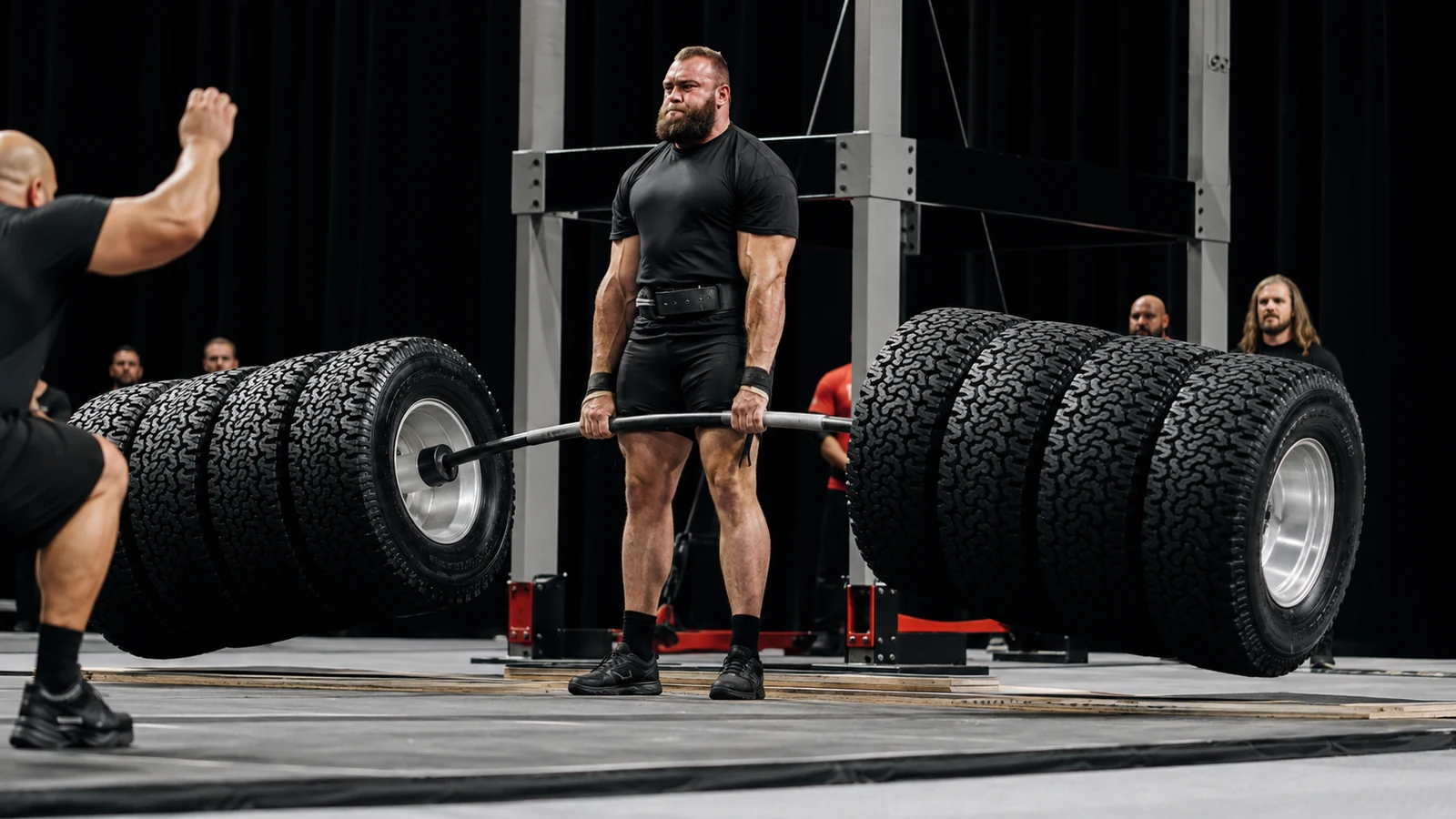
At the 2022 Shaw Classic, Oleksii Novikov pulled a bar that started six inches higher than that.
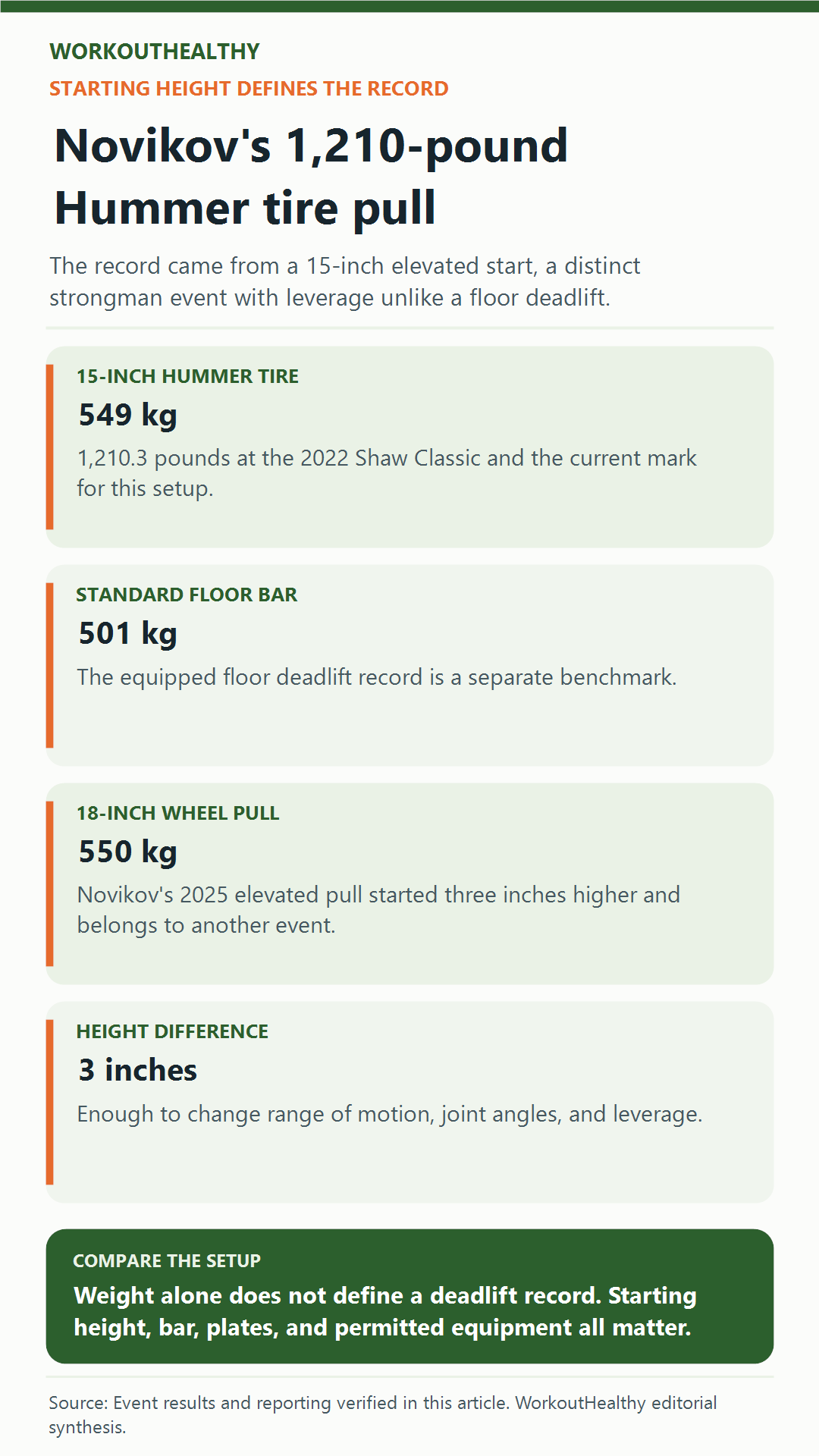
The load on it weighed 549 kilograms, or 1,210.34 pounds.
That is the hummer tire deadlift world record, and it is heavier than any standard barbell deadlift ever recorded, raw or equipped.
The number gets shared constantly, almost always without context.
Here is what actually happened, why a higher starting point lets a lift carry more weight, and what this record does and does not prove about strength.
What Novikov Actually Pulled at the 2022 Shaw Classic
The Shaw Classic is Brian Shaw’s own strongman event, held annually in Colorado and named for the four time World’s Strongest Man champion who founded it.
In 2022, alongside the main competition, Novikov attempted a hummer tire deadlift, a specialty lift built around the wheel and tire assembly from a Hummer H1 or H2.
He locked out 549 kilograms.
Converted precisely, that is 1,210.34 pounds, which matches both the number in the original workbook entry for this record and the figure that circulated in the social post built around it.
The lift was filmed and posted by Shaw Strength, the YouTube channel run by Brian Shaw and his team, under the title “New Hummer Tire Deadlift World Record.”
That same footage is embedded near the bottom of this article, and its title, channel, and thumbnail were checked against YouTube’s own data before publication.
For scale, the heaviest standard barbell deadlift on record, an equipped pull using an Ohio bar, sits at 501 kilograms, set by Hafthor Bjornsson in 2020.
The best raw deadlift on a stiffer competition bar sits at 474.5 kilograms.
Novikov’s hummer tire number beats both of those by a wide margin, which is the first clue that this lift is not simply a heavier version of a normal deadlift.
It is a different event, built around a different starting position.
What Makes a Lift a Hummer Tire Deadlift
A hummer tire deadlift is not a specialty bar loaded with unusual plates.
It is a full wheel and tire assembly, the kind taken from a Hummer H1 or H2, stacked and rigged so a barbell or handle sits across the top of it.
Because the tire itself has real height, the bar starts well above where a conventional deadlift bar would sit.
In Novikov’s 2022 lift, that starting height was 15 inches off the floor, compared to roughly nine inches for a normal deadlift loaded with standard plates.
Six extra inches sounds small.
In a deadlift, it is not.
Those six inches remove the very bottom section of the pull, the part where the bar has to break off the floor from a dead stop with the back, hips, and knees all at their least favorable angles for producing force.
A 1996 biomechanical analysis of the deadlift, published in the Journal of Strength and Conditioning Research, tracked bar velocity and joint angles through a full pull and found the early phase off the floor behaves very differently than the lockout phase (McGuigan & Wilson, 1996).
Starting from 15 inches instead of nine skips a meaningful slice of that early phase entirely.
A hummer tire deadlift and a standard deadlift share a name and a general motion. They do not share a starting position, and that difference is most of the story behind a number this large.
Why a Higher Starting Point Changes the Whole Lift
Deadlifts are not equally hard at every point in the range of motion.
Most lifters have a specific point where the bar seems to stall or slow down the most, commonly called the sticking point.
A 2017 review in Sports Medicine examined sticking points across the deadlift, squat, and bench press, and found that joint angles and leverage shift through a lift’s range, changing which muscles carry the heaviest share of the load at each stage (Kompf & Arandjelović, 2017).
For most lifters pulling a conventional deadlift, the hardest leverage tends to sit somewhere in the lower half of the pull, where the hips and lower back are furthest from an efficient angle.
Starting a lift from 15 inches instead of the floor removes a large share of that low, unfavorable range entirely.
The lifter begins the pull already closer to a position where hip and back leverage work in their favor.
That shorter, more favorable stroke is a large part of why an elevated implement like a hummer tire can carry far more total weight than a full range conventional pull ever could.
Less distance and better leverage do not make the lift easy.
Five hundred and forty nine kilograms is still an enormous load to control and lock out, regardless of where it starts.
It does mean the lift is measuring something different than a standard deadlift measures, which is the real reason the numbers do not compare directly.
The Opposite Problem: What a Deficit Deadlift Demands Instead
It helps to see the hummer tire deadlift against its mirror image, the deficit deadlift.
A deficit deadlift has the lifter stand on a small platform, usually one to four inches high, while the bar stays at normal plate height.
That increases the distance from floor to lockout instead of shortening it.
A deficit pull forces the lifter through more of that difficult bottom range, not less, and it is well known in strength training circles as one of the hardest common deadlift variations for exactly that reason.
A hummer tire deadlift does the opposite of a deficit deadlift on purpose.
One variation adds range of motion and punishes weak positions at the bottom.
The other removes range of motion and rewards whatever leverage is left once the hardest part of the pull is gone.
Our breakdown of Floor Press vs Bench Press: What Actually Changes covers a similar idea for a pressing movement, where changing the body’s starting position changes which muscles carry the load, even though that comparison covers a horizontal press rather than a pull.
Range of motion is not a minor detail in a lift.
It is often the whole story behind why one number looks so different from another.
Who Actually Tracks a Record Like This
There is no single global federation that governs strongman specialty implements the way the IPF governs raw powerlifting or the IWF governs Olympic lifting.
A hummer tire deadlift is not on Guinness World Records’ standard list of certified categories, and no evidence turned up during research for this article showing Guinness has ever certified this specific lift.
That does not make the number meaningless, only recognized differently than a Guinness mark is.
This one is tracked the way most strongman specialty lifts are tracked, through the promotion that hosted it and through independent strength sports archives that catalog verified marks across competitions.
One of the larger such archives, StrengthRecord.com, lists Novikov’s hummer tire pull in its deadlift records section, citing the same 2022 Shaw Classic footage used for this article.
That is a different kind of verification than a Guinness plaque, and it is worth understanding the difference.
Our piece on DonnaJean Wilde’s Push-Up World Record covers a mark that did go through Guinness’s own certification process, with adjudicators and formal rules on site.
Edith Connor’s Guinness World Record for oldest competitive female bodybuilder is another example of that same formal path.
Novikov’s hummer tire number took a different route to being called a world record, and readers deserve to know that distinction rather than assume every record claim was verified the same way.
Does the Record Still Stand
The workbook entry behind this article listed the hummer tire deadlift record as current but unrefreshed, which is a fair flag for a mark set back in 2022.
Independent verification for this article found no evidence that anyone has beaten the specific 549 kilogram, 15 inch hummer tire mark since Novikov set it.
Novikov himself set a related but distinct record more recently.
At the 2025 Ultimate Strongman Barcelona Grand Prix, he pulled 550 kilograms, or 1,213 pounds, in an elevated wheel deadlift starting from 18 inches.
That is three inches higher than the 2022 hummer tire setup, and three additional inches of starting height matters for exactly the leverage reasons already covered in this article.
A taller starting height and a heavier top end do not erase the earlier record.
They describe a separate event with its own starting position, which is precisely the point this whole article is making about how much starting height changes a deadlift’s identity.
As of this writing, the 549 kilogram hummer tire deadlift from a 15 inch start still stands as its own recognized mark, separate from the 2025 lift at a different height.
Novikov’s Resume Beyond One Tire
The hummer tire pull is one entry in a long competitive record.
Novikov won the World’s Strongest Man title outright in 2020, at 24 years old, making him the second youngest champion in the event’s history.
He has finished third at World’s Strongest Man twice since, in 2022 and again in 2023.
He also won the Arnold Strongman Classic in 2020, took two World’s Ultimate Strongman titles in 2021, and won both the Rogue Invitational and Europe’s Strongest Man in 2022.
Away from named competitions, he has set several other specialty marks, including a 267 kilogram wrecking ball hold and a 455 kilogram super yoke carry over 25 meters.
He is also a member of Ukraine’s Kyiv Police Special Forces, and he was drafted into Ukraine’s Armed Forces in 2022 during the war, receiving leave to compete that year at Europe’s Strongest Man, which he won.
That resume matters for reading the hummer tire number correctly.
A single specialty lift is easier to trust when it comes from an athlete whose broader career has already been checked by federations and competing athletes for nearly a decade.
What This Record Does Not Prove
None of this makes the 549 kilogram number fake or unimpressive.
It is a genuinely enormous weight to lock out, from any starting height.
What it does not prove is that Novikov’s raw pulling strength, measured on a standard barbell from the floor, exceeds every raw deadlift world record on the books.
A shortened range of motion changes what a lift measures, not just how heavy the number looks.
It is also worth remembering that one elevated pull says little about volume, consistency, or work capacity, the qualities that matter most for anyone training outside strongman competition.
Treat this record for what it verifiably is, the heaviest confirmed pull from a 15 inch hummer tire start, rather than stretching it into a claim about deadlift strength in general.
Common Mistakes People Make Reading a Record Like This
The most common mistake is comparing 549 kilograms directly to a standard deadlift world record, as though the two numbers measure the same thing.
They do not, for the range of motion reasons already covered here.
A second mistake runs the opposite direction, dismissing an elevated lift as fake or as a gimmick because it starts higher than a normal deadlift.
A 2011 survey of 167 competitive strongman athletes, published in the Journal of Strength and Conditioning Research, documented how heavily this sport leans on odd object training, grip specific work, and full body carrying and pressing rather than isolated barbell lifts (Winwood, Keogh, & Harris, 2011).
Specialty implements like a hummer tire are not a shortcut in that training culture.
They are the sport’s actual events, trained for deliberately, and locking one out at over 1,200 pounds still requires elite strength by any honest measure.
What This Means If You Deadlift Yourself
Nobody needs to chase a hummer tire to get something useful from this story.
Understanding how starting height changes leverage is directly useful for anyone doing rack pulls, block pulls, or pin pulls in a normal gym, all of which shorten the range of motion the same basic way a hummer tire deadlift does.
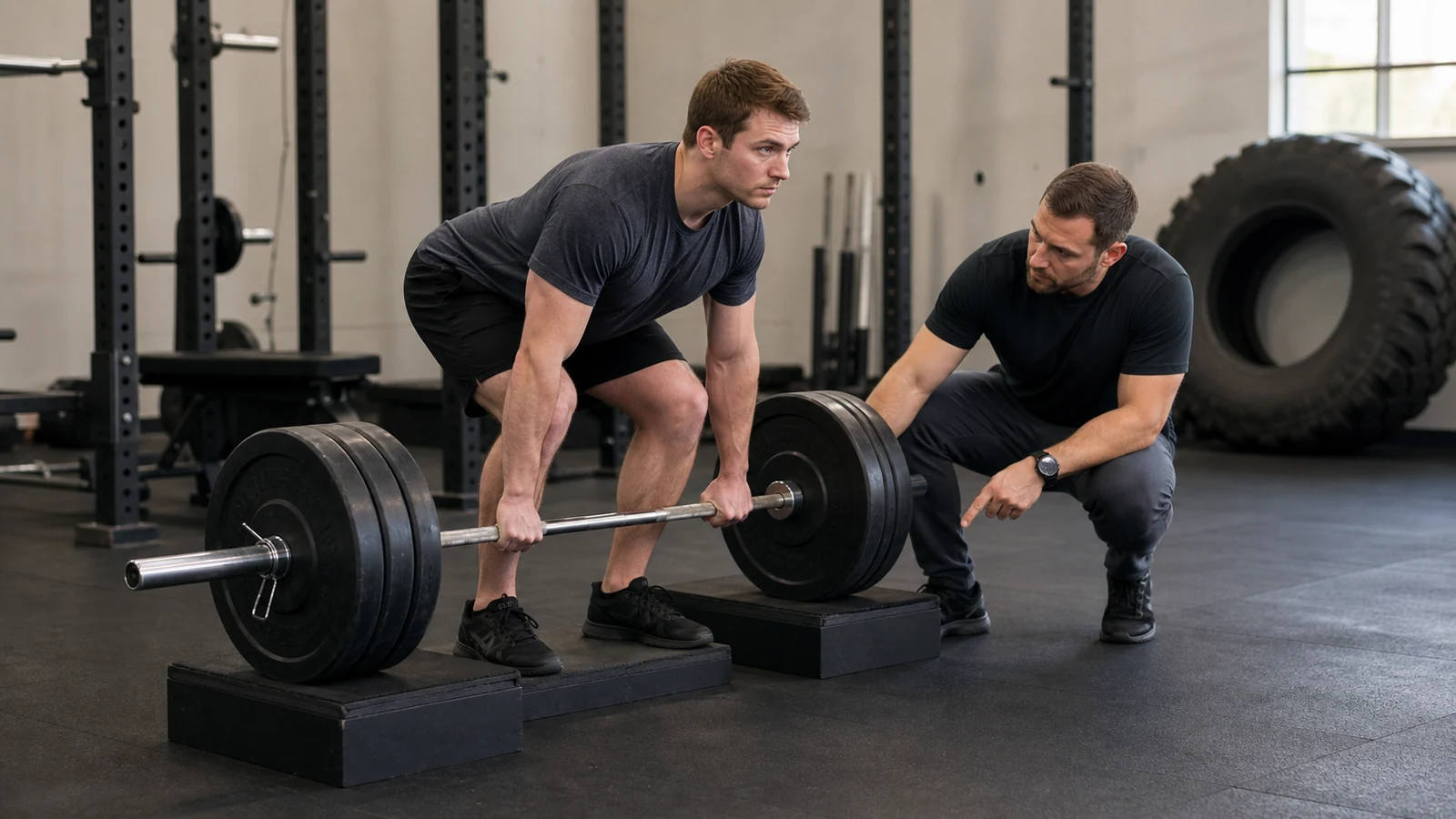
Those variations let a lifter safely handle more weight than a full deadlift allows, which can build confidence and top end strength when programmed with intention.
They should not replace full range deadlifts entirely, since the bottom portion of the lift they skip is exactly the part that builds strength off the floor.
A sensible approach mixes both, using elevated or partial pulls as a planned addition rather than a permanent substitute.
Explosive strength off the floor is trainable outside of pure barbell work too.
Our piece on Can Box Jumps Build Muscle? What Research Says covers how jump training builds some of the same explosive qualities a fast pull off the floor requires.
Anyone with a history of lower back injury, a current disc issue, or uncontrolled high blood pressure should be cautious with any near maximal deadlift variation and should check with a doctor or physical therapist first.
Grip is usually the first thing to fail on a heavy pull, elevated or standard, so grip specific training such as farmer’s carries and dead hangs pays off regardless of which version of the deadlift someone trains.
Strength built through a full range of motion, then tested occasionally through a shorter, heavier variation, is a reasonable structure for anyone chasing a bigger pull, even without a Hummer tire in the garage.
Watch the Original Video
Want the next record fact-checked before you share it? Subscribe to WorkoutHealthy Insider for practical explanations behind popular fitness claims.
References
Kompf, J., & Arandjelović, O. (2017). The sticking point in the bench press, the squat, and the deadlift: Similarities and differences, and their significance for research and practice. Sports Medicine, 47(4), 631 to 640. https://doi.org/10.1007/s40279-016-0615-9
McGuigan, M. R. M., & Wilson, B. D. (1996). Biomechanical analysis of the deadlift. Journal of Strength and Conditioning Research, 10(4), 250 to 255. https://doi.org/10.1519/00124278-199611000-00008
Winwood, P. W., Keogh, J. W. L., & Harris, N. K. (2011). The strength and conditioning practices of strongman competitors. Journal of Strength and Conditioning Research, 25(11), 3118 to 3128. https://doi.org/10.1519/JSC.0b013e318212daea
This article is for general information only and is not medical advice. If you have an injury, ongoing pain, or a medical condition, talk to a doctor or physical therapist before you change how you train or eat.